

As our thoughts turn to Spring and Summer, now is the time to consider how to keep invasive species out of your pond. An invasive species is an organism that causes biological or economic harm when introduced into an environment where it is non-native.
Invasive species are not just fish.
Plants, snails, mussels, and plankton can often cause major problems and deserve some thought because they are easier to transport and harder to control once established.
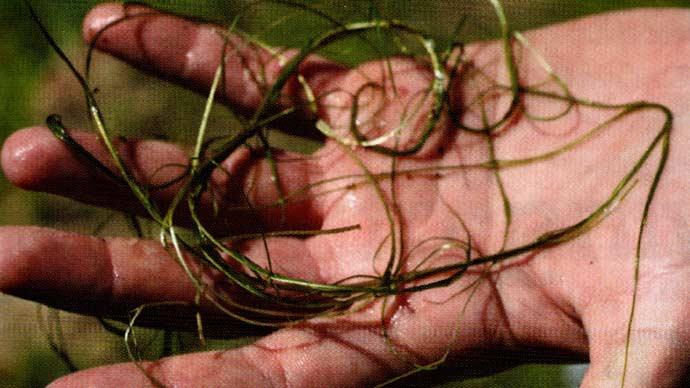
Submerged aquatic plants such as Eurasian Watermilfoil (EWM) are a real problem once established in a pond. Milfoil is particularly noxious because it quickly colonizes depths less than seven feet and rapidly builds canopies, shading out other native pond macrophytes and producing an unwanted monoculture. The resulting reduction in native plant diversity means a loss of fish habitat diversity.
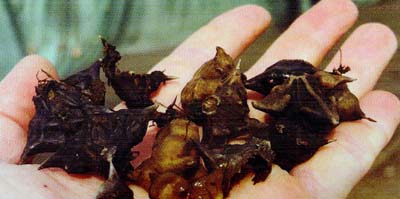
Another example of a problem-emergent plant is the water chestnut. This invasive species spreads via horned nutlets that can remain viable even when dried. These thorny, devilish nutlets will leave a nasty gouge in your foot if stepped on. I have even seen them put a hole in a trailer tire! These seeds stick to nets, boat bunks, webbing, ropes, and other fabric. Once established, water chestnuts are difficult eradicate, even with continued chemical control, because the seed bank remains viable for years after the plants die.
If you see a chestnut in your pond, pull it immediately by the roots, burn or bury it well away from the pond.
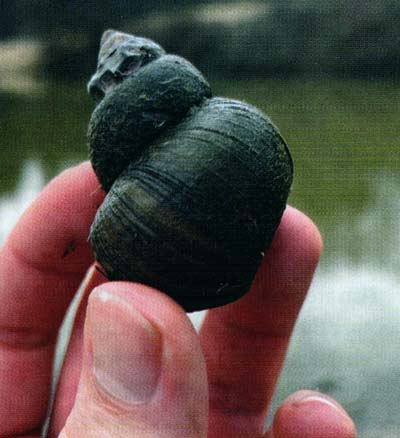
Invasive snails like the Chinese mystery snails can also be a real problem. While they look cool with their huge, peaked spiral shells, these snails grow to very large sizes and form high densities. They will crowd out native snails such as the smaller ramshorn snail (Planorbid snail). Mystery snails can carpet the bottom in small ponds, consuming much of the benthic algal production. Once they reach a large size at adulthood (3" tall!), they are virtually invulnerable to predation by "normal" pond fish—meaning they are no longer part of the food chain until they die and decompose.
We have these snails in a campus pond, and a recent population estimate put them at >20,000 adult snails/acre. That's a lot of snail biomass! Bullhead catfish will eat them, but only when the snails are juveniles. How did they get here? They are a popular aquarium algae cleaner easily purchased at pet stores. A student probably set a small population free in the pond years ago when they went home for the semester. Yikes.
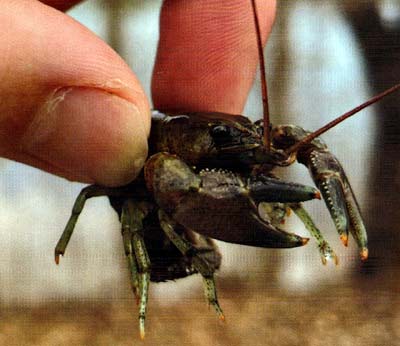
Invasive rusty crayfish are native to the Ohio River drainage but are rapidly expanding throughout the Northeast. Rusty crayfish are identifiable by their rusty sides and black-banded, orange-tipped claws. They grow to huge sizes, can move overland short distances, and their aggressive nature means they can easily outcompete most native crayfish, like the paper shell crayfish. The loss of the paper shell is unfortunate because they are a great prey item to stock in new ponds and readily live in mud bottoms.
The invasion of rusty crayfish in New York is so complete that finding a native crayfish is rare and noteworthy, as rusty crayfish have caused their decline. Natives still occur in streams where a physical barrier, such as a waterfall, exists. How to keep them out?
Rusty's should not be bought, sold, or transported as bait. If you buy crayfish as bait or stock your pond, make sure that they are not Rusty's. Don't let any bait go at the end of a fishing trip.
Invasive plankton such as the spiny water flea and hook-tailed water flea have arrived in the United States via ballast water of Great Lakes freighters (as have multitudes of other invasives). They have now established themselves in the Great Lakes, Lake Champlain, and many of New York's Finger Lakes. They can be easily transported in water or attached to gear such as landing nets. They even attach to fishing line, making them a real nuisance. These spiny water fleas compete against native Daphnia for dominance in the pond and are considered poor food for planktivorous fishes.
Bottom line, you do not want them in your pond.
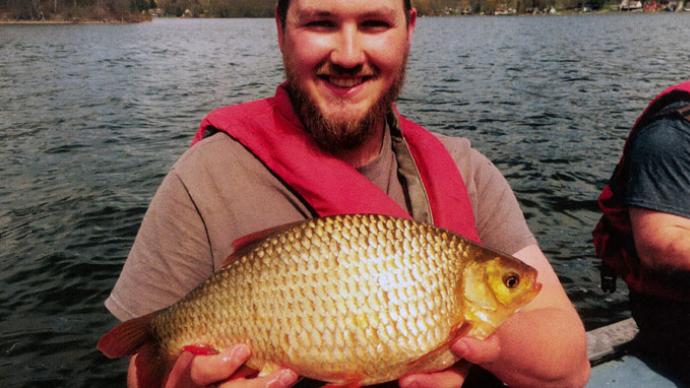
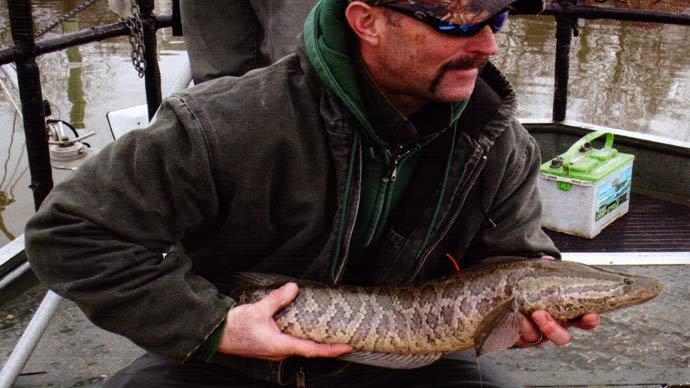
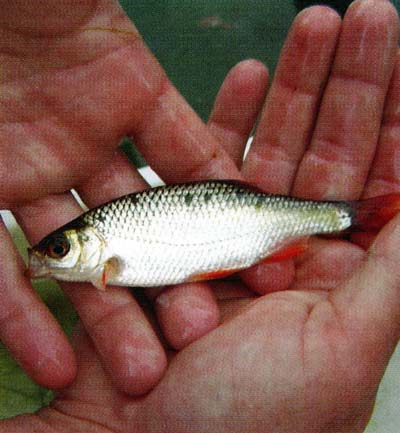
Fish are a little easier to keep out of a pond because they are easier to identify and perish quickly when out of the water (with certain notable exceptions like snakehead and weatherfish). Most pond owners choose what to stock (or not). But invasive fish may be accidentally stocked when trying to stock something else. For example, a pond owner might accidentally stock European Rudd when they intended to stock golden shiners. The two species look remarkably alike, particularly when they are small. Sometimes Rudd can inadvertently get mixed up in tanks of shiners. How to avoid inadvertent stocking? Deal with a reputable fish grower and make it your business to identify all fish brought to the pond.
When stocking fish, be sure to add only fish, not water. Transport water should not be drained into the pond. Net the fish out of the transport tank or live well, and try to keep water transfer to the pond to a minimum.
Zebra mussels and quagga mussels may be old news, but they are still a big problem. They can be accidentally introduced because their planktonic larvae (veligers) can be transported in water in boat hulls, bilges, live wells, or bait buckets. Additionally, they attach to boat hulls, plants, docks, rocks, buoys, anchors, trailers, and just about any other structures. Treat all water, boats, and equipment as if contaminated.
To keep out most aquatic invasive species, follow the rule of three D's. Drain. Dry. Disinfect. Drain your boat, live well, buckets, and nets before using them in your pond. This means eliminating all ponded water everywhere, even in the bilge of a boat and the hull of a kayak.
Put gear (including nets, lifejackets, buckets, and coolers) in the sun to dry out and bake. Most aquatic organisms (and even plants) do not survive if left to dry out completely. Let gear completely dry for a minimum of 2-3 days, with a better goal of 5-7days. If this drying period is not possible, disinfect the gear. Pressure wash boat hulls with active steam from a steam Jennie at a local boat launch. Hot water (>140°) will kill most aquatic invasive species. Pay careful attention to remove plants hanging from trailers or that are trapped by the boat hull on trailer bunks. Pull the boat plug on a hill and let the bilge completely drain. Spray hot water and steam as far into the hull as you can. Use a dilute bleach solution in the bilge and live well to kill anything else that you missed with the pressure washer. Cycle some disinfectant through your recirculating pump. A high-concentration salt solution for 30-60 minutes can be used to disinfect nets, waders, damp life jackets, and other gear you don't want to bleach or pressure-wash. If a pressure washer cannot be located, a high-pressure soapy car wash will work, but it does not get as hot (or work quite as well) as active steam.
My best advice is to be vigilant about what you stock in your pond. Closely look at the fish and invertebrates that are coming in from routine stockings. Don't move around water or gear that is not disinfected.
Minimize moving boats and other gear from lakes with known invasive species (such as zebra mussels or milfoil) into the pond.
Lastly, consider buying a dedicated pond boat, anchor, and other gear to keep invasive species out.
Mark Cornwell is a professor of fisheries at the State University of New York in Cobleskill, NY. Based near the Catskill foothills, he feeds the brains of hungry fish students, offering plenty of applied science and hands-on opportunities beyond the classroom. Cornwell also works with select local landowners, collecting data and analyzing ponds, with students benefiting as well. He also assists the college's aquaculture department.
Reprinted with permission from Pond Boss Magazine