

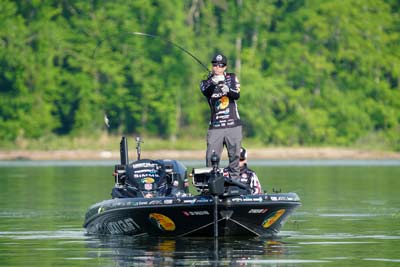
The crankbait is a timeless bass fishing lure, and they come in many shapes and sizes. There are baits that you can fish at just about any depth imaginable, and to this day, they are among the most effective ways to catch bass. Longtime professional angler Brent Ehrler uses them often and offers tips to make crankbait fishing easier.
Choosing the Right Crankbait
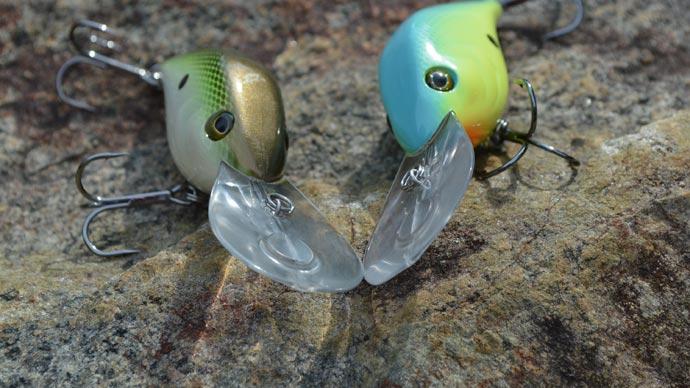
For Ehrler, choosing the correct crankbait for the job comes down to the depth and cover he is fishing. He uses a host of different baits, but some of his favorites are the various square bill crankbait models, as they allow him to fish quickly down the bank and deflect them into anything he comes across along the bank.
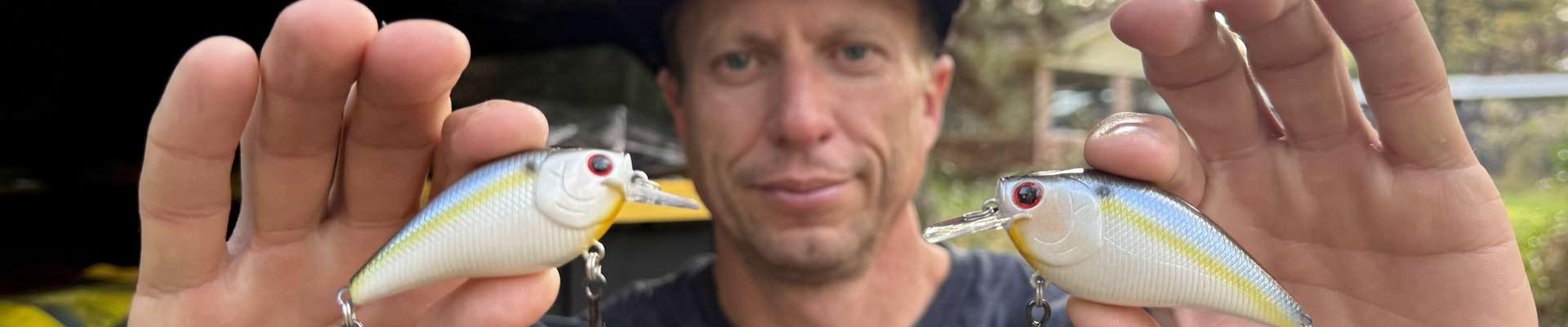
“One of my all-time favorites is a Lucky Craft 1.5, but if I need a little more buoyancy when fishing around wood, the 2.5 is good because it doesn’t bury into cover as much,” he said. “The bigger one is much more buoyant, and if you are winding through tree limbs, you can pause it, and it will back away from the cover instead of snagging as much.”
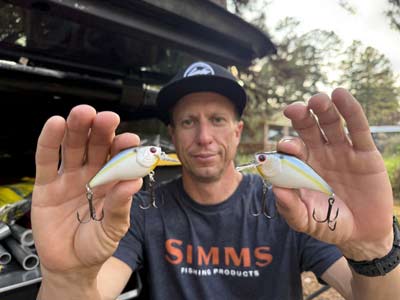
From there, it’s all about diving depth, and he uses a host of different baits, but pays close attention to how deep a bait will dive and where he’s fishing. “If the crankbait maxes out at say 5-feet deep, I’m fishing that in 4-feet of water or less,” he said. “I always want to get the bait to dive a foot or two feet deeper than how deep I’m fishing because I want that bait digging into the bottom. If you are not hitting bottom on every cast, you can still get a fish to bite, but you’ll get many more bites when the bait is deflecting into the bottom; that’s what triggers most of the bites.”
Cadence and Target Casting
Most of the time when Ehrler is fishing a crankbait, he’s fishing it fast. He believes that speed is what gets most fish to react.
“There are times in the winter or early spring when you have to slow down and make that bait crawl around like a crawdad, but most of the time I’m fishing one quickly,” he said. “I’m not saying wind it as fast as you can, but keep it moving along. That speed is what gets those fish to react most of the time.”
When Ehrler is going down the bank and fishing cover, he will make multiple casts to the same area. “I’ve learned over the years that if you go past something and don’t get a bite, it doesn’t mean that a fish isn’t there,” he said. “If I see a good laydown or other cover, I’ll make multiple casts to the same spot, and that can end up triggering a fish to bite it. Making several casts to one spot will definitely help you catch more fish.”
Don’t Overthink Colors
Crankbaits come in many different colors, but Ehrler says to keep it simple. He only uses a handful of various colors, no matter where the tournament trail takes him across the country.
“For me, it’s pretty much always some sort of shad color,” he said. “In the winter and spring months, I’ll use more reds and crawfish colors, but outside of that, it’s almost always some sort of shad pattern like pearl threadfin shad from Lucky Craft. I’ll also mix in a bluegill pattern in the spring with a color like BE Gill, but most of the time, shad colors will work for you no matter where you go.”
When many anglers reach for chartreuse in stained, dirty water, Ehrler still goes with a shad pattern. “A color like chartreuse shad has a chartreuse stripe down it, but it’s still a shad pattern that will show up even in the muddiest water, and it’s a color I have a lot of confidence in,” he added.
Choose the Right Rod
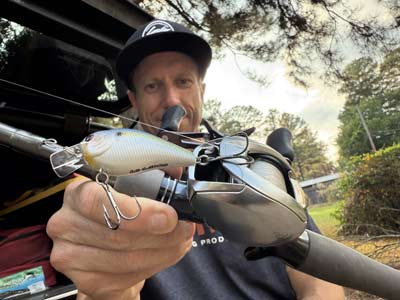
Crankbaits are much different than most bass fishing lures as the diving action they create causes the rod to move quite a bit. Sensitivity is still important, but not nearly as crucial as baits fished along the bottom. Because of this, Ehrler prefers a composite rod that is part fiberglass and part graphite, which helps him be more efficient with crankbaits.
He likes the addition of some fiberglass as it helps to dampen the strike, which may sound counterintuitive, but he has his reasons. “With baits that have treble hooks, when something bites it, and you are winding it back in, your reaction is to pull back immediately,” he said. “What happens is you tear a big hole in the mouth of the fish, and you end up losing a lot of them. I want something that will dampen that strike, so I don’t pull it away from them, and the give in the rod also helps when you are fighting the fish, and you end up landing more because of it.”
He designed a 7-foot, 2-inch rod for the Daiwa Tatula Elite Series lineup, made for shallow crankbaits like squarebills. “The length is a good all-around rod for shallow diving baits and has a medium action,” he shared. “For shallow crankbaits, you are making shorter roll casts and need to be precise so that the length is perfect. For deep-divers where you want a longer cast, I use an 8-foot medium-heavy in the same lineup.”
Reel Speed and Line Size
Choosing the proper gear ratio for crankbaits is a matter of personal preference, but Ehler has settled on a 6.3:1 gear ratio, either a Daiwa Tatula Elite or a Zillion.
“I don’t like going with any reel speed faster than that because I tend to overwind it as it is,” he said. “If I use a faster reel, I’ll wind it too fast, and the bait will tend to blow out. There’s a fine line of fishing a bait fast enough and not too fast, and the slower reel speed helps me with that.”
For line, he’s always using fluorocarbon, generally somewhere between 12 and 16-pound Sunline Sniper. “For most shallow divers, I like 12-pound but will go up to 16-pound when fishing larger squarebill crankbaits,” he said. “The heavier line helps when banging into cover and can also keep the bait running shallower than it would with lighter line.”
Crankbaits are so popular because they work in many situations, and while the simple idea is to cast them out and reel them back in, some nuances will help you catch more fish with them. Choosing the right bait, gear, and how you fish them can all add a few more bass to your catch total.