

While covering Bassmaster tournaments for B.A.S.S. Times, I reported on Stephen Browning fishing a magic spot that produced wins on the Red River two consecutive years.
During both tournaments, Browning kept returning to a backwater spot that kept replenishing bass. The spot filled with laydowns kept producing the key bass Browning needed to win the Opens on the Red River two consecutive years.
Whether you are on a vacation at a renowned bass fishery or competing in a multiple-day tournament, you can also hit the bass jackpot every day if you can find a replenishing area like Browning did on the Red River.
“It is a place where you can go to several days in a row or a period of three weeks to a month and catch fish consistently in that spot,” says former Bassmaster Elite Series pro Brian Snowden.
Areas that seem to restock daily with bass can be found on any given body of water. Finding the right bottom contour, baitfish presence, and current are some of the keys to finding replenishing areas on your favorite bass waters.
Highland Reservoirs
While guiding on the deep, clear waters of Table Rock, Snowden depends on areas where he can consistently put his clients on fish. Snowden’s favorite replenishing areas on his home waters are main and secondary points laced with sunken brush piles or standing timber. These points extend about 50 to 100 yards with a gradual slope from depths of 5 to 10 feet down to the 20- to 30-foot range.
“Bass can do several things there,” says Snowden. “They can get up on top of the point in the shallower water to feed in the morning, or can pull back out on the deeper creek channel drop, or they can actually suspend over the brush piles or in the standing timber."
The Missouri guide favors secondary points in early spring, as bass stop to feed on these spots en route to spawning in bays and coves. His favorite lures for working the secondary points included Carolina-rigged Baby Brush Hogs, split-shot-rigged finesse worms, and topwater plugs such as a Heddon Zara Spook.
Main lake points restock best in the summertime when bass move up from their deep summertime haunts to feed in the shallows. Snowden catches these main lake feeders on football jigs, finesse worms on drop-shot rigs, and Carolina-rigged Zoom Brush Hogs or Baby Brush Hogs.
Lowland Reservoirs
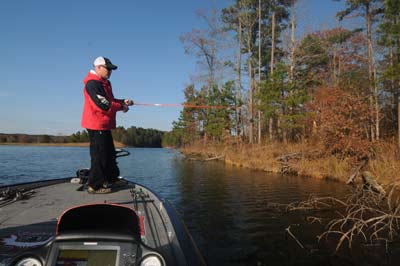
During his early years of competitive fishing, Missouri angler Chad Morgenthaler earned checks by finding replenishing areas on shallow, mud-bottom impoundments in the farmlands of his former home state of Illinois. The former FLW Tour pro discovered bass replenished on flats more than other types of structure on lowland reservoirs.
Since these reservoirs contain more flats than any other type of structure, the key is to find the best replenishing flats. Morgenthaler looks for flats with baitfish and isolated pieces of cover, such as laydowns or stumps. He believes main lake flats replenish better than flats in coves or creeks, which seem to contain more resident fish. "On the main lake, anything goes,” says Morgenthaler. “A lot of fish move around from a lot of different areas and use those flats for feeding.”
The size of a flat matters when searching for an ideal replenishing area. “I like a flat that is about an acre in size because it gives me a lot of options,” says Morgenthaler. “When dealing with a flat of that magnitude, it is going to have some irregular feature on it, whether it is cover or a ditch that runs through it or something that the fish tend to stay around.”
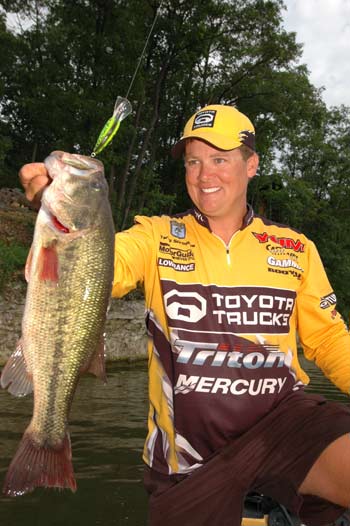
Summer and fall are Morgenthaler’s prime seasons for targeting main lake flats since bass tend to stay longer on the structure and gorge on the plentiful supply of baitfish there. Morgenthaler’s lure choices for the replenishing flats are topwater lures (LuckyCraft Sammy, Zara Spook, Rebel Pop-R, or a buzz bait) and a square-billed crankbait.
Rivers
While honing his skills on his home waters of the St. Johns River, Terry Scroggins found bass replenishing on a particular type of offshore structure that is common on most rivers.
“I like ledges because fish can move around on them, and when it comes time to feed, they position themselves right where they need to be," says the five-time BASS winner. When the current is heavy on a river, bass tend to bunch up on the ledges and wait to ambush baitfish being swept by the flow.
Replenishing river ledges consist of rock, sand, or shell beds that begin at about 3 feet and drop to 10 feet. The sharpest drop on the ledge is the sweet spot of this replenishing structure. "A lot of the ledges will have a tapering drop, but there will be one specific area that will step down really quick and have a little notch in it, and that is where the fish will sit," says Scroggins.
The Major League Fishing (MLF) pro rates summer as the best time to target ledges on a river. His favorite lures for ledge bass include shaky head worms and medium-diving crankbaits