

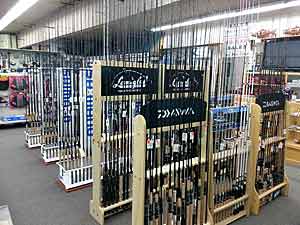
The introduction of several bass fishing techniques and lures in the last 30 years has prompted rod and reel makers to produce specialized tackle.
In honor of BassResource’s 30th anniversary, I have been assigned a four-part article on the evolution of bass fishing since the media company’s inception in 1996. The first part covered the introduction of new lures and techniques since 1996, and this second part will focus on innovations in bass fishing rods and reels over the last 30 years. The other two parts will cover the evolutions of bass boats and electronics in the last three decades.
Rod Innovations
The new tactics the pros kept developing to win tournaments prompted manufacturers to make specialized, lightweight, and ergonomic rods rather than the heavy general-purpose models of the past generations. By the mid 1990’s, rod makers began focusing on requests from tournament anglers for rods with greater sensitivity, longer models for greater casting distance, and better leverage on hooksets. Tournament competitors also wanted lightweight versions to reduce the strain of holding a rod for eight hours or more.
Greater sensitivity and lighter-weight rods were achieved by using high-modulus carbon fiber and a fortified resin system to increase durability without adding weight. St. Croix developed two new processes during this time to improve the strength and durability of its high-end rod series (Legend Xtreme, Legend Tournament, and Legend Elite). The first step was an integrated poly curve (IPC) built into the rod blank’s mandrel to give it a pure slope, eliminating stair-stepping in the mandrel design (which enabled the company to build a rod with a more consistent wall thickness from butt to tip). The second process — advanced reinforced technology — used a carbon fiber material running perpendicular to the linear fibers of the blank. The process allowed St. Croix to use lighter, higher-strain-rate material to maintain a durable, yet lightweight rod.
Rods longer than 7 feet were popular flipping tools from the 1970s to 1990s, but the trend towards specialized rods for other tactics spurred the demand for rods measuring from 7 feet, 3 inches to 8 feet by the 2010s. B.A.S.S. imposed a rule for decades, capping rod lengths at 8 feet, but changed it in 2016 to allow rods up to 10 feet long. The rule change sparked the ultra-long-rod craze, with specialized techniques such as deep cranking and fishing magnum swimbaits.
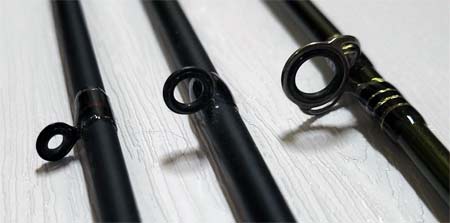
The demand for lighter, more sensitive rods led to the introduction of the micro guide system by major manufacturers at the 2009 ICAST show. Manufacturers striving to reduce rod weight led to the shift to smaller guides. The weight reduction allowed the rod blank to maintain its natural action and increased sensitivity, as the line stayed closer to the blank, making more contact points.
Duckett Fishing claimed to be the first manufacturer to offer a complete line of casting rods using micro guides. Pro angler Boyd Duckett suggested his micro-guide concept resulted in a lighter rod, better balance, better feel, and improved casting distance. Wright & McGill introduced its Skeet Reese signature series of micro-guide rods in 2010, which significantly boosted the trend’s popularity.
The introduction of numerous finesse tactics from the mid-1990s to now has also led to new developments in spinning rods. Modern resin systems, such as St. Croix’s fortified resin system and G. Loomis’ nano-silica resin (introduced around 2010), used microscopic particles to fill gaps between fibers, creating rod blanks 20 percent lighter and 25 percent stronger than previous generations of spinning rods.
Spinning rod guides have evolved to handle modern braided lines and maximize casting distance. In 2012, Fuji developed the KR Concept, a system using high-frame “choke” guides that quickly transitioned the line from large loops into lightweight micro guides to reduce line slapping into the guides and increase casting distance, especially with braided lines.
Since 1996, the industry has shifted from medium- to heavy-duty, multipurpose spinning rods to specialized models for tactics such as drop-shotting, Ned rigs, and hair jigs. The specialized rods featured customized tapers and handle lengths.
Reel Advancements
Reel innovations since 1996 have focused on reducing friction for longer casts, lowering the reel’s center of gravity to improve angler comfort, and increasing gear ratios for faster retrieves.
Lightweight became the big buzzword for baitcast reels in the 2010s. The Abu-Garcia Revo MGX set the standard for thin reels by winning the 2011 ICAST Best of Show award. A combination of a magnesium alloy frame with C6 carbon side plates allowed this reel to weigh in at a mere 5.4 ounces. Daiwa produced one of the slimmest reels on the market with its new ultra-compact PX Type R baitcasting reel, weighing in at just 5.3 ounces.
Baitcast reels combining centrifugal and magnetic brakes emerged in the early 1990s and became a widespread feature by the mid- to late-2000s. Shimano introduced an advanced braking and spool system with its Magnumlite (MGL) spool in the late 2010's. The system's ultra-lightweight design reduced startup inertia, which allowed longer casts with lighter lures.
Techniques requiring higher-speed retrieves led reel manufacturers to build baitcasters with gear ratios higher than the standard 5:1 gear ratio models popular in the 1970s. Around 2005 to 2006, reel makers started introducing 7.1:1 ratios, and in the early 2010s, baitcasters moved into the 8.1 to 9.1 range. The Abu Garcia Revo Rocket established a landmark moment in 2013 with the introduction of a 9.0:1 ratio. Today’s reels for specialized tactics feature gear ratios as high as 10.1:1, which retrieve over 40 inches of line with each turn of the reel handle.
Spinning reels for bass techniques have also evolved over the last 30 years from heavy, multipurpose models into specialized, durable tools with advanced drag systems.
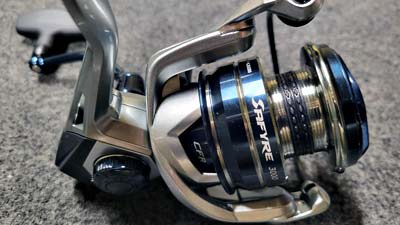
Reel makers began using carbon-composite materials to replace heavy aluminum and cheap plastics, creating a lighter, more rigid reel. Companies also shifted from solid rotors to skeletal designs to reduce startup inertia when turning the reel handle.
Advanced drag systems were introduced in the 2010s, including the Daiwa automatic tournament drag and Penn’s HT-100 carbon drag system. These innovations made drag engagement smoother, preventing line breakage on hooksets and surges.
The need to use electrical tape to spool braid onto spinning reels was eliminated in the mid to late 2010s with the introduction of braid-ready spools. Companies such as Penn and Daiwa constructed spools with rubber inlays or specialized coatings to prevent braid slippage.
While infinite anti-reverse was available on high-end spinning reels in the mid-1990s, the feature became an industry standard after 1996. The feature eliminated play in the handle, creating immediate hooksets required for drop-shot fishing and other finesse techniques.