


FrogTastic
Members
-
Joined
-
Last visited
Everything posted by FrogTastic
-
15 gallons will last about a year. I, coincidentally, have experience with sharks, and I would not use this. Are you fishing off a boat, or the shore. I would assume boat, so I'd use ground menhaden.
- 15 replies
-
- frogtastics
- guide
- to
- making
-
Tagged with:
-
I make this bait when I have nothing else to do in the dead of winter, when it's freezing cold. I make this approximately one time each summer, so it's not like I spend tons of time making this bait. I, too, would much rather catch fish than make this stuff. Also, I respect that you like fishing with crickets or worms, I just have found that small bluegill won't touch this bait nearly as much as a small worm or a cricket. I've caught many big fish on crickets, but if you're interested in that stuff, check out my thread on baits.
- 15 replies
-
- frogtastics
- guide
- to
- making
-
Tagged with:
-
-
I'm not using the circle hooks, I was just stating that I got a few of them. Sorry for the confusion!
-
-
Well guys, it's time for the final thread in this series. I'm sure every angler has designed their dream body of water, stocked, of course, with their favorite species of fish to catch. Well, today we're going to design one for bullgills. So without further ado, here we go- PERMISSION: The first step is to get permission to build. This is very important! Without permission, you are subject to heavy fines, and possibly worse. You'll also need a nice chunk of land to build on. I'd suggest building right in the center of the land, as wildlife will congregate there. Be sure you have a healthy insect population, and a nice population of frogs is good too. I would, if I had the choice, have it so that a small stream runs into the pond. That way, anything in the stream gets rolled into the pond. SIZE: Any size pond can hold big bluegill. I've caught 1-pounders out of water no bigger than 1/8 an acre. I've also caught them on 680-acre bodies of water. I'd suggest a 5 acre pond. It's a nice size - you can use your boat, fill it with fish, and have plenty of open spots. If you must go smaller, get as close to that size as you can. I'd probably make the pond in a figure-8 shape. DIGGING: The next step is to either rent a backhoe and dig out the land yourself, or pay someone to do it. Neither is that cheap. Unless you can properly operate a backhoe, I'd have someone do it for you. When digging, keep the pond an average of 2-5 feet deep - big bluegill can and will come into extremely shallow water to catch some of their favorite prey items. Plus, they're easier to catch in shallow water. The deepest spot in your pond will probably be around 15-20 feet deep. I'd recommend having peninsulas, as big bluegill like to surround smaller fish against cover (in this case, land) and just pick them off one by one. When building the peninsulas, have it so that they drop off to deeper spots, that can be utilized as spawning beds. Make the beds approximately 10-12 feet deep. In the middle of the pond, have the bottom gradually slope down to a point 15 to 20 feet deep. A useful thing for anglers is a channel dug straight from the deepest points up to a shallow points, as it can be a choke-hold for fish. PLANTING AND DECORATING: By now, the entire pond should've been dug out, and for the most part, the construction trucks are done. There are a few things that you can do to make your pond better, rather than just having open water. That's so boring, and you probably won't catch nearly as many fish (mostly because they'll die off). The first thing to do is create a little bridge going from one side of the pond to the other. Use large rocks for this purpose, as it provide nooks and crannies for small critters, which provides space for the big gills to root around in. When building the bridge, make it so that it is completely out of the water when the water is lowest, but is usually deep enough for a small boat to pass over, with or without a motor. In any area that has a pretty flat bottom, put pea gravel over it, and plant it with grasses. It can hold small insects, which bluegill will greedily eat. Also, tiny gills will congregate near it. Finally, plant any coves pretty heavily, with hydrilla and pads. Plant the middle areas more sparsely with stalky plants and pondweed. Plant the shoreline of the pond with tall grasses in some spots, plus willow trees. If you can get some, plant some cypress trees. Plant the rest of the shoreline with stringy plants. By the time that is done, you can start submerging some trees. I'd recommend chopping down a tree or two and just throwing it into the deeper parts of the pond. Afterwards, you can build a dock. I like the "T"-shaped ones best, but any style will work fine. Make sure you can fish from it, as well as board a boat from it. STOCKING: Before any gills go in the water, you'll need bait in it. Introduce bait species like fatheads, tiny goldfish, golden shiners, mosquitofish, baby bass (not a lot - only about 100 of these), baby bluegill, crawfish, and tadpoles. Let this ecosystem thrive for at least 6 months, but a year is best. By that time, you can introduce big gills. INTRODUCING THE BIG GILLS: By the time all your bait species have flourished, and various other small species have taken up residence in and around the pond, you can introduce the big gills. To introduce big bluegills, first make a list of bodies of water that are filled with big ones. Then, go to a different lake every trip. Catch your limit of big bluegill, and live-transport them to your pond back home. Only go to a single body of water once, so that you don't take all the fish out of a single body of water. That means that you can't fish for big gills there anymore. To live-transport them, you'll need 2 or 3 pickups, a bunch of those gym totes, and a bunch of aerators. Once you catch a fish, simply fill a gym tote with water and hook the aerator up to it. One gym tote can hold about 3 big gills. Once you feel that your pond is well stocked (about 400 big gills, plus a few other fish), stop transporting fish to your pond. Live-transporting is much easier than stocking, and I'd love to see a place that stocks 1 pound plus bluegill. OTHER FISH SPECIES: Depending on where you live, you can introduce tons of other fish species to your pond. There isn't much that will eat a monster bluegill, so your trophies should be safe. If you have a 5 or 6 acre pond, you have a wide variety of options. Maybe you want some more panfish? If so, go for fish like crappie, tilapia, yellow perch, rock bass, oscars, mayan cichlids, pumpkinseed, warmouth, big shiners, or redear. Maybe you're going for some kind of bass? Go right ahead and stock largemouths, peacock bass, hybrid stripers, or even a striper or two. Maybe you would like something with teeth? In that case, cool fish include northern pike, walleye, chain pickerel, bowfin, longnose gar, or even an alligator gar (be careful with this one- he'd have no trouble eating a big bluegill). Maybe you just want something different? Try going with carp, American eels, channel catfish, blue catfish (will also eat your bluegill), or rainbow and/or lake trout. I have only ever heard of one person with a pond with lake trout, it was a 5-acre my friend in Canada has. If you stock a little more than 400, say 500-600, you should have no trouble keeping populations high, even with big gar or catfish. FINAL WORDS: Well guys, I really enjoyed writing this series, and I hope everyone has enjoyed reading it. More importantly, I hope everyone has learned something out of this. It is really helpful information, and can help turn a day full of 4 inchers into a day with a 4 pounder. So, remember these skills, and you may set the new world record! Thanks to everyone who read this far... Drew
-
-
In the last 3 threads of this series we talked about basic fishing for big bluegill, catching live bait, and creating the ultimate dough bait. In this thread, we'll talk about setting up the ultimate fishing camp. NOTE: I use this camp for 24-36 hours at a time, so I can manage to set it up pretty fast myself. With 1-2 more people, we can get it completely done in 15-20 minutes. FOREWARD: Earlier, I had stated that to catch big bluegills, you need to stay out for a while. You can't go out for 45 minutes and say "it's too hot, I give up". That kind of attitude will never catch you anything. You can't stay out for an hour and expect to have stringer-full of 1-pounders. It doesn't work like that. It's kind of like fishing for 15+ pound bass - you fish all day, and might get one or two (except with bluegill, it's usually more). That is why a good camp is essential for anyone looking to catch big bluegill. THE BASIC RIG: For starters, get yourself a good tent, maybe 1-2 person. I personally prefer a 4-person, but 1-2 works just fine. I like a black tent, as it is stealthy on the shore. Other colors/patterns that work well are light blue, green, and camo patterns. The tent should have good screened-in windows, which you can place a cloth over to close them up. It should also include a waterproof tarp. This stays on top of my tent at all times, because you never know when rain might hit. The next step is to take a tarp, say 6 feet long by however wide your tent door is, and two big sticks, however high your tent is. Put the sticks firmly in the ground 6 feet away from the entrance to your tent, and place the holes in the tarp through the thin part of the stick. Then, place the other holes in the tarp through the tent rods. The last step to create a basic camp is to place a super-comfy chair under the tarp. Now, you have a nice spot to sleep in, sit in, and fish under. FURTHER ADVANCEMENTS: While the basic rig should work just fine, there are plenty more creature comforts that I like to bring with me. A cot is nice. I place a thick blanket over it, and have a pillow too. That makes for a nice napping place, and it's far more comfortable than my chair. One thing I have learned to do is light up my campsite at night. In the summer, I'll sleep for about 6 hours a day, in the hottest hours of the day. Night fishing works well for big bluegill, so I'm sure to be well rested so I can fish all night. To light the camp up, I usually hang lanterns along the tarp, plus a light in the tent. A basic cooking set, with a stove and some pots/pans/silverware can come in handy. Sometimes I bring it, but it adds a lot of weight to my bag. Sometimes, I just use MRE's. But after a long day of fishing, a nice cooked dinner tastes better than you'd think. I bring stuff to make pita pizzas. Look them up if you've never made them. They're easy and good. Another invaluable tool to have is a fan. They feel great when you're napping during the heat of the day. The only other things that I bring are my headlamp, a small first aid kit, and a small survival kit. GEAR TO BRING: You don't want to bring tons of gear to your spot. On any given trip, I have: All the above stuff A cooler, full of drinks 2 rods A tool kit, with a few knives, a multi-tool, duct tape, super glue, and hemostats A landing net Some containers/food/aerators for live bait; plus, some stuff to catch live bait If I'm going to use a boat, it's already at the spot. Carrying a big canoe gets tiring quick, even for 2-3 people Last but not least, a 2-tray tackle box chock-full of lures and terminal tackle WHAT TO WEAR: Camo. The main reason people only catch small bluegill is because they spook off the big ones. How often do you see a little kid wearing something that is dull green/brown/legit camo? They like to wear bright colors, and that's fine. It just means they won't catch big fish. Basic dark khaki cargo pants, a dull green shirt, and a blue hat is my "specially-designed" camo. The dark brown represents the dirt and dead grass on the ground-level. The green represents the trees, a bit above ground level. And the blue represents the sky, way above ground level. I also carry a gray hat and a white hat (white for really cloudy, blue for clear, gray for stormy). From a fish's perspective, you're generally above them. They are looking up on you. That's why this setup works. The other thing I cannot stress enough is to wear boots! I used to wear flip-flops on the trips, until I stepped on a massive fire ant hill. That ruined what was supposed to be the longest, best trip of the year. Also, high socks will help with the boots. BRAVING THE ELEMENTS: Many a time, anglers have backed out on me because of the weather. Usually, they're being sissies, but sometimes the weather can be pretty miserable out there. Light rains are never a problem, and they actually help. Brutal heat can be the most miserable. Occasionally, I'll go for a swim if it's that hot. Heavy, torrential rains are nothing a good angler/outdoorsman can't handle. Even snow can be fished through (that's where a good campfire comes in handy). The only weather I won't fish through are bad storms. That actually gets to be pretty dangerous. One tip I've learned over the years is that you should never cancel a trip until an hour before you leave. The weather can change very quickly, and one minute it may say it's going to storm, and then 15 minutes later it changes to sunny and 80 degrees. You never know, so you should probably go. After all, you can always come home. PEOPLE: Sometimes, having lots of people on a trip can be pretty fun. When fishing for big bluegill, I never have more than 2 more people with me. It becomes too much gear, too many people to worry about, and too much mess to clean up. Also, you have more people moving around the water's edge, which means there are more things to spook off that trophy 4-pounder you just saw. I'd say a two-man crew is best. LAST WORDS: Well, there you have it. You can now (hopefully) set up a simple shelter for 1-2 days, with all included creature comforts. Hopefully this thread has taught everyone something about the enticing world of targeting massive bluegill. See you in our next, and final, thread. Adios!
-
-
It's a shallow-diving crankbait by Megabass. I have a friend that swears by them. He loves them.
-
They should do one on Castaic. That'd produce a hefty 3-day total!
-
Also, remember that this is designed for big bluegill. Red worms and crawlers don't work well for big'uns.
- 15 replies
-
- frogtastics
- guide
- to
- making
-
Tagged with:
-
I buy all local/scrap ingredients, and catch my own insects. Also, buying in bulk helps.
- 15 replies
-
- frogtastics
- guide
- to
- making
-
Tagged with:
-
For the third thread in the 5-part series, we'll be discussing how to make the ultimate dough bait for big bluegill. This is the only bait that I use for big bluegill that comes from the kitchen(sorta). Well, here we go! FOREWARD: Just a few warnings before you start. The first - wear rubber gloves the entire time. This bait is truly disgusting. I had a catfisherman, who makes his own bait (he literally calls it *****) tell me that this stuff was the most disgusting thing he'd ever seen. However, I recently caught a few 2-pounders with this mixture, so it's well worth it. The next - do this somewhere outside. I do it in my garage, with all the doors and windows open, and newspaper all over the floor. It's that disgusting. Another - you need a strong stomach to do this. 'Nuff said. One more - go to thrift shops or something and pick up some old kitchen appliances/tools and a few other things, rather than use the ones you use everyday. You'll need A blender, capable of pureeing and blending (get the biggest one you can find) Big Ziplock bags (1 gallon) A meat hammer Small plastic trash cans - get as many as you can get, they'll all come into use sometime or another A big trash can (pretty big) A 15-ish gallon trash can A big spoon. I actually use one of those ones that you'd hang on your wall, as a decoration "BAIT LIQUID 1": Collect a bunch of small critters, either by collecting, buying, or both. You'll need wax worms, red worms, nightcrawlers, minnows, crawfish, and leeches. Feel free to add and subtract these - I support experimenting! Throw all of these into the blender, and puree them. This is one of the nastiest parts. Save it in a small trash can for later. "INSECTS": Collect some more critters. Read above on how. You're gonna need crickets, mealworms, grasshoppers, and beetles. Take these and place them all into a big Ziplock bag. Using the meat hammer, mash them into a pulp. Save this in another trash can. "BAIT LIQUID 2": This is probably the nastiest part of this bait. You'll need juice from shrimp (I get bags of them from the grocery store, already peeled, and let them sit out a week or so; then dump out the juice), the juice from a can of corn, perch eyeballs, Gulp liquid, the juice/blood from a can of chicken livers, all the juice from a jar of pickles, some vanilla extract, some almond extract, anise oil, the juice from chicken gizzards, and some food coloring. Big gills get ticked off by red. Mix this liquid into a smaller trash can with "Bait Liquid 1". This stuff smells BAD. "MEATS": Get a few cans of baby shrimp, some hot dogs, some chicken livers, bacon, some chicken breasts, some chicken gizzards, and a few raw sausages. Blend this mixture, keeping some chunkiness in it. Once you feel it's done, dump it into a trash can. "RANDOM STUFF": For this mixture, blend the materials like you did the meats. The materials are white bread, american cheese, swiss cheese, corn, and pickles. Once finished, place it in a trash can. "BASE MIXTURE": For your base, take the 15-gallon (ish) trash can, and fill it with plenty of water, and plenty of flour. The amount of flour can be difficult to gauge, so just eyeball it. Use enough that the bait can stay thick enough to stay on the hook, but thin enough that they're not just ordinary doughballs. After you have the flour-water mixture, throw in some garlic powder, garlic salt, onion powder, and salt. Mix with the spoon. "STARTING IT UP": Once you have the base mixture, mix all the bait liquid into the mixture. Stir again. "ALMOST THERE": Now, simply add in everything else. Stir it for a very long time, and make sure it is consistently mixed throughout. "CLOSER...": Once you have the trash can filled with this mixture (the 15-gallon one should be filled completely), leave it out for 3-7 days and nights. Works best if it's in the sun. I'm just waiting to see what this smells like left out in 100-degree weather. Even in 75-degrees, it smells pretty bad. Once you take it out, if it doesn't smell bad, keep it out. Some people swear by keeping the lid off when doing it for catfish, but I prefer not to. I like to leave the lid on, to hold the scent better. "STORING": To properly store this stuff, it should be refrigerated. The problem it, this would need its own refrigerator. My simple solution is to get a trash can that can easily fit the smaller one into it. Place lots of ice into it. Before placing in the ice, drill a drain hole near the bottom. Attach one of those things that a glass lemonade-serving jug-thing would have in it (where you pull the lever up, and it comes out, and then stops when you put it down) to the bottom, to drain melted ice. Replace the ice as it melts, which should be after a few days. When I need to bring some bait with me, I'll place it in a glass mason jar, and take it with me in my bag. FINAL WORDS: Please post in the comments if you have made this bait, and/or if it has worked for you. I only started developing it as of October of 2014, and the first batch was made in December 2014. First fish caught on it in January 2015. I've caught a decent amount of big'uns on this bait. While it never beats live baits, it works when nothing else will. Thanks for reading, and see ya in the next thread!
- 15 replies
-
- frogtastics
- guide
- to
- making
-
Tagged with:
-
Yesterday, I posted a big thread on How To Catch Big Bluegills. I've decided that I'm going to do a 5-part series of those articles. Today's will be on catching live bait for big bluegills. FATHEAD MINNOWS: One of the most popular baits for any fish is a fathead minnow. If you can find ones around 2-3", you can use them for big bluegills. My preferred way to catch them is: The first step is to find a body of water filled with fatheads. You can't catch them if they're not there. Look for a pond with clear to stained water, and a decent amount of vegetation. Go for ones with submerged native grasses, rather than lots of pads or hydrilla. The grass beds make excellent spawning grounds for them. Wade out into the shallows until you find a spot full of minnows. Star by instantly catching some with a shad net. My preferred net to use for all of the bait species is the Shad/Shrimp/Smelt Net, found at Bass Pro Shops. You can also chum them. These fish will eat crushed up crackers, among other things. Once you have caught at least a few in the net, it's time to collect some other types of bait. It's good to have as many different types of bait for big bluegill, because big ones can be extremely picky. While you search for other bait, throw out as many minnow traps as it takes to surround the bed. Fill them with dry dog food, maybe 15-20 pieces. Tie them off to trees. If you need bait now, take a big seine net, and surround the minnow traps and grass bed with it, to keep the minnows in until they go into the traps. MOSQUITOFISH: Mosquitofish are little fish that you find in swamps, ditches, and other stagnant bodies of water. I have ponds filled with them. They like ponds that are stained to muddy, with lots of pondweed in them. They like to hide in the stringy stuff, not the firm, stalky stuff. They are often to small to be caught in a minnow trap. The best way to catch them is to chum liberally with crackers, and then scoop them up by the dozens with a net. SHINERS: Golden shiners can work, so long as you use ones 2-3" long. They are often found in shallow water of all qualities, often around grass beds (robbing fathead eggs), or lily pads. You can usually catch them around the same place you'd catch fathead minnows, and you can use the same methods. Traps work better than nets. BABY BASS: These baits are like bullgill candy. The first thing to do is to find a body of water to catch these little guys in. The perfect body of water: Is privately owned, and you have permission to take baby bass Has a healthy or high bass population, including plenty of breeders Has clear to stained water Has plenty of logs, rocks, and stalky plants Has soft bottom Once you've found a body of water, the best way to catch them is with a seine net. The dip net usually doesn't work, because the fish are so fast. Traps don't work because they don't eat "human foods". Be sure not to take too many of these guys. Also, collect them around May to August, right when they are still really tiny. BABY BLUEGILL: Find a lake with stained to muddy water, and stringy vegetation. Make sure it has a good population of insects in/around it. That helps a lot. Find a spot around 3 feet deep, and around structure. Fill a few minnow traps with dog food, and throw them into the spot. If you have a big concrete pipe, like some ponds do, reach the net down into it. You may pull out tons of bluegill. Keep the minnow traps tied up to trees, and check them every 2 hours. GOLDFISH: The only reliable source of goldfish is the pet store. Get bright, small ones. These baits work great in winter. CRAWFISH: Catching crawfish for bass and catching crawfish for bluegill are two completely different things. My preferred way of catching them for bluegill is to find a super stagnant pond, with stain ed water and lots of hydrilla, maybe 2-3 feet deep. Then, just scoop the net right on the bottom, and you'll probably catch some craws. GRASSHOPPERS: Chances are, you've seen some grasshoppers near your fishing spot at one point. However, that may not be a reliable source of bait. The best way to get them is to take a good old net (I've taken a butterfly net, and replaced the wire with a thicker gauge, and replaced the mesh with the stuff in the shad net), and find a big field of green grass. Now, with crickets, you can throw out bread crumbs and stuff. That kind of stuff doesn't work with grasshoppers. To catch grasshoppers, just swing the net over/all around the grass, and you'll probably catch some. The best time to catch these grasshoppers (the green kind) is during the summer. However, the tan grasshoppers you may see work just as well, if not better. To catch those, take the shad net (that thing can take a beating) down to a big pile of rocks. They should be like plain tan pebbles you'd find, just bigger. Kick around stones until you see a grasshopper fly off. Chase it down with the net, and swing it down on top of them. There are ups and downs to green and brown grasshoppers. Green ones are easier to catch, but don't work as good. Brown ones take longer to catch, but work much better. You can be the judge of if browns are worth it. My vote is 'yay' to browns. COCKROACHES: I've never seen, nor heard of, another angler using cockroaches for bait. The idea branched off when I found one in the bottom of my tent, and I had run out of bait. I threw one of those on the hook, and - BOOM! - 1.5-pounder. The good things about cockroaches is that they are easily available. I usually throw out a few pieces of newspaper on the floor in the corner of my garage. The next part of the trap is to place super-thin wire mesh around the edges of the newspaper. On the inside of the walls, line the top of the mesh with petroleum jelly, taking care not to let it get on the outside edge of the mesh. You can nail a bit of wood to the inside, and coat that with petroleum jelly if using mesh is too hard. Next, throw your dinner scraps into the pit, and let it sit over a few days. After a while, it should be full of roaches! FROGS: Using frogs can be a great way to catch greedy sunfish. Naturally, tiny leopard frogs and bullfrogs tend to dive downward to escape prey. They will only dive down if they are too far from shore, though. The trick to fishing live frogs is to use a super long loop for the hook with a drop shot rig. This allows the frogs to dive right down into a bluegill bed. Often times, you'll catch a big bluegill on a frog when nothing else works. To catch frogs, find a stagnant body of water with stained to muddy water, stained preferred. The next step is to take your shad net, and just scoop right along the edges of the water. You'll either scare frogs out of the water, or into it. Once you see the frogs, try targeting them one by one. Use frogs an inch or under. Go for cricket, chorus, leopard, or bullfrogs. Toads have never worked, as they drown rather than dive. TADPOLES: During the summer, take a kid down to the pond with you the day before. Give him a net, and let him catch you a bunch of tadpoles. After he's gotten tired of catching them, go through them and release all of them that aren't between 1-2 inches total length. Save them until the next day, and fish them on a drop shot rig, just like a frog. The place to catch these is preferably in stained water, although muddy water produces lots too. Any type of vegetation is a must. Open ware seldom produces tadpoles or frogs. KEEPING BAIT ALIVE: To fish baits for big bluegill, they have to be alive. I've never caught a bluegill over a pound on dead bait, nor anything from my kitchen. I have been, however, working on a secret bait formula (*hint hint* look for it in the next thread) that has caught me quite a number of big gills. To keep fish alive, I've always taken a 5-gallon bucket, and filled it with pond water. Then, hook up an aerator and you're set. If you're fishing in the heat, keep the bucket in your tent and drop ice in every once in a while. If you're keeping them for a long time, get a bulk can of shrimp pellets from the pet store. To keep craws and tadpoles alive, do the same rig, except feed them something different. Feed tadpoles specialized tadpole pellets, available at the pet store as well. Feed crawfish scrap lunch meat. They like roast beef. I'll take it off my sandwich and throw some in their bucket. Don't add lots of ice to tadpoles' water; quick temperature changes will quickly kill them. Instead, add 1-2 cubes every 30 minutes or so. For frogs, use a bucket, but no aerator, and throw a few rocks in the bottom, so they can leave the water if they want. They usually will be fine without food, but if you want, feed them tiny chunks of earthworms. To keep insects, I've always used cricket baskets for green grasshoppers and cockroaches. For brown grasshoppers, I usually use a critter keeper from the pet store. Handle them in your tent, or else they'll fly off! For insects, throw an assortment of grass and cheerios in the cage. FINAL WORDS: Well, thanks again for reading! It really does mean a lot. In the next thread, we'll be discussing my newly developed dough bait. It may take a while to make, but you can easily make a bulk container of it, and it will last a long time. Well, see you in the next thread!
-
-
-
Sorry, but I must add two more lures I've used. Lindy Watsit Jig - This is a good lure for bluegills around 1 pound. I don't usually have much luck with HUGE bluegills on this, but I've caught some pretty big ones. Gary Yamamoto 3" Tube - This is a good search bait. If it gets hit, you should know there are big bluegill in the area. It helps get the biggest bluegill in the lake.
-
If you're looking to catch big bluegills, check out my guide. It's called Frogtastic's Guide to Bullgill Fishing. Yes, bullgill. It means bull bluegill
-
Bass fishing is all about getting the fish to bite. If you run something right in front of a big bass' face really fast, they will most likely strike from reaction. If you can tick off a bass, they're gonna attack whatever's got them mad. Speaking of big worms, try tomhawks. Rig 'em on a 4/0 Trokar hook and a 1/4 ounce eagle claw weight. Drew ~Catch 'em
-
I'd get an Abu Garcia Orra spinning combo and get it spooled with 10 pound mono line. I picked one up at Dick's for $100. Get a 7' medium light one. I'd try picking up a kit wits some assorted soft plastics, weights, and hooks. A few other bass lures I'd get would be a Booyah pond magic and a small frog. For a pond that small, I'd go with a Lunk3rhunt frog. Get a Strike King 1.5 squarebill and you'll be set for bass fishing. For panfish, pick up a beetle spin kit and a few rooster tails. Finally, pick up an assortment of split shots, hooks, and bobbers. Pick up some nightcrawlers, and you're set to fish that pond. If you have a bit more $$, a net and/or crawfish trap will help catch those crawfish and "shad". I agree with everythingthatswims, they're probably not shad. I'd guess they'ye golden shiners, or maybe even small bluegill. Drew ~Catch 'em
-
If I could add a few artificials that I forgot: Rebel Creek Creature - This is a forgotten bait; I haven't ever seen anyone else use one of these. Roadrunner Jig - The thumping action on these gets bluegill fired up Any Of The Micro Creme Creatures - I'd get a kit, save a bit of money. Get anything that doesn't come in the kit, though Rebel Bumble Bug - These work alright, I guess http://www.ebay.com/itm/1-Pack-Green-Trout-Bass-Crappie-Scented-Micro-Shrimp-Lures-4cm-NEW-/180874898006- These little things work pretty darn good I would like to see a Rapala Shadow Rap produced in a smaller size as well. That'd be killer. Another good bait, if they're in season, are live tadpoles. One more thing would be a Strike King Bitsy Minnow in a red craw color.
-
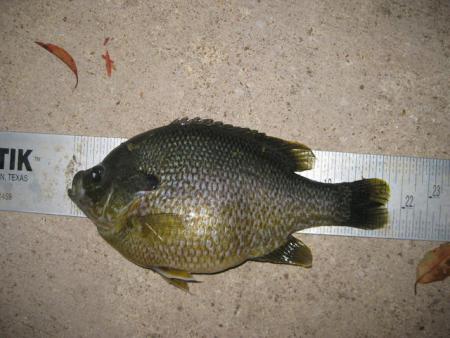
Hey all, You may have seen my thread titled "Incidentals". In it, I had stated that I caught a 3.5 pound bluegill, which may now be 4 pounds (there's a pic in the thread). I have decided to start a thread on catching big bluegill, like "The Beast". So, here goes: LOCATION: If you can't find big bluegill, you can't catch big bluegill. Lots of people will fish a heavily pressured area, and expect to catch big bluegills. Not once have I seen a big bluegill pulled out of a body of water where a whole family is fishing with their Zebcos. You need to find the spots that have been untouched. A lot of people will say that you need deep water to catch big bluegill. That is only partly true. If you want to catch bluegill during the spawning season (summer), then I'd recommend you find a few deep (at least 7') holes to fish. They could hold a big bluegill bed, and more importantly, a big bluegill. But any other time, those nests often become hidey-holes for snapping turtles, and other bottom creatures. Then, the bluegill move into shallow water to seek structure, like sunken trees, and docks. Even in summer, I've caught big bluegill in the shallows. They usually come into the shallows for food, once their supply gets sparse in deep water. A good place to fish is one that has trees above it, especially willow trees. I've found that bugs are usually all over willow trees. When it gets winds, the bugs all get knocked off the tree, and then they fall straight into the water, to be consumed by bluegill. If you find one near shallow water, it will also be plagued by smaller bluegills. If you find one that is right above a deep hole, you've just found yourself a perfect place for bullgills. SETTING UP CAMP: When you're trying to catch big bluegills, it's not like you go out for an hour and catch a bunch - it's like fishing for 15+ pound bass - you wait a long time, and catch maybe one fish (except with bluegills, it can be more). Sometimes, I will set up a camp and stay out for 24-36 hours at a time. If you stay out for 5-6 hours, you may catch 1-2 biggies. Staying out 24-36 hours can yield up to 20 biggies. It's well worth it. My basic camp is just a tent with a tarp stretched out front, and a chair under the tarp. I pitch camp close to the water, so I can just sit in my chair and fish for hours on end. I get very little sleep while fishing - usually, it's during the hottest hours of the day. Big bluegill get turned off during super hot temperatures. A cooler will serve you well while fishing for big bluegills. It can hold drinks, food, and bait. I find it useful to bring one big one, rather than one for food/drinks, and one for bait. A 5-gallon bucket with an aerator will also come in handy, if you're using anything you catch in the water for bait (*hint hint* - YOU SHOULD). When it's cold, a fire at night is nice. When on the shore, I cannot stress enough that you need to be stealthy. Keep a low profile. Camo works well. Covering your tent in black tarp waterproofs it and adds to the stealth factor. The other important thing is rods - don't use tons of them. I usually only use 1 rod at a time, maybe 2. Having a dozen rods out gets confusing, especially when you're on your own. Two is okay - one with live bait, one with an artificial. RODS, REELS, AND LINE: For bullgills, ultra-light just won't cut it. I prefer a medium-light spinning rod. The Vendettas are nice, and they also double as my drop shot rods for bass. I prefer a 7 foot rod, just so I can cast super far to a spot without having to walk all the way over. Abu Garcia Orra reels are my favorite. They're super smooth, and won't break the bank. For line, I never use monofilament. Well, never since a 1+ pounder ran me through rocks and broke me off. I prefer a "3-stage spooling system". First, spool 1/3 of your reel with 10-pound Spider Wire monofilament. Next, tie on some 10 pound Spider Wire braid. Fill almost the rest of the spool. Leave room for a 4-foot, 8-pound Seaguar fluorocarbon leader. Now, your reels have been properly spooled for big gills. LIVE BAITS AND RIGGING: While big gills have certainly been caught on flies, I feel it is a waste of time if you're going for lots of big gills. Not to mention it can be hard as f&$*. To set up a live bait rig for normal sized bluegill, you could just take a red and white bobber, a little split shot, and a soze 6 baitholder hook. None of that tackle is sufficient for big bluegill. First, you should start with a Thill spring bobber, the ones that clip on. These are black, rather than white, and when they hit the water, they make a smaller splash. The floats are only used if fishing with a float rig. When drop shotting, don't use them. To finish the float rig, take the smallest split shot you can get, and coat it thickly with black paint. For some reason, big bluegills HATE the presence of lead, so anything you can do to hide it will help your case. On top of that split shot should be a small red bead. While some bluegill anglers swear by using spinner blades, they suck for big bluegill. If anything, they deter them. To finish the rig, use a size 2-4 red or black hook. I prefer Eagle Claw hooks, but any brand will work fine. Use aberdeen hooks for that, not baitholder. Another hook option are size 6-4 circle hooks. I prefer Mustad for those. To set up a drop shot rig for bluegill, first set up your dropper loop like for a normal dropshot rig. Use a size 4-6 circle hook. Aberdeen hooks are OK for this rig, but circles are preferred. After you have your little loop, tie on your sinker. I prefer a 3/16 ounce tungsten drop shot weight for this. Now, just either let it sit, or very slowly drag it across the bottom. For live baits, there are lots of ways to go wrong, and lots of ways to go right. Let's start with your everyday minnows. Fatheads work, but only big ones. My favorite minnow to use is a big, fat, gravid mosquito fish. I catch and hand-select these in a local ditch, called "The Breeding Pond". Shiners will also work. Have you ever noticed bass preying on bluegill? Well, sometimes it's the other way around. tiny baby bass are like candy to big gills. Utilize these, if possible. Another bait is baby bluegill. Yes, bluegill are cannibals. Crawfish are another good bait. I prefer soft-shell crawfish that I hand-pick. I always use these live. Let's look at worms. This is probably the biggest mistake you could make, fishing for bluegill. If you want to catch small bluegill, sure, go right ahead and use those earthworms from your garden. If you want to catch 1/2 to 3/4 pounders, you can try nightcrawlers. The problem with worms is that everything else in the water will go for them. Leeches have never caught me a big bluegill. Only smaller ones. Crickets are bait for small bluegill. If you want big ones, use a grasshopper. One of my secret baits is a cockroach. They work great, and you can catch them in your basement or garage. The last bait I like to use are baby frogs. Make sure they're pretty small though. ARTIFICIALS: Plenty of artificials will catch big bluegill. My PB was caught on a Livetarget squarebill, but that was the only bluegill I'd ever caught on that lure. I would never try to catch bluegill with that bait. Why? It simply isn't designed for bluegill, even or epic proportions. My favorite lures are listed below: Rebel Big Ant - This is my No. 1 big bill lure. It's a hard find, but stock up on these - they're great. Jointed Rebel Minnow - There's just something about the somewhat off-action of these lures that pi$$ off big gills. Rooster Tails - 1/16 ounce to 1/8 ounce - get yourself some. Booyah Pond Magic - These will work, but usually catch more bass than bluegill. Good if you want a break from gills. Creme Frog - This flat-out works. Beetle Spin - These baits can work great. The trailer needs to be replaced though. Replace it with a Creme frog, or a live bait. BPS Uncle Buck's Series - Almost all of these plastics have worked for me, but they can catch small ones - use at your own risk. Leland Panfish Magnet - This tantalizing bait works great when dropped over a bed. Or anywhere, for that matter. Rebel Pop-R - If you use a really tiny one, this thing flat-out kills 'em. Mini Lizards - There is nothing that ticks big gills off more than a lizard "robbing" their nest. I have someone who hand-pours lizards for me. You can also buy 4" Zoom lizards, and rig them with a spinner thing from a Creme worm, or texas/carolina rig them. Strike King Bitsy Minnow - Holy moly, hold on tight! Gulp Alive! Minnow - Drop these under a dock, with just a hook = deadly. Megabass Siglett - I once had one of these, and caught a 1.2 pounder on it. I'm currently looking for more. Rapala Husky Jerk - If you get a small one of these, it won't disappoint Rapala X-Rap - You know those x-raps you use for bass? Downsize a bit, and you might just hook into a monster gill, Maki Plastics - These are expensive, but pretty cool. They're like the creatures of the panfish world Strike King Bitsy Pond Wiggler - Eh... They're alright. Good to have 'em. They work well in pressured waters. Rebel Hellgrammite - See the pond wiggler. Rebel Raider - I have recently discovered these, and they might just be my new favorite. OTHER THINGS TO HAVE: Bluegill fishing is kind of like shark fishing - you have your guys who fish from a boat, and the budget-minded guys fishing from shore. I prefer to fish from shore to catch big bluegill. However, a small canoe or pond prowler without a motor will work fine. A useful thing to tale with you is a net. I use a shad net, found at BPS. It can land bluegill, and catch bait. It's practically bulletproof. I always carry my Leatherman surge. I also carry duct tape, Orvis hemostats, superglue, and a Kershaw outdoorsman knife. That should do you good. If using a boat, a small fishfinder might work well. Minnow traps also will help you to catch bait. LAST WORDS: If you read this far, thanks a bunch! It really means a bunch if someone actually read this guide. I hope you can go out and use this information to help you catch those big bluegill. Thanks again, Drew ~Catch 'em
-
-

