Fishing Rhino
Super User
-
Joined
-
Last visited
Everything posted by Fishing Rhino
-
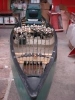
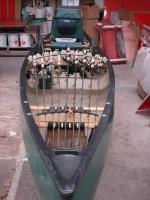
Nine, in my canoe. All arranged in a rack in front of me. In a pinch, I could work with ten. Nine in the rack, and one in my hand. With nine, there is always an empty slot when I am fishing.
-
Thank you. I shall do just that.
-
I have two, but, there is one annoying thing about them. It wasn't until I started jigging this spring that I realized it. They do not have the instant, or constant anti reverse found on most quality spinning reels. My Shimano Saros reels' spools/pickup will not reverse at all, whether I try with the handle or the pickup bail itself. The Johnny Morris reals will spin backward as much as an eighth of an inch, which becomes annoying when twitching a jig. Click, click, click, against the stop when twitching. Other than that, the drag system is fine, and the reel is smooth. I imagine using a topwater with a walking the dog technique would produce the same clicking when the pickup rotated against the anti reverse mechanism.
-
Sounds like you've experienced the same problem with the finesse stuff? I had another problem with finesse worms. Figured I'd be smart, and put an assortment of plastics into a zip lock bag, rather than toting 'em all. The finesse worms disintegrated, and the colors of the others bled into each other.
-
Yes, it does. I appreciate it. I've had years of dealing with electronics as a commercial lobsterman for nearly thirty years. Seen it all, from Loran A to Loran C to GPS. From flashing depth sounders to paper recorders to color machines. Sure made fishing much easier. The old guys used a sounding lead to determine depth and bottom. The lead had a hollow pocket at the bottom. It could be filled with wax, grease, soap or something similar. When it hit the bottom, it would pick up mud, sand, small gravel, shell fragments, etc. There is a section of the ocean floor south of Westport known as the "iron bottom". It's called that because the lead sounders would come up with a rust colored sediment stuck to whatever they used in the hollow pocket. Each technological advance made operating them easier to operate. Had 'em with all sorts of bells and whistles. Prefer to keep life simpler, and basic now. Thanks again.
-
Here's one for all the "little boat" guys out there. It ain't the boat that catches the fish, it's the man that's in the boat. Years ago, when I was commercial lobstering, I owned what was known as "a slab". A slab is jargon for an old beat up inexpensive boat, usually an old Novi. Slabs could be bought cheap, they leaked, and were generally on their last legs. But, with some elbow grease, and a few dollars, they could be made into a reliable vessel. One day, a good friend, and fellow lobsterman said to me, "You do all right in that old boat." I told him, "Milton, it's the fisherman in the boat that counts the most, not the boat the fisherman is in." Milton replied, "Ouch!" Keep in mind, there are some days you will not be able to get to places the "big rig" guys can because of weather. But, there are places you can reach in a puddle jumper, that the big rigs can never go.
-
This falls into the "live and learn" category. About fifty years ago, I bought a custom rod, from a local tackle shop in Fall River. The tackle shop was Buckos, and one of the brothers who is now in his 80s still goes to work every day. Good shop, prices as good as they get, good service and good advice. It was that way in the 1950s and 60s, and is so today. The rod was built on a Harnell blank by Charlie Murat. Charlie was a striper fisherman and rod builder of note in RI. His shop was just off 146 in the shadow of a drive-in theater. I believe it was in Smithfield or No. Smithfield. Harnell had the rep of being among the best rods in that era, among the locals I spoke with. Shortly after I bought it, the tip broke while fighting a fish, right at the tip eye. Brought it to Buckos, and no big deal, they replaced the tip with a better one. No charge. It broke again. Back to Buckos. Apparently there was a flaw in the blank. Send it to Harnell via Railway Express. Two or three weeks later, a new blank along with the hardware from the old rod was delivered to me. Off to Murat. Charlie was a man of impeccable reputation, but he wanted to examine the original blank. I understand his reasoning. Perhaps I had damaged the rod in some way, and that would void the warranty. So, back to Buckos, since they sold me the rod, and had seen it. A phone call from them to Murat (they sold a lot of his rods), resolved the problem, but necessitated another trip back to RI. They would have gotten it to Murat, but I wanted it back in operation ASAP. A couple of days later, and I picked up my new rod. It cost me nothing out of pocket for the rod, and gas was under twenty cents per gallon. The aggravation, and downtime was an entirely different matter. That experience soured me on buying anything from a third party supplier. Older, and hopefully wiser, Bucko should have taken the rod from me, returned it to Harnell, who then could have dealt with Murat. Ideally, Bucko would have had the same rod in stock. But alas they didn't. Fishing rods are like golf clubs. The pros, and very low handicap golfers "fine tune" their clubs to get the feel they want. Ninety-nine percent of golfers wouldn't be able to detect the difference, nor would those clubs shave a fraction of a stroke from their handicap. IMO, the same is true of rods. I probably spend more than my ability requires to catch fish. But, if I have a problem with a rod under warranty, I am able to get a replacement anytime the vendor is open for business, usually the same day.
-
I'm going to get a handheld GPS, and would greatly appreciate any and all advice. All I want to do is mark events/waypoints. The simpler the better. One pushbutton would be ideal. The pond I fish has several brushpiles, discarded Christmas trees. Someone has been kind enough to "plant" this cover in several places. I've "found" several" and have marked them using ranges on the shore. I have four that I can always find, though it may take a few minutes of paddling an area to find them. I always keep an eye on the fishfinder for interesting bottom, and have a fairly good idea of what constitutes productive bottom. Took a while to learn what to look for, but over two decades of commercial lobstering taught me to watch for subtle changes in the returning echoes recorded on the screen. Navigation is a zero factor, aside from being able to return to a precise spot on the pond. I'm looking at the Garmin eTrex H for around a hundred dollars. Reviews, suggestions?
-
All but a few of the fish I've caught have been on a jig. Strike King football or BooYah pigskin in the blue/black flash seem to work equally well. Using the larger *** Beaver Craw in the watermelonred color as a trailer. Been fishing the drop offs, and the outer edges of the shelf. In my case, the dropoff at the outer edge goes is a bank which drops from four to six feet in depth. Sloowwww, seems to be the rule with the jig. The trick is to stay in contact with the jig and the bottom, so you feel everything. But, you do not want excess tension in the line. I find it best to keep the line nearly straight without bending the rod tip (except when moving the jig). During pauses, a slight belly in the line will still allow you to feel the jig. Two "bumps" seems to be the norm for a hit, in my case. I then increase tension in the line. Any indication of life on the other end, set the hook. Also tried a shaky head jig and trick worm today for my first attempt at "finesse" fishing, and caught a couple. Had to switch to larger worms. The pan fish were driving me nuts. They'd pick it up by the tail and run off with it. They never managed to steal the bait, nor could I hook one of them. I suppose the solution is to allow them to peck away at the bait. Eventually something larger will come along to grab it. The bass have moved tight to the shore, in a foot or less of water in some places, and will attack anything that splashes down near them. I'm in southeastern Mass. Westport. From what others from this area have posted, that seems to be the norm. My guess is that this weekend should really see them moving into shallower water in greater numbers. Today, they were really splashing around in the shallows.
-
I have several packages of Strike King finesse worms, and they are a pain to use. The absolutely refuse to hook on any type of head holders, be they of the twist lock, ringed or barbed type. They even resist the Owner twist locks with the center locating pin. The spiral wire simply does not penetrate the material, and the same applies to the barbed or ridged keepers on jig heads. Heating a finish nail, then piercing the head works, but it still takes fighting with the worm to get it on. You must twist the worm, or it simply "rolls" onto the barbed shaft and then back off when released. Heating a twist lock with a cigarette lighter would work, but then needle nose pliers would be required to hold the twistlock. Is there a simpler solution?
-
Yes!
-
Catching them in deeper water, and right against the shore. They've moved in to the beach in some areas of the pond I fish, but not all. Mostly where it is a sandy sloping bottom. They are holding tight to the beach in a foot of water or less in some places. Where the shore is rocky and loaded with dormant vegetation, they still seem to be on the outer edge of the shelf where it transitions from 3 or 4 feet to six feet. Except for three nine foot holes, the pond is only six feet deep.
-
Thanks. I thought bass spawned around here sometime in May. Trying to get a handle on what is happening for future reference.
-
I saw no beds either, but there are very few places in this pond where the bass can make beds in the very shallow water (less than three feet). Most of the shore is solid cobble, rocks and boulders to a depth of about four feet. The areas that have sandy/gravel bottom in the shallows show no beds of any type. The one place I launch had a bunch of beds side by each, but they were filled with leaves. I assume they were from last years spawn of bluegills since they were quite small, about a foot in diameter. It used to be a smallmouth only bassin' pond until someone introduced largemouth into it sometime during the last forty years. Been that long since I started fishing again last year. According to accounts, it's been years since a smallmouth has been caught there.
-
Fishing has been slow the past two weeks. Yesterday it picked up. Rainy, breezy, foggy, almost sunny at times. Anchored at the usual haunts, and caught four to six bass at each w/o moving. The females no longer had bulging bellies, and their vents appeared irritated (reddish tint). Today, the bass were on the beach in some areas. Caught a few, then tried a topwater (rage tail shad) with not a look. As the canoe glided close to shore, several swirls indicated startled bass tight to the beach. I let the boat glide closer and saw several hightail it for deeper water. I backed off and cast an *** Beaver Craw, watermelon red, and the bass and pickerel attacked it. Water temps 56 - 58. This will be my first full year fishing freshwater in nearly 40 years. Took up the pasttime again last July. Seems to me the spawn is on, or has already occured. Would appreciate your assessment.
-
When someone fishes with me, they are free to use all of my gear, including baits. If they want to bring their own, that's fine too. My feeling is that the "host'' should always treat his company as guests, going out of his way to accomodate them. Otherwise, why invite them?
-
I really like the bucket bushes. Grease up the inside of the bucket, arrange your tubes, and when the concrete hardens, pop it out. Two things come to mind. Unless I'm mistaken the pvc tubing (usually used between the pump and the connector on well casings) is cheaper per foot than the straight piping. If so, I'd use the coil tubing. They are also curved, and in combination with the straight tubes, you could really make a fairly dense cover. The second thing is that it seems if the surface of the pipe was roughed up with a sanding disc and coarse sandpaper, the result would provide for an even denser algae growth. For sure, for sure, I'm going to make a half dozen or so of them. I have the perfect place in mind to "plant" them.
-
Kudos to all responsible. To those who run it, and to the sponsors who make it possible.
-
Mine can do either on a timer. Mostl I fill my livewell and then put it on auto recirculate, then after a few hours I will change out the water. Thanks.
-
I'd rather be proficient with several types of baits and techniques. Putting aside the "fun" thing, the object in fishing is to catch fish, as many and as big as possible. Some days topwaters do the trick, other days it may be jigs, swimbaits, spinnerbaits, etc. Other days they'll hit anything or nothing at all. To improve at anything necessitates doing it differently, and becoming more adaptable to changing conditions. Until this year, I'd never caught a bass on a jig. Never really gave them a fair chance. While I've got a lot to learn about them, I have a measure of confidence in my ability to use them. There's always something better. Gotta keep looking for it.
-
A question regarding live wells. Do they constantly circulate the water, or are they simply filled, then aerated?
-
I had not caught my first bass on a jig either, until I made a concerted effort with them this year. Now, I feel like the kid in a candy store. I started with jigs in the middle of March. On the first day, I caught one bass on a spinnerbait, and one on a chatterfrog. They were my favorite baits last year. Then, I started working with a jig, and I caught nine more, just fumbling my way around with a jig. I've made a couple of half-hearted fruitless attempts with the spinnerbait, and a swimbait. After a few casts, they went back on their slot on the pole rack in my canoe. Back to the spinnerbait. I can only imagine how effective they are in the hands of someone who really knows how to use 'em. I cannot say this is the best way to fish them, but it's what is working the best for me. Try working them parallel to the shoreline, in various depths, and preferably rocky bottoms. Most of the bass I'm getting come from 4 - 6 feet of water. The pond has a shelf around most of its perimeter. The shelf varies in width, but at some point it drops quickly from three or four feet to six feet deep. I'm fishing the slope. At six feet, the bottom levels off, then gradually drops to seven feet in the middle of the pond. When I get away from the bank, I get nothing. When you're alone on the pond, get some marker floats, and use them to mark the drop off, preferably in the water just away from the bank. Place them at intervals so you can see them. Then you can work the bank from that reference. A few minutes setting your markers will save you many times over from making casts outside of the area that is holding the fish.
-
Line twist. The bane of spinning reels. No matter which way the side of the spool faces, even if it comes off the spool so that it is wound around the reel spool the same way, the reel spool is much smaller than the spool of line. It can take two or three turns on the reel to remove one from the spool. There is an ancient, tried and true method to get the line twist off the reel. Stream the line off the reel behind the boat (slowly). Then reel the line in. The line will then be free to rotate in the water, eliminating the inherent twist producing nature of a spinning reel.
-
When I'm rigging at home, I use the Fish N Fool knot. On the water, the Palomar, it's quicker and easier for my fumble fingers to tie. I make a plenty big loop when a jig needs to be retied. Otherwise, the strands of the skirt seem to come alive and dart into the loop.
-
Every technique has its vagaries, which at times contradict the "rule of thumb" for others. I never gave jigs much of a shot in the past, and set as one of my goals for this year to catch bass on jigs. One goal met. It certainly demands concentration. Is that weight on the line a stone, log, bottom muck, or a fish? Each seems to have its characteristic feel, and in my short experience, it seems at times, that a bass can mimic any of them. At times, a bass strike will be obvious. At others, impossible (for me) to distinguish. I've adopted the, gradually increase the tension in the line. At the slightest sign that something living is on the other end, set the hook. It's like solving a puzzle. Challenging, and rewarding, plus it heightens the senses, keeping one alert.