phatfish
Members
-
Joined
-
Last visited
-
thank you for the comments regarding attaching the transducer onto the motor body, but I was more interested in the wiring that leads to the transducer. I am trying to figure out a way to have a quick disconnect for the wire to the transducer, so that when I take the trolling motor off the boat, I don't have to dismantle the wiring from the boat and to the battery.
-
Sorry for any confusion. The trolling motor is mounted to the bow of the boat. I am trying to figure out a way to have a way to quickly disconnect the transducer when I am storing away the trolling motor.
-
Hello all, I am working on my own jon boat conversion project (hope to post pics in the near future), and I was wondering how some of you all mounted and wired your fishfinder's transducer on to the trolling motor. I have a tiller electric trolling motor that I can take off when I am trailering the boat or if the boat is stored outside (so no one can swipes it). I want to mount the transducer on the trolling motor, but what do I do with the transducer wire? It comes with 10 feet of wire, and I know you should not splice it, or it will disrupt the calibration of the fishfinder. I do not want to have to take all the wiring out (leading to the battery and to the transducer) every time I want to take the trolling motor off. Is there a way to have another receptacle (next to the power receptacle for the trolling motor) I can plug my transducer into? Any help would be appreciated. Thanks
-
Hello all, I need your expertise. I have been fishing this local lake of mine and been looking to find myself some nice size smallies (>14 inches). I would troll along the bank looking for fish. When I come to a spot where I am catching fish they are usually smaller fish, about 10 inches. If I stay on a spot, I can get about 5-6 fish in 15 minutes, but they are all about the same size (10 inches). My question is; is it worth it to stay on a spot producing small fish and trying to weed my way through the smaller fish in hopes that a larger fish might be there, or is it better to just move on, because most likely the spot is saturated by smaller fish? Or can the larger fish be found close by? Or do I have to change my presentation (lure, color, etc) to entice the larger fish out?
-
Like the subject line says, I just want to know what is the best way to organize 10-20 packets of plastic worms.
-
I am just curious to see how every keeps there bass baits. Are you old school and have all your tackle packed into a tri-level flip-one hard plastic tackle box? Or do you have everything organized in plastic bags and organizers in a over the shoulder tackle bag? Also how does everyone organize their baits? Or are there an tips to share on how to keep your gear organize. It will be interesting to hear what everone has to say.
-
oops... i mean craigslist.com... with an s
-
check craiglist.com
-
I have a quick question for everyone. I am retrofitting this old 14ft alum. semi- v jon boat. I want to put a motor on it, but I don't know what size to go for. It is rated to 25 HP, but those are hard to find and are far more expensive. Since I am adding a deck, so the boat will be heavyier then usual, and I want something that will get me from point A to point B in a reasonable amount of time. Any advice will do. Thanks
-
This, like most things that deals with pain and suffering, is a highly debatable topic. Do fish feel pain? Well. Raul is right Fish are highly evolved vertebrate animal, with a highly complex and organized brain that allows a fish to responds or react, the way it does, to some kind of stimulus (ie. a hook set). What a lot of people might not realize is that pain, rather then a response or reaction to something, is something that is perceived. Pain is an interpretation the brain makes from negative information that is sent to it. So, in humans, if a person was to hook themselves, that information is sent to the spinal cord first, where an initial reaction is generated. At the same time, this information travels up to the thalamus and then sent to primary sensory cortex (the wrinkly outer portion of the brain). This is where the current debate occurs. The reason why humans are what they are is because we have the most primary cortex then any other animal. This is where the brain perceives things (ie sight, hearing, taste, and touch) and the complexity of the primary cortex is what is required to perceive things. Fish, on the other hand, have no primary cortex present in their brain (if you were to look at a fish's brain, it would be smoothed and lack the wrinkles). Because of this, one might conclude that fish do not perceive pain like humans and are simply reacting to a stimulus (depending only on the spinal cord). So the current university studies support the above conclusion, but there is a missing portion to this conclusion. Like I said earlier, the primary cortex is the location in the brain where senses are perceived, so this includes sight, hearing (vibration) and taste. As we all know, being fisherman who take advantage of these perceptions to entice a fish to bite, fish have the ability to interpret a lure as potential food. How can this be, if what is known (that the primary cortex is the location for perception and that fish lack this), that allows a fish to interpret a lure as a tasty treat. As for fish, lacking the pain receptors around the mouth, it is known that there is what we call nociceptors (pain receptors) around the mouth of a fish. They differ greatly with forms found in humans, and are able to tolerate a greater amount of pain, due to the nature of the tissue. But if you think about it, a fish's mouth act like its hands as well, where it can feel things out. In the humans, the palms of our hands have fewer pain receptors, (that is why we squirt hot milk on the back of our hands when testing how hot it is) so that we are able to tolerate some things without it hurting us. It wouldn't make too much sense for an animal to put lot pain receptors in an area that is uses to explore objects, such as spiny crawdad shells, or the spiny dorsal fin of a sunfish. A lot of the present studies that state that fish do feel pain from penetrating hooks are primarily based on behavior of the fish, (ie, what the fish does after being released from a hook). These are based on comparing the behavior to what we as humans considered negative, such as the lack of feeding after, the attempt to dislodge an embedded hook, and the rapid darting movement to name a few. The only problem is that we are comparing behaviors of two animals with totally different makeup of the brain. It is like comparing apple and oranges because they both fall from a tree. There is no way of truly understanding what is happening in a fish's brain with out simply asking it. For me, when a fish is hooked, the stress it feels from being dragged through the water overcomes any kind of discomfort it feels from the hook. It is like asking someone who is being dragged behind a car whether the rope around their legs burns. So as fisherman, I think it is more important when fishing to reduce the total stress on the animal by following the proper Catch and Release procedures. Well that is my ten cents okay.. okay.. more like 10 bucks.
-
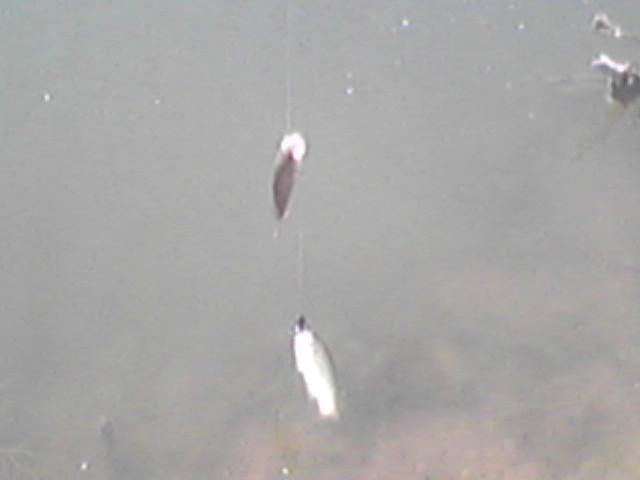
Fishinaz, I know how you feel. I too never knew what a bite of a jog felt like. And yesturday I tried the jig/dropshot combo and what happens... I get a double header. So technically I still don't know how it feels to get a bite off a jig. Here is a lousy pic, but it is from a camera phone so what else can you expect. The two little dinky thinks on the line are little ~ 1-2 lb bass.
-
I was fishing with a younger cousin, and he really wanted to use marshmellows to catch a fish. Not to argue with a 7 year old with his mind set on something, I put a small piece of marshmellow two feet under a bobber, thinking at least he would have some fun with little sunfish. Well after fishing for 15 minutes, low and behold, he hooks himself a 2 pound bass. Which at the time felt like a marlin on a two foot donald duck pole, and at the time scared the living bejeebers out of my cousin. Let just say it was a funny sight. I coached him through it and he caught his first fish.... and if anyone wants to know... NO... I did not fish the rest of day with marshmellows... I have some pride...
-
I have had the same thing happen to me. Cast a Worm out and then have it come back half gone. Thinking it was a nice bass, I put a new worm on and cast it right back to the same spot and came up with a nice size snapping turtle. Thank god I had my pliers with me. Lets just say the turtle wasn't too happy after being caught, it was a mess trying to release him. Teach him a lesson for stealing my bait....
-
I don't know if this is common or not, but I have been fishing this little pond near my house and I have been having a productive (quantity-wise) using the same presentation. I have been drop-shotting a 6 inch dk purple worm from shore and I have been catching a lot of little basses. All the fish I have been catching are almost exactly the same size. I can see a good number of larger fish in the water, but it seems that all I can catch are the little ones. So my question is, can a presententation, even though a successful one, be limited and target a particular size of fish? Are there any changes I can do to this presentation to catch larger fish? Or is it simply the fact that it is early summer and the most active fish are the smaller ones? Any comment would be much appreciated.
-
Thanks Flatfish for the info...