MickD
Super User
-
Joined
-
Last visited
Everything posted by MickD
-
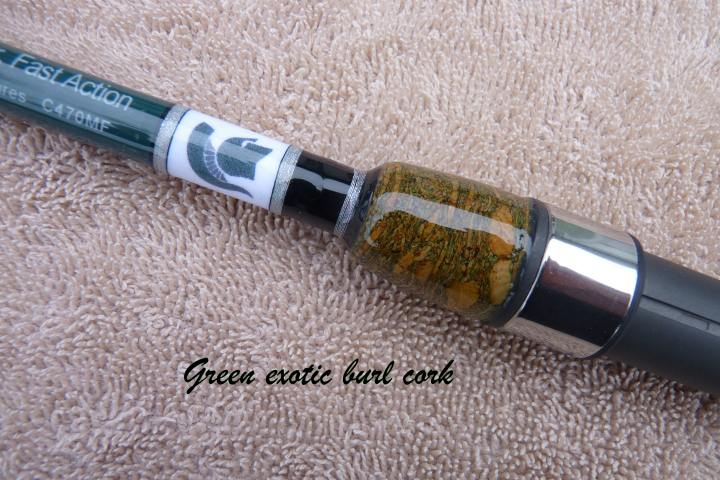
It is probably much longer than 7 feet, right? They are used, as I understand it, to fish hot n tots and similar lures behind river boats for steelhead. The tip is very light compared with the power of the rod allowing the lures to dance freely and their action is easily seen on the blanks. The light tip explains why the tip goes vertical before being loaded enough to get to 30% deflection (RDA/CCS tests). Because of their powerful mid/butt they can handle powerful fish. I am building mine into a casting rod (with components from Anglers Resource under their latest promotion) to use at first for blade baits (smallies in the spring and fall), then will see where it goes from there. I think it will also make a great drop shot rod. It is obviously going to be the fastest action I've ever seen.
-
By the way, the other two Point Blanks I have made were PB 6' 9" medium power, XF action, built into casting rods for my son. He loves them, and casts a very wide range of lure weights with them. Here are the PB data: PB691MXF Length: 6 ft 9 inches Action Angle: XF •67-degrees (RDA) • 76-degrees (CCS) Power: Med / 440gr (RDA) • ERN 20.7 (CCS) Weight: 1.76oz. Butt Dia: 14.06 mm Tip Size: 1.81mm (5.0) Lure Wt: 1/8 to 5/8oz Sugg Line Wt: 8-14 mono 10-15lb braid Notice that the 76 degree AA is 6 degrees lower than the 7' 3" discussed above. These rods did not go vertical when deflected to 33%, so have a more "traditional" action. My son uses them for all kinds of lures, from light blades to pretty heavy spinnerbaits and cranks. He uses FC line. ONe thing I forgot to mention, the finish on the Point Blanks can be "smoothed out" by the rubber wheels on wrapping machines. The finish is described as "cat's tongue," and feels a lot like that. Keep the force on the wheels to a minimum, or tape the blanks where the wheels will contact, especially when drying epoxy (long exposure time to the wheels.) If it gets "smoothed" you can blend the appearance back to normal with a grey Scotchbrite pad, but better not to have to try that.
-
Length: 7 ftAction Angle: F • 65-degrees (RDA) • 78-degrees (CCS)Power: Med / 460gr (RDA) • ERN 23.1 (CCS)Weight: 1.94oz.Butt Dia: 14.31 mmTip Size: 1.73mm (5.0)Lure Wt: 1/8 to 1/2ozSugg Line Wt: 8-14 mono10-15lb braid Data from the PointBlank.com site, only shows on the individual listings for the blanks. Nice work Angry John for finding this. If you have the conversion chart for ERN (Effective Rod Number) to CCS grams you can have the CCS power number. The RDA numbers are grams to deflect the blank to 30% from horizontal instead of the CCS 33%. Same process, different deflection. since the deflection is less, the Action Angle will be less. Based on my experience with Point Blanks the AA will be about 78 when deflected to 33%. (Just noticed, the data above say 78 for CCS) About the same as a St Croix Legend 70MF. I thought I had a good conversion for RDA to CCS power numbers, but not so sure now. I think this blank may be a little under the power of a St Croix 70MF or just about the same. I just noticed something on the catalog RDA data for the PB731MXF, 7 foot 3, medium power, extra fast action. It is their only blank that they rate differently on their power data from their normal RDA process. They give the grams to deflect the blank to tip angle 90 degrees, or vertical. What this means is that the blank is so fast, with such a soft tip compared to the rest of the blank, that the tip goes vertical before the deflection reaches 30%. It was the ONLY blank on their catalog listing that was evaluated that way. This is not mentioned in the on-line data. They call the AA 67 RDA and 82 CCS. This is the blank I tested today and I was amazed how differently it reacted relative to any other blank I have ever tested. I got an action angle of basically 90 degrees since I deflected it to 33%. A St Croix Legend 70MF has an AA of about 78 degrees. I was surprised at the CCS power number I got, way above what I expected for a "medium power" blank (775 grams). What this all means to fishing is that this blank will cast light lures because of its light tip and long length, but it loads very quickly with added force so that it will also cast quite heavy lures well. It will handle very powerful fish well because its mid-section and butt are so powerful. Very interesting indeed. This is an entirely new animal to me. This is a VERY powerful rod with light tip. I believe one might call it a 7 ' 3" "hotshot rod." S Hovanec, if you want to try a Point Blank, try this one. I'll bet it will be different from any other rod you have.
-
Can you post the exact site address for this? I just went to PointBlank.com and there are no power numbers there. You may have found the old site that had the numbers, since replaced by a new site without.
-
What is the model number?
-
I am interested in your response to the Quickline when you get it built. I've done fly blanks, like them, but no other Quicklines. You are right about the Anglers Resource power/action numbers. I'll have to look at my old catalog but I don't think they gave an action angle, right? But they did their power measurement at 30 % instead of 33 % of blank length. Their XF actions are in the range of 78 degrees AA, if I remember right. I came up with a conversion to get their power number to correlate with CCS. One catalog had actual CCS numbers, then they took them out. If you need their numbers, or a conversion for their numbers to CCS, e-mail me and I'll hunt them up. I suggest you do build one. You are a respected builder, and I, for one, would like to hear your evaluation of one. AND, no one can have too many rods.
-
I have built two into casting rods for my son, and have one in now that I have not yet started. In my opinion, their power is stated correctly, and they are very sensitive blanks that build into very light rods for the power rating. If you can find a past Anglers Resource catalog, they had objective power ratings listed. I believe that builders gave them so much crap about not agreeing with their ratings that they stopped listing the objective numbers. Their numbers and mine agree quite closely. Builders whine about not being able to get objective numbers, and when a blank maker provides them, the builders give the maker so much crap that the builder withdraws them. In my opinion, Point Blanks are in the same class as other top of the line blank/rod makers, like Rainshadow Eternity.
-
If you shop Ebay and buy only from sellers who have high volume, reasonable return policies, and over 99% approval rating you will not get scammed with bad used products. Read the descriptions carefully.
-
Keep in mind this chart is only bass boats. Would be interesting to see total "fishing" boat sales, with all the Lunds, Crestliners, Monarks, BPS, and others.
-
When you don't use color preservative on regular nylon wrapping thread it becomes more transparent, not more opaque. Especially light colored threads. Even with color preservative on regular nylon, the guide feet will often show through a little.
-
Of course. And as long as you keep your music to yourself, no problem. If you "share" with those who don't enjoy your music, then it's a problem. This doesn't seem to be all that complicated. None of us owns the lake. It's simply about courtesy.
-
I've noticed little cracks on the other side at the base of the frame, but haven't noticed them going around the frame. Mine have never caused a problem, and structurally, they won't fail. However, if you notice the wraps getting "foggy" looking, or cloudy after fishing in the rain, that would indicate water getting in. If that happens put a small drop of epoxy on the crack to seal it. I would do nothing unless you see the cloudy wrap.
-
I have heard of your complaint before, and in spite of my son and I having probably over 2 dozen spinning rods that I have made for us, we have not encountered the problem. I tighten the nuts very tightly, and that's it. Not sure why you are having the problem. I would not use any glue or locking liquid on the nut threads. There is so much area there that you may not be able to loosen them, and some rods have plastic nuts, so they are not as strong as metal reinforced ones. In the custom building "racket," we can get the Fuji locking nut for all (I think all) of their seats, (also work on some other brands of seats) so if you do in fact change some seats, I suggest you get that inexpensive but effective nut installed, too. If I were encountering the problem I would do a wrap around the reel foot with a few inches of Winn's grip wrap. Looks good, is tacky and soft feeling, and I believe it would work. Tighten the nut very tightly, then apply the wrap. You could do a number of rods with one $10 roll of grip wrap, and if it worked, would be MUCH less expensive than changing seats/grips. If you cannot find it near you and don't want to order on-line, go to a tennis shop and buy a grip wrap there. Similar, probably not quite as good, but might work.
-
What are you using the tape for? Curious, don't understand tape relative to this string.
-
If you want to spend some time practicing and perfecting, try the FG knot, videos all over YouTube, search for "how to tie the FG knot." It's the slimmest knot, and if done right, the strongest. But a lot of people have trouble with it. My suggestions to help are to use about 20 weaves, (if yours slips, next time make more weaves until it doesn't slip) make sure to pull it REALLY tight as you are setting the knot, make sure it's wet when you do, and put a drop of super glue on the half hitches (only the half hitches) when you're through. This knot will last a long time since it doesn't get beaten up by the guides. I find that the knot generally lasts until I have to tie on a new leader because repeated lure changes have shortened the leader too much.
-
While I agree it's probably not worth it, it is possible to remove a seat and replace it from the rear. The seat can be carefully cut with a Dremel type saw, longitudinally, a few times, then torn off. The grip or grips can be taken off by carefully cutting the cork/EVA off, cleaning it up. Finally, when all is prepared, use wraps of masking tape to provide the base for a new seat and grip, essentially removing the taper from the blank. Lots of work for little return, in my opinion. All my spin builds are done with up-locking seats. They put the fingers on a smooth surface rather than threads and allow me to put a ramp on the front, which is just about like having direct contact between the fingers and the blank.
-
Sounds like a business opportunity to me.
-
A local lake has a wakeboarding concession, and it appears that no one can wakeboard without loud rock music. I have to admit, it really ticks me off to have to listen to it. It could be any kind of music, but I would still resent the intrusion that it is on my enjoyment of the lake. We fishermen don't have to contribute to this. If you can't fish without music, please keep the volume down.
-
If you are not already using braid, try it. It will transmit vibration a lot better than mono or FC.
-
Best stereo for everyone else on the lake is none.
-
Regarding hardness. How hard is hard enough for max casting distance? The rings are not deforming, not being dented, not even wearing. The loading from the line is about zero when casting. If you can find a coefficient of friction difference, then maybe there is a difference in performance. But I think it will be insignificant compared to the other factors I mentioned. On most of the guides I inspect, they are coated in crud from the water and clean only where the line hits on the cast. So the line is also a crud cleaner. What won't the Torzite do? Torzites will do everything other guides will do. And if they are lighter, then the rod will be more sensitive. But I didn't get that sensitivity was an issue. If lighter, the rod will recover a little faster, and that's good. But lighter than what, and by how much? Check the guide weights between different identical geometries and the lightest will be the best. Enough to justify the cost? A torzite 20 mm KLH costs $41.00. One guide. I haven't priced the set for your rod, but likely about $200. If you are willing to pay whatever it costs to possibly get the absolutely longest cast, even if it only exceeds the options by a couple yards, then torzite is the answer. But you can do much better by simply going down to 20#. Keep in mind that wonderful striper you fear may not even be reachable with any 30# rig. And if you hook it on 20, you will have significantly more line on the reel. And if it gets close to spooling you, chase it. While you are setting up for a very low possibility, you are giving up the more likely chances at fish outside your 30# casting range. But yes, regardless of line, torzites are the best. But no
-
I just thought of another issue in maximizing casting distance. Are the ergonomics of the rod correct for max distance casting? You may want to cobble on an extension of the butt of a few inches and try it. Or maybe some other modification can help. Something to think about.
-
Agree with DVT. Guides can make a difference in distance, but it is not in the hardness of the rings or the cost of the guides. It's in the design of the guide set with respect to height, ring size, and progression. DVT is right on his recommendation of Fuji KLH guide train; I don't think Microwaves offer the same value or versatility. Or performance. I recommend using a three guide reduction train starting with KLH 20, then a KLH 10, then KLM 5.5, then 5.5 KB's to the end, number and spacing determined by a stress test. Look at the new Fuji Fazlites, much better corrosion resistance than past stainless, and moderate cost. Look at the Anglers Resource catalog for details on the guides and the guide train design. Torzites may offer an advantage for sensitivity, but that is not your priority. And any advantage they have come at an almost astronomical cost. Those who have commented on the advantage of lighter braid pound test are right on. That is probably the easiest, cheapest, most effective way to increase distance you will ever find. Two things to consider. Can you live with the lighter braids? The best guide train will have about 5 mm running guides, can you tie a knot that will go through those guides? An FG will, but if you don't already know how to tie it right, it will take some significant practice to master it. I truly believe your solution lies in the text above.
-
I agee, if it's still under warranty, return it. But, interesting to me is that if the sound were generated from within, where the grease is, I would expect it to not be described as a rubbing sound. A drop of oil right at the rotor/shaft interface might tell you if that is the area that is suspect. But, returning it before anyone really tampers with it is the right solution.
-
A ten pound fish can generate more than his weight in line tension. That doesn't mean that he cannot be landed on ten pound test line, but for a short distance, and with a little slack line to provide shock when it tightens, no problem to generate more tension than his weight. I've had king salmon, most likely less than 20 pound fish (since I never caught one bigger than 20, I expect the ones I've lost are less than 20, too) fail split rings with advertised strength higher than 30. With respect to braid line test, my casting trials have proven to me that 30 pound sacrifices casting distance with a stradic 400 and choker rings of 20mm. I use 10-15 almost exclusively, and think 20, with reasonable casting distance sacrifice, is as high as anyone needs for almost any fresh water bass fishing.