grub_man
Members
-
Joined
-
Last visited
Everything posted by grub_man
-
Hmm, strange, well glad it worked out in the end!
-
Did you try running the transducer wire outside of the Terrova coil? That may have been the simplest solution. The coiled wire makes a solenoid/electromagnet. Since the Terrova has the power management feature, it saves battery by switching on and off rapidly. Every time it switches the magnetic field changes, inducing a current in any wire inside the coil, causing interference in current sensitive electronics. Making the mistake of spiraling a transducer wire down the shaft of a TM has a similar effect as well. In any case, glad you found a work around! riverbasser, if the crazy depth readings are tied to running the TM, it is likely interference. If they are not, it may be sign of a poor connection between the transducer cable and your unit. make sure they are snug, or it may be a damaged transducer cable, most likely near the stress relief on the cable near the head unit or near the transducer itself. The last time I had a transducer fail, it would give funny readings, drop connection, or weak signals. It was damaged at the stress relief at the transducer. I diagnosed it by wiggling the wire around the stress relief points after checking its length for damage. Good Luck!
-
The proper way to fix it is to find a fiberglass section that fits snugly on the inside of the break and one that fits snugly on the outside of the break. Since you don't have the scrap pieces laying around you will have to come up with something. One option is to take some good measurements of the ID and OD of each side of the break as well as the wall thickness, and the OD on each side a couple inches on either side of the break. You can then extrapolate to see what the OD needs to be at each end of the inner sleeve and have good measurements for the ID of the outer sleeve. You can then go and look for some cheap fiberglass rods at a second hand store or garage sale to source parts for the repair. St. Croix sells blanks as well as finished rods. I've never tried, but you could call and let them know that your rod failed and tell them that you are interested in starting to build and see if they could cut you a deal on a similar blank. If they go for it, you could end up with a very nice blank at a fair price. After all the current MSRP on a 3S70MHF spinning blank is around $110. As far as salvaging components, guides are easily salvaged. Reel seats not so much. If they are properly epoxied into place, they are a bear to remove. If you cut them out, the time spend drilling, reaming, and cleaning them up is usually worth way more than the cost of a new seat. Unless it's a very pricy are particularly well loved reel seat, then it may not be worth salvaging. You can always cut the rod just in front of the fore grip/reel seat and epoxy in the business end of a fly swatter. Those always get a few good laughs from time to time. Rod building is not particularly difficult, especially starting off on a clean blank with fresh components. Repair work is more challenging because each situation is unique and may require some out of the box thinking to get some things done. Personally I think it's easier to learn starting from scratch than it is by repair work, short of maybe stripping and rewrapping some guides.
-
Experiences like that give you an idea of how much the drag of the line moving through the air affects casting distance. After losing a lot of energy in stretching the line until it fails, the lure keeps on going and flies much further than a normal cast. Braid will fail just like any other type of line when the fibers are damaged or pinched down like Scott F mentioned. I've had monos and braids alike fail mid cast, on hook sets, pulling snags with a steady pull. It's all part of fishing. The vast majority of line failures can be avoided by keeping line fresh, retying as needed, not using the reel to pull snags, and making sure backlashes are properly picked out, especially with braid.
-
1. On my home lakes, not that crucial. On a new or big body of water, much more crucial. I use them to see at what depth most fish/bait are suspended to get an idea of where to start looking for fish. I use them to keep myself in the proper depth zone. If I venture offshore a bit, then they become very important in helping me stay on a structure or spot on that structure. 2. I'm far from a superior fisherman. When I upgraded to a small screen unit with the bells and whistles of GPS, Navionics Maps, and SI, I had an eye opening experience. It's incredible how much is down there and easily missed. Using the GPS and maps have proven instrumental in improving my confidence as I venture offshore. Spending a year on Lake Norman taught me the importance of finding the spot on a spot. There are some pretty big structures on that lake and the fish tended to group up around shell beds, rock piles, brush, etc. If you didn't have a good way of finding those spots a lot of time could be wasted thinking there were no fish in the area. 3. My ability to aid in eliminating unproductive water and start honing in on finding fish improved a bit with the addition of electronics. The challenge still is pulling myself away from places I've caught a few in the past and trying new areas. If you learn how to use them for the tool that they are, then electronics will definitely help. 4. Time on the water and learning something every time out is still key. Buck Perry, the father of structure fishing located offshore structure, the spots on the spot, and how to catch them without electronics. It's a tougher challenge and time consuming to say the least, but it can be done. 5. My home lakes are in the 1000-3000 acre range, and you would be surprised at how much is out there.
-
Yep, as DVT mentioned, at least one well known rod blank vendor ships in triangle boxes. Some of the ones I've received over the years have been beat up pretty badly. But, as long as the blank/rod is in good shape and handles a couple deep flexes, it is just fine. Don't lose any sweat over it. Regardless of how nice your favorite tackle shop is, the rods arrive there the same way they arrive to you. If it's a big box store, they arrive just chucked in the back of a 53' trailer with reckless abandon. I spend a period of time working at a big box store unloading trucks when I needed to make a few dollars in between jobs. It's amazing how much abuse the packaging can take and leave the rod/blank intact. If you saw how TV's arrived, you would cringe.
-
trwoh, What part of OH are you in? Welcome to the fun world of fishing and casting reels! There is no need to break the bank on a casting reel to start out. As mentioned something like the Abu Garcia Black Max can be very good starting point. They are much nicer than they were 20 years ago or so when I started into casting reels. $100 or so can get you a solid reel that will last you for years with a little maintenance. This spring I picked up a Revo X to be paired with a rod I built on a 7' 1/4-3/4oz. MH power Fast action rod. The Revo X fits the bill nicely for what I was looking for. On my lakes over in the eastern part of OH, this (7' 1/4-3/4oz.) is about as powerful of a rod as I need for most applications. This type of rod is a general purpose bass rod designed to throw single hook lures (spinnerbaits, buzzbaits, weedless bass jigs, Texas rigged worms) with about 3/16-1/2oz. of lead. It is a very versatile type of rod, and pretty much every company makes one. Fishing on foot means that you may be a bit more rough on your gear than fishing out of a boat (though gear can be abused in any setting). If you want something slightly more durable, look at standard modulus rods (typically ~$100 give or take). The rod will be sensitive enough to work with the lure weights mentioned above in most situations. If you want to stretch your budget a bit look for a mid-modulus rod (typically ~$150 give or take). These rods a bit lighter and a bit more sensitive. In my opinion the mid modulus stuff is the sweet spot in rod blanks, where you get a light sensitive blank that won't break the bank. Ignore the high end stuff for now. I use high modulus rods with 1/8 oz. or less of lead when it is tougher to feel what is going on down below. You made mention of MM rods. The MM is short hand for Medium Power Moderate Action. These rods are designed so that the start to flex deeper into the rod blank and are designed for treble hook lures. As you start to flex the tip of a rod a fast action rod will generally start deflecting somewhere in the upper 1/3 of rod. A moderate action will start to flex in the upper 1/2 of the rod. A Slow action will start flexing all of the way back at the handle. All rods can be force to flex all of the way to the handle, action just refers to where they start to flex under light loads and gives the angler a bit of info about what to expect in how the rod will perform in certain tasks. The moderate action rod reacts and responds a bit slower which makes it tougher for a fish to throw slack into the line which can help them mover the lure around to dislodge the treble hooks. Starting out, you can get by fishing your treble hook lures on your spinning rod and try not to horse the fish in. As you start building up your rod collection and maybe spend more time in a boat, then it will be time to look at a dedicated treble hook rod. My preference is fiberglass in the right action and power here, a MH power Moderate to Moderate Fast action.
-
The way I read it, the reel seat is designed so that the reel sits closer to the tip and further away from the trigger than most other designs. I too would like to see a pic or two, or at least the rod model to look into to wrap my head around it. If this is the case, you may be able to remove a bit of material from the front of the reel foot pocket and possibly use a dremel to remove some material at the back of the pocket to get the reel foot in deeper. However, if you take too much, you are back to cutting off the seat and replacing it.
-
Now on to the next bit about sensitivity. A rod blank is most sensitive in its raw form, i.e. before reel seats, grips, guides, etc., because inertia is the enemy of sensitivity. The more mass that gets added to the blank and how it is distributed will affect the sensitivity. This is why the trend toward split grips, no fore grips and micro guides has happened. These things will reduce the mass of the rod and more importantly its moment of inertia, effectively limiting the loss in sensitivity. As far as spinning vs casting being more sensitive, rods on identical blanks with identical handles and equal weights, the casting rod should be ever so slightly more sensitive due to the fact that it has a lighter guide train with less mass toward the tip. The problem is that casting and spinning rods are not made of identical parts. Casting rods typically use a more massive reel seat. Spinning rods have more massive guide trains. I will say that spinning rods that ditch the reel seat all together are significantly more sensitive than those with a traditional pipe style reel seat. Ditching the reel seat can save an ounce or more in total build weight depending on the design of the TN handle. When it comes to objectively measuring sensitivity, I've exchanged messages at length with a guy who was a retired instrumentation engineer and used strain gauges to measure 'sensitivity'. The problem is that is tough to quantify, and the measurements are sensitive to how you set up your measurements and a number of other things. That said, I've heard through a third party that one of the major players in rod blanks has been consulting with a seismologist and possibly others on performing sensitivity measurements. Whether any of that info will make it into the public domain, only time will tell.
-
Stephen B, The type of sensitivity that we are all talking about I like to call 'feel-the-bite' sensitivity. It is essentially how well a rod transfers signals in the line to the rod. The signals that we are feeling for are changes in tension of the line. If you have hands large enough to palm your reels and keep direct contact with the line, then more power to you. I have small hands, so that doesn't work well for me. In order to get the changes in tension to the rod, you want your line to be at a 90˚ angle to the rod tip. This will be the angle that results in the most movement of the rod tip for the force applied. This is why we fish 'feel' baits with the rod held around the 2 o'clock position. When you feel things in your rod, you are feeling impulses (small changes in the motion of the rod tip). As your lure is moving, changes in its motion result in changes in the tension of the line. The line will then pul the tip down ever so slightly and then the rod reacts and tries to rebound. It is these small changes that you feel. As mentioned, the stiffness to weight ratio is the property most closely related to the sensitivity of a rod. Over the years rods have been made from different types of wood, metal, fiberglass, and carbon fiber. Each of these materials has different elastic properties, i.e. different stiffness to weigh ratios. You can build rods with identical powers and actions with any of these materials. The most sensitive ones will be the lightest. The NRX is more sensitive than the E6X because the material in the NRX is higher modulus meaning that the fibers are stiffer and lighter than those used in the E6X material (or a lower density resin is used). I know this is an abbreviated explanation, but I hope it helps. If you have more questions, I'll be glad to help clarify some things or go into more detail.
-
Take it back, and NEVER leave the store with a reel that you haven't taken out of the box and looked over yourself. Minor issues happen with reels, but you shouldn't have one that feels lesser than the display model that you handled. Shimano's reel oil is quite good, and I wouldn't worry about using it on a couple of minor things like you did.
-
Like the others, hang tight and keep an eye out for a deal. A little over a year ago I picked up a Humminbird 698ci si with a Navionics card for about $350 when they were closing that unit out. It lacks the ability that the new Helix units have to make and draw maps in real time, but I'm quite happy with it for the money, and I could reuse the base from my old 405sx. After moving the pins around in the 405sx, I use both in the boat with the 698 where I need it most. For example, if I'm just running a bank and keeping the boat in the same depth, then I run the 405sx up front. If I want to stay on a spot, then I'll run the 698 up front where I can keep an eye on the map. Eventually I'll pick up another head unit and run both, but until then the system works. Side imaging is really incredible at helping find rock piles, channels, drop offs, isolated brush and lay downs, etc. off shore in new water more quickly. It's really helpful, but most useful under the power of the big motor. You can use it on the trolling motor, but target separation isn't as clear as wen running at least a couple mph. The most important upgrade is the GPS in my opinion. DI is nice, but since my unit is a 'bird SI unit, I don't get true DI, it's pieced together from the SI readouts. However, My buddy showed me DI pic he made with his Helix 5 DI GPS of a little bridge that is fully intact on a lake last week from back home. Now I'll have to go find it and make some SI and DI images with my unit and see how they compare. In any case, determine which features are most important to you. I made the jump literals from the same generation of depth finder as you, and it really is a game changer. Most say to go to as large of a screen as your budget will allow, but if you have good eyes, then the smaller units aren't that bad. My circumstances led me to the smaller unit, and I'm quite satisfied. There are times where I would appreciate a large display, but they aren't many.
-
What has made the customer service so poor? How did your hds10 get its water damage? Is the unit still within its factory warranty? Trying to get any electronic device (yes even those meant to be used near water) that is water damaged replaced on someone else's dime is going to be a tough sell even in the best of circumstances. If it is still within its warranty period, you may be better off, but if its out of warranty, I doubt you will get too far. However, if you tried to open the unit to check its internal seals, all bets are off. Just my gut instincts on the situation. I run older Humminbird units, but I've heard good and bad about the customer service at all of the manufacturers. Good luck and I hope it works out for you in the end.
-
One thing I saw is that with the Striker 7cv, you get GPS, but you cannot use it with mapping software. You will be able to mark things you find on the lake, but you won't be able to see contour lines or even the outline of the lake on the Striker unit. To be able to make your own contours, you will need the Striker Plus 7cv. With that model, you create your own maps, which is very appealing, but requires time on the water to get a lot of areas mapped. To be able to use existing maps, I believe, you will need something from the Echomap series from Garmin. Make sure you get the one that works best for you.
-
Shoot, I would "settle" for your reservoir. It sounds like you have a really good multi species fishery there! Walleye certainly aren't the most vicious critters when it comes to fighting, but they are still fun to catch. For those brown bass and spots, they will come up and hit top waters like no tomorrow. In general you'll be most successful on top early in the morning and late in the evening when the light is low. However, keep an eye on top, and if you see them start chasing bait, get a topwater out near them. They travel in packs and when they start feeding on top, there is generally at least a small school of them around. When it comes to rods, you are in the right general ball park right now. With treble hook lures that you work with the rod, you basically have two ways to go. Option 1 is a moderate to moderate fast crank bait rod. A good fiberglass cranking rod will have a lot of power in the butt section (probably my choice if regularly catching wipers), but they are heavier than graphite rods and can be tiring if really working a jerk bait for long periods. The glass blank reacts and recovers more slowly and helps keep the fish hooked better. The graphite crank bait rods tend to have a bit less power in mid and lower sections. They are lighter, more sensitive, and more responsive. Option 2 is a medium power fast or extra fast action rod. These rods have soft tips and are very light making for a less tiring day when jerking. The downside is that you will be more prone to pulling the treble hooks out of the fish, and because they react and recover so quickly, it's much easier for the fish to get slack into the line to throw the bait. For the light T-rig rod, that Medium power fast to extra fast action rod will get the job done perfectly. My home waters in OH and Lake Norman down here in NC seem to be quite similar to yours in terms of cover. Most of the rods I've built for myself over the years are variations on the couple of rods I mentioned above. The most powerful rod I have in my boat most days is a 7' MH power worm/jig rod. The cover in my waters just don't dictate that I use more powerful rods. I'm a shorter guy as well, 5'8" and typically prefer shorter rods around 6'6" - 6'10", but a 7' rod will really help get that lure out there further when you need to.
-
E-DOG, How did the reel feel before you re-lubed it? Was it fine when you tested it in the store before bringing it home? What kind of noise is it making? Do you just feel the gears meshing more than you like? Does it have an audible squeak/squeal? The reason that some recommend tearing down a reel and re-lubing it before use is because the factory tends to be a bit overgenerous with the lube, and that can keep a reel, particularly a casting reel from reaching peak performance, particularly if the spool bearing have too much oil or a higher viscosity oil than the owner prefers. Reels generally require a light coating of grease where gears mesh and parts slide past one another. If you look inside a factory lubed reel, there will often be globs of extra lube here and there that don't do anything after they get squeezed out of their primary locations. Spool bearings on casting reels require only a drop of very light oil. With other bearings, you can use a drop or two of the same oil as the spool bearings or something with a little more viscosity. Factories tend to over-lube the reel knowing that most anglers won't take the time to properly care for their equipment. This buys a bit more time before re-lubing is needed, but not a lot. If you keep them lightly lubed, then more regular maintenance will be required. An extremely heavily used reel or one used in brackish or saltwater might require attention 2 or 3 times per year, whereas a very lightly used reel may require maintenance only once every couple of years provided that you keep them in clean dry storage areas. If you take the reel back, odds are that they will not open the reel to see if you re-lubed it. But if it was in good shape before you gave it attention, then give it another going over to make sure everything is exactly the way it should be. It's pretty easy to small washers or other small parts out of place that can have an adversely affect the reel. Personally, it might be a good investment to hold onto the reel and use it as a way to learn how to properly lube and maintain your reels.
-
I'm a hobby builder and buy most of my stuff at retail, but one place I use is worth a good look on your end. If you use Batson or PacBay stuff at all, give Utmost Enterprises a call. The only downside is that you will have to connect over the phone to get them your card number, but once they have it, a simple email with your list of components will get stuff out to you quickly. They are literally just down the road from Batson and PacBay, so if the stuff is around, it gets shipped. Their pricing for retail customers is phenomenal, not really that far off of wholesale. Unfortunately, I don't think there are many options that carry a product line as large and diverse as Mud Hole. Angler's Workshop might be an alternative to look at.
-
Oops, my reply is on the duplicate thread, but didn't add much beyond what is already written above.
-
Tom Kirkman's Rod Building Guide is another short but great read. Get Bit Outdoors had a pretty good little video series. I think Bill Batson at Batson Enterprises did a small series of videos a few years back, but I'm not too sure where to dig them up these days. His finishing technique video(s) was very good. Building is not terribly complicated, and is a great hobby! You'll find yourself hooked, pun intended, very quickly.
-
The feeling of breaking in a new build is awesome! Good for you, breaking in a spiral wrap with a fish large enough to appreciate it a bit, and on a hand tie to boot!
-
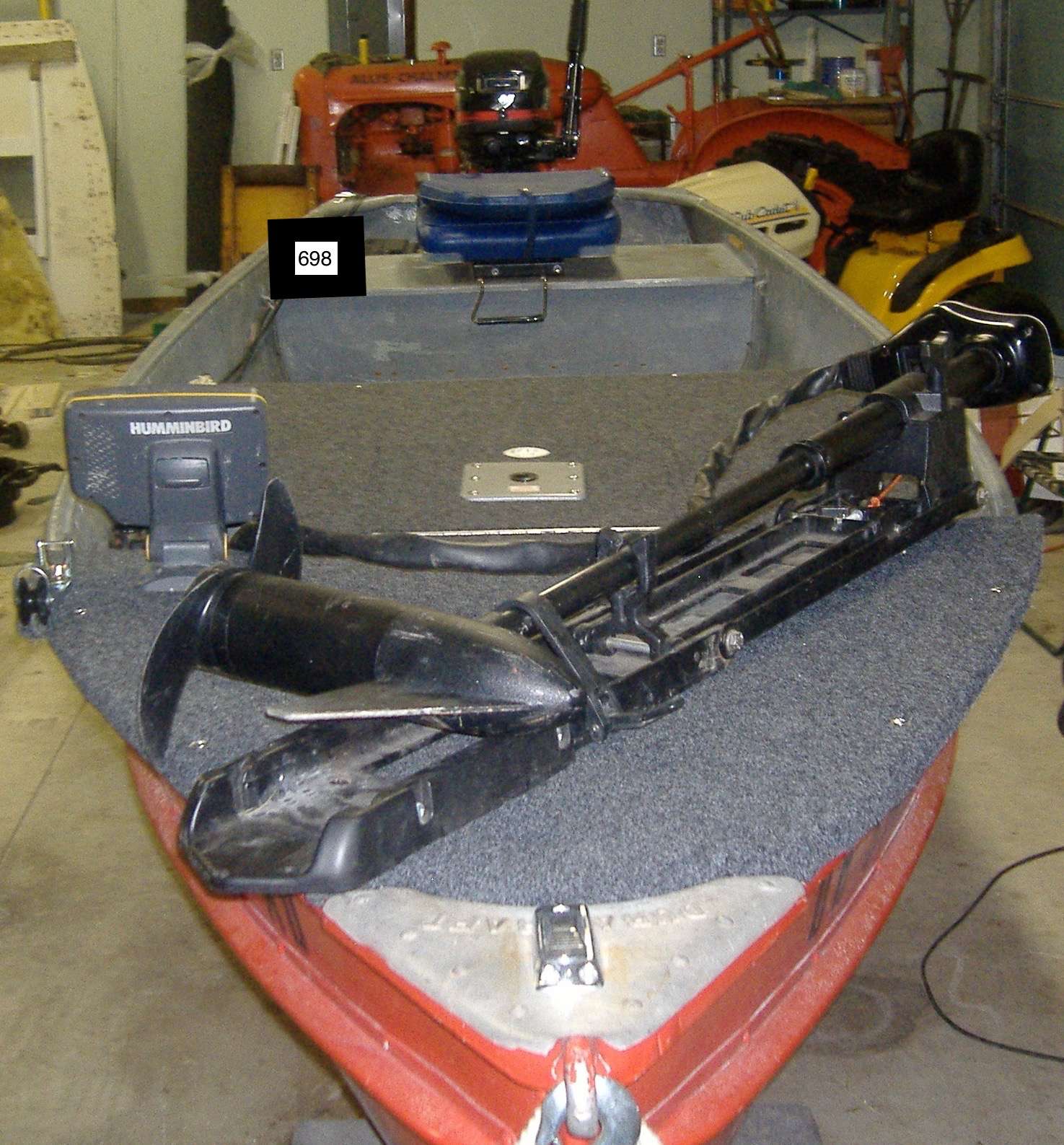
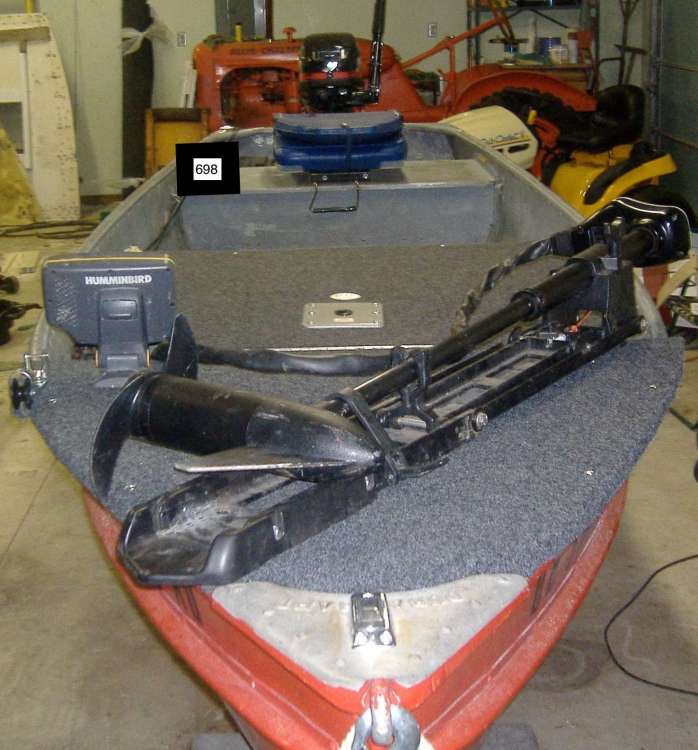
You have a nice looking hull to work with. Most of my home lakes back in OH are 9.9hp lakes (max depths at the dam between 27' and 50'), and I fish out of a 14' v-hull. Last year the transducer gave up on my old single cone Humminbird, so I finally had a need to upgrade. At the time Hummnbird was closing out the 698si units making it a no brainer. Unfortunately, the boss vetoed getting two complete units. However, she did support picking up the extra transducer for the trolling motor. The image above shows the boat after I finished re-carpeting the deck several years back. Unfortunately, I won't be able to take pics of my current rigging for a couple weeks, but if you want, shoot me a PM after the 23rd or so, and I'll gladly show you more details. That said, the HB base is in the same spot, but instead of the transducer running to the back, it goes under the deck, and runs back to my TM battery wire. From there I wrapped it to the battery wire with electrical tape.(Do not spiral around the wire as spirals create loops and when the current changes inside the loop it will interfere with your depth finder signal. I've had no issues with running my transducer cables alongside my 12v TM wires.) Then when I get to the foot pedal, I wrap it to the steering cable, and then down the shaft to the motor head where I have the trolling motor transducer. Again, do not wrap the transducer wire around the shaft of the motor or steering cable and any interference will be minimized. Basically in the image above the transducer wire would run right along the top of the steering cable and shaft. I did have to put in a little dog leg to route around the builtin strap. The battery cable runs straight along the side of the boat to the battery. At the back, I screwed down a RAM mount to the back bench. The other unit base is mounted there. The transducer is then mounted to the hull just behind the battery compartment, and I was even able to do a little sanding to make my old transducer bracket work, which meant no new holes in the hull of the boat! Both transducers are SI transducers. The transducer for the old unit used a different cable than the new on, but it had the correct mount molded into it. So with a little reading up on the pinning of the transducer, I was able to drill out the appropriate holes and move pins around inside the unit to make it work. I can now still have access to the single cone signal for the old unit and access to all of the bells and whistles with the new 698 regardless of where they are in the boat. So, if I am out exploring, I'll run the 698 at the back and the old unit at the front. If I'm fishing off shore and want to stay on a particular structure, I'll run the 698 up front so I can keep an eye on the map. That is what I went with for my boat. I'm happy with my 'birds and they work well for me, but if you can find something from Garmin that can make your transition easier, then by all means stay in the Garmin ecosystem. All of the big manufacturers make incredibly powerful units these days. Okay, now for a few other side notes. Regardless of what unit you are running, it will confuse dense weeds for the bottom. You might be able to help get around it by turning the sensitivity way down, but even then, there will come a point where enough signal gets reflected back early that it thinks the stuff is the bottom. My old single cone unit would even do this if I passed over a thick enough lay down or even a dense enough bait ball. It's the nature of the beast. The most important feature will be getting a unit that has GPS and adding a mapping card. It is with these maps that you will be able to find the major structures on your lakes. It will still take time to learn the intricacies of the structures, but you will have the ability locate and stay on structures with using the map. From there, if you can splurge on the SI unit, it can be helpful in locating isolated breaks on a structure such as a rock pile, lay down, etc. DI will be most helpful if you want to know the depth in the weeds, because it uses a very narrow beam that eliminates a lot of clutter, and produces some really clear images. As with anything, new electronics come with a learning curve, but man are they helpful. Units that network would be great, but I would have to do some research on the particular units you are looking at to know. I do know that with Humminbird, networking units do not come cheap. Good luck, and if I can help any more, let me know!
-
I've heard good things about them, but never attended one myself. I see you are in Michigan. There is a very active group of rod builders in Michigan. I believe they still have pretty regular get togethers to talk rod building, and are always welcoming to new builders. They are a great group of guys. I'm willing to bet that you should be able to find a mentor or three within MRBs group and get all of the tutelage you need. I'm pretty sure one of the founding members of that group is now down in FL working for American Tackle. http://www.michiganrodbuilders.com/home.html A couple other guys and myself have tried to run a group for Ohio Rod Builders in the past. We generally struggled with bringing in enough people to cover the cost of the venue rental and keep the entry fee low. Profit was never the goal, only to share information and promote the craft. Leftover money would serve as a deposit for the next event's venue and maybe a few door prizes. I'll be returning to OH soon, and will hopefully give it one last go sometime in the next 12 to 18 months. You'll find some very talented builders show up at the little grass roots events, as well as some newbies to the craft. Everyone learns something, and has a great time.
-
For deeper water it's a 6'9" MLXF 1/8 - 1/2 oz. rod built on a US made Liberty blank with a split TN handle made from woven graphite with EVA trim and the Microwave guide train, and a Shimano Sahara 2500FB spooled with Power Pro 6/30 (It's the only braid I had laying around, but will probably drop to 15 or 20 in the future). It's only been in service for a coup of weeks, but thus far, I'm impressed. It's going to suit the niche I built it for quite nicely. For shallower water and/or target casting and close quarters work, it's a 5'8" Cabela's XML MLXF 1/8 - 3/8 oz. with a split TN handle of woven graphite and EVA trim, and a Shimano Sahara 1500FB spooled with 6 lb. mono.
-
Nunz, You are definitely doing it for the right reasons. I greatly prefer rods built to my specs than a factory rod, and every one of my builds fishes better than any factory rod I've ever used. Welcome to the craft, and let me know if there is anything I can help out with.
-
Nunz, You have some good advice so far. As a beginner, buy a copy of Tom Kirkman's Rod Building Guide. It's a short read, but explains all of the basics that you need to know to be successful in your first attempt. At this point some of the components shown in the images of the book are a bit dated, but that is immaterial, as Tom takes an approach that teaches your how to think about the process and it should be straightforward to see how smaller lighter guides can be utilized. When it comes to thinking about implementations of split grip/no fore grip designs, if you can look at your design and say, "What is needed is there, and what is there is needed," then you have a solid design. That book was one of the most helpful reads I had when I started, and it can be finished in a couple of days easily. When it comes to equipment, I built a hand wrapper from some cheap lumber and hardware, and it served me well. I had kicked around making a new wrapper out of 80/20 aluminum extrusion, but could never pull the trigger on buying all of the components I would need, as it was going to be pretty pricy. So, this spring I picked up the CRB hand wrapper from MudHole with the aluminum track, and I have to say that I am quite satisfied. Even without the track it's a great unit. The best part is that it will be a unit that can grow with you. You can get the hand wrapper now. Add the track later. Bolt on a drying motor or sewing machine motor onto a support to add power features. A nice set of reamers makes grip fitting much easier. I found I wasn't as handy with rat tail files as I thought I could be, so when I got a set of Dream Reamers, it was a major improvement to my work. Turning rods by hand during drying works well, but it requires a good couple of hours of commitment. So, a drying motor is a great investment, but not one that is mandatory right away. Buying at full retail makes it tough to save money by building rods, especially with the initial startup costs, but it's a fun hobby, and if you are looking to build on really high end blanks, you can definitely save a bit over their off the shelf counterparts. Good luck and enjoy the craft!