grub_man
Members
-
Joined
-
Last visited
Everything posted by grub_man
-
Big Ed, It's just going to take some getting used to. When I first stepped down to a Curado 100b and Citica 100DSV from my 200 sized reels, I had the same problem and needed 3 brakes instead of 2. After a few months of making peace with the smaller reels, I eventually backed off to 2 brakes. Keep at it, and the distance will come along and I bet you'll start reaching for the Calcutta more.
-
You said that one of the magnets flipped, as in came out of its hole and stuck to one of the other magnets? Are you sure that you got it back in place with the correct side facing the reel? You need to make sure that the correct pole of the magnet is facing the correct direction. If one of the magnets has the wrong pole facing out, it reduces the magnetic field and reduces the braking ability of the magnets. You might need to dig the magnet back out and flip it over, if you remember which one it was. If you don't, then you will have your work cut out for you. If you want the details of why the orientation of the magnets is important, we can do that, but it's a pretty lengthy post. A bit more than I have time to type at the moment.
-
Big Ed, I think you are just overpowering the cast on the 200b just a bit. It holds significantly less line than the Abu 5500. Because of this, the spool has less inertia and will rotate faster. When that lure is getting out to 20', that's about the time that the spool is reaching maximum speed, and it is just rotating way faster than the lure is pulling line off. With the 200b, you should be able to cast just as far with less effort. The solutions are: 1. Back off the power of the cast just a bit 2. Turn on more centrifugal brakes and/or swap out for heavier brake blocks 3. Use more thumb earlier in the cast. The centrifugal brakes help control the spool speed at the beginning part of the cast as the spool its max speed. The cast control knob helps with the end of the cast as the spool is coming to a stop.
-
I doubt too many bass fishermen could tell the difference between a well made modern 2 pc rod and a 1 pc rod with the same action and power when wearing a blindfold. It's not like ferrules are made out of brass or nickel anymore. The added weight is minimal. The problem is that you will not find many technique specific rods in multi-piece designs. I use a little 4pc 6' L power F action when fishing steams on foot. It handles the little jigs, weightless plastics, and light T-rigs I use the most in those situations just as well as the little 1pc 5'8" ML power XF action rod I use in the boat. I give up nothing in terms of performance, but gain a lot of portability. I use 1pc rods most of the time, because I can manage to transport them just fine, but find that multi piece rods don't take much off of the table these days. I built that little 4 pc. rod to use while in grad school. We had a little river just off campus that was like a little slice of Canada with a surprising smallmouth, pike, largemouth, and crappie fishery for a little flow that I could cast across in most places. When I needed a break, I knew I could go find a few fish for an hour and come back to work.
-
1. The size of the company's marketing budget. 2. Brand recognition. 3. Warranty policies. 4. Size of the company/required profit margin. 5. Country of origin. 6. Blank material (graphite fibers are manufactured for the aerospace industry, fishing rods is a minuscule niche market). 7. Component selection. The fact of the matter is that the carbon fiber industry is an aerospace industry, and fishing rods are just a niche market for the material. Some companies make better quality materials than others, use higher quality resins in the prepreg material, and different scrim materials. What sets apart one blank from another is how the blank designer decides to use the material (multi-modulus designs, how the fabrics are cut, QC, etc.).
-
My first build was a casting rod on the RX8S822.5 (older version of the eternity 610MXF). I built it primarily for 1/8 - 1/4 oz ball heads and 3" - 5" grubs, for which it is incredible. It's absolutely the best rod I've ever used to cast 1/8 oz buzz baits. It's also great with light shaky heads, light T-rigs, and weightless plastics, though I tend to reach for my slightly more powerful 823 for the shaky heads and T-rigs. I don't drop shot a lot, but it gets the job done well. I don't particularly care for either of those XF blanks for tubes, but when I fish a tube, it's generally a 4" tube (Venom, similar to Cabin Creek, not particularly thin walls) with 1/8 - 1/4 oz stuffed inside and rigged Texposed. The tips of those blanks are just a little soft for lifting the tube up and over cover for my taste. I generally fish my tubes on MB783 or MB843 type blank. For Bitsy Tubes or the thin walled finesse tubes, it's a bit different.
-
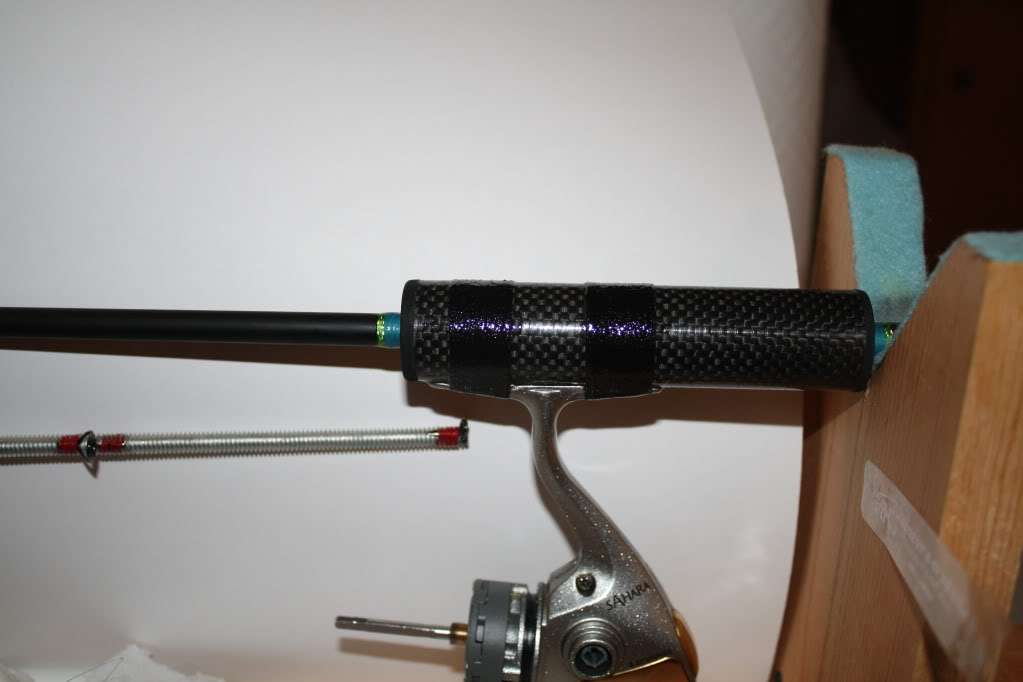
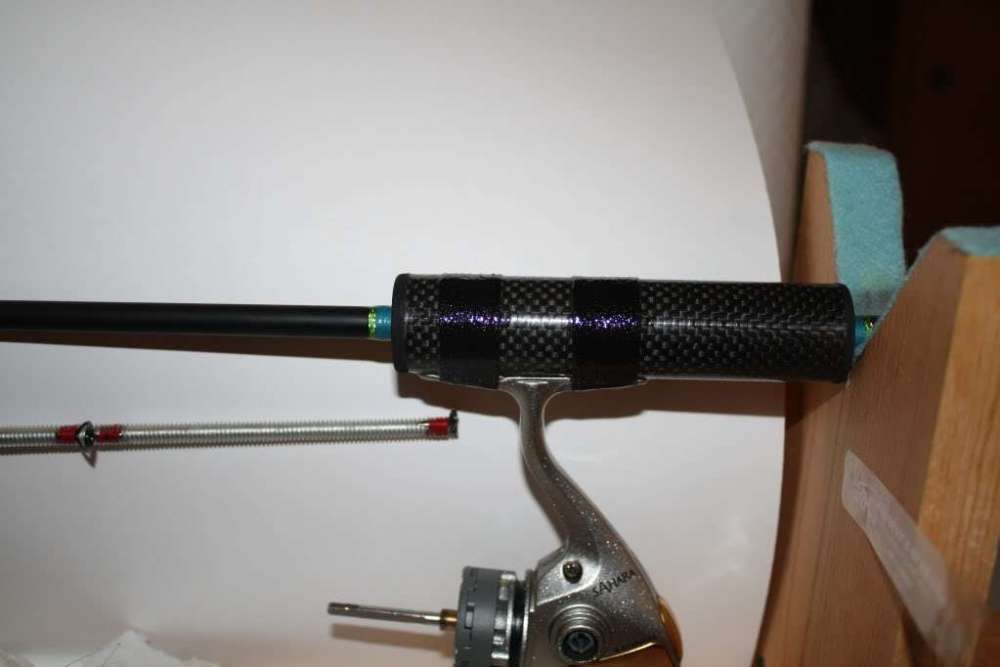
Thanks! The ci4 is so light that just about anything is going to feel a bit tip heavy. The rod in my middle pic is a 6'10" MXF and going to get an old Sahara 2500fb wrapped on. It is going to feel great in hand, but that reel is 2.7 oz heavier than the ci4. The palm swell on the Zodias, if it lands in your hand the right way should go a ways toward helping with the pain. A lot of guys like the palm swell on spinning rods, but they never seem to match up well with the curvature of my hand.
-
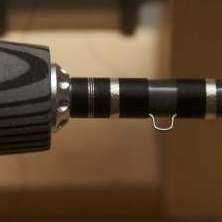
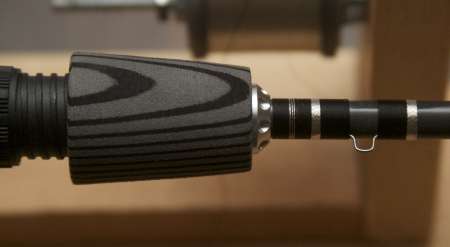
I would recommend finding a rod with a reel seat/grip that fills your hand well. I avoided my spinning rods like the plague when bass fishing for exactly the reason that you experienced yesterday (and this was when I was in my late teens and early 20's). After I built myself a few casting rods, I decided to give a spinning rod a go. I settled on a split TN handle with the reel wrapped on with thread and finish, just like a guide. The grip is just long enough to fill my hand and allow me to put my thumb and index finger on the blank, if I want to. I can set the hook and fish without pain shooting up my forearm. The difference is amazing! Edit: Added Captions and to say A rod with a size 18 seat will fill you hand much better than the standard 17 mm seat and much better than the split seats that are seeing more use today. One with the reel wrapped on, needing a little clean up and a final coat of finish: One ready for the reel to be wrapped, a current project: One with a plate style seat wrapped on:


-
You could check in with Billy Vivona, leader of the Northeast Rod Builders (NERBs) club. He regularly gets components from Matagi in Japan. I have no idea whether Matagi does that particular pattern, but it might be worth a look. However, a painted Fuji seat from Matagi comes at a premium price and may take a bit to get in hand.
-
Batson's dropshot blanks are probably the most versatile blanks I've ever used.
-
A piece of grit in the gears is my guess. When the spool is out, the pinion gear can slide around a bit and pass by the grit easily. With the spool in, the gears are forced to mesh together and the grit won't let the gears mesh properly. Take off the handle side plate, and rotate the gears slowly looking for the grit. Use a soft bristled brush to remove the grit. Close it back up and check things out. If it's more than a few pieces of grit, it might be worth cleaning and regressing the gears. I had a Citica do just this to me a few weeks back. It was laying in the bottom of my work bag and managed to get some grit in the gears.
-
Which Coriolis is it? The old white one with a body style like the old Curados and Citicas of the day, or the red one? I still have a red Coriolis 200D. I don't fish it often these days, but keep it around in case something happens to one of the reels in my regular rotation. At $80, it was my first 'nice' casting reel in high school. I had 2 until I gave one along with a 3 pc. travel rod to a kid I taught in a UBMS program last summer. The reel is a pretty simple design, and if you follow along just about any casting reel teardown, you will be just fine. You don't have any springs tucked under the cast control cap or in the drag star to deal with. The drag only has one washer sandwiched between gear and steel washer. On the red 200D, the screws that go in the left and right side of the frame above the level wind that hold the hood on are different lengths, and something to watch out for. Unless you have a bunch of debris to clean out, you shouldn't need to do much on the magnetic cast control side, other than pulling and lubing the spool bearing. The only parts I've had to replace on mine were a damaged level wind pawl, and the thumb bar spring. The Boca Bearings that I put in it were a welcomed upgrade. The only issue with it is that with the graphite frame, it does not feel as crisp as its Citica and Curado cousins.
-
It's been about 10 years since I had the upgrade bug. Mostly because I hadn't really known what to look for in a rod until I got the rod building bug. Once did my research and learned what I needed and built it to to suit my taste, the rods have stayed. The only rod I built that I haven't liked is a graphite 6'6" crank bait rod. It got 'upgraded' to a 7' glass cranking rod. This year I am replacing my RX7 MB783 6'6" MH fast action jig/T-rig rod and old Curado that went in the drink with me last spring (Was not happy when I could not recover that one). The new blank is a metallic silver MHX MB843 and getting Ohio State inspired EVA grips making it by far the flashiest rod in my arsenal. It's getting paired with Revo X. I'm also adding a spinning rod for targeting spotted bass in deep water. It's getting built on a Liberty MB692XF 1/8 - 1/2 oz drop shot/shaky head type blank. It will be paired with an old Shimano Sahara 2500 I have laying around with the reel wrapped onto 4.5" sleeved woven graphite TN handle section with red EVA trim rings on the ends and a red EVA butt grip. This rod is filling a niche. Before I relocated, I rarely had to fish more than 10'-15' deep. Now I need to be able to fish deeper water more effectively and the spinning reel is the way to go.
-
Seeker BS706-S-glass (7') or BS756-S-glass if you prefer 7'6" Being a glasss blank, it's not as light as many of its graphite cousins, but with the large OD butt, the 706 really doesn't feel any more tip heavy than an MB843 or MB844 in hand.
-
The diameter of the spool is much too small for 20lb. mono. Anything above about 8 - 10 lb mono on a spool that size will want to jump off. Wind knots are not generally caused by the reel. 1. Check to make sure that the line roller is turning freely. If it is not, it may be part of the issue. 2. When you cast, close the bail by hand and give the line a slight tug to pull it snug before reeling. 3. If 8 lb mono is breaking on small bass, you need to either use fresh line, retie, and/or check the line for abrasions. Junger, Does it create twist on your reels? If not, run with it. I spool all of my reels with the line coming off of the top of the spool, whether it is a casting reel or spinning reel. I run the line through all of the guides and use my feet for tension on the spool (about the tension of reeling in a 10"-12" bass). I never have line issues on freshly spooled reels anymore. I believe it is the tension that helps more than anything else.
-
Jann's Netcraft used to sell some low cost fiberglass blanks that you could get 5 of the same model for about the price of a nice mid-range blank. I don't know if they still do that or not. It's been a while since I checked. The Mudhole CRB blanks are pretty decent graphite blanks at a reasonable price. However, they are not technique specific powers and actions. They are more of a general purpose type rod. If you want something a little nicer that will find a place in your rod collection for life, take a look at the MHX blanks. My first two builds were on high end blanks. The finish work may not be stellar on those rods, but they are still the first rods I reach for in a great many situations. I keep telling myself that maybe I should go back and rewrap them, but I haven't talked myself into it yet. Most of my personal rods have some sort of experiment going on anyhow. Guides wraps with color preserver only and no finish, guide foot tunnels unfilled, and a few other things. Since they aren't built to be works of art, some cosmetic defects don't bother me. Rods that end up in someone else's hand on the other hand get held to a much higher standard. By the way, as you are learning, if you want to experiment with different guide sizes and or layouts, wrapping the guides and coating the thread with color preserver is a great way to experiment. You can take them out and fish them like normal. If you want to try something different, cut them off, clean up the blank with alcohol and try again. I have rods that have been in service for several years with only CP on the thread.
-
That is definitely an overload failure. Take an uncooked spaghetti noodle, load it from both ends and it will generally snap into 3 pieces. It's the physics of the system at work. When I was studying for my physics qualifier exam, we had the same problem phrased in the sense of a tall chimney tower. The goal was to show that it would fail 1/3 of the way up the tower. The other failures come from the released energy after the initial failure. As far as the line not breaking, virtually all fishing lines have a fudge factor built into them and they break at above their labeled strength. Unless it is marketed as an IGFA line class line that breaks at or below its labeled strength, you can rest assured that the line is intended to break at a higher strength.
-
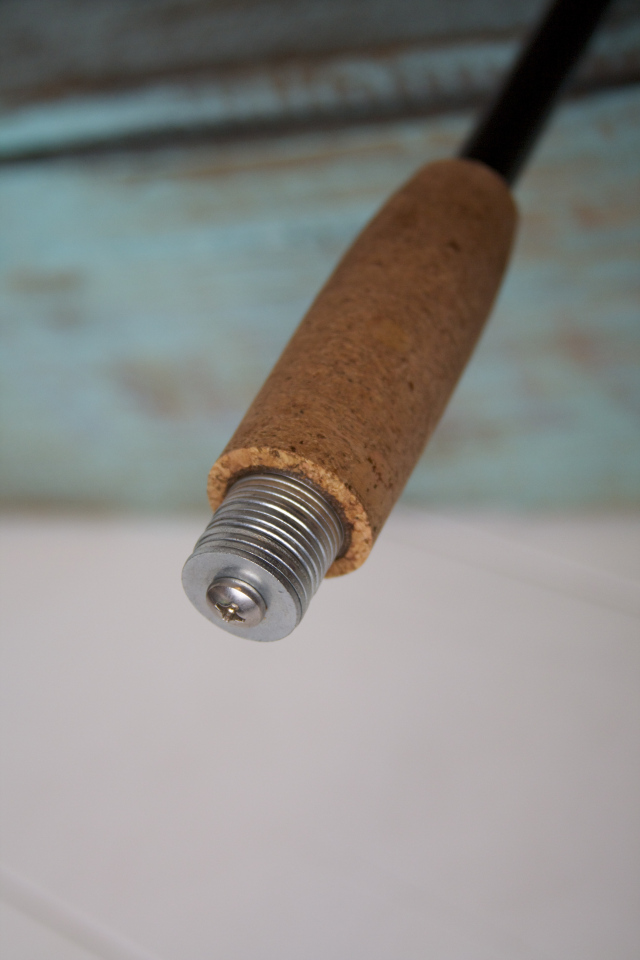
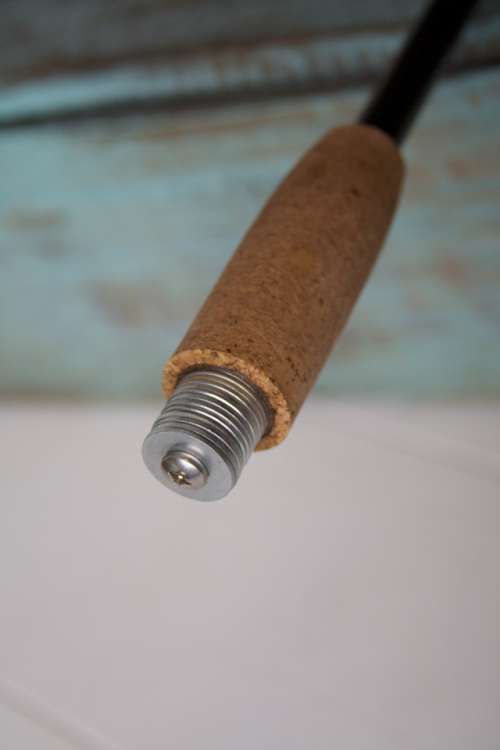
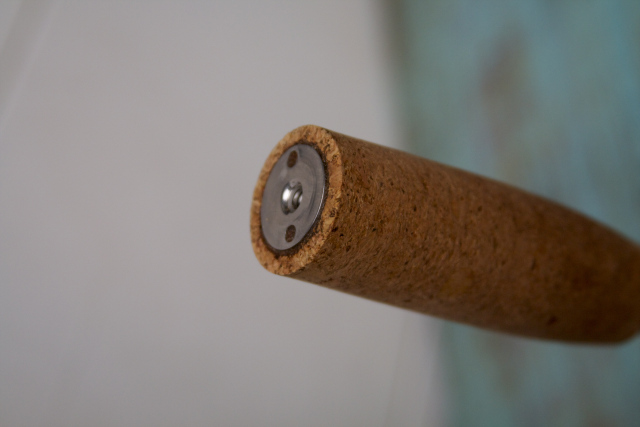
My thoughts on balancing rods are this: 1. If you must add weight, it must not alter the handle length. If I wanted a longer handle, I would have built a longer handle. 2. Add weight at the extreme butt of the rod. 3. Do not just shove weight inside the blank. You will need to add much more weight this way, as the center of mass of the added weight moves forward the deeper in the blank it goes. 4. If you can't get enough weight in a counterbalance weight hidden under the butt cap, use lead tape wrapped around the outside of the blank, and build it up the largest OD you can get away with before moving up the rod. Why weight on the outside? Take two grips with the same shape and mass. On one grip, ream out the grip some amount. On the other turn it down the same amount. Which one reduces its mass the most? When adding weight, it is the reverse. You get more bang for your buck adding weight with a larger OD. How I prefer to do it. What I do if I want to balance a rod is to mount a tee nut in the butt of the rod blank. Using a wood block and a threaded rod, I'll make as big of a lead weight as I can fit into the butt cap. Drill a pilot hole for the threaded rod. Then bore out a hole the ID of your butt cap. Screw the threaded rod into the wood block and pour your own cylindrical weight. This will add as much weight as you can to the butt of the rod where you want it the most. If I need more weight, I use lead tape (found in golf supplies) wrapped around the blank starting at the butt. You will need to bore out your grip material to cover the tape. On the rod in the attached images, it is shown with steel washers rather than the lead weight (a little prettier than my lead weight). There is lead tape behind the tee nut. I mixed some cork dust with the rod bond when I slid the butt grip into place, so the lead tape is hidden away. Once the butt cap is epoxied into place, no one will ever know that the rod had weight added to it.
-
Take a look at the Zebco Rhino spincast reel. It's a remarkably nice spincast reel for the money.
-
You are talking about a difference of about 8 turns of the handle on a 35 yd cast (yes I've done the math and accounted for the spool diameter difference at the start and end of the cast), assuming the same spool dimensions, and about 3s @ 3 turns per second when trying to quickly get the lure in for another cast at that distance. The differences are pretty negligible. So, unless you are spooling the reel with every cast, fishing a very small target zone, and burning it back, it really doesn't matter.
-
I use 6'10" just because my drop shot and shaky head rods are just so darn versatile that they fish topwaters really well. It's incredible how subtly you can work a topwater with those rods. The only problem is that the backbone locks up really quickly and I need to be much more careful playing the fish than I am with my glass cranking rods.
-
Lucas, You know my thoughts since I was the one that recommended taking a look at the FS905. Since I don't personally fish many lakes that have real slop, I generally throw my frogs on an MB783 or MB843 type blank. If I were fishing the slop, I would prefer to have a rod that has an action more conducive to keeping the fish hooked up. I'm yet to meet a soft plastic or hollow body frog that is so light that I need to rely on the rod having a soft tip to be able to throw it. They are generally heavy enough that they will fly farther than I can set the hook without loading the rod much. Frog rods seem to be a specialty rod more due to marketing than anything else. If you use a rod appropriate for singe hook lures and the amount of cover available, you won't go wrong. yosef, I would like to know why the SCV doesn't measure up. About the only way an SCV is not going to be a great rod is if you choose the incorrect blank or make some really poor decisions in ergonomics and component selections. basscatcher8, Like you, I find long rods a bit awkward. It might be more due to the fact that for most bass rods, I'm not going to more than 9.25" behind the reel seat. If I go longer the handle gets in the way. So, when I build a 6'10" blank, it fishes more like a lot of 7' rods off the rack, and a full 7' rod fishes more like a 7'2" or 7'3" rod off the rack. I love my 7' cranking rods, but no matter how much I fish them, landing fish still seems incredibly awkward to me being a shorter guy.
-
I use a Cardiff 100A, a lower priced little sibling to the Calcutta, and I would not hesitate to use a Calcutta if it fit the budget. That line has been around for years largely unchanged for a reason.
-
WRB gave some really good info. I'll ad a few more tid bits. The 'standard' powers and actions that we use in bass rods have been around for quite some time. For example, a few years ago I was given a Lamiglas 7062 (I think that is the correct model) blank by a rod building friend that was new old stock from his father's supplies in the late '60s. This blank is a yellow fiberglass blank that is right on par with the best glass cranking blanks available today. The standard worm/jig 1/4-3/4oz. fast action blank has been available from the likes of Loomis, St. Croix and others for as long as I can remember (I'm 35), essentially since the early days of graphite rods. Rich Forhan has heavily influenced what a bass rod has become. Even though split grips have not been new to the fishing world, Forhan was one of the first to adopt the design. He was known for cutting and modifying reel seats introducing the concept of the split reel seat. He was well known for building rods for some of the elite tourney pros. If they couldn't find what they needed, they went to Rich. Many of the 'standard' powers and actions that are used today are based off of blanks he chose to meet the needs of those guys. We all owe a debt of gratitude to Rich Forhan. If you look at the seasonal bait selection article image from the homepage, there are 3 rods (definitely the baby poop green Seeker blank) on that casting deck that I would be willing to bet came from either the late Bill Stevens or Lance Dupre at Swampland, or possibly another builder. I think Forhan stopped before that type of burl became available. I believe Forhan's notes are now safely housed and well kept by a pretty well known builder in the Carolinas. Micro guides were introduced to the bass rod community by Steve Gardener from NC in 2008. The original micro guides came from Batson Enterprises and were originally designed for use in either the Asian or European market. When Bill Batson showed them to Steve, a new idea was born, forever changing bass rods. Over the next few years, manufacturers went to work designing their own as well as small braced tip tops. The original tip tops are unbraced and adorn the top of a couple of my favorite rods. Those unbraced tip tops require an occasional adjustment to keep them in shape. The extra fast action of the drop shot rod was likely developed to satisfy an angler who wanted a ML power tip on a M power rod. The way this is done is to take a ML fast action blank and extend it from the butt end moving the flex point further from the reel seat and giving more power in the butt because there is more material down there. They have been around for a long time, however, primarily as spinning rods. I started building because I wanted this power and action in a casting rod. The modern flipping stick comes from Dee Thomas, and I believe Rich Forhan working with him to select the proper blank. About the only 'new' to bass rods over the last 15 years or so are dedicated swimsuit rods and A-rig rods, however the powers and actions for these rods already existed in the inshore saltwater market and just needed to be selected. What you are seeing now in the way rods are marketed is a combination of marketing, and a better educated clientele. The magic of the internet has allowed rod builders to start educating the average angler on rod characteristics and blank selection. As the average fisherman became aware of what was available, manufacturers have been quick to adapt and start putting out product that meets the demand of the customer. It is amazing how many technique specific rods adorn the shelves of even department stores these days. You used to have to spend a decent sum of money to get into a technique specific rod. That is not the case these days.
-
Take a look at Falcon's options in the 1/4-1/2oz. Medium power Moderate action range. They are not whippy like a number of other graphite rods marketed as crank bait rods. I think you will be pleasantly surprised if you get your hands on one. Before I started to build rods, I used a few Falcons from the Original/Silver Series. Over the years they've tweaked the look a bit, but I believe their actions and powers are still the same. I still have those rods sitting in the corner of the garage, and if they weren't such a pain to strip and clean up, I would have rewrapped them long ago. The (FC-3-166 or FC-3-17) 1/8 - 3/8 oz ML power Moderate action and (FC-4-166 or FC-4-17) 1/4 - 1/2 oz M power Moderate action blanks were/are special. They are forgiving enough for crank baits, yet powerful enough to work well for finesse applications.