
txchaser
Members
-
Joined
-
Last visited
Everything posted by txchaser
-
Don't forget the TRD Craw too.
-
After a few rounds now of fiddling, and having a similar situation here's where I came out. Backpack - tried an osprey 25l, pack was great, shape was weird for tackle. Looked at all the fishing backpacks, and found them to be some combination of low quality or giant. Seriously the 4/5 3600 box packs were really big. So I had a molle backpack laying around, a SOG Ninja (the name kills me, but it is cheap and strong) - sort of a knock-off rush 12. Because of the molle I can attach some pouches to it and do some good config. I can fit a slim 3700, two 3600's, and a BPS worm binder in the main compartment. 3700 in back, two 3600's stacked in bottom, binder on top. few 5-6" Swimbaits in internal pockets. Boxes 1) fixed six compartment stowaway for senkos, swim senkos, and fat ikas. Colors are separate no worries about bleed. Example is GP senko, swim senko, ika, all in same part of the tray. The fixed means there's no divider tabs pushing in, everything stays straight. 2) Cabelas medium waterproof 3600 - misc plastics, lizards/brush hogs/hula grubs/etc. Same strategy as above, organized by color. This box is way better than the flambeau or plano waterproof boxes because it's not overbuilt. I'm just storing misc plastics in it, airtight is fine. And because it isn't overbuilt it is square and straight. 3) 3700 thin - cranks, lipless, jerkbaits, jigs, chatterbaits. Packed tight. 4) maxped barnacle - all hooks 5) bps binder everything that's not in the senko or lizard box eg trick worms, zakos etc. Mostly things that dont get damaged by pressure/not being in hardsided case, plus worm weights, stoppers, etc 6) small polycarb fly box with no foam - all TRD kit 7) 6x3 pouches (two) external attach - one for creature/craw bags and one with an empty thick silicone bag for throwing whatever I just took off into, to deal with later. doubles as a quick pocket kit if i want to grab a handful of baits and go Extra soft plastics stored in the open 3" deep 3700 boxes. Out of season or extra hard baits stored in 3600's I'm sure it will change again because I fiddle with it a lot, but so far it is really working out well. And there's no way I could haul a duffel around especially while I'm casting. If I was going to try something else it would be the recon-size 3500 pack from wild river. It is really well built and not too big. 3600 size is really big. But pretty expensive for what it is, and I'm liking the flexibility of molle.
-
https://www.clearbags.com/spec/fishing-industry-packaging/worm-bags The 6x3 or 6x4 are great. Not much depth so they stand up well, and fit right about a half of a bag. 10c per bag. They are on amazon too. Not great for paddletails though.
-
I gotta be honest, I thought this was bs. Drug two dink bass out of the water hanging off the tail of a swim senko this weekend. Wow.
-
My future PB broke off a t-rigged lizard on 6lb flouro leader this weekend. Well, I broke it off, when I saw it hit. Felt horrible about leaving a fish swimming around with a hook. I know it happens, but this was an awfully big fish for this lake. Anyway, switched to a jig on a heavier rod/line, caught a few others out of the structure, and finally picked her back up. Yay pre-spawn feed! She had the lizard down in her gullet, bend and barb all the way in. The out through the gills technique worked flawlessly, and took 15 seconds. So good it should be required reading for new anglers.
-
I'll second the recommendation for the Deeper, in particular the Deeper Pro that will let you make a map of the lake. Another tip I picked up here (from the guy with the killer bass biology vids, @Paul Roberts ) is that sometimes the structure is out of the water. Look for about anything different... trees as an example. And Glenn made a good point about transitions in bank type being an interesting spot. Barring that, start fishing in one direction and just keep going. Notice whats in and around the water when you are catching. You'll find the pattern pretty quick. It's 132 casts to get around the lake assuming a 40' cast. One afternoon, at two minutes per cast. And I'd guess with that much shoreline, there's more than one spot, so you'll be on them before you get hungry.
-
Found these this weekend - I wanted to keep them in a sealed container, but the plano waterproof are way overkill. Just a small gasket around the top, no wasted space with all the extra curves in plano and flambeau waterproof. Dividers are horizontal, so the 3600 size isn't great for density of worm-shaped stuff like a senko. Cabela's Waterproof Box At the moment I'm using Plano 3600 fixed compartment for senkos, swim senkos, and I just throw it in a big ziplock if it's going to be put up for a while. It is an extra step, but it also saves me from a stinky spike it tail in the house. Because it is a fixed compartment, there's a little more space, and the divider-holders aren't jamming into the side of the worms. I also tried the 3x6 bags from clearbags/amazon. They are about 10c each, and are very compact. I'm not sure why I moved away from that other than I have more time to fiddle with tackle than fish right now. Edit - I also saw the 3600 and 3700 worm boxes in person. Hard pass for me.
-
I recently caught a nice-sized bass for the small lake I've been posting about, and I wanted to share my thanks. Almost everything I did was done based on something I learned here, and there's zero chance I would have ever been on this specific fish otherwise. In particular: 1) Water temp and how much it matters. Growing up, winter was for hunting but definitely not fishing. But now I know I can get a bite in 50 degree water (hey that's cold in TX) if I just slooooowwww doooowwwnnnn. Was fishing slow off the bottom. 2) Color choice related to visibility of the water and the light. It was dusk, and the water was low-visibility too. So I chose black and blue, which is a color I wouldn't have picked by myself. 3) Lure action based on time of year/temp and water clarity - chatterbait. Typical lake visibility was cut in half, so I thought hey I need to ring the dinner bell. 4) Line choice, and in particular helping me sort out a knot problem on braid to flouro that cost me a pretty big fish prior. 5) What those crafty fish are actually doing underwater - in particular the importance of structure. I ended up buying a Deeper (castable depthfinder) so I could see what was going on under the water. And in this case I was working my way around a lake that was mostly a featureless bowl, fishing the bank weed edge to no avail, and mapping on another rod. As I was pulling the depthfinder in, I saw a big hump offshore, with weeds on top of it. Because of BR and knowing that bass love structure, and it was cold so being able move down in deeper is important too, I thought to myself "A fish will be there, now catch it." So I put the CB past the big hump and worked it back jig like - pumping it off the bottom enough to get the blade on, the letting it settle. No rush (it's cold). As it was coming over the top of the underwater vegetation and started its fall past the hump and on to the lake bottom, FISH ON! 6) caught another nice-sized one (3.4) the following weekend throwing a lipless crank - for some reason it was swirling/chasing something on top (wierd, it's cold) but whatever. Threw it in it's face and it was too much, it had to swipe at it rattling and splashing and shaking by. Bonus: While I'm sure that all would have been fine on a spinning rod, BR gave great advice on where to start as a baitcasting noob, so I ended up with a Fuego CT paired with a MH/F rod, and enough tips to get started baitcasting without loosing my mind. PS: I know y'all warned me about the bait monkey. I guess it's part of the process. There's definitly stuff in the bins (bins? how did I end up with bins???) that I have no idea why I actually have. I'm sure there's a perfect time and place for a GP ring fry, but I can't for the life of me figure out what the sequence of events would be that gets me to put it on.
-
I have been using the extra blue anti-rust dividers from Flambeau boxes.
-
A crawfish trap. So I can see what the forage looks like. - $7.99 Shipping - $0.00 The look from my wife when she saw it. - Priceless
-
The lack of complexity on senkos and TRDs seems to support the featureless idea. I'm looking forward to seeing a bite on and chopping up something with parts and seeing what happens. I recall (perhaps from another post?) that Berkely also concluded that no one would buy a lure that looked like a thumb. One of the fun things about all this is mostly we are blind, and occasionally get glimpses of something that might work, but no one's really sure, because the data is sparse, and there are too many variables to get clear pictures.
-
Read this post a few days ago (and some recollection of a similar one) and it has been bugging me. Does this mean (if true) a Fat Ika would be more effective with no skirt on it? That varying blob color and size may make a difference but all the legs/arms/skirts etc aren't helping, at least with a craw presentation?
-
After a bit of reading it seems like Ned and the infish crew have moved to red or chartreuse heads. Trip reports almost always have red/chart, occassionaly blue on a black/blue bait. I'm baffled that most of what I see in pictures are GP or black, and other colors are scarce. Am I missing something, or that just didn't translate into wide adoption? Or just one of those 'it worked one day so they keep doing it but no one really knows if it makes a difference' things?
-
The creek/culvert is full of 2-4" bass fry (huh?), and a small gang of 1 lb'ers (expected). North texas weather makes for a train wreck of a spawn season I suppose. I can guess why decent-sized (4-5lb) are being caught in the spot between the creek/culvert and the main body, on paddletail swimbaits - some loose snacks make their way out to the nice warm spot. That same place (far NW) also has a submerged drain pipe (3') that may be good cover, in addition to some nearby weed beds and oddly placed submerged concrete. I did notice around an hour before sundown that many had apparently been holed up in 2' incoming drainage tubes that are submerged. I guess it makes for good cover, but I can't say it would have occurred to me that they would call it home. The dinks would eat any TRD I threw at them, bubble gum, cal craw, GP, GP goby, I kept changing to see if there was any color preference. But they were utterly disinterested unless it was within about a body length of them. Clear water, rocky bottom, 1-2' deep. Very skittish to splash or visuals of me, so pitching to a bank and dragging off into the water or far overshooting the target worked best. Chart and Houdini (sortof a baby bass pattern) 360GT swimbaits were ignored. I suppose that means they aren't really active/feeding? Air temps 60-72 degrees for the last few days, and enough sun to warm the creek/culvert substantially. Can I imply anything from the dink behavior about the larger fish in the main lake (that's likely much colder)? Also fished the SE point today, didn't map it though, pressed for time. Appears to be 45 degree or steeper bank, down to the bathtub bottom, also leaf-covered. Scattered shore weed beds, no other apparent cover or structure. Drug or bounced GP swim senko was ignored. Hopefully this isn't polluting the forum with what's a bit of a trip report, I thought I'd just get my observations and questions down as I figure this lake out.
-
Thanks. Will have to get a kayak to get out there. But that's on the table now, the inflatable kayaks are kind of interesting.
-
Thanks @WRB Thanks @FCPhil Good catch, I went back to the city web site and it is the park that is 40 acres. Should I infer a) bass are likely going to be feeding more near the shore than hanging in middle, barring some underwater cover out there that attracts gills? b) shad patterns/colors may be less successful than greener or gill-ier patterns/colors? Interestingly most of the 4+ lb from the lake have been on paddle-tail smokin shad. Person catching reported that he used to fish watermelon colored swimmers but the bass inhaled them too deeply, and that senkos were somewhat unproductive for him over a long period of time. Appears that most of the fish from the lake this 'winter' have been larger, but very infrequent. Winter is in quotes because our temps are so volatile some of them are in full spawn in the back of the creek now. From nearly freezing last night to mid-sixties today. Texas! Water clarity more than doubled in the last few days and I could see to the bottom in the spot that most of the recent catches have been. It was a ghost town, and I found nothing I could get a bite on on the west and north shores. Lockjaw I guess. I would think it was just me, but five other anglers in different spots with (likely) different baits got the same no-result result. That's what I fished today, spinnerbait, watermelon/red fat ika, crawdad TRD finesse in brown with belly flake. Will keep looking. I decided to put up the depth finder today so I could focus on fishing and stop trying to multi-task. I'm wondering if it should have been the other way around. Has a wide mode too that is 1x depth/width. Should I leave it on narrow/hi-def?
-
Probably 200-300 yards to the fountain. But I have been eyeballing a kayak so we’ll see.
-
Thanks. That’s an interesting point. It’s pretty much like a bathtub drain that’s 20’ across. Now I’m curious if there are shad chasing plankton that’s getting pulled in that direction since it is skimming mostly off the top of the water. Floaty stuff on the other end of the lake seems driven by wind; I wonder how far out there is an effect.
-
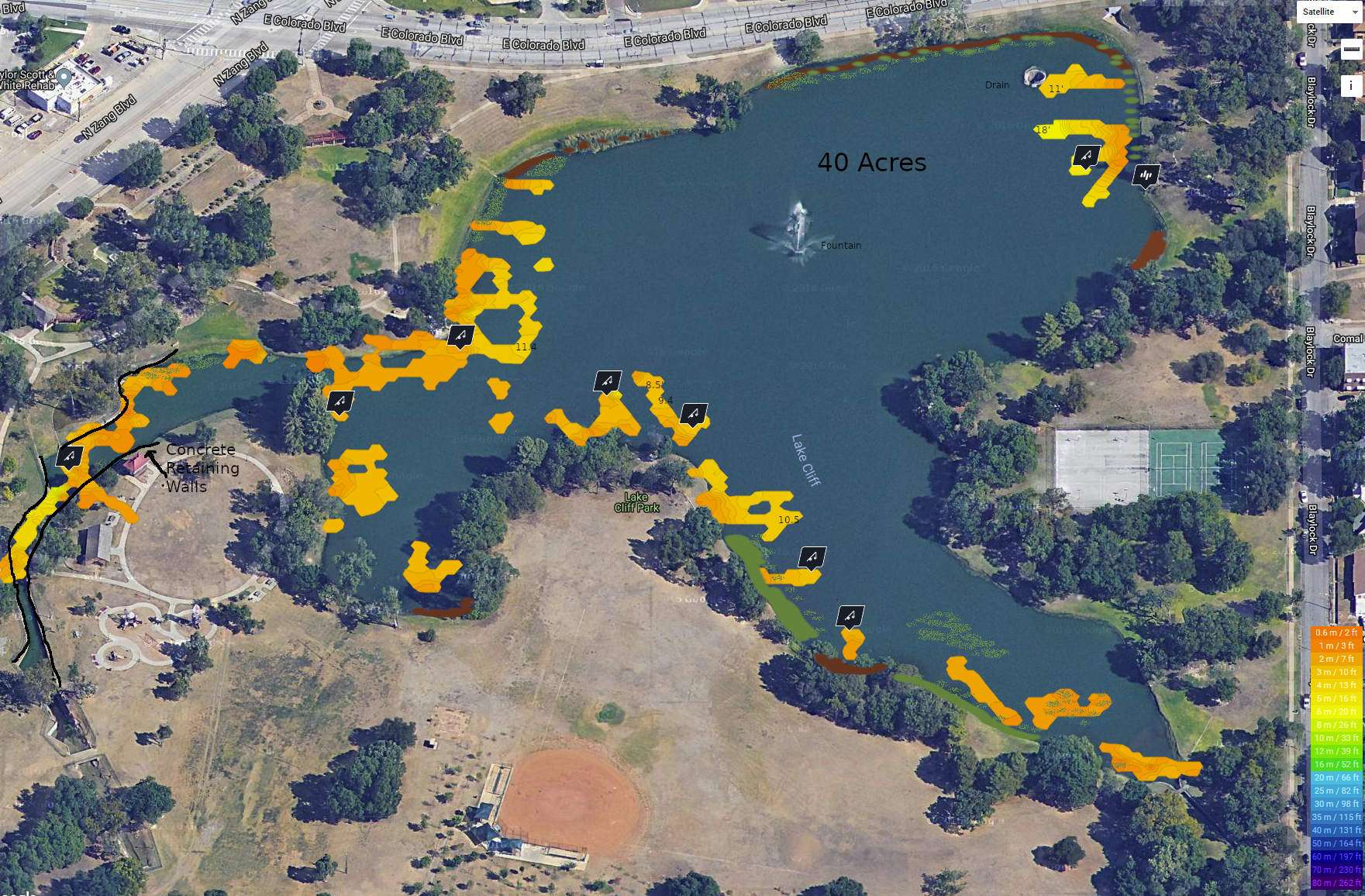
I'd love to learn more about how to figure out this lake. I know 100% I need to slow down presentation and go back to basics. The depth/fishfinder almost makes it harder; "hey i just looked there and theres no structure and no fish, why would I fish it? What does a fountain do to fish behavior in the winter? Other seasons? What does the 20ft drain hole in the NW corner do for behavior across seasons? What questions should I be asking myself or the lake? Where are the bass when the concrete isn't warm? Legend: Brown lines are cattails, currently cut to water level by park mgmt. Green are surface or near surface weed beds. Spotty green are subsurface weeds. The image is a lot bigger than the box below if you click on it. Commentary and learnings so far: Water more tannic than muddy. Bottom often is oak leaves, at least 5' from the shore. 3-4' visibility. Few small laydowns here and there, like 6" max diameter. 2lb (GP fat ika "magic rigged", mine, 12" hops, pause about 10 secs), and a couple of 5lb (smokin shad swimming fluke, unknown color googan bug, neither mine) caught in the ingress on the west, near the concrete retaining walls after some warm days. Few more bites in that zone but nothing I could hook up with. All seemed well-fed. History of the lake seems to be lots of soft plastic catches in better seasons, mostly senko and lizards t-rigged. Two hits just north of the drain hole, one ate the blade off the spinner bait, one ate the back off a fluke. Have seen no baitfish, but I did see a heron hanging around near the mouth of the west ingress in the weed mat. Yellow/orange is from a deeper depthfinder. I labeled a few places with depth for context, and there's a legend on the lower left of the image. I've seen the very occasional fish on the finder, although some of the spots on the bottom might be a fish jammed up on it? Was hoping when I found the 18' deep space I'd see them bunched up in there somewhere. But I ran out of battery and hadn't seen anything yet. Water steady in the 52-56 range on the surface, depending on recent weather. Very little structure in the lake. So far it mostly looks like a big bowl. Some interesting depth changes are visible in the topo stripes below, like the shallow point after a deeper trench. Reasonably steep near most edges so far, probably 5' deep within 10' of the bank. East seems pretty trashy. Not sure whats under there but this lake seems to eat most things with exposed hooks, at least on the north and east. Probably doesn't help that I'm trying to stay on the bottom given the season. The north shore and the two points on the north shore and NW shore look pretty interesting, in the summer. Ghost town right now though.
-
Thanks @Paul Roberts! I have a way to measure temps now so I'll see what I notice about the creek inlet vs the shores. Helpful to know that the bluegills are more able to deal with colder water. Two zones of cover in one of these lakes, cockleburr infestation around the edges when the lake was low, then it rose a few feet. And a weed zone after that, around most of the lake. Very little otherwise. In warmer temps the boundary between those zones produces well. We do get some wild weather, we had young grasshoppers out and it had been in the 30's, and it was late December. Tossed one in and it was ignored. Is patrol direction a biological thing, N/S hemisphere thing, or just random by body of water? For anyone tracking this thread, this is helpful.
-
Just made the connection! Watched a bunch last night. They are really good. https://www.youtube.com/channel/UCata79WFUPYPDG33LrC57Wg/videos
-
I've seen the same pattern of small fish behavior in a couple of ponds where I fish. 10' vis so I get to see a lot of what goes on. Both are intermittently creek fed with manmade dams. When it is anything other than winter, fish of all sizes patrol the edges. I can't recall seeing them go in any other direction than counterclockwise. When it got cold, everything at 1/2 lb or better (including the perch/sunfish of size) were nowhere to be found visibly. Nearly dead-stick Ned rig found them all in the deep though. Jigging a chatterbait may draw some bigger ones. Anyway the smaller ones still come out in the afternoon and patrol, bass and perch mixed, mostly ignoring each other. None of the little ones will bite anything I've offered, including topwater flies. Haven't tried other flies. When it is warm they will bite nearly anything. But they are clearly cruising for something. I have occasionally seen the larger ones move back up into the creek in the afternoon. Lots of cover there, but pretty shaded so not sure how it warmed up enough for them to move. Inconsistent. Why are the little guys going back to normal patrol and the mid-size and larger ones not? What else should I be watching for? Related, any good resources for pond management? I've heard half the people say take the 12-14's out and half the people say take the big ones out, I'm guessing there's some science somewhere. Perch and bass pops both appear healthy, my starting place is don't mess with it, as everything is healthy and there's low pressure on the ponds.
-
Is this helped in the (what appears to be) stiffer FC leader or made worse?
-
Oh this is interesting - the vids were very focused on no cross in the eye of the hook, but I don't recall hearing about this.
-
Hmm, that's the part of tying that I was wrestling with anyway, the bight sitting on top of the knot. Great idea. I'll get some practice and I'll also do a pull test to see how much it can really take, at least on a fresh knot. I've come to the conclusion that much like a plane crash, a big pile of small avoidable errors piled up. Poorly set drag and heavy stress over multiple fish eventually showed the failure to tie the knot well. Somewhat related: 1) has anyone done shock testing on knots and line, vs slow pull? 2) is there a definitive well-tested source for knots by line/brand/type/use? Seems important, but I could only find one source that did any meaningful amounts of testing, and that was only five runs per bracket (salt water site). Thank you all!