



redmeansdistortion
Members
-
Joined
-
Last visited
Everything posted by redmeansdistortion
-
My favorite time of the year. Fresh chrome from the big water and spawn goo on your wool gloves. It's peaceful. Everybody else is stooped over a hole on the ice. Out here it's just me and the beauty of mother nature.
-
I think a lot of people that get skunked fishing for trout are giving up too easily. The very, very first skill you need to learn is reading the water. Learn how trout feed and you will learn to read the water. Second, learn the body of water you are fishing, and this can take time. It isn't like bass fishing where you can go to a lake, drop bait, and yell "fish on!", it's much more nuanced than that. You aren't going to learn your stream if you don't put the time in. Each one is different, and if you've learned to read water in general it will make your time learning your stream much easier. Streams are hardly ever a constant. Flows change and bring with them changes to the underlying topography which removes some pools, makes new pools, or makes existing pools larger and/or deeper. Trees fall which also changes the underlying topography. Pro tip, if you're a river smallie guy, the same logic applies. Smallmouth occupy the same niche in warm water streams as trout do in colder streams. Their feeding habits are very similar in that regard. If you're after big trout and are a fly fisherman, streamers like @Further North suggests are your ticket. If you're using spinning or casting tackle, use jerkbaits as they serve the same purpose. Bigger trout have a much higher content of fish in their diets than smolts. I don't fly fish, but use jerkbaits near exclusively. My local stream is highly pressured as it runs through a large urban area, and I seldom get skunked. It's because I took the time to learn the water, what works and what doesn't. Being that this stream has little natural runoff left, the topography changes much faster more frequently and I have to relearn a lot of it every single season. These are wild fish, too. The fish in this picture was 1 of 8 I caught that morning, he came on a 5g Tiemco Laks 50S.
-
As long as the reel feels good, it should be good. The Belleville washers shouldn't be warped unless the reel was stored for many years without the drag backed off. A slight gear noise is normal and common with the meshing of gear teeth, just the nature of the beast. If the star wheel is skipping, did you remember to grease your Belleville washers and the spacer directly above them. When you installed the carbon washers, did you grease them or install them dry? How did you test the drag afterwards? A dry drag will have more bite and a marginally higher maximum capacity, while a greased drag will have a smoother startup and slightly less capacity.
-
No idea. The owner bought it on eBay and wanted me to go through it. My guess is that it was serviced at some point in its 33 year life. If that was the factory grease, it would've stiffened by now. Somebody overdid it along the way.
-
I don't believe it's surface area that is the cause, but the quality of the materials in general. I actually had a discussion about this with Simon Shimomura not long before he debuted his 6.3:1 2500C gears. He didn't use micro teeth like Avail, a company that also offers faster 2500C gears. His word was that they are structurally weaker due to those finer teeth. The teeth in his gears are massive and while they are comparably noisier than the Avail gears, they are still just as smooth. Brinnelling just wasn't nearly as common in the old days like it is now. I've been through quite a few reels, some of them fished hard for many decades, and the gears were just fine. None of those had micro gearing as that wasn't even a thing until recently. Something that must be understood about reels is they are relatively simple machines. When you get down to it, they are really only complex for the sake of complexity and not functionality. Now most are designed and manufactured under a planned obsolescence model. Aside from the advances in braking systems, most everything else is there just to move products off of store shelves. Speed, lightness, max drag capacity, and bearing count are what sells reels. It's all a numbers game, and as humans we are born with that mentality to seek abundance, that more is better. The marketing departments know this, and they forward the memo to the engineering team.
-
Something I feel that gets overlooked often is the use of mineral spirits. I can get internals cleaner a lot faster with a combination of a toothbrush, brass brush, and mineral spirits. When I used an ultrasonic for internals, I often had to go over the gears or driveshaft after because some deeply embedded stuff was left behind. The cleanup and drying process of this Black Max 3600 took about 10 minutes after I removed the gearbox cover.
-
Denatured alcohol does contain about 1-5% methanol which is used to discourage consumption, but methanol itself doesn't leave residue behind either. The contents and their percentages will be disclosed on the MSDS. Reagent grade is higher purity and used in lab environments, while the other stuff is sold as a parts cleaner or camp fuel. Even then, they will only leave residue behind if there are impurities from the distillation process or include non volatile contents. As always, read the MSDS and technical documentation for what you're using, whether it's a solvent or lubricant to know if it will be suitable for your uses.
-
Doyo has facilities in China as well as Korea.
-
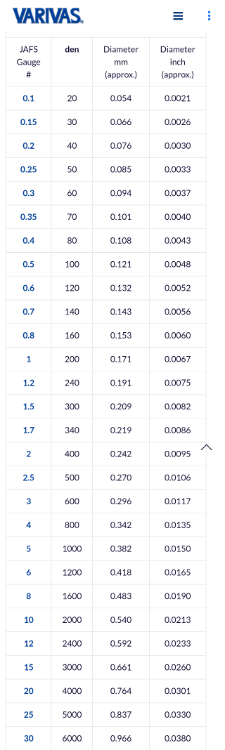
Go by the JAFS diameter rating printed on the label as it's closer to its actual diameter. This number will appear in gou, designated by the gou character 号. Take the imperial and metric diameters with a grain of salt, they use those purely for marketing purposes. I use the 6lb often, labeled as #0.8 号. Visually comparing it to #0.8 YGK Upgrade x8, the x9 is just a tiny bit larger in diameter to the naked eye. You can compare the goh rating of X9 to the chart on the Varivas website to get you a ballpark figure of its actual diameter.
-
Keep in mind that Cal is a little on the nitpicky side of things. That's his job as a reviewer. In practice, the Ambassadeurs don't lack cranking power. Are they as powerful as something with a larger drive gear? Not necessarily, but here's where things get interesting. Abus use deeper gears, which will have more torque on tap than a faster set of gears of a similar diameter. The larger diameter spool in this case is what "speeds up" the reel, since more line is wound every turn around the circumference of the spool. As an example, every fall I swap my faster 2500C gears from 6.3:1 to the factory 5.3:1 for steelhead fishing. I lose about 5" per turn, but now I have more oomph on the bottom end which is more important than speed in that scenario. I'm after fish in that 5-10lb range that have a lot of fight in them. The difference in torque is very noticeable, especially on the 30mm dia spool in that particular reel. Retrieve speed drops from 23" to 18" per turn, but I run a shorter handle which I can crank much faster to make up for it. There is no free lunch. You can have torque or speed or try to find a nice balance. On that note, I've had plenty of Daiwa and Shimano models in my shop with gear brinnelling. This is only in the faster geared models. Brinnelling is when the gear teeth become malformed from stress. During the cleaning process, I sometimes find metal shavings. The reel may operate smoothly, but there will be an unusual amount of noise coming from the gearbox. The easiest way to find it is to thoroughly clean the gears and check for discoloration on the pinion, specifically where it contacts the drive gear. If it appears off color, that is brinnelling and no lubrication will fix it. The reel will still be perfectly usable, it'll just be a little chatterbox until the gears are replaced. I've seen it mostly with the Tatula platform and Shimanos with micro gearing. When you read of people saying their reel now sounds geary, brinnelling is the most likely culprit. It usually happens from fighting fish with the drag set too high or pulling snags with the drag locked. Brinnelling is much less common in Ambassadeurs due to the thicker teeth hobbed into the gears.The last low profile reels I had were a pair of Alphas CT SV70s, one in 7.2 and the other 6.3. Awesome reels but when I got my Millionaire CT, they took a backseat and were eventually sold. Now I'm all round reels. I prefer the aesthetics and in the case of Daiwa and Abu, the customization options. The current iteration of the Ambassadeur has been around since 1991, and the Millionaire since 1997. I love my Shimano Calcutta Conquests, but they change the design every 7 years to the point that there is no backwards compatibility with parts. With the Millionaire and Ambassadeur, you can roll your own out of factory parts.This was one of my favorite builds for a customer of mine, dude is a king salmon diehard. All new or new old stock parts, only aftermarket parts are the Rocket Reel Co. 5.3:1 gear set with the stainless drive gear and hardened bronze pinion. Brake plate is from a Royal 4500 so it has both an AR dog and roller bearing, chromed brass frame, 5500 C3 spool and line guide, 5600C4 level wind, 2bb idler gear, etc. I did this build 5 years ago and receive it every spring for a freshening. He actually got his personal best on this one in 2022, 41" and 39lb on a Thunderstick.Thanks! When I do a reel build, I like to make it look like it could've come that way from the factory. I was the same way when I used to turn a wrench and play with cars. I don't do disco with flashy colors, I like subtle distinction.All of the tools above will cost about the price of 3 or 4 reel job, then figure another $20 to $30 for grease, oil, and applicator brushes. Not too bad, plus you get to learn something. The learning curve isn't bad if you're mechanically inclined. You'll make mistakes and lose parts, but it's all part of the learning process.This will cover most of your bases https://a.co/d/9ifP9Cj A couple of JIS that are nice to have https://a.co/d/3eXjrhW https://a.co/d/eoFmHcc Tweezer set https://a.co/d/2ICMaed Bearing check tool https://a.co/d/eEQyvUG I highly suggest the Wiha set above, it will cover the majority of jobs for most bass reels. You'll also want a 10mm wrench, or even a small adjustable wrench. As far as cleaning goes, lots of methods you can employ. I use mineral spirits and a toothbrush for all non bearing parts and an ultrasonic cleaner with denatured alcohol for bearings. Every one of us reel technicians has a method to our madness. You will be no different as you find out what works for you.Called that one. I'm actually surprised it took such little time though.The NMB bearings found in reels are rated P0, which is the equivalent to ABEC 1 standards in Japanese manufacturing. This is in their technical documentation. However, I've noticed GRW and NSK don't mention that info in their technical documentation, much like your experience with Timken.I'm running Falken Wildpeak AT Trails. I went up a little over OEM, from 225/60 to 225/65 and got another half inch of ground clearance. I also have a CVT cooler and skid plates in the diffs and CVT. I wish these still came with a manual option and the dual range transfer case they offer in Australian and South African markets.This is the story of many of my fishing adventures. I'm one of those guys that lives out of a backpack and sleeps in a hammock for up to 5 days at a time. My gear has been all over from canoeing through Algonquin Provincial Park to the backwoods in the UP of Michigan in search of tiny streams meandering through the woods. None of my reels have a mark on them. I carry them in padded pouches and when it's time to play they come out and are put on a rod. When I land a fish, the rod butt goes into my wading belt and the reel stays off the ground. My most blemished piece of "gear" is my Subaru Forester. For only being 4 years old and having 53k on the clock, it's full of scratches and dings from traversing narrow primitive roads and getting hit by falling branches and nuts. It literally looks like it has triple the mileage. It isn't something I'm worried about though because I bought it to be a mule. Some guys I know will have their truck in the body shop the second an acorn puts a dimple on the hood. I do more wheeling in my Forester than most others do in their Jeeps, Broncos, and pickups, and I don't even have a dual range transfer case either, but I do run all terrain tires rated for severe snow service. When I'm out bushwhacking, I like to keep a 16" chainsaw in the back just in case the trail is blocked by a fallen tree. Plus it's also great for procuring firewood. Great tool to have handy when you're out brush busting.I dunno if I'd call it high end, but if you're a river rat like me and spend most of your time fishing in waders, a Folstaf wading staff is very well worth it. You can wade fast water much easier because of the added stability, and it deploys with just one hand. It's like having 3 legs. You can also better navigate steep river banks and poke around for deep holes and obstructions. My fishing buddy called it a sissy stick until he took a swim in a cold stream and had to go home. Now he too never hits the rivers without it.I got mine new old stock for $100. Funny story is I saw it originally on marketplace, guy was on NC and didn't want to ship. I told him I'd cover shipping and throw him another $20 for his troubles, nope. A few weeks later, I get an eBay alert for that very reel, dude decided to eBay it. I told him my offer still stands, "no the Japanese sellers are getting $300". I told him it will probably go for $100 to $150. I ended up winning the auction for $100, and he covered shipping. He'd have made about $50 more accepting my offer when it was on Marketplace. Instead, he was on the hook for shipping and eBay fees.Black Max predates the Morrum. Black Max was made from '92-'00, Morrum from '98-'15. The Morrum was the successor to the original Max reels and were only made side by side for a couple of years. Both are great reels, but the Max reels don't have the aftermarket support of the Morrum. The Max series was intended to compete with the Calcutta B, and in turn the Calcutta Conquest was designed to compete with the Morrum and CV-Z.One big thing I'd like to clear the air about is ABEC rating. I'll talk about what ABEC is and is not. ABEC is the industry standard that specifies the dimensional tolerance of a bearing, measured in micrometers. Essentially, it's the tolerance in relation to how it fits to a shaft or housing, that's it. It has nothing to do with internal clearances, raceway finish, or ball quality. Too high an ABEC rating can actually be counterproductive in some instances, as too tight a fit can cause the raceways to distort which puts them out of round, compromising performance. Bearing resellers use the ABEC system as a marketing tool which is not indicative to end performance, but pass it off as being related to internal clearances. Higher numbers move products out the door, the human mentality of more is better. The biggest quality bearing manufacturers are in the USA, Europe, and Japan, with manufacturing facilities in China, Thailand, Singapore, and their own domestic production plants. Here in the USA we have Timken, Carter, Schatz, and Del-tron. In Europe the big players are SKF of Sweden, RBC of France, and GRW of Germany. In Japan, we have NMB, NSK, and EZO. By and large, their biggest customers are manufacturers of dental tools, precision machine tools, aircraft instrumentation, and automotive instrumentation. Those bearings need to have rotational stability and a long life. These also happen to be the same bearings used by fishing reel manufacturers. These companies are so big and produce so many bearings that some can be had for peanuts. For a manufacturer of this caliber, making anything is a breeze. Their manufacturing technology is well matured and their QC among the best. If it weren't, purchasers would be looking for somebody else to supply their bearings. When it comes to reels, the manufacturers are the same. Their engineers will pick the highest quality within their allotted budget, and that usually means NMB, who supplies over half of the precision bearings sold around the world. I bought in bulk from Japan and paid a little over $1 each for my stash of NMB bearings after shipping costs. Even questionable ceramic hybrid bearings from the popular Chinese sites weren't that cheap. Domestically, they run about $5-$8 each depending on the retailer. NMB bearings are used across many reel brands. Daiwa, Shimano, Isuzu, Doyo, Abu, and even the better quality CDM reel brands use them across their entire product lines.Major Craft Days is a fine rod. I'd even dare to say to look at the 65ML. I have it and even though it's rated to 3/16 at the bottom, I've thrown 1/8 total weight on it numerous times. While not technically a BFS rod, it does cover a wide range. Where I am, there are plenty of surprise musky and big sheephead (freshwater drum to you non Great Lakes people) that also prowl the same waters as bass. Having that extra backbone can help considerably in those situations.





Important Information
We have placed cookies on your device to help make this website better. You can adjust your cookie settings, otherwise we'll assume you're okay to continue.