


JHoss
Members
-
Joined
-
Last visited
Everything posted by JHoss
-
Remind me what state Lake Guntersville is in? ALABAMA... like in ALABAMA Spotted Bass. Of course the lakes and species in its native range have evolved to have a balance between the species that naturally occur there. The problem is when they are introduced into lakes where they are not native. They are invasive in nearly all situations of introduction as long as the temperatures don't get too low in the winter. I'm sorry man, but the science says you're wrong whether you want to accept that or not.
-
Ever heard of Major League Fishing? It's the same format they use, but with photo submissions for length instead of a marshal weighing and logging each fish. Typically, results are finalized an hour after lines out.
-
I could never bring myself to put a buzz on a reel that slow. I use a buzz for covering water too frequently and would wear my arms out turning the handle fast enough to keep it on top when I'm closing on it at 1.5 mph with the trolling motor.
-
Just like you, fish have certain periods where they're actively looking to eat and periods when they're not in the mood. You can trick an inactive fish into eating, but it's much harder than getting an actively feeding fish to take a bait. If you know there's fish in the area but they aren't eating you have two options: stay and wait for them to turn on or run somewhere else and look for a different group of fish that are actively feeding. There's countless examples of successes and failures with both strategies at the highest levels of bass fishing. I, personally, don't have the patience to wait them out, so I'll run to a different part of the lake and try there. Often times I'll return to spot multiple times throughout a day if I think it will turn on at some point. Some times it does, some times it doesn't. If you do choose to stay and try to convince those inactive fish to eat, you either want to attempt to trigger a reaction strike with a moving bait or go ultra finesse and subtle. I would warn you against believing everything a scoper tells you. A lot of those guys think they know what they're looking at, but have no clue. I've had it almost a year now and struggle mightily to differentiate a bass from other species- most guys aren't good enough to do that consistently. So a scoper may think he's looking at a creek full of big bass when in reality they're gar or some other trash fish.
-
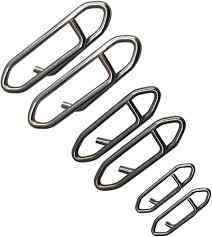
I prefer them, but can't say they're necessarily better or worse. I prefer them over a traditional snap for three reasons: Speed. I can get these on and off a lure faster than a snap. Weedlessness. There's no tag end of wire sticking out to grab on to weeds like most traditional snaps have. Ease of use. These are much easier for me to get on and off a bait with my fat fingers compared to a traditional snap that has to be clipped and unclipped.
-
I referenced Snakeheads in regards to asking anglers to kill fish. When snakeheads were first in VA/MD, DNR regulations said you could not release them after a catch, but people who enjoyed catching them did not follow the regs. And many of those who were trying to abide by the law, misidentified bowfin as snakeheads and killed them. If a law was passed mandating the culling of any Alabama Spot caught, you would have some folks releasing them intentionally and other folks killing LMB and SMB because they can't properly differentiate the species. Biologists don't need crystal balls for Alabama Bass, they have lakes that are 20-30 years into a Alabama Bass invasion that they can study. Those lakes show that Alabama Bass replace native LMB and SMB populations and they will do that in just about every watershed they're introduced to. Alabama Bass outcompete LMB and SMB when they're 3-8" long. No amount of fishing harvest can impact that size class. Check out the most recent episode, "You A'int From Around Here!" from the Better Fishing with Two Bald Biologist Podcast. It's all about invasive species in NC and they go into detail how the Alabama Spotted Bass have impacted specific NC lakes and rivers.
-
The problem is there is no way to control them once they become established. You could help lessen the impact by requiring tournament anglers to kill any Alabama Spot they catch, but as we've seen with Snakehead and Blue Cats, that doesn't work. People who enjoy catching them will still let them go. And possibly worse, people who can't accurately identify fish will kill the wrong species. Also, unless you find a way to only catch spots vs LMB and SMB, you're still going to be harming the native populations with release mortality anyway. From the research out there, the only way to protect a watershed from Alabama Spots is to make sure they never get in to begin with. Personally, I'd love to see violators face extremely harsh punishment for introducing them anywhere they don't belong.
-
I'd say you can completely prevent it by using a quick clip. The only sharp spots are the ends of the wire and if your knot hits that, your baits already gone. You're going to get a different answer from everyone. I don't have a brand preference, but I like the quick clip style like these instead of a traditional snap. I just buy whatever brand the local tackle shop has at the time I need to restock. Usually around the 20-30 lb range.
-
I believe the one I'm throwing is a heavy moderate which may help. I throw it on 17 or 20 lb fluoro, but I've heard of some guys going to braid with a glass rods if they can't get it to bust free. I still have to pop my rod to clear grass on occasions, but it seems to be less frequent than when I threw it on a graphite rod. I will say the weight is a disadvantage. My glass chatterbait rod is the heaviest rod I own by a long shot. This is another big factor for why I like my glass rod that I forgot to touch on. I tend to be quick on the trigger with moving baits and a glass rod lets them get it a little deeper.
-
We all start there. Casting a bait caster becomes so much more fun than a spinning rod once you get the hang of it. I've found Lews and Kastking to be a couple brands that have decent products at their lower price points if that's what you're looking for.
-
I'm not sure the videos do justice to the size of these fish. When we talk big reds in the Chesapeake Bay, we mean 40" plus. And a lot of those schools are made up of nothing but those 40"+ fish. We usually use TLD 15s or 5000+ spinning reels when targeting that trophy class. I'm not sure I'd want to hook into one with anything I carry bassing. This is something I had kind of forgotten about. Like many people, I enjoy "leveling up" in whatever game or hobby I'm doing. But, my wife says that my ADHD causes me to lose interest in an activity once I've "leveled up" high enough to be in that expert class of participants. That's why there's a garage full of woodworking tools and a closet full of camera gear- I got to a point where I had it somewhat mastered and it became boring. There's so much to bass fishing and it's always evolving, so I don't know that I'll ever truly feel like I've mastered it and get bored, which is something I love. When I start to feel bored, I can find a new technique or body of water to learn.
-
I'll take a stab at these, though I'm sure there are more qualified folks on here. Why am I catching bass around docks and laydowns. There's two main reasons here: cover/hiding and temperature. A dock or log allows bass to get something over their head to hide them from birds of prey like Osprey. They allow them some protection from larger fish that could eat them. And maybe most importantly, it gives them a spot to hide and ambush prey. Another key factor is the ability to hold heat. A large piece of wood will hold onto heat way better than the water. So a dock or laydown that has the sun beating down on it all day may make the area around it slightly warmer which will attract fish. Conversely, in the heat of the summer, this wood can hold onto the coolness from the night longer than the water warming around it. There's also entire food chains living on and around this cover. The wood grows vegetation and algae that bugs and craws eat. The bigger fish come to feed on those organisms. Most of the time, there will always be some bass on some of these types of cover. The question to ask is, "Is the bulk of the population doing this or should I look for them elsewhere." And can I be catching more bass if I moved away from those things. Sometimes. Patterns are constantly changing. One moment the bulk of the population may be associating with boat docks, the next they may be offshore chasing shad. Have a plan to try different things and areas to get a feel for what the fish are doing that day before you commit to running one pattern. I often look for an area that has a wide mix of cover and structure where I can feel out a lot of patterns in a short time. At this time of year what are the bass moving torward and are they still deep with temps around 58-66. In my opinion that's a bit of a broad range for the waters I fish. At the high end, they're still very much in their fall patterns, chasing bait up shallow and feeding up for the winter. At the lower end, I expect my fish to start moving towards their winter haunts, which are often deeper. It's important to remember that there will always be some bass up shallow and always be some bass out deep. Id like to go out there and feel like I know what I’m doing instead of just fishing the obvious docks and laydowns and points. I'm not sure if you're fishing from a boat or kayak, but I'd suggest making a plan before you head out. As I mentioned earlier, you can really help cut down how long it takes to figure out what the fish are doing if you can find a small area that has a lot of different cover and structure. My favorite way to do this is find a shorter creek that checks a lot of boxes. Maybe it has a main lake point at the mouth and a couple secondary points within the creek. I want it to have manmade cover like docks and a blend of natural cover like laydowns, grass, stumps, cypress, etc. If I can find all of those things in a half mile to mile stretch, I can try a lot of patterns in a lot of areas to start to figure them out. Are they main lake, mouths of creeks, middle of creeks, back of creeks? Are they on docks, cypress, pads, etc? Then its a matter of refining bait selection. Hopefully you figure it out in the first area, but if not, I'll run to a different section of the lake and try it again.
-
They deserve no love in VA or anywhere else they're not native. There's enough science out these days to show that when they get into a new body of water, they outcompete the LMB and gene swamp the SMB to the point of being the dominant bass species in that water. An acre of water can only hold so much life, so that increase in spotted bass has to come at the expense of other predators, which is often the LMB and SMB you've been fishing for. Since we're talking Virginia, the James River is quickly succumbing to Alabama Spots. North of the fall line has historically been a great smallmouth fishery, but over the last 5 years the Alabama Spots have gotten in and outcompeted the smallies. Now you catch more 8-10" spots than smallmouth and in 10 years, those smallmouth will be so gene swamped by spots, that they won't even be considered smallmouth anymore. That's a shame that such a historic fishery will be wiped out because some dumb a$$ bucket biologist decided they wanted to catch spots in the James.
-
Personal preference. The idea behind it is when your bait contacts a clump of grass, you just keep reeling and the glass will load up and then rip the bait through the grass. With a stiffer graphite rod you have to pop it to free the bait. My main chatterbait setup is a glass rod and its pretty good about this. But the main reason I haven't switched to something lighter is that this setup has produced a very high landing percentage for me.
-
No. Snap OR Split Ring in my opinion. Having both increases the noise from the bait and a second possible failure point without any benefits aside from saving the time to remove the split ring.
-
Yep, I figured you meant that they were all connected by ownership, but thought it worth clarifying for anyone not as familiar with the area. Did you make it out to Branch or Mills this year? They have been two of my favorite local lakes the last few years, but they were NOT good to me this year. Branch is probably 5 ft below normal pool right now making navigation tough and the bass seem to be struggling to maintain weight for some reason- not for lack of bait, though. Mills was also tougher this year than usual. I struggled to catch limits in a few events out there and most tournament bags were down across the board. I didn't notice anything different about the lake health other than an anecdotal increase in pickerel. I'm with you, I wish we had a big, deep lake around here. Branch is one of the few around with actual structure, but its too small to really run a pattern on. Back Bay, Northwest River, and North Landing River have the size, but lack the depth and traditional structure that a bigger lake would have.
-
Looks like an Ugly Stik? Afraid that might just be poor design. I've seen a lot of the lower end Ugly Stiks do this.
-
While all of those lakes listed are operated by the City of Norfolk, they are not a connected chain as I'm reading here. Western Branch, Burnt Mills, and Lake Prince are a connected chain. Lake Smith, Little Creek Reservoir, and Lake Whitehurst are part of a different, connected chain of lakes. Couple things to add to this thread: Word is that the Whitehurst Ramp is a great place to have your truck broken into and stuff stolen. While they say it's gotten better in recent years, it's still one of the worst around. I would think long and hard before I ate anything from Whitehurst with the amount of pollution coming in from the airport. Last time I was there, there was a sign to this affect warning about the contamination from jet fuel.Couldn't agree with you more. Now that I think about it, the rod market feels a lot like the health insurance market over the last 14 years...Start using the same length rods and you'll be the Bryson Dechambeau of fishing.This topic sort of came up on the most recent Bass After Dark Podcast. Jordan Lee and one of the other guests discussed how in the late 90's to early 2000's, many of the guys on the top tours were bringing in $750,000-$1,000,000 per year in sponsorships alone. Now, most of those guys have some sort of second "job" outside of tournament fishing and sponsorships just to afford to fish the highest levels. I personally, have no opinion on this as I've only seriously chased bass for 4 or 5 years now. I do believe my greatest eras are yet to come, but for a reason many won't resonate with. As a lifelong hunter, I've seen private hunting access become so expensive and so hard to find that I expect I won't have access to any private lands to hunt in the next 10-15 years. 15 years ago we had access to 20 farms, today it's down to 3. Public land is limited around me and the pressure is already too much. I imagine it will just get worse and worse over time to the point that it will, largely, not be worth pursuing. So, I'm expecting that as that access dries up, I'll have more time to devote to my other outdoor passion, fishing. I hear that fall bite can be pretty good.Gotta disagree with you here. I fish salt 10-20 times a year these days and can't remember the last time I trolled or jigged. I'm not sure there's a saltwater species that can't be caught with artificials. I threw live bait on two occasions this year- sight casting big cobia in open water, which is more like bed fishing than anything else. Aint nothing boring about watching a 50+ lb fish inhale a bait you presented perfectly and then holding on while that fish runs like a freight train. I'm with you on this- it's one of my favorite parts of bass fishing. But it doesn't have to be exclusive to bass. I've used this philosophy and the things I've learned from bass on many species both freshwater and salt. I'd agree most of my fun fishing is for bass unless there's an unusually great bite/run of something else going on. I likely differ from you and most folks in that my fun fishing for bass is practicing for future tournaments in my mind. But if we get to pick when we get skunked, I'm going with a late spring day on the Chesapeake Bay, a couple good friends, a cooler of beer, and someone else's boat so I don't have to worry about driving us home. Can't argue with any of that reasoning. I think a lot of die-hard bass anglers would be a little less die-hard if they lived places with an abundance of equally exciting species to chase, like reds. Reds may be one of the few saltwater species we have close to year round, so maybe their patterns would challenge me like bass if I dedicated some time to them. Have you ever seen the videos of the giant schools of bull reds cruising the Chesapeake and being sight casted to with topwaters and bucktails? Not what most folks think of when they think of redfish, but I doubt anyone would complain about getting on that bite.This is why people should have a basic understanding of relative weight for bass. You're not going to catch tanks in waters that have a population with low relative weight, so why even fish there if your goal is a big fish. And if you do fish those waters, harvest can be extremely beneficial.There's lots of studies out there about the how scent affects fish. I believe Berkley did the largest study for bass specifically. They said that sun screen and bug spray repelled fish more than anything else they tested, which included everything from gasoline to MaxScent. Apparently, fish will run from the area when those two scents are introduced. I try to be careful about keeping most foreign smells off my hands when I'm handling tackle. If I think I may have gotten something on my hands that could deter a fish, I'm more likely to add scent to any baits/lines I touched.



Important Information
We have placed cookies on your device to help make this website better. You can adjust your cookie settings, otherwise we'll assume you're okay to continue.