Paul Roberts
Super User
-
Joined
-
Last visited
Everything posted by Paul Roberts
-
First of all... make sure you are in water that has catchable numbers of big bass. What "catchable numbers" means to you may depend on your willingness to go fishless. Most big bass are caught... where there are big bass; The more the merrier.
-
Colorado: 11-6, 22.5 inches long, 1997. A trout stuffed beast. At 22.5" a "normal" bass would be in the 6lb bracket. The state website also lists a C&R record of 28" but the consensus, including an account of someone who was there, said it was 22" if that. All our bass here seem to be on the short side. If they have the food, they just seem to get round.
-
No. But I've caught a few of them. One was the baited rod of a friend was lost -yanked right off his boat dock. The talk was that it was a HUGE carp; The ultimate"big one that got away story". A couple days later I caught the rod, and reeled in a 15" carp.
-
Between the wind(!!!) and a couple bouts of a stomach bug, I'm not too happy with her either. And I usually like her just fine.
-
Hmmm... Didn't think about how that might be taken. Honesty has never been lacking in me. Forthright, sincere is more like it; That I am willing to put my name to my words. The "uppity" part was for a bit of humor, although there is some truth in there too. My wife has said about me, "Paul isn't always nice, but he's always good." I have been called "driven" at times, and I am in my interests. Not for personal gain ("unfortunately" says my wife) as much out of sheer passion. So... I often have a lot to say, and will question something I don't agree with -for sake of clarifying the subject; I really want to know. Hopefully not coming off too strongly, or stepping too firmly on toes or beliefs. Years ago, while being interviewed for a research position, I was asked why I wanted to do science. I replied unhesitatingly, "Because I want to see the face of God." It wasn't hubris, or overconfidence; It was pure passion.
-
Ok... Let's just say, sometimes they bite and sometimes they don't. And leave it at that.
-
"Magic" is in one's own head. OR... magic is as magic does lol. Stop looking for magic; It'll hurt you! When I get a moment I'll pipe in with my 2cents. In the meantime, be thinking about the myriad factors that can affect a living critter, like a bass, and all the critters involved in the chain that leads to bass. And then think about just how good fishing is as a consistent sampling method.
-
When I started on discussion forums, about 15 years ago now, I made the decision to use my own name. It was impetus to be honest and... willing to be set straight if I got too uppity.
-
Photoperiod lights the spark, heat makes it burn.
-
You've got to identify bass habitat -where bass can make a living in your waters. They are not everywhere, esp in larger waters. One thing that would help would be to fish smaller waters, esp in winter and summer. This question is the same one as a boat angler might ask. Start reading all you can on bass seasonal habits and locations. The articles and video sections here should get you in the ballpark on your waters.
-
-
I've seen SM act like LM -sortof. Had a pond with both in it. It was heavily vegetated around the perimeter with open water in the middle. Smallies hunted under the slop along shorelines like the LM's. Caught SM up to 19" on frogs.
-
True beast, tank, toad... Congrats!
-
Bluebasser's and Croakhunter's assessment is spot on. Angles matter.
-
It'll thermocline for certain.
-
No I don't. In my shallow waters, and in shallow wind protected places in larger waters, I can get a pretty good estimate from weather history over previous few days using the average daily temp. I've taken temps for years so I have a feel for how water heats, but there are still a lot of variables: sky, water conditions, aspect, albedo, how close to deeper water, ... . So I still temps. The other day I was on a good aggressive prespawn bite. It then promptly died in the afternoon. After trying a few presentation adjustments I thought maybe the fish had moved into warmed shallow shoreline cover where the water was flat calm. So I pressed back into it to take a temp, and found it no different than the more open water I'd been catching in. Gotta measure to really know. I still don't know what had happened to that bite. Take a temp profile in your quarry, every time you fish. Then you'll get a handle on it. It'll often be the same year to year. The deeper steeper -the more massive the mass of water, and wind protected- the more stable, slowly evenly, it'll change.
-
Thanks, all. Just great responses. I do use those and do very well on them. When thinking about tinkering I was thinking along the lines of using an in-line. I also like the big CO blade idea too. Here's what I'm after: Essentially a waking/bulging buzzbait. A friend had bought a very cheap standard buzzbait style from a local hardware store. It had a plastic head! If reeled at buzzbait speed it just planed on its side. So my buddy retrieved it really slow. It sat really low in the water, and just waked and bubbled, crawled in the surface film. Oh my, did it catch bass, and big ones. Waking and bulging baits tend to interest big bass and, remembering my buddies cheap buzzer, I'd like to make something like that. Thanks Bobby. I probably ask this question every spring! And every spring I say I should pick up a Cavitron. Guess it's time.
-
Thanks all. Looks at this point it'll be Cavitron.
-
What's the slowest working buzzbait out there? And... can I slow BB's by bending blades?
-
Try the #13. I use the #11 in really calm conditions, but go to the 13 the rest of the time. Also, the jointeds also work well as a twitched topwater, one way I use the original Rapala's. That rolling twitch of the straight Raps is exacerbated in the jointed model. The jointed doesn't work so well as a jerkbait though.
-
Yes, small and shallow waters are MUCH easier to get a bead on. The way heat gets distributed makes deep waters -that can hold onto masses of heat- both more stable to outside heating, but potentially more volatile when winds kick up. Then there are tributaries... Jon's on that one... He and I have both spent some time winter steelheading. They say the Inuit use something like 80 different words to describe ice and snow. Don't know if that's true, but I can certainly imagine it. Quite a while back now, I wrote an article about winter trout fly-fishing. In it I stated that air temps below ~27F created such hard ice in the guides and on the line that fishing -with fly-line- became impractical. The heavy-handed Editor changed that number to 32, among other things.
-
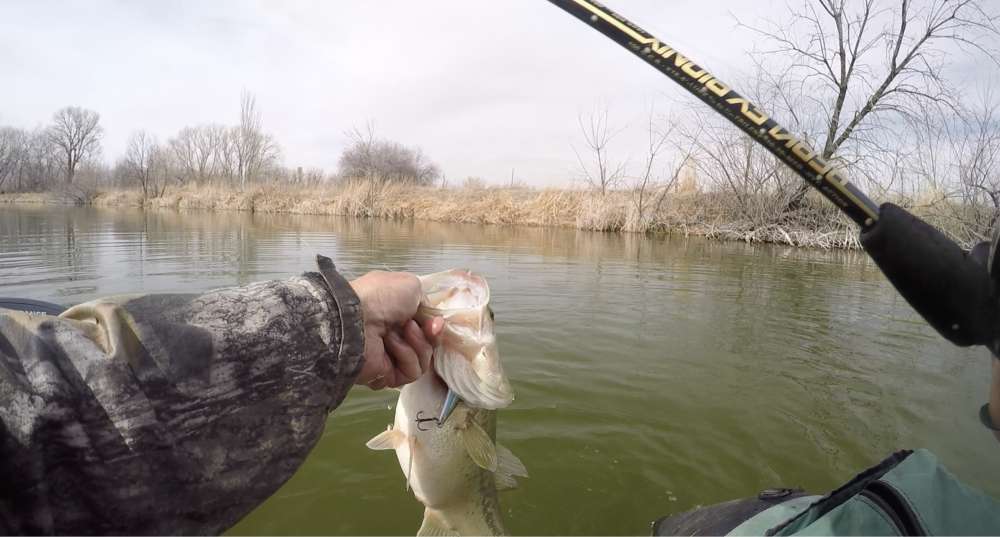
I had this one just the other day... Took on a pause after some hard jerks. She sure was excited and almost sucked it right out her gill flap! It lodged in her rakers -that's what they're for after all- and not a single hook point was stuck in her. The plug was clamped between gill arches.
-
Yes. Although, you should ground truth it on your waters to get a more accurate bead on heating. Nature can be capricious. In general, if you look at the average daily temperature over a couple days time the shallower waters (~<8fow) will follow with a delay of a few hours time. The deeper you go the more buffering there is. Bright sun with calm conditions heat best. Overcast and calm still heats, but less. Wind will roll up cold water however. I've taken temperature profiles for years so I have a good idea of how water bodies heat. At one time I fished and took temps so much I was accurate to a degree F by touch alone. Wish I could still fish that much.
-
If they'll take a straight retrieve, GREAT! But, often they need to be triggered. I always talk retrieves in my videos as I fish; They can be pretty important. There's a Late Summer one that describes fishing cranks in vegetation, and describes and shows how to set up "the rip". In the one above, that Choporoz brought up, the water was cold and the pauses were critical. In general. motion tells the fish the lure is "alive"; the pauses let them know they can catch it. As you can probably imagine, the colder, or less aggressive, the fish are, the more important the pauses are. There's another, the Mid Fall cranking one, that shows this even better. There's another component too -horizontal vs vertical- which affects speed control too. Only two fish in the Mid-Fall video broke this long pause pattern: but both struck on the "initial descent", which is essentially a more vertical, and therefore slower retrieve speed (in the horizontal). Hope this helps. I'm also working on one that will address presentation directly.
-
There are quite a few aquatic worm species. But guess what? (My son would respond 'chicken butt!'; He's just about cured me of saying 'Guess what?') Nightcrawlers are not even native here! Oh! Yes, I remember "black/brown eels" being in ocean tribs. But... I wonder when and how far they move inland. It's true that bass were originally from the backwaters of the Ohio River/Great Lakes and tribs (post-glacial, when the waterways were bigger). Possibly some could have had access to elvers? "My take away is fish eat them. Basically nothing else to the story." That's something we can all agree on! But, there's always more to the story!