Paul Roberts
Super User
-
Joined
-
Last visited
Everything posted by Paul Roberts
-
-
Not where I live. My bass are small-ish, generally with high water clarity, with lotsa sun. Tough to hide 10-20lb lines striking, and cutting, the water over super-spooky fish. In fact, it can be tough to hide a 6lb mono from super-spooky fish. Again, we can't separate the lure from the line it's attached to. They are a package. And big packages more easily spook fish.
-
Neat thread. When I lived in NY, I often found old fishing tackle at garage sales and flea markets. Now, in CO, it's rare, and more apt to be trout fly-fishing stuff. Very cool, Harold! Real frog skin! Now that is cool. Love the spinnerbait, Brian. Looks like that one was to address the idea that bass sometimes target the blades. Not sure that's really what's going on there, but that explanation did get passed around a lot.
-
Gotta chime in on this... Great post A-Jay, all of it. "Prediction" is easy when we're talking broad time scales. Things get chaotic as we narrow the timing, down to... days, or hours, or... Heck, when a bass bites, it's really a momentary decision. I know my bass will initiate spawning between mid and late April every year. But, when each water body, or population, initiates is a matter of conditions, circumstances, and likely, history of that population. And in terms of mood and feeding behavior, there are a lot of potential variables: motivators and disruptors. The game is not some machine we can plug in some data and spew out a solid predictable answer. Thus, the "search", each and every time out. As to sun angle -I know where you got that one : That's not something we need on our electronics units. It's occurring in large scale, but it is what drives heat gain and loss, seasonally. Following "sun angle" would be like following the Julian calendar for our fishing. That said though, a bright sunny day in March, or October, is a whole different animal than one in July, or December. Agreed, prey locations matter enormously. If there was one crucial variable, it's that. I find my baitfish -mostly bluegills, here- visually. It saves me a bunch of nearly wasted time to do a tour of a water before I start to fish, to locate clusters of bluegills. There will be bass there too. But those 'gills are in those locations for a reason, and it has to do with food, protection, and at times, heat. Heat, also has an effect on how aggressive, or catchable, fish are. No... I do not track heat as some end all, be all. But I don't ignore it either. It can be a major factor behind what I've come to call "Carnage Zones". No, unfortunately, most of my fishing does not involve Carnage Zones, but I certainly don't ignore the potential. Following this Carnage Zone idea... I fish small waters, some really small. So, locating fish is not the issue; They are all a cast away. Instead it's locating scenarios that make those fish vulnerable to lures. That involves conditions and circumstances that are at play, at all time scales. I do see patterns, that are repeatable year to year. And, yeah, exactly when they set up varies to some degree, bc there are multiple variables potentially at play. I think it's worth understanding those variables. Heat is one. And in my experience, it is a big one. Here are a couple trip reports, from.. a ways back... that describe targeting heating. Photos are long gone, unfortunately, but the text is interesting and enlightening. Sure made my idea bulb burn brighter. : http://www.bassresource.com/bass-fishing-forums/topic/46927-two-more-fascinating-days-on-colorado-pond-almost-a-skunking-and-pure-carnage/ http://www.bassresource.com/bass-fishing-forums/topic/116606-searching-out-those-zones-of-carnage/ In the end, yes, we have to find biters, and searching out prey fish whereabouts is key. But we cannot always know what the immediate results will be, so we have to search to get plugged in. But, there are reasons for those big bites, and those dead periods. They only appear random, esp over fine time scales. It sure helps to fish every day. Not many of us can do that.
-
Not so sure exact color is all that important. I think fish behavior and lure action are primary. I fish small waters and went with I Know It. But it seemed it quickly sells out, so I nabbed a couple when the notification came in. So... does color matter? To me it does. The fish... not so sure.
-
For me, "finesse" means, down-sizing the lure and line. Down-sizing the "package size" of the lure, directly involves the line -they simply come together. Down-sizing/Finesse gets important when the water gets cold, or under high visibility conditions for the fish. When you down-size line, you must also down-size the hook to match the line. "Finesse" seems to mean: As little disturbance as you can make. In winter cold water, two things are usually at play: water clarity goes up, and fish are generally feeding on smaller prey items, if at all. So we do better on smaller baits, which, in turn, require thinner lines. In my mind, we cannot separate the lure from the line; They are a package deal. Here's my in-depth presentation on what's going on down there with the fish:
-
Since you are asking about line weights for jigging... try this video. It explains why fishing line diameters are so important. And what's going on with the fish during those times when we need finesse presentations.
-
To me "finesse" has come to mean, down-sized on light tackle. Weight of the head has less to do with it than overall package size. Down-sizing the package size of the lure gets important when the water gets cold. I fish all winter here and small package jigs (1-1/2 to 2-1/2" long) catch really well. For my waters (<15ft deep) I'm fishing jigs that weigh 1/16 to 1/8oz. But if I fish deeper, a 1/4oz could still be a "finesse" sized jig. And, during the warm seasons, I often fish a 1/8oz swim-jig, but it's a full sized package, 3 to 4" long.
-
Hair jigs work as well as skirted jigs in my mind, maybe better in some cases. They were "phased out" bc they are more labor intensive to produce. Rubber skirts just made things simpler. Rubber (silicone mostly) do offer more variations in color, and translucency, which can be a plus. But, hair moves water -makes a wake- better bc of its mass and buoyancy. And that wake seems to say "food" to fish. Hair is esp good in winter bc it slows baits down and moves well in really cold water. But they work all year long. Before "Living Rubber" came out in the 80s I used deer hair jigs for a similar purpose. They worked really well. I also used marabou a lot, and still feel that if I was left with one material to tie jigs and flies with, marabou would be it. I used marabou jigs with either a pork or plastic trailer. If there is a drawback to it, for bass fishing, it's that it is somewhat fragile -will get torn up eventually, and it collects algae, dirt, and detritus. Light colors, esp white, will get dirty and stain. But... nothing moves like marabou in the water.
-
I believe my first worm kit -if I'm remembering right- had the same green plastic box, so it must have come from Northwoods -prob through Fishing Facts. Amazing how I still remember, really well, how that box opened, a bit stiff. Man, I think I can still smell it too. I had some Crawford jigs too. My buddy back then caught the first really big bass we ever saw, a 23" 7lber, on a purple Crawford "Governor" jig. I began to tie my own shortly thereafter; Used a lot of marabou with worm tails after that.
-
Keep throwing them. You'll learn to love them.
-
I try not to go through plastics, for a few reasons: -I'm stingy. -I am concerned about biphenols like pthalates in the water, due to some evidence that some can cause reproductive harm in fishes and other aquatic life. So... I maintain my soft plastic baits. I repair them with Mend-It, or cyanoacrylic glues. If one gets torn and looks like it'll only catch one more fish, I replace it, and mend it when I return home. I try to find more durable substitutes for certain baits. Bc of toxicity concerns, I never discard soft plastics around water and pick up all I find out there. I'm also using some Elaz-Tech type plastics that are more durable and, supposedly, without the reproductive toxicity potential.
-
Been there. I have actually been out fishing, and said to myself, "What the heck am I doing out here! I should be home... mowing the lawn or something." Fishing is nice, but catching is... the main reason we are out there.
-
Yes! Lay it on us.
-
Agree. I keep firm tension all three strands, and I tug them tight on every turn. At the end, I pull everything tight.
-
Thanks, waymont. That's a good article. Those Midwest Finesse reports are sure detailed. I appreciate Ned's willingness to compile such detail. Fishers find things that work for them in their waters. However, there are basic properties in lines that underlie the reasons we end up divining what works. One thing that is very telling in that article, for the OP's question, -and something not many are willing to try: It's that straight -leaderless- braid catches fish regardless of its color. As I try to describe in my video, the ability of fish to see fishing lines is not the main issue. Bass are physically capable of seeing just about any line. Each and every individual fish can be line shy, but not because they know what line is. Instead, its more bc they don't know what that "large" object moving close by is. Line, by sheer surface area, is a large object. The fact that our lines are inseparable from our lures is the reason I came to believe that line is the most important piece of tackle we own, in terms of getting fish to bite. We aren't presenting a lure, but a lure and line combination. Can fish be "line shy". Absolutely. Easily. But whether the line is fluorescent orange, or "the same refractive index as water" is low on the list of the major reasons why.
-
I've seen plenty of ponds, sitting side by side, that differ enormously in terms of cover, fertility, water clarity... . They fish entirely differently.
-
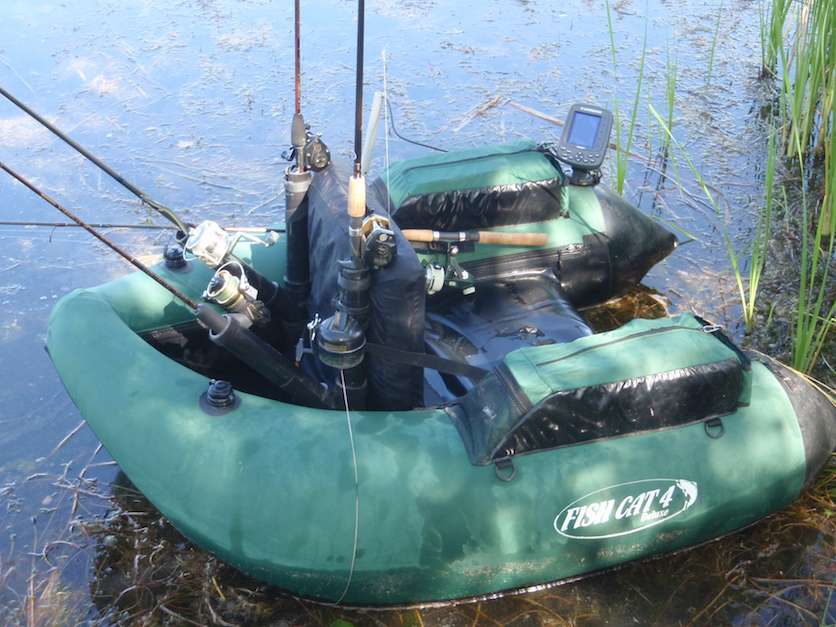
I suggest going with a V-Tube design, like those made by Outcast. I've been in a Fish Cat 4 for somewhere near 10 yrs now. A V-tube is a great design for adding rod holders behind the seat. Mine are made from ABS tubing. I also strongly suggest rigging up an anchor. Float tubes are so maneuverable that they offer excellent boat positioning control. But, even light breezes will skate you out of position pretty quickly. I use my anchor a LOT. To save weight I use small mesh bags and gather stones at pond side. Anchor line is 80lb Dacron in a big saltwater sized spin-cast reel, a Zebco 808. Ditto the PFD. On small ponds in summer -mebbe not. I'm pretty hip to water and boating safety. My main concern is less about not being able to get myself to shore -float tubes are small water craft- but getting all my gear in should I get a catastrophic puncture. My tube is pretty tough, so no such issues so far. And... ditto Jaime's "easy chair" description. I just love fishing from my tube. I'm comfortable all day.
-
I recently put together 3 videos on the significance of line in bass fishing, what I consider the most important piece of tackle we own in terms of getting fish to bite. Yeah, it took me three feature length videos to get it off my chest. Fishing line is the most important piece of tackle we own! -Fishing Lines 1: Tells why. -Fishing Lines 2: What do the different line types do? -Fishing Lines 3: How are they applied to lures and techniques? Here's the first one; It addresses how fish perceive and respond to fishing lines:
-
Like Glenn said, "Be yourself". Not much of a choice, really. Before I started narrating, I was picturing a mix of David Attenborough and Rod Serling. But, I got... me. Following Glenn's lead... If you are not an expert at something, or think you might not be, don't pretend to be. There are too many real experts out there that will expose you. Documenting your journey, your process, your learning, can be a good way to go. And... don't just follow what so many others are doing: "new toy" reviews, or catching fish after fish after fish after fish... without a story -unless maybe you live in a unique place with uniquely large fish, and you can catch them regularly (NDYakAngler, BamaBass, ...). If you are "just fishing" then think of your outings in story form (SBFISHINGTV). People relate to stories. Look up "storyboarding" so you can step back a bit and think in story form. Think in terms of adventure, finding things others don't, especially if they are accessible to many, they just don't know about them. 618 Fishing offers this type of intriguing content. Another venue is the vlog. A day in the life of... you. Sharing what you are excited about. Besides avoiding really annoying faults like bad audio, really poor language or speaking, motion-sickness-inducing camera work, too much "truck time", repetitive scenery, etc ... the most important thing seems to be the sheer volume of... not totally lame content. Seems people are habitual, and can become regular followers. I had a housemate who could watch 3 episodes of a sit-com in a row, every evening, and... they were all re-runs he'd seen a million times before. Frequency and consistency. If this is a just for fun, or a potential business venture, your strategy will likely be different. The YT model may or may not work for you. YT pretty much requires frequent and consistent production to build an audience, and get a good click rate, which is where ad revenue -all YT offers, directly- comes from. Sheer volume and attention-getting productions earn you clicks, and hopefully, an audience. In my case, I'm, maybe foolishly, bucking the model, and gone for in-depth content, and documentaries. Lengthy and labor-intensive stuff that the YT model doesn't directly support. But that's who I am. Remains to be seen if it'll fly. Otherwise, I either have to adapt, or... find a different venue. Good luck with it. The new media venues out there are exciting. Jump in and find your way.
-
Exactly. If you can't wait... close your eyes! Yeah, swim jigs are fished more like spinnerbaits. And a lot of jigs are swum: various grubs, swimbaits, hair jigs, .... IME, you can't give those bites much time. Of course, I never do! But when I have, they're gone. Line tension perhaps, compared to a jig picked up on slack line on bottom?
-
Yes! Concentration means expecting bites. And your body is very much involved. Learning to set the hooks on visible bites can be frustrating. I have come to believe that one must wait for the bass to inhale, eject the water, and bite down. When seeing that mouth pop open, or those gills flare, over your bait, it's all too easy to yank! Also, strikes really close in, on a short line, can result in the same result: Pulling it away before they've handled it. I have to say to myself, "Wait! Wait until you feel em!" A lot of my jig fishing has been with swim jigs that, here, imitate bluegills. My bass often don't hold those jigs very long. How long? That I cannot say, as I've learned not to give them much of a chance. Once it's in there, and they've clamped down, I set.
-
This is just great advice. My first thought to "proper form", like Catt, had me kinda scratching my head. As Glenn suggests, first, get familiar with what is happening down there. This, I believe, is the "concentration and experience" Catt is talking about. It's not something you can practice at home exactly. But Glenn's advice will get you there quicker -bite for bite- than any I can think of. With soft plastics -esp lightly weighted ones- bass often give you some time to react. I'll actually "weigh the line" at times, by drawing slightly taught to feel for weight or "life". Soft plastics usually give you that time. If I don't wait long enough I may come back with half a worm. If I wait too long, I may get too deeply hooked fish. Soft plastics are a great way to learn the feel of bites. Again, you have some time. Now, as you add weight to the rig, however, bass are more quick to spit. I do not weigh the line with jigs (although I know Catt has), as I've found bass to spit jigs quicker. But, if you are on top of things (here, visualizing what your lure is doing at all times) you have time with jigs too. But not if you aren't in contact with your jig, and you don't know what to feel for. It helps a lot to fish your jigs in really clear water -even a swimming pool- so you get familiar with their sink rate and tension on your line. If you know where in the water column you are, where bottom and cover pieces are below, bites are easier to discern. Again, "concentration and experience" are not something you can read about and just do. So, maybe head to that pond that'll offer frequent bites, use a lightly weighted or unweighted soft plastic and play with those bites. Find clear water to swim some jigs around in. Get familiar. Another thing, I find I do not need to strike as hard as I see so many other fishers do. It's as if there is some "form" they need to follow -like a tennis stroke or something. Certain situations can call for some serious power in the hook set: deep water, big irons, stretchy lines, fish in heavy cover when the set and extraction from the cover is almost one and the same motion. But with braid, appropriate power in the rod, and sharp hooks, hook sets are pretty much just coming tight quickly. Man, I scarcely think about it. If I'm missing fish, it's usually something going on "down there", rather than my "form" being off. Hope this helps.
-
Thanks for the head's up, Brian. Do bass have a behavioral memory for previous spawning areas? In the fisheries biology world this is called "site fidelity". Apparently, bass do show site fidelity; Smallmouths apparently more so than LMs. But neither as strongly as some other fish species, as others mentioned above. Bass have been shown to be reasonably good at finding their way back to established home ranges, even across fairly large areas, when captured and then released away from the home range. But not all individuals do so. The reasons could be due to personality traits (exploratory vs reclusive individuals) or ecologically motivated (resulting in home bodies vs roamers); Likely both play a role. It's also been shown that in LMs anyway (and presumably all bass), olfaction is the most important sensory mode used in locating spawning sites; Or at least in re-locating them as this was determined through a study in which bass were removed from established spawning sites, altered (non-invasively to block various senses), and released away from their spawning sites. The area you describe sounds like very good spawning habitat -a "protected area" off the main lake: good heating, and calm water away from wind which can destroy nests by siltation and cavitation, and temperature changes. If an area successfully produces bass, you can expect bass to return there. If an area fails repeatedly, not so much.
-
Thanks, DB. I debated 1 or 2 trolleys. Starting with one and will see how that works. Hoping I can afix my one to both the bow and stern, right at the very end so.