Fishing Rhino
Super User
-
Joined
-
Last visited
Everything posted by Fishing Rhino
-
Pickled? I may be showing my age, but is that the same as getting the shaft?
-
Anything more than a utility trailer, get a regular hitch. If you're handy with tools it's a bolt on project. And, as mentioned you can get the proper height for the ball, rather than making do with the bumper height.
-
An excellent point. I always have the hatch to the battery compartment wide open when using the onboard charger. Not only are the fumes explosive, they are also corrosive. As a side note, batteries in good condition will produce much less gas when being charged. If you notice a sharp, pungent odor when you open the battery compartment, it's very likely you have a bad battery, or a battery on its way out.
-
I make fiberglass race car bodies, and the name of my company is Rhino Hide, indicating tough and durable. So I incorporate it into my screen name to fit the forum.
-
Technically, just enough water to cover the plates. Usually, or used to be, you fill them to the level of the bottom of the fill tube when you remove the cap. That was the way I learned to do it years ago. Today, ????????? The main thing is the plates should be covered. Excess water will dilute the acidity levels of the electrolyte.
-
I've been pretty harsh with BPS of late. I've listed several grievances about their cutting corners and compromising quality for cost savings. A problem developed with the single lever remote for my motor. In reverse, the throttle was very stiff. It would go into reverse, but to get more than idle speed, considerable force had to be applied to the lever. And, there was the problem with my Z7 getting up on plane. So I called the Foxboro store and they told me if I could get it there, they would look at it right away. Hooked up the boat and got to the store an hour later. They were scratching their heads about the planing problem. I told them the motor would turn about 5200 rpm at full throttle with the stern squatting and the bow toward the heavens. Seemed to me like the prop wasn't getting enough bite or wasn't large enough. The Nitro "expert" came out, looked at the prop and asked me if I had changed it. Told him no, it was the prop that came with it. He asked if I was sure. Told him I would not forget something as significant as changing a prop. He said it's the wrong prop. Too small and a 20 inch pitch. Should be a 23" pitch. The tech checked it out and the Pro was correct. They made some adjustments on the control which resolved the reverse throttle issue. Got home, took the boat out on So. Watuppa, a nearby pond that is about six miles long and and two miles across at max width. Night and day. On takeoff, the motor would only turn about 3300, but the stern would squat, the boat would accelerate and the bow would drop. Not a drag boat by any means, but a huge improvement. It would now stay on plane at 2000 rpm where before it took 3500 to stay up. At 5000 rpm it's doing about 52 mph by gps. Put the throttle wide open, tune the tilt and it will hit 60, maybe a tad more. I've read about "getting the boat up on a pad", and I don't know if that's what happened, but at some point, it felt like the boat had lost contact with the water and was dancing on a cushion of air. It was a little unsettling, but an exciting sensation none the less. So, in fairness, I have to say I'm very pleased with the service from BPS today. And, a lot happier with my boat.
-
Your sub conscious is telling you to check your sump pump. Did you disconnect it to plug in something else? Yours Truly, Mr Cleo.
-
Been out twice since returning from Pickwick. Once in my Nitro with a buddy, and once in my canoe on my favorite pond. We caught six fish on a Cape Cod pond from the Nitro. Two smallmouth, two pickerel, one largemouth, and a trout. This week, I loaded my canoe, gear, and took the ten minute drive to where I launch. Not having fished the pond in several weeks, I cast a wacky senko to the south from the dock. It no sooner hit the water, and a small bass inhaled it. Released the fish unhurt and made the second cast. Another bass. When a few more casts yielded nothing I tossed the bait to the north. A third bass. A few more blank casts and took off in my canoe. That success ratio did not continue, but it was a great day on the water. All alone, light breeze, cloudy, temps in the high 60s, perfect! For whatever reason, an unusual number of fish got unbuttoned, but no matter, I was in my canoe having a ball. There is a fellow who fishes the pond from a bass boat. During one of our conversations, he told me he used to fish from a canoe, but once he got a bass boat, he'd never go back to the canoe. I couldn't disagree more. A canoe is perfect on that small pond. I would not even think of putting my Nitro on that pond. On that type of water, give me my canoe. On Pickwick, I did bring my canoe just in case there weren't enough seats. Turned out it wasn't needed, but I never had the urge to use it there. Same thing for some ponds around here. I will use the bass boat for fishing them. Each has its place, but there is something special, for me anyway, about a small boat on a small pond.
-
Man, you tell that to my compadre ! Raul: "compadre, lower anchor pleez" Raul 's compadre grabs the anchor and throws it, anchor lands creating a huge splash kinda like a cow just landed on lake after being thrown from a plane without chute and reaching terminal velocity. What part of "lower" he didn 't understand ? :-? for what I know lower and throw are not the same. : What would he do if you told him to weigh anchor? Look for a scale? :D
-
That's a possibility. Unless I'm mistaken, the Carolina Skiff is a knockoff of the Whaler. I also seem to recall that BW did authorize some companies to copy their design, though not to make the molds from their product. That was over 30 years ago, so the recollection is a bit hazy. http://www.gregterzian.com/2009/10/carolina-skiff-jv13-a-better-boat-than-the-j-series/
-
I don't know how many rods you want to be able to access, but, if you use the pvc piping to hold the rods, there is no reason the rocket launcher cannot be secured in a manner where it overhangs the bow. Three or more pvc pipes, lashed together should be quite stout enough for the times you might run them into the brush. You're not propelling your canoe at breakneck speeds. I can envision the rocket holder also being a way to tote and even store your rods. You'll need to devise some simple, but sturdy way to mount the "unit" on your canoe. Do that, and they will not intrude into your space. edit: a couple of "cradles" mounted securely on your boat can receive the bundle of rods. Then a good bungee cord can hold them in place. Quick, clean, and neat.
-
I had the pleasure of fishing with five different members on the Road Trip, and would do it again in a heartbeat. If there is one regret about that great time it is that I did not get to fish with more of them. Next year, hopefully.
-
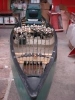
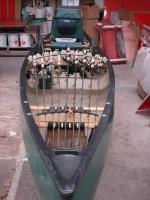
Given my druthers, between my canoe and my Nitro, on smaller ponds/lakes, I'll take the canoe everytime. Even with a side imaging sonar on the Nitro. On larger waters, like Pickwick, the canoe is not a practical alternative. You can certainly fish it from a canoe, but you are very limited. I've heard others say the opposite. But, I like being close to the water. True, you can carry more gear comfortably in a bass boat. And the foot control trolling motor is an advantage. But I still prefer the canoe whenever either will do. As for rod storage. The racks on my canoes work very well, provided you are fishing alone. With a second person aboard, they are in the way, and I remove them. The first consideration is how to stow the rods so the fragile tips are protected. In my paddle canoe the tips are below the rails and the small foredeck. I can drive the canoe into brush, low overhanging branches. etc., without worrying about them getting caught up. Still, it is possible for a branch to get between the line and the rod, and cause problems. I'd suggest a "rocket launcher" that looks something like this, but with the tubes staggered, rather than stacked on top of each other. Thin wall pvc piping is light and durable. They also come in eight foot lengths which will protect the entire rod from the reel to tip. The trick is to space the pipes so the reels have clearance between each other. If you want to protect your rods from getting scuffed in the tubes, rod gloves or stick jackets slide on and off easily and will protect the blank and the guides. The butt ends of the rods are quite sturdy, and casually backing into brush with the butts should not be a problem. To build your "rocket launcher" rod holder, get a hole saw that will match the outside diameter of the piping, and a piece of plywood. Figure out the spacing you want, mark the centers, drill out the holes, insert tubes, secure them with a silicone adhesive, and you're good to go. You only need the one plywood spacer, since its function is to keep the reels apart. The other end of the tubes can be "bundled" together, then wrapped with electrical tape to hold them. You can configure the arrangement to suit yourself. You're going to really enjoy fishing from the canoe. It's peaceful, quiet, low profile, you can do everything right from your seat, and you can get to places larger boats cannot. Best of luck with your new vessel.
-
Interesting question, and I'd like to hear a definitive answer. That is my situation. starting battery and two 12s hooked up in series. Two bank charger came wired to the starter on one bank and the 24 volt combo on the other. Here's the problem. A tech told me that setup would charge the trolling motor batteries. I disconnected the leads from the tm batteries, and the charger output was 13.2 volts. I don't understand how a 24 volt system can be charged with a 13.2 volt input. Maybe someone on here can explain it to me. What I did was to disconnect the charger from the starting battery. The motor's alternator takes care of it anyway. I connected a bank to each trolling motor battery. Works much better set up like that. I've never understood why the onboard chargers, other than for convenience. You still need an outside power source. If mine goes caput, I'll get a regular three bank charger, rig some plugs or use alligator clips to each battery, and do it that way. I've read a lot of posts and articles about onboard chargers failing. It seems to be a common theme. I don't hear so much about it happening to the regular chargers. I'd have to deduce that at least part of the problem is the onboard charger lives in a hostile environment of moisture, vibrations, and the shock from a hull pounding over choppy water. There are systems which can take care of all the batteries using the motor's alternator, but those I've seen cost $$$$$$$. Speaking with one of our members, after a couple or three of the onboard failures, he eliminated the onboard charger, and uses a multi-bank charger that he hooks up when he gets back to the house. No problems since he made the change.
-
My standard reply. Electronics, electronics, electronics. Number one priority unless you have no gear or boat. Having said that, electronics are useless unless you familiarize yourself with them, and get comfortable using them. It's a learn as you go process for everyone. No one is "born" knowing how to use the electronic gizmos. But once you start to get the hang of using them, they become an invaluable tool. The boat gets you to the fish. The rods, reels and associated gear, enable to catch the fish. But the main factor in the equation is finding the fish. At that, the electronics shine. Again, providing you study, and practice using them. When you know an area usually holds fish, study the bottom echo carefully. There can be subtle differences in the fishy bottom and the barren areas. The better that you can distinguish between them, the more fish you will put in the boat. You will eventually be able to "see" the transitions in the bottom echo. Transition means any type of change, be it depth (which will be obvious), composition, or cover. You'll also find spots you did not know existed. Apply yourself to getting the most out of whatever unit you get, and you'll be in for a great experience.
-
When the nose starts to come down on plane, I back off the throttle some. Not much, but enough to keep the boat from suddenly jumping forward, about 4000 rpm. Leaving the throttle there, once on plane, I trim the motor up, until the rooster tail is not quite as high as the motor. At that point, the motor will be turning just over 5000 rpm, and the boat will be doing 48 - 50 mph. I then back it down to the 4000 range and cruise in the low 40s. At that speed, if I put the throttle in the corner, the boat rockets forward, gets to about 56 mph, and the warning horn sounds, so I back it down. It helps to understand that for years I was used to 8 or 9 knots in my lobsterboat, and for the past three with either a paddle canoe or one with a trolling motor. So it's all very dramatic to me. My only gripe is getting the beast up on plane. Other than that she behaves herself. In a fair size chop, I trim it down, and increase the speed 'til it stops pounding. It's amazing how forcing the bow down smooths the ride. I know, I know, there are limits beyond which you can bury the nose in a wave. Hopefully the hydrofoil will be the cure. It's a pain when the boat falls off plane with the motor turning 3000 rpm.
-
Aha! It may have been the first time you've had this problem, but you finally got around to telling us the rest of the story. It was also the first time you had that much fuel, a full live well, and a heavy partner with a lot of gear. I've got a Z7, which is 18' 8", with a 150, and it has the same problem with a fuel tank more than half full, empty live well, and a second person in the boat. The motor will turn up over 5000 rpm and still not get up on a plane unless the passenger sits forward on the step to the bow. I've got a vented prop. Someone suggested removing one of the "plugs" to give the prop a better "bite". So I removed one. Nothing happened. Having read some of the prior posts, I have to wonder if the vent plugs are causing cavitation, and therefore robbing thrust from the prop. I mean, the nose is in the air with the motor trimmed down to the max, and backwash slopping over the transom. I'm wondering if plugging those vent holes would be an improvement. I'd hate to think what it would be like with a 115 on the transom. I'm considering a hydrofoil. They look goofy, but so what, if they work. A couple of fellows told me they cured the same ailment in their boats.
-
Maybe something like this? The overwhelming percent of fish I have caught using the drop shot have been caught swimming/drifting the drop shot. I started off letting it drop straight down, and twitching/jigging it very slightly. I began experimenting with casting and retrieving and drifting the drop shot, and my catch went up dramatically. I would think that if you were over a school of fish, and maintained your position, the standard drop shot method would produce great numbers. But I have never found such gatherings in the places I fish. So, I developed, what works for me, a method of "swimming" the drop shot. It is particularly effective on grassy or weedy bottoms. I set the distance between the sinker and hook according to the height of the vegetation. I want to snag the vegetation occassionally, but not constantly. The trick seems to be to keep the bait in the water column at the height of the plants. I use 6 pound fluoro with twenty pound fluoro leader and a swivel. Primarily because of pickerel. I like the stretch of the fluoro. It reduces the input of twitching the rod to the bait. I let the weight of the rod do the work. I hold the rod loosely, and give it a slight horizontal flick to get it moving. Then I allow the rod to move on its own, flex and spring back in my hand. The stretch of the line and the flex of the rod causes the bait to move/flutter/twitch very little, but it's enough. I'll twitch the rod perhaps 12 times to gain a couple of feet. Reel in the slack, and begin again. On windy days the drift is fast enough across shoal areas surrounded by deeper water, or anywhere fish tend to hold. I've also, forgive me, tried trolling the drop shot when I'm in a lazy mood, using the same method of retrieval. It works very well too.
-
I could never figure this out. Our older daughter goes to Daytona with us for speed weeks. From time to time, she imbibes too many White Russians. Consequently she is up a few times that night, puking her guts out. Is boozing it up really worth the aftermath?
-
If they don't smell bad, cook 'em for the dog. While dogs do eat things that smell bad, they also puke them up from time to time. And, sometimes they die from eating things they've found.
-
Put the fillets on foil covered baking tin. Spritz with lemon juice. Sprinkle on seasoned bread crumbs. Place under broiler until flesh becomes flaky. You can try tomato slices on the fillets before sprinkling the bread crumbs. DO NOT OVERCOOK. Fish becomes cardboard if cooked until it's dried out. As soon as it is heated through, it is cooked.
-
There is a significant omission from that tutorial. It is reading the bottom echo. Mid water column echoes can be misleading. I've found fish when nothing but the bottom shows on the sounder. Granted, in most cases it is rocky bottom where fish can hold in pockets and therefore do not show up on the display. As I have posted before, I was a commercial lobsterman for over 25 years, and knowing how to read bottom echoes is absolutely crucial to finding lobsters. So, my focus was always on the bottom echo, and I learned to detect subtle changes many might ignore. When I went to a Furuno color sounder from a paper recorder, those differences which were barely discernible on the paper machine stood out clearly on the color sounder. Find a particular type(s) of bottom, and you'd find lobsters. Fish move around, but the types of bottom that fish like to inhabit don't. One day the image may contain a screen full of arches. An hour or a day later, the same spot may show nothing. Fish relate to structure, cover, food supply, and spawning areas. In my opinion, it is of the utmost importance to be able to distinguish bottom types. You will then be able to identify areas capable of holding fish. You don't even have to understand what the bottom composition is. When you see a particular echo(s) on the screen, you'll know that bottom can hold fish. You'll also avoid those areas that are very rarely, if ever, productive. That's not to say you should ignore images in the water column. Those will vary. Save for the appearance and disappearance of vegetation, bottom images will remain constant.
-
Would that by any chance be the BPS in Foxborough?
-
"Depth finders" do more than tell you depth, but like any other electronic gizmo there is a learning process. The bottom echo will change with changes in the composition of the bottom. A smooth thin line indicates a fairly flat bottom. As the line gets thicker, it can indicate a number of things including a rocky bottom. Here's why. The bottom line is created by the echo of the trandsducer beam from the bottom. It transmits in an upside down cone shape. So, depending on depth, it is sending radio waves not to one small point, but one area. The deeper the water, the larger the area. A smooth bottom will reflect the signal away from the transducer. Only those directly beneath the unit will "return" to the transducer. Those outside of the center of the transmission will bounce off the bottom away from the transducer. Kind of like a billiard ball bounces off the cushions. So, on a smooth bottom you get a narrow bottom echo on your display. There is an exception, and that is a soft bottom where the signal penetrates a bit until it is reflected back. The line on your display will be broader, but also not as dark on a monochrome. On a color machine a soft bottom can be seen in blues and greens. On a monochrome with shades of grays, it will not be as dark as a hard bottom. A rocky bottom will produce a wider (from top to bottom) image of the bottom. That is because rocks on the outer parts of the circle that receives transmission bounce the signal in many different directions, some of which return to the transducer. Because the signal travels further to the perimeter of its circle, they also travel further back. Though it may only be inches, and sometimes feet, the sounder shows them on the display, and a line that once was an eighth of and inch wide is now a quarter inch or more. Once you learn how to "read" it, you will be able to identify vegetation, rocky, muddy, sandy bottoms, etc. But for now. Keep it simple. If you have favorite places where you are fishing, study the bottom echo at those places on the display carefully. Find more bottom like that, and fish it.
-
It was a lot of thought and a couple of hours work, but it turned out pretty well. The canoe will still be my primary fishing vessel, since it is adequate for most of the ponds I fish around here. There are two or three whose size make a canoe impractical. Same for some of the places I want to fish when we visit our daughter in Georgia. Lakes Lanier and Alatoona are not far. Wheeler and Guntersville in Alabama are only a couple of hours from her home. lf I had knowlege of those places, the canoe might do, since there are several launching ramps on those waters. The fish don't know if you're hauling 'em in from a canoe, tube or bass boat. On the larger waters I fish around here, a goodly portion of the time is spent moving from one place to another. The Nitro will make what takes 15 or 20 minutes in the canoe to a couple of minutes. Conservatively, we should have an extra couple of hours with our lines in the water with the Nitro. Some places don't matter. You just work your way along the productive bottom along the shoreline. There are a couple of guys who fish my favorite pond in bass boats. The only time they start the main engine is to load the boat on the trailer. Other than that, they launch, and work their way around the shoreline just like the guys with trolling motors or paddles.