Fishing Rhino
Super User
-
Joined
-
Last visited
Everything posted by Fishing Rhino
-
? Was it a woody tick that attacked your private?
-
Welcome to today's duh club. I've stuck to the small hook drop shot rig for no good reason I can think of. That is so unlike me. All my life I've tried to build better mousetraps at whatever I do. I love tinkering and experimenting. Why I "played by the rules" for drop shotting is beyond me. Maybe because it worked so well. Now I'm wondering how many of the missed strikes I could have hooked. Oh what might have been. Well, I'm going to find out.
-
This tool may be just the ticket. It's made of stainless steel, and reasonably priced. About ten or eleven dollars. The tips can be optimized with a bit of modification, but can be used as is. Makes Crestliners method a two hand, no knees needed, job. Put the band on, spread it, insert hook and worm, release and slip band and bait off tool. Here's one source. www.lynnmarinesupply.com/gaugesbandersbands128.html
-
match the hook to the bait....as small as #6 split shot hooks, up to 5/0 wide gaps for bubba shotting big plastics in weeds. I've wondered about using larger hooks. The largest I've used has been 1/0. Strange that I've stuck to the "rules". There have been times I've thought larger hooks might work better. Drop shotting and fishing Jackall Wacky Jig Heads are the only times I use such small hooks. I'll use 3/0 to 5/0 hooks for most of my other fishing. Why not for drop shotting as well? Why not indeed. The weight is just to get the bait into the strike zone, fluttering around the top of vegetation, or close to the bottom. (Smacking myself aside the head.) : :-[
-
Humminbird 898. The best I have seen is nine feet, though 17 is most common. How accurate that calculation is, who knows? I can return to the same marker time after time within a few feet. Hazardous places to avoid are given a wide berth. Patches of bottom that are productive can be easily found. For small patches I usually put out marker floats. A visual reference beats reading the display to stay in position.
-
I had the same problem getting on plane. A Nitro Z7 with a 150 Merc. A larger prop with more pitch 23 vs 20 solved the problem. But, the motor was turning over 5000 while trying to get up on plane, and would over rev when on plane and the motor trimmed. The prop did not provide enough thrust. Same problem, but a different solution. I assume for takeoff your motor is trimmed all the way down. If not, that will help. If you have a vented prop, larger vent holes may help. It will allow the prop to turn with less resistance. The problem is, too large and it can cause cavitation. A simple fix would be to move weight forward if possible. That would help the boat get on plane, but possibly at the cost of some top end speed. Boat speed and handling is a series of compromises, unless money is no problem. Ninty horsepower can only do so much. A four blade prop may help you get on plane faster than a three blade but at a cost of speed. You need to find a wheel that will provide more thrust while allowing the motor to turn within, but not over the recommended rpm range at full throttle.
-
Guys that have them swear by them. After spending a couple of thousand dollars, some might be reluctant to say they aren't worth it. If you have use for them in a good percent of your fishing, I'd say they are worth it. But, if I had the extra thou or two to toss around I'd opt for the MinnKota GPS Pilot (I think) trolling motor. It will hold itself in a precise position. I say itself, because it can stay in one place while the boat pivots around it. But, to accomodate that, you'd just have to cast in the same compass direction to fish the same patch of bottom. But, the tm can be programmed to follow a particular course, be it along the shore or the edge of a shoal or weed bed in any depth of water. I think the power poles make a bass boat look like a grass hopper. But, effectiveness trumps appearance.
-
For launching, I have a rope tied to the bow eye, and the safety strap. It allows the boat to float about ten feet away from the trailer. When the boat floats, I pull the trailer from underneath it, then slowly and carefully pull the boat forward, until the keel (you need a keel guard to do this) touches the ramp. Then, I get out of my truck, and pull the boat a bit further onto the ramp by hand. Disconnect the line from the safety strap, and park the truck and trailer. Return to boat, step onto boat, secure the line to a cleat and stow the rest so it cannot get over the side and into the prop. Tilt motor down enough so the water intake for the pump is submerged, start engine and back away. To load, let the boat slowly glide onto an area beside where you will back the trailer. Tilt motor if necessary so it is the bow that stops the boat and not the motor. Make sure the boat is securely grounded so it doesn't drift away. Use the launching line to make it secure to the beach. If the ramp has a pier beside it, you can tie to the pier/dock, leaving your boat in deeper water. You can use the launching line to secure it to the beach. Back the trailer into the water. The top of my fenders are about even with the surface of the water. You'll learn to judge this with your rig. Get into boat. Line it up with the trailer as best you can. Slowly, taking the motor out of gear if necessary steer the boat onto the trailer. If the trailer is at the correct depth, the boat will align itself onto the trailer, and stop short of the bow eye being snug against the bow roller. If the boat is out of alignment, put the motor in gear, and steer to get the bow lined up with the winch and roller. Apply only enough power to align the boat. Once aligned, gradually apply only enough power to move the boat into its final position. You should not need to use the winch to pull the boat. The trick is to get the trailer at the proper depth. Too shallow and it's difficult to drive the boat all the way forward. Too deep and it's difficult to get it into alignment, and to keep it there. When my boat's forward glide stops, it is only a foot or so from it's final position on the trailer. It will take practice to get comfortable doing it. Once mastered, launching and loading is a breeze, even as a one man operation. Be advised, some ramps do not allow "power launching" In such cases, the trailer will need to be just a bit deeper so you can winch it the last few inches.
-
It behooves each of us to report any infractions we witness...that's our job. The FWC cannot be everywhere at once, so it depends on you and me to keep them abreast of violations and maximize their effectiveness in the field. Most anglers and gunners tote a cellphone afield, below is the Wildlife Hotline in Florida: 1-888-404-3922 (24/7) Roger There are several ways to skin a cat. It was, and probably still is, common for some folks to leave their trash bags at the commercial town dock in Westport. Several years ago someone left a half dozen trash bags on the dock beside my lobsterboat. I found them there at about two in the morning as we were about to head out. After poking around in some of the bags I found junk mail addressed to them. So, I took the trash bags about a mile away to a state highway and set them down around a traffic light. They got a visit and a summons from the state police. I know this because I plowed snow for the state, and asked the garage boss who was in charge of us if any of his crews found trash at the traffic light on the state highway. When he said they did, I told him the story. He laughed and commended me for my creative way of handling the mess the slobs left for others to clean up. The only time I've ever seen fines approaching those from the judge are those that were handed down to guys with egg bearing lobsters, or scrubbed lobsters. Good for the judge. Thirty-three other states, plus Ohio, means there are sixteen more states where they have no record. There should be a nationalized system in place that shuts them out of every state for any egregious violation.
-
Glenn is correct. I like the sealed units. Don't need any tools to replace them, and the rubber "grommet" reduces shock and vibration which are enemies to light filaments. Just push the light housing out. I think it pushes out easier when you push it through. Push on one end, and it should pop out. Install the new grommet if available, and pop the new housing in. While it may not seem like a secure installation, it stays put without a problem. It's much better than fighting with bulb bases that have gotten corroded, or having to daub 'em all with dielectric grease. Use dielectric grease on the plug to prevent corrosion, and to facilitate changing the light unit in the future. You might consider going with the LED units. They cost more, but draw a tiny fraction of the amps of incandescent lamps, and have a much longer life, supposedly.
-
If you end up with outside storage, get a cover. The sun's uv rays will raise heck with vinyl/plastic seats and padding, plus any lexan/polycarbonate windshields, finishes, etc. Doesn't need to be anything fancy, just good enough to securely stay put, and to block out the sun's rays. It will also keep the boat from getting grimy from contaminants in rain, and airborn pollen from plants.
-
Do not put wet lures/hooks/baits in any type of container with other gear. That goes double for stuff used in salt water. Rust begets rust. One hook with a speck of rust, placed in a compartment with new hooks can and most likely will contaminate the new ones. Yes Sir Snookalot, rust is the result of oxidation. Even aluminum will "rust"/oxidize. Its "rust" is whitish however, not the reddish brown commonly associated with rust.
-
Typical of just about all magazines. Remember when Newsweek and Time were thick magazines? Sports Illustrated, same thing. What were once magazines are now the equivalent yesterday's pamphlets. Heck some have no more pages that store flyers.
-
I've posted elsewhere that my planing problem has been solved. The prop was too small, with too little pitch. It would turn 5300 without getting up on plane with another person in the boat, unless they moved forward. Went to a larger prop with a 23 inch pitch. It will only turn 3200 plus or minus when squatting before getting up on plane, but it now gets up on plane without hesitation. It will also cruise on plane at 2300 rpm, and properly trimmed it will do 50+ mph in the mid 4000 rpm range. Wide open, it will top 60, but starts doing some funky handling things that will take some getting used to.
-
When I was at the Road Trip, Pickwick Lake was one of the "hot maps", and I found everything to line up, boat position over shoals, at buoys, in coves and channels. Recently, when I got home I went to a Cape Cod pond that was also "hot mapped", and again, the boat position on the screen matched the actual position on the pond. Last week, I went to another Cape pond that was not "hot mapped", and found the boat position to be off by a couple of hundred feet from what was displayed on the screen. Sooo, I marked my favorite spots once I was actually over them. From now on, I'll be able to navigate directly to those positions.
-
One other consideration. A couple of smaller boats. Two per boat, fish in the same areas, and switch "fishing partners" during the day. That would give two a sense of independence, yet still be supervised, and would give them valuable experience in boat handling. I'd think the 12 and 14 year olds are mature enough, and you could certainly let the 10 year old be captain while you are first mate, and there to take over if needed. Something in the 12 to 14 foot range should work. Cartop one, you've got plenty of muscle to help getting it on the racks, and trailer the other. Two trolling motors, and you're good to go. Or a larger boat on the trailer. Lots of possibilities to consider. Just a thought.
-
That rules out most bass boats. While there may be space for four, most of the bass boats I've seen have seating for three, and clearly states on the load capacity, three people or XXX pounds. Not sure if you could be cited by law enforcement for exceeding the capacity, but safety would dictate you adhere to the recommendation. An open water, center console type of boat might be your best bet. Problem is, they lack the stowaway storage of a bass boat. Four on a boat casting is a dicey thing. Even three anglers on a bass boat need to exercise caution and pay attention to the other anglers every time they cast. At ages ten, twelve and fourteen, you'll really need to be on your toes supervising and instructing them in safety first. Sometimes a difficult thing, especially when the fish are really biting. Boys will be boys.
-
Too many people on the water or golf course for that matter have no business on either. They have a total disregard for others who may be sharing the resource. Seems to be a fact of life. Either you can live with it, or you can't. It seems that the casual boaters/fishermen have less regard for smaller boats such as canoes, kayaks, and jons than they do for bass boats. Jet skis, water skiers, tubers, etc., seem to give me a wider berth when I'm fishing from my bass boat. Could it be because they know you cannot possibly give chase in the smaller boats, but know you can run 'em down in a bass boat? Rudeness abounds on the water, golf course and the highways. When we were on Pickwick for the road trip, we had two pontoon boats pass between us and the shore when we were casting toward the shore. They waved as they went by, not even realizing what they were doing.
-
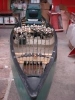
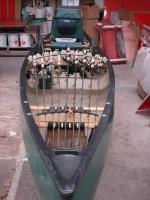
Here's another option. But, you'll need to make some provision to access gear you might want to stow forward. I tied a cord to my tackle box, and pushed it forward with the paddle. The other gear I could reach. If I had to do it again, I would make a rocket launcher type or rack so that the rods could be "stacked" leaving a space open to access gear. The main thing to consider is the protection of the rods. If you work along a shore with brush or overhanging branches, they can snag and easily break fragile rod tips. In the photo, the tips are safely protected by the fore deck, though it is still possible for a branch to snag the lines in the photo. Never happened, but within the realm of possibility. Let your imagination run wild and customize your canoe to suit your tastes.
-
If I had to leave one out of the garage, it would be the jon boat, sold or not. Good luck with your new boat.
-
Not sure what a floor kit is, but suspect that it is part of the fix. My guess would be that it adds stiffness to the bottom, preventing the flexing which would have caused the problem, akin to bulkheads in larger boats. Either way, it's a good thing to have done. Hope everything from this point on works out to your satisfaction.
-
If you're really worried about hurting the fish,...........don't fish. I don't use a net from the canoe, but I did get a big rubber net for my bass boat. Most of the time, I'll get off the deck into the cockpit and reach over the side. Crestliner, I understand where you're coming from. I ain't gonna do all those lie on my back on the deck of a bass boat things attempting to lip a fish. But for really good fish, I'll use the net. The last time I used it was on the Road Trip at Pickwick. Several times.
-
There is a reason bass boats are designed with most of the weight aft. If you have ridden in the bow of a boat into a heavy chop, then ridden closer to the stern, you'll understand that the ride is much rougher toward the bow. With a jon, you're not looking for speed but be aware that in a chop with all that weight forward, you are likely to take water over the bow, simply because the weight does not allow the bow to rise fast enough. Weight aft is much easier on passengers and components. Too much weight aft and it may make the boat difficult to get up on plane. It's a balancing act no matter how you look at it.
-
Glad you found us. Pull up a chair and join in.
-
Welcome. Glad to have you aboard.