balsabaiter
Members
-
Joined
-
Last visited
Everything posted by balsabaiter
-
That is a really great picture Boone! Inspiring! ...now where's my "goby-green" Createx...ha hee...
-
Curing time of E-tex will vary according to temperature and humidity, and if you mix it a drop or two heavy on the resin, it may never cured hard, so be sure to mix precisely 1 to 1. The best time to recoat any epoxy is before the previous coat has completely cured: That way it will chemically cure and bond as a single coat, and eliminate the possibility of delaminating between coats. If the previous coat has fully cured already, scuff it with a Scotch-Brite pad, and clean it with an oil cutting soap such as Dawn, and then rinse thoroughly and allow it to air dry. Avoid contaminating the surface with fingerprints, or lint and oil containing paper towels, for your best chance for a solid mechanical bond.
-
Gerald has had several back surgeries: I'd like to know how much he attributes his back injuries to the pounding he's taken in a bass boat, and what steps he's taken to protect his back while fishing and boat driving on big water.
-
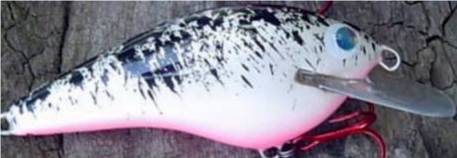
Sweet work Marty! And speaking of Splatters, here's one I just built:

-
The Eclipse HP-BS is what I use, and would buy another one if mine was stolen...I think that from Dixie Art Supply it was about $20 or so more than the Revolution, which I hear is also a nice gun. Definitely go with gravity feed over siphon! I'm also very happy with a Harbor Freight airbrush compressor, Model #93657, 56 max pressure, 0-40 working. It is auto shut-off, and has an easy adjusting regulator & water trap. It was $80, not on sale, and it out-powers some Name Brand units. I swear I've seen much more expensive units online under different names that use this identical compressor unit. Good Luck!
-
Deep cranking post-spawn when a big sow actually sucks the bait in in a big swoop that actually throws slack in you line...I need a smilie for goosebumps and a shudder. No.2 is when the blades stop on a slow-rolled spinnerbait.
-
I agree, very good stuff!! You can book study some of this, such as the conditions and probabilities for seasonal patterns. As WRB suggested, break down the lake into sections. Study your maps and run a lot of water following the channels, and coordinate that with your map study and your observation of the terrain that is out of the water. by understanding your seasonal patterns (bass biology and its relation to habitat) you'll begin to connect that knowledge with the underwater terrain, and pretty soon the fish arches and schools of baitfish you see on your sonar will begin showing you places or pointing you toward places or cover you get the feeling you should be fishing. Trust that feeling and start fishing those places with confidence because of your knowledge, and fish every chance you get. I used to say that there is no substitute for time on the water, but you can accelerate you learning curve by learning all you can about the biology of the fish, and learning the habitat where you fish for them. If you stay with it it will become a transferable process. You'll go to a new place and approach it confidently. Bass fishing is a thinking man's game, and simply learning all of your available choices in a day's fishing is the first step. And it's all fun. Good luck!
-
The bass in my avatar was or is a female that weighed 5-8, the third week of March last year in Kentucky caught from water that had slowly crawled to the 54 degree mark. She was suspended out over a channel in a laydown. This fish was thick with roe but not bursting, and was nearly a month before the major spawn. Her tail was already showing some significant wear, and though not blood colored like later bass, was showing red right at the base, at the bottom of the tail; very typical of good sized females caught north of mid-Kentucky in March out of mid 50 degree water. Taking the view of the two biologists, the question is not about the exact center of gravity, or its buoyancy, but what is normal for most of the year. It remains that if you add heavy roe to a big female bass, that this weight is added to the rear portion of the fish, or at about 2/3's of the way back of its length, pitching its normal distribution distinctly rearward of the normal weight mass. And I'll accept that a Texas fisheries biologist should be about as good an expert on spawning bass as there is. Anyone who has read the book Sowbelly by Monte Burke, knows that Texas is very very serious about growing big bass, what with their selective breeding program known as "Share a Lunker, and "Operation World Record". I only wish that Kentucky was one-fiftieth as serious about their bass management! And it may well be that there is sometimes a combination of several factors resulting in significant tailwear, but I have many times seen (raised in a family marina business on a good bass lake and weighing lots of bass year after year, mine included) big bloody-tailed females out of cool water as long as a month before the spawn.
-
Nest building is not the cause, but simply the wear and tearcaused by the unbalanced condition of these lady lunkers propelling themselves from cover and the bottom. Males do the nest building. This information came from 2 different fisheries biologists, one from Kentucky 40 years ago, and I heard it reiterated on an outdoor show recently...I think it was the one hosted by Wade Middleton, who credited a Texas Fisheries Biologist for the information. Because the tails frequently look quite worn, as would be done over a period of weeks, and it occurs primarily in big female bass, and not the general bass population every spring, regardless of the rate of temperature increase, I'm going to side with the biologists and the pickup trucks for this yearly phenomonon taking place throughout the country. I'm not saying that a rapid temperature increase would not cause capillary rupture and a bloody tail. I'm just saying that it is unlikely the cause of worn lunker female bass tails every year, when the rest of the fish population is keeping its tails clean!
-
Beautiful work, as always, Marty!!
-
-
Actually...big egg-laden females beat their tails on everything in the spring because their egg weight shifts their center of gravity towards the rear...kind of like an old overloaded pickup truck...except female bass negotiate turns MUCH better! I see people confused every year when someone hits the dock with a big bass that has a bloodied tail, a month before any bass are spawning. The males do all of the bed preparation, and their tails still usually stay in better shape than those big females.
-
I used to not buy enough. I am now trying the best way I know how to find forgiveness for those past sins. 8-)
-
First the big picture: water type such as reservoir or type of reservoir, such as highland, lowland, riverine, natural lake, or river and relating currents in combination with the season: prespawn, postspawn, or a transition period; and how the water may be oxygenated during this season, as far as presence of a thermocline. The seasonal pattern is the first step to help determine the aggressiveness of the fish, and location and feeding patterns, and along with the water level and fluctuation will go a long way towards determining a preference for crawfish, soft-ray baitfish such as shad or herring, or spiny ray bait like panfish. Of course I also consider the predominant forage species and all of the above factors including exact water temperature and moon phase to get a feel for how the fish are orienting structurally (main lake points, humps, saddles, drops etc), and whether I think I'm fishing for schooling fish, or, fishing for individual fish and targeting a certain type of cover like wood or grass. Now, a combining these factors, with sky & barometric conditions, and water clarity will get me to my first considerations for color selection: Are the fish looking up (toward the sky) to feed, or down toward the bottom to feed? What is the most likely depth, I expect to catch fish? What is the size of their strike zone, or how far will they move to feed? And, how fast can I move my lure and still catch quality fish? And another factor: Does this water receive constant heavy fishing pressure? Once I have considered the above, I know I can put some odds in my favor and fish confidently. If I'm fishing dirty water slowly in the early (pre-spawn) spring with a soft plastic and the water has cooled off a few degrees over a few days, I may be looking for fish that are looking toward the bottom for food where temperature is a bit warmer, in which case I'd be fishing a plastic with strong contrast; and black is hard to beat for that. If that same water is on a warming trend I would likely be fishing cover that is higher in the water column and using flourescent yellow and or white for a general baitfish type bite beneath a sunny sky. If fishing clear water in that first scenario, instead of black (cloudy) or a purple (sunny) I'd first go with a pumpkin color. Post-spawn bass can become very forage-specific, because they lose their territorial aggression, and turn into high efficiency protein ingestors. All they want to do is maximize their protein intake while minimizing their energy expenditure. This often leads to predictible feeding times, areas, and forage, all of which helps a savvy angler in color choice...I'm just not going to throw flourescent orange as a first choice, when fish are feeding-up on shad in clear water! Sorry for the long post, but all of the above factors and more, help to determine the first color I'm going to impale to be be confident from my first cast. While it may seem like a lot to some people, choosing a lure color is really a quick mental process that is all a part of, "Where are we going to go?", and, "What are you going to throw?", process. Hey, it was a heckuva question! ;D bb
-
Thanks everyone! Good to be here, I really like the upbeat attitude here on the boards. I recognise some top-notch lure building & fishing addicts, and all around class guys here from another forum, which speaks well for the boards here. Much of my life and work has revolved around fishing, and I'm always glad to be around people who realize that it is all about the fish! bb
-
Good luck Tred!! There are a lot of appreciative and good ol'hardheaded, like-minded folks pulling for you!!
-
Hello, I mainly fish for bass these days but have experience fishing many species, freshwater stripers, muskies and snook and redfish in the salt. I also build some lures, primarily balsa cranks, but topwaters etc too; and I also enjoy collecting some lures, but not in the high-dollar game. I recognize some good folks from other forums, and I like the relaxed demeanor here! balsabaiter