Goose52
Super User
-
Joined
-
Last visited
Everything posted by Goose52
-
I'm on the road for the holiday but should be home by Sunday afternoon and will be putting in an order...
-
Wow - water with fish in it....VERY cool...
-
-
It's funny...but it's sad too. All my lakes are man-made, and with one exception they were all logged and most stumps pulled before they were filled so I see this view quite a bit. I do have some lakes with some structure features - ledges/drop offs, vestigial channels, etc, but in general, even the 30-35ft deep lakes are just big, empty bowls.
-
I can start with a little humor. Here's a screenshot from my HB 798 SI/DI of a view that I see quite often on my little lakes. Welcome to my world.................................................
-
It sounds like you're looking at the two types of stabilizer floats offered by Spring Creek Outfitters. These floats are part of systems intended for installation on canoes and kayaks. The EF floats are $100 cheaper than the HD floats and like you said, are really intended to be positioned an inch or two above the water when the boat is trimmed. The HD floats are tapered and can be run touching the water if you want, but they will still add drag. If you intend to motor the boat, the added drag of the HD floats may not be an issue. The advantage of the EF float is primarily lower cost. The disadvantage is that since the floats are a bit above the water, you will have some roll before the float touches the water and stops the roll (less primary stability). The advantage of the HD float is high primary stability at the cost of some added drag. The disadvantage is higher initial cost, and higher cost in the event that you need to replace a float. I run the Spring Creek system on my canoe and I chose the EF floats for the lower cost. The somewhat lower primary stability offered by the EF floats really isn't a problem. I stand and fish all day and all I have to do when I stand up is shift my weight until one of the floats touches the water and the boat is solid after that. When motoring, I shift my weight to keep both floats out of the water so I have zero additional drag.
-
Woo Hoo! Congrats on the PBs and the good times!!
-
It will work fine as long as the size doesn't bother you. I have a 35-size Pflueger spinning reel w/10lb YZ line on a 7'6" m-xf rod and it works fine for that application. However, I also have three "30" size reels on other rods and the "30" is my standard size for bass. IMO, you go to the "35" size for balance reasons, to run heavier mono/flouro/co-poly line, for the line capacity, or perhaps for the bigger drag surface in the spool; otherwise, it's probably more reel than you need for bass or other similar fresh-water fish. The "30" is lighter, has plenty of line capacity for mono or braid, and has enough drag. Actually, my most-used Pflueger (over 2,200 fish so far) is a "25" size that I have on my grub rod (7'1" m-xf)...but in this case it's just a bit small for that application. I think many folks find that the "30" size is the sweet spot for bass use.
-
BPS Pro Qualifier BC Reel - 5 Year Challenge
-
This almost takes longer to type than to do...but, if you have the room to walk-out the line then: Walk-out until you have the 75 yards of braid and cut the line. Tape an end of the braid to your spool and crank all that onto the reel. Then, using your knot of choice (uni-uni, etc.) tie on your backing. Crank that on until the spool is full and cut the backing. THEN, walk the combined backing and braid out. Go to the backing end of the line, secure to the spool (arbor knot), then crank it all back in. You will have the perfect amount of backing and the spool will be full. This works with braid since you don't have a problem with coiling/memory like you would with flouro. Of course, you need to have an area to walk all the line out (I use my 100 ft driveway and use pylons at each end - you can also go to a park, football field, etc., if you don't have room at home). After some trim-backs, knot tying, etc., when your spool level gets low, you can walk-out all the line, attach the braid end to the spool again, crank it all back on, add more backing until the spool is full, than walk it all back out, reverse the line, crank it back in, and the spool is full again with the braid on top. You will probably only need to add to the backing once - after that you will have only 30-40 yards of braid left (less than a cast-length) and you can then pull that 30-40 yard section, use it for backing on another reel, and install your second 75 yard section of the 65lb. Folks will say this is too much work...but it really only takes about 10 minutes to do. I do have an advantage in that I have 50ft and 100ft markers on my driveway so I have known distances for measuring, along with a set of pylons, so I can easily walk- out and reel-in line in short order.
-
Glad that you and your bud are OK and thanks for posting this. It's a good wakeup call for everyone. I'm part of the 100% of the time PFD crowd. Cold water, warm water, doesn't matter - I wear it 100% of the time - especially since I fish alone. However, as your event pointed out, even if you're fishing with someone else that could help you if you go overboard, perhaps that OTHER person went over as well...
-
Thanks! The seat will recline back a good ways - then you can kick your legs up on the dashboard or the gunwale and relax - I do that while eating lunch sometimes. The rest of the time I'm standing - I usually only sit down to boat a fish, change baits, and eat lunch. I haven't taken a nap in the boat yet - there's fish to be caught...
-
Yes, I car-top. From the time I pull up to a launch point with the canoe on the roof of the car, until I shove off the bank to go fishing, is 13 - 15 minutes (not much longer than it takes many people to launch a boat from a trailer - pull up to ramp, back-up, launch boat, park tow vehicle and trailer, return to boat). My record is just under 11 minutes when I was really hustling one time and I had the back bumper of the car only about 10 feet away from the bank of the lake. The main systems are modular. Plug in the "dashboard" and you have the sonar (head unit and transducer), a couple tackle trays, and a rod holder. Clamp on the cross-bar behind the seat and you have the mounting for the outriggers, TM, anchor system, and 4 rod holders. Plug in the outrigger floats and anchor system, clamp on and connect the TM to the extended battery cables (contained in a conduit that runs along the starboard side just below the gunwale), and connect the battery (in the bow). Then add your stuff - rods, tackle, paddle, lunch, raingear, etc. - put on your PFD - and you're good to go.
-
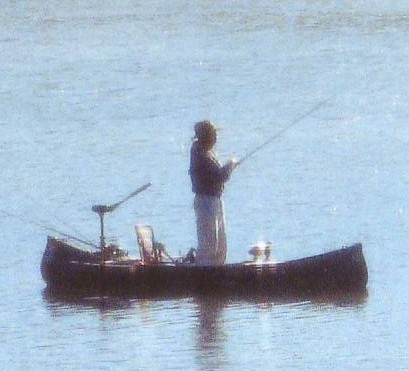
My canoe is a floating platform...
-
Board member Frog Turds is probably our most prominent 'toon user and may be along with his comments on inflatable pontoon boats. And of course we have lots of kayak drivers on the board. I only fish my local, small neighborhood lakes (2.5 to 200 acres) and looked at all small watercraft from float tubes, pontoons, yaks, canoes, bass raiders, etc. I ended up with a heavily outfitted canoe (TM, SI/DI sonar, outriggers, etc.) that meets my needs. Can be car-topped, doesn't need a launch ramp, no gas, little to no maintenance... As you say, it's nice being on the smaller ponds - no lake lice or other fast boats around you all the time. Of the 12 lakes I fish, I prefer the smaller ones that have less boat traffic. Sometimes, I'm the only boat on the lake.
-
And that's OK - whatever it takes to enjoy your fishing experience... Me? I tend to think more about the fish on the wet end of the line than the hardware on the dry end of the line...
-
Hey Rooster - good questions. Question 1: The test period is 5 years because that is the period mentioned by a board member that prompted this test. By itself, the term a "year" or a "season" has no meaning since everyone fishes a different amount. SO, I wanted to fish the reel as MUCH as possible to put the maximum amount of use on the reel that I could. At the end of the test, if I have documented, say, 450 catch days, and I estimate, say 1,000 or 1,200 use days - an angler can compare that usage to how often they fish, and calculate for themselves how long the reel might last in their service. The data is already showing that the reel will last much longer than 5 years in typical service by most anglers and for certain, it is NOT a one-season, disposable reel. Question 2: I tend to use things until they are "used up"...as long as they are still giving acceptable performance. For instance, my primary fishing car I bought new 25 years ago, my "back-up" fishing car I bought new 41 years ago - they both still run OK and get me where I need to go. Not as nice as a 2013 car I bought last year but still give acceptable service. I still use tools that I've owned for 40 to 45 years. As long as something still works, I tend to keep using it. I don't really care if it doesn't feel "new" any longer - performance is what counts. Now, if something no longer gives acceptable service, or it becomes seriously obsolescent by newer technology, I might consider replacing it. You might remember the thread I started a while back about retiring the last of my mid-80s vintage Shakespeare spinning reels. They were all still serviceable, they worked, caught fish...but the lack of an instant anti-reverse was bugging me so as I came across good deals on modern spinning reels I gradually phased them out. So, this PQ, as long as it works acceptably, will continue to be used. Same with one of my "modern" spinning reels - it's already over 2,200 fish caught, is getting a little grindy, but still gives acceptable performance, so it will be used until its used up...
-
Thanks Kirby! Another year to go. If the frame hasn't cracked by then, I'll keep fishing it past the 5 year point, but perhaps at a reduced rate so I can spend some time with my other gear.
-
I'm not part of the crowd that thinks that color is critically important...but I'll have to admit that the RES Orange Belly Craw pattern is particularly effective in fall and winter...
-
Thanks again guys - I appreciate the acknowledgements of the effort that it takes to conduct this test. Since the "S" word got introduced a number of posts ago...let me make something clear. This test is not about trying to demonstrate that the PQ reel in particular, or BPS reels in general, are better than Shimano or any other brand. There are lots of fine reels out there, representing a number of brands; most work well, will last, and will help you catch fish. I personally own BC reels from BPS, Shimano, Daiwa, Abu, and even an Ardent. The purpose of the test is to demonstrate that these mid-range BPS reels (PQ in particular) offer value that can equal or exceed their price. They are viable options when shopping for a reel in their price range. That some of the internet lore about them is not correct. Value is about more than a name, or how many "seasons" (whatever those are) a reel will last. It is the totality of the fishing experience with that reel. It's the number of hours fished, or fish caught, or cycles (casts & retrieves), per dollar spent. It might also be about the performance and feature set of the reel - how far it can cast, how good is the drag, etc. For some anglers, the smoothness of a reel is important, along with other subjective characteristics, The PQ, while not the best reel in any of those categories, offers a feature set, performance, and longevity that most users consider to be above its price range - thus offering value for money spent. The PQ is offered in 4 gear ratios, in both left-hand and right-hand - pretty nifty. Will a PQ last as long as an Ambassadeur 5000? No. But it's OK for a mechanical device to eventually wear out - the question is whether you received sufficient value from it during it's useful life to justify the cost of the item. The PQ, while not necessarily better than other competitor reels, offers such value. The test PQ will likely eventually develop a frame crack at the grooved wear points illustrated earlier in this thread. At that point, it will likely have reeled in over 1,000 fish - achieving a cost per fish of about a dime - excellent value delivered. To extract similar value from my Daiwa PX Type R, or Shimano Conquest 50, I would have to reel in 5,000 fish to equal that cost performance ..... Well, bass seem small compared to the grass carp but here's a few LMB.
-
Yes - the stock drags are "pathetic." Good thing I was using a whopping 10 lb line on the PQ test reel so I didn't have to rely on stock drag performance to land these fish...
-
Darren - I've tossed down to 1/4 oz with PQs with no problems. A GYCB 4" Senko weighs 1/4 oz not counting the hook and casts like a bullet so it shouldn't be a problem casting it with a PQ. Now, under 1/4 oz? I haven't a clue - I have better tools for that weight range than a PQ... In theory, DBS equipped reels might be at a slight disadvantage in the lighter weight ranges as the spool might be a bit heavier than other braking systems due to the captive brake shoes and springs, and the cover plate that provides the surface for the mag brakes to act on.
-
Regarding the Shimano-bot that jumped on... I own 13 Shimano BC reels: 3 - CU50E, 1 - CU200E, 1 - Core 50, 1 - Calais 100A, 1 - Calais 200DC, 1 - CTE-50GT, 1 - CTE-100GT, 1 - CTE-200GT, 1 - Calcutta 100DC, and 2 - Conquest 50. Nice reels - they work, catch fish. Usually good values at their price points. The purpose of this study is to determine if the PQ, a sub-$100 reel, is a viable option at its price point. It is.
-
Thanks again guys. Rooster - sorry, I missed this comment earlier. The reel is not THAT bad....the goal is to always have a fish on 'cause you don't notice the reel at all then... Wind gives many people problems, especially if trying to cast directly into the wind. Gusting wind (as opposed to steady wind) can give you fits as well. Magnifying the problem are baits like spinnerbaits and some crankbaits that lose velocity quickly. Assuming you have your reel working OK for no-wind conditions, when the wind comes up you can try adding more magnetic braking. If that doesn't work, add another centrifugal brake and play with the mag brakes. AND, as everyone says, that educated thumb needs to come into play to lightly ride on the spool and feather, or stop, the cast if you feel the reel getting ready to backlash. I have reels with centrifugal brakes only, Daiwas with Magforce magnetic brakes, and dual brakes. I prefer the DBS reels in windy conditions, or in conditions like near- or sub-freezing temps when the educated thumb suddenly gets dumb....since you can add more mag braking to supplement the centrifugals. In some cases, especially with really strong gusting wind, you end up using so much braking and/or thumb that you really sacrifice a lot of casting distance - in that case, it's time to re-position the boat (if you're afloat), or try another spot on the bank that is more favorable for wind. THEN, when all else fails, grab a spinning rod !
-
Thanks Rooster. Regarding the scope of this test, one might reasonably extend the conclusions to other mid-range BPS reels of similar design: the Rick Clunn/RCX/Carbonblack, ProLite, Gen1 Carbonlite, etc.; on the assumption that BPS would have specified with their OEM manufacturer similar requirements and quality of components as they did with the PQ. Regarding other house-branded reels, like Cabelas, or the well-regarded Academy Mettle, someone ELSE will have to conduct those 5-year tests............................