


RoLo
Super User
-
Joined
-
Last visited
Everything posted by RoLo
-
Right you are. I came very close to going on a tilefish trip in Jersey. In New Jersey though, the Hudson Canyon is nearly 100 miles offshore, so it entailed 3 days and 2 nights offshore, and was prohibitively expensive. Roger
-
Largemouth Bass = Plastic Worm Smallmouth Bass = Plastic Tube Roger
-
Lowrance does not make maps. Lowrance does however, buy the rights to offer Navionics and Nauticpath maps for their plotters. Many are surprised to learn that even Garmin used to farm-out cartography to Navionics. They were called G-Charts but Garmin pulled the plug in 2004 (all their software is now proprietary) With respect to "better maps", both Garmin and Navionics offer HD maps in one-foot increments. As you'd expect, the Garmin HD map of Lake Kissimmee begins at the one-foot contour line. Sad but true, the Navionics HD map for Lake Kissimmee begins at the six-foot contour line! Here's the upshot, the lion's share of vegetation and best bass fishing in the Big-K is under 6 feet > Roger
-
Wayne, I own a Lowrance GPS unit, so I've tried most of their available software. Perhaps due to the fear of piracy, Lowrance maps (Navionics maps) are not available on DVDs. Consequently, patchwork software is constantly being introduced to compensate for the shortcomings of SD cards. As I stated originally: "Navionics" is the major mapmaker for Lowrance plotters, it's their software anchor. Lowrance also offers Nauticpath software for the budget minded, which is essentially a knock-off of Navionics at half the price. But again, the software should always be selected first without cutting any corners. Since I use both Navionics and Garmin software, I've been directly exposed to the advantages of Garmin DVDs versus Navionics SD cards. Spoiled by DVD disks, I have several patchwork software disks and several miniSD cards just collecting dust in a drawer : Roger
-
Since the 1960s, I don't recall fishing any waterbody without first pre-selecting the trial sites. Conduct a chart survey at home by scrutinizing the contour lines for spots where key depth lines diverge and/or converge (flats & drop-offs). Pivotal depth levels will vary sharply according to fish species, seasonal period and current pool level (the last one's a sleeper). In the 60s and 70s we had to rely on hardcopies like K&H Maps, Top Spot, Kingfisher, NOAA, etc. At first I used RDF, then Loran-C for many years and finally GPS after they unskewed the signal. Today of course we all have electronic maps, which makes our job much quicker and easier. Using contour analysis, it's possible to eliminate 85% of the lake's area in a matter of minutes, without every seeing the lake. Even so, an "onsite survey using your depth sounder in conjunction with the GPS is always necessary to confirm the bottom contour. Discrepancies between the chart and the real world are rampant, moreover, many subtleties are uncharted (some of the best). When on-the-water, you'll also have to evaluate the "cover" at every trial site, a vital part of the elimination process. If you're referring strictly to lure coverage, you will attain the greatest area coverage by "Trolling" or "Drifting", where one cast may substitute for a hundred. Roger
-
Bathymetry is one of the most important facets of fishing, yet it seems to be one of the most misunderstood. When you say "easy to use", that tells me that you're focusing your attention on the chartplotter. Be reminded that the chartplotter is a piece of hardware made by every electronic company, a device that makes very simple calculations. The meat-and-potatoes of contour fishing is the "software" (the contour maps). The software should always be selected first, because it's a simple matter to cherrypick among the many brands of GPS devices. Magellan, Lowrance, Humminbird, Garmin and Northstar are all examples of chartplotters (GPS devices). Every GPS plotter however needs to be compatible with some mapping software, a whole other science performed by the mapmaker. With respect to "on the water" bathymetry (as distinguished from "over the road" cartography), there are really only two major mapmakers: Garmin and Navionics. Because I place great importance on contour analysis, I own and operate both Navionics and Garmin cartography. The Navionics contour maps are plotted on my Lowrance GPS unit while the Garmin maps are plotted on my Garmin GPS unit. I can tell you firsthand that the difference in convenience and efficiency is like night and day, and Garmin takes the cake. For instance, I recently upgraded to the "Garmin INLAND LAKES 2009 DVD". Unfortunately, Navionics software is not available on a CD-ROM or DVD, as their proprietary media is SD cards (secure digital). In sharp contrast, Garmin DVDs provide total computer interaction, instant waypoint transfer (unit to computer and vice versa) and far superior convenience & speed (no SD cards to shuttle between computer and device). I could expound on every point, but I'm afraid that time & space would not allow. Roger
-
But only the "insiders" are aware of True Value Roger
-
A grub I like very much is the "Kalin 6" Mogambo"(smoke hologram). Rigged on a 1/2oz T-Rig Jig, I fish it like a swimbait (slow & steady). It's more grub-like than worm-like with more bulk and thump. http://www.***.com/descpageSOFTKALIN-KMG.html#pImage Roger
-
In the winter, the zoom big critter craw works very well because it's not overactive but flaps gently at the midriff when hopped along the bottom. As the water warms though, I like more active craws like the berkley chigger craw and paca craw. Though we've caught a horde of bass on paca craws, I really don't enjoy fishing them because the claws flop around like the flippers on a dead turtle. Fast becoming our favorite plastic craw is the Strike King Rage Lobster. Here you've got a plastic trailer with a hefty profile and a tight reliable pulsation at low speeds. It's a real winner as a standalone target on an unskirted jig like the Owner Sled Head. Roger
-
On balance, the pool levels in Polk County lakes are normal to above normal. If conditions stay on track we're in for a banner spawning season. Roger
-
Below is a recent knot-strength comparison using fluorocarbon line: > Palomar Knot 72% > Uni-Knot 69% > Trilene Knot 67% When I used to fish with 10 lb monofilament line, knot-strength was a critical issue. Today I use 30-lb braided line, where the difference between 72% and 69% knot-strength is totally meaningless. In fact, the bigger issue with braid is getting it to break. My favorite knot by far is the 6-twist "Uni-knot", and for three good reasons: 1) Tying to a plug with three treble hooks is no more difficult than tying to a bare hook 2) The uni-knot is unexcelled for joining lines of different diameters and different materials 3) The uni-knot is very simple to tie, and can be used for everything (hence the name "universal") There's never a need to pre-wet a uni-knot, and as long six-twists are used and the knot is "pre-tightened", it will NEVER slip. You can rest assured, if the uni-knot ever slipped or broke, I'd avoid it like the plague. Roger
-
Looking at the insert and the extent of erosion, that picture looks eerily similar to a stainless-steel insert In any case, the Gold Model Carrot Stick just made my Blackball List. With a micrometer and some ferrule cement, you can easily replace it with a guide having a silicon carbide insert (else it will fray your line). Roger
-
My jigs are subdivided into four categories: > SKIRT JIGS Skirted, Fiber Weedguard, Dressed with Trailer > T-RIG JIGS Self-Weedless, No Weedguard, No Skirt: e.g. Owner Sled Head, Brewers Slider Head > HAIR JIGS Bucktail Hair - Squirrel Hair - Fox Hair - Bear Hair - Etc > MARABOU JIGS Feathered Tail (usually with Chenille Body) I have four favorite jigs, one for each category, but I'm going to assume that you're asking about skirt jigs. Outkast RT Jig Although I like the attitude of a 60-deg eyelet, they don't get very far in Florida's maidencane and pondweed nor in Canada's cabbage and milfoil SKIRT JIG FEATURES > Embedded Eyelet (maximal weedlessness) > 135-Degree Angle between weedguard & jig forehead (A square 90-deg corner is a weed-trap!) > 5/0 Mustad Round-Bend Extra-Strong Hook (ample for trophy musky) > 54-Strand Silicone Skirt > Double-Barb Trailer Keeper > Double Rattlebox (rattleboxes are removed) CAVEAT> The bristleguard is very soft; do not remove any bristles nor shorten the length (flare as usual) Roger
-
There are many interesting replies to this thread, but I can relate best to the explanation offered by J Francho. John suggested that his hooksets were second-nature, that he wasn't exactly sure of his procedure until concentrating directly on the hookset. With regard to crankbaits, spinnerbaits and swimbaits, the strike of a bass is surrounded by many variables. For this reason, I believe it's important to remain flexible, by relying heavily on "natural instinct. With some hooksets I find myself using a sweeping action, with others I tend to continue cranking, but with all my hooksets I interject an abrupt snap. I've lost too many bass at boatside; fish that were apparently clamping onto the lure without being solidly hooked. The sharp pop (even with braid) assures that the lure will move in the bass's mouth, and drive the hook-point beyond the barb. One of the most critical variables is bass disposition. When bass are highly aggressive they make us feel like we're first-class aficionados, but on days when bass are following and slapping passively, I feel more like a retarded chimp. Another critical strike variable is the attack angle. While some bass may overtake the bait from behind, some may T-bone the lure, while others may launch a frontal attack. It's not likely that one hookset is the best hookset for all attack angles, a case where "instinct runs the show. Another critical variable is whether the bass remains on track after taking the lure, turns perpendicular to the angler or ends up facing away from the angler. Again, the hookset should rely heavily on natural instinct, which may be as different as snowflakes. For the record, I can't say I've ever detected the presence of a bass before it physically struck my lure. On the other hand, physics do not rule out that possibility. The trail of a moving bass is followed by a low-pressure system, while the lead edge is characterized by a high-pressure system. I suppose it's possible for a bass to create a high-pressure wave that might dampen the lure's vibration. All the same, it seems more likely that a lull in action would more likely be caused by some part of the fish brushing the lure momentarily, or momentary contact by another fish in the same school. In any event, if it provides a warning signal, it's all good. Roger
-
Thanks everyone for your kind words. We have several members that fish the Kissimmee chain such as MrLiteTackle, Lee (fishindaddy), Big Mike in Fl, Fishing Cowgirl and others. I'm looking forward to meeting some BR members on the water, I'm sure it's just a matter of time. Arched Rods Roger
-
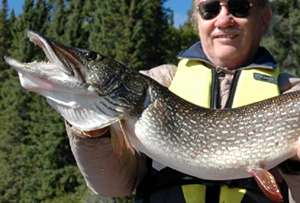
If nothing else, I think we've learned from this thread that neither "time-of-day" nor "water depth" hold the key. Fourbizz and Catt are accomplished moonlighters that do big business after dark. Raul and myself are sun-worshippers who not only live in the skin-cancer belt, but embrace the midday hours (my favorite is 11am to 3 pm for both large and smallmouth bass). I love deepwater fishing and find it easier than shallow-water fishing for pinpointing location, which is sharply limited by bottom contour. My best pike and walleyes have come from deep, offshore holding sites, along with a slew of saltwater species (pike in my avatar was 18 ft deep off the outer weed-line). Although we've taken lots of smallies from deepwater haunts, it's never been the ticket for trophy largemouth bass. I've spent a lot of time fishing for bigmouth bass in deep water (too much time), but most of our heaviest bigmouths have come from water less than six-feet deep (Hannon style). RogerThe distance between the sun and earth has little or nothing to do with the temperature of air and water. The earth is closest to the sun in January and farthest from the sun in July. The temperature of air and water temperature is most dependent on the entry angle of the sun's rays, augmented by day length (photoperiod). The atmosphere acts as an insulation for solar energy, and during winter, when the sun's rays strike the earth most obliquely, the heat is filtered by more miles of atmosphere. The more perpendicular the sun's rays strike the atmosphere, the less atmosphere needs to be penetrated before reaching the earth. More on topic, the absolute temperature of air and/or water isn't nearly as important as the current temperature trend. A severe and protracted cold-front followed by a sharp warming trend is a Dream-Come-True for any vacationing angler. RogerThe Big-K is about 13 miles long and has a number of different faces. The entire Kissimmee Chain spans over 35 miles and is even more diverse. Here's a couple more: Most tourney pros have passed through this portal; the Southport Lock at Lake Toho Inhingua (water turkey) Bass love spatterdock Only Texas has more beef cattle than Florida RogerYes, and lately she's been outfishing me on a regular basis. When we first got married (1964) she had a million questions for me. Today the questions are a far fewer, and half the time I'm the one looking for an answer RogerNice work Mottfia, 15-7 is a great stringer! RogerOh Boy, I hope my wife doesn't see that statement, because my mother is 90 yrs old! ;D Although my daughter's mom is in her early 60s, I do have about 5 years over her. RogerToday we had a major cold-front in Florida with temperatures in the 50s and northwest winds gusting to 20 mph. In sharp contrast to last weekend it was jacket weather in Florida, and we spent the afternoon fishing leeward shores. Although the fishing was slow, we did manage to get a couple decent fish to the boat. On Lake Kissimmee, houseboats line the canal that leads to Grape Hammock Fish Camp. A common sight on the Big-K is a mix of waterlilies and maidencane (locally known as Kissimmee grass). In the wild, waterlilies usually display white blooms, but a yellow-flowering variety is prevalent on Lake Kissimmee. This year in central Florida, the fall topwater-bite has been better than it was during the post-spawn (search me). For the past couple of weeks the Gambler Pop'n Toad has been a real standout. Mom boated the best fish of the day on a J-spoon, a 23 bass weighing just under 7 RogerIf I'm thinking of the right spot Lee, you can name about 5 plant species in that weedy pass. I also like the north end of that same boat trail, toward Brahma Pass. Instead of saying "let it sit", I should really have said to "bottom drag" the worm. After the Big Stick reaches bottom, impart a sharp 'double-twitch' basically in place, then do nothing for at least 3 seconds (more than 3 is fine, but no less). Repeat till the worm is out of the strike zone or if you feel the terrain is stale, simply drag it a few feet to new terrain. The Big Stick has frequently produced for us, when no other lure was working. After answering a couple PMs, we'll be headed out today. Looking out my window we're in for some choppy water today...Bring It On. RogerNorthland and Lindy Tackle go all the way back to the Fishing Facts magazine (1960s), followed by the In-Fisherman (1970s). Basically so-so tackle, but like you said, now and then a real winner. During their heyday, Ron & Al conducted their so-called "Magic Act". They'd go to the right place at the right time, and document the success of ANY lure (as if we didn't know). They came clean after launching their highly successful In-Fisherman magazine. Roger
Important Information
We have placed cookies on your device to help make this website better. You can adjust your cookie settings, otherwise we'll assume you're okay to continue.