RoLo
Super User
-
Joined
-
Last visited
Everything posted by RoLo
-
Ditto on all three counts. Though the action is typically excellent on golf ponds, I've caught much larger bass on farm ponds. Can anyone expound on why that might be so? Roger
-
Bass, otter and beaver all live very well together. Man is the intruder.
-
Texskin or Texpose? :-/
-
If you're dealing with a very small pond, it only takes one angler who knows the pond well, to fish it down. You will hear otherwise I'm sure, but I'm speaking from experience. When my wife was a real estate agent in Georgia, we got permission to fish three tiny ponds. They were all going to be drained, filled and developed, so it was a catch-and-keep situation. My wife and I fished down all three ponds in short order, as the fishing went from fantastic to subpar! We were never able to come even remotely close to our performance during our first few visits. Surprisingly, the biggest bass in those ponds were the first to fall, probably because the pond lords are the most aggressive fish. Roger
-
This is a sensitive issue with me, and one where I tend to get verbose. So in the interest of brevity I'll just say one thing in passing: Some of the best lake management I have ever seen was no management at all. Roger
-
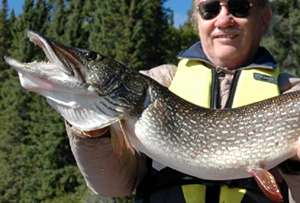
"Gator" is the pet name for a large pike Roger
-
Welcome aboard rrupe What part of Florida? Roger
-
It is a fact; the average buck weighs almost exactly 50% less than the average cow. The weight-ceiling for cow bass is 12 pounds, and with remarkable adherence the weight-ceiling for buck bass is 6 pounds. Nevertheless, the vast majority of cow bass never reach 9 lb and the vast majority of buck bass never reach 4.5 lb. Roger
-
I'm a cherry-picker Though I try to remain flexible and adjust to seasonal and daily conditions, I find myself finesse fishing the overwhelming majority of time. In the same vein, my confidence is much stronger using a rifle approach rather than a shotgun approach. Roger
-
Until the first bass is caught, the fisherman is utilizing an approach or system, but not a pattern. There can be no pattern before the first bass is caught, because patterns are dictated by the "fish" not by the fisherman. For example, two bass are in the livewell, and both fish were caught where wood meets windblown maidencane, that's the pattern. The fish are talking and the angler is listening. Once the bass have disclosed a pattern, the fisherman adjusts his approach or system accordingly. Roger
-
On balance, a 25" bass will weigh about 9 pounds, but varying of course. Twenty five inches represents an extremely stubborn length plateau. The reason is because 9 pounds is an extremely stubborn weight ceiling. Over the years I've compiled a Length/Weight Conversion Guide based solely on length (w/o girth). Stored in my computer for decades, this is the first time it's ever seen the light of day. It consists of every bass my wife and I have weighed, but more importantly it comprises the results of bass tournaments, state award programs, beer-company contests and magazine awards (e.g. Field&Stream, In-Fisherman, Fishing Facts, etc): Beginning at a length of 21", a bass will gain about 1 pound per inch until 29" long. After 29" long a bass will gain about 1 pound of body weight for every half-inch in length. 21" = 5-lb (every inch adds one pound until 29") 22" = 6lb BUCK CEILING 23" = 7lb 24" = 8lb 25" = 9lb TROPHY-CLASS 26" = 10lb 27" = 11lb 28" = 12lb RECORD-CLASS 29" = 13lb 29.5" = 14lb 30.0" = 15lb WORLD-CLASS 30.5" = 16lb 31.0" = 17lb 31.5" = 18lb Roger
-
I've caught stripers to 44 pounds, and those under 37 lbs I have found to be disappointing. I have never caught a peacock bass, but from all I've read and seen, they'd probably take any black bass under the bleachers. Roger
-
Always begin by searching the littoral zone first (shallow zone) for WEEDS. Look for cattails, lily pads, bulrushes and also look for submergents like pondweed or wild celery. Drag the bottom with a bottom-scraping lure with trebles (no cover, no problem). You may discover short sand grass or nitella (algae). If veggies cannot be found, look next for "WOOD": stickups, stumps, blowdowns and docks. That failing, look next for "ROCK": rock piles, manmade masonry structures, large rocks and rip-rap. Last but certainly not least, look for rapid change in bottom depth (contour). In the absence of cover per se, then structure has to serve both roles. Even a sharp pocket or acute corner in the shoreline can serve as cover. This situation is something I have dubbed "The priority of poverty". Roger
-
Between lower Florida and upper Quebec, I've yet to see a lake without cover. Roger
-
When using hardcopy charts (HotSpot, Kingfisher, etc) you don't have the ability to preselect coordinates until you're physically on the water. Using GPS software charts you can pinpoint your waypoints in the comfort of home, without being on-site. Roger
-
Al Lindner Not for his personality, but for a learning experience. Roger
-
That would be my first choice as well (dyn-O-mite). Actually a light chop can be beneficial for topwater delivery because it tends to hide imperfections. The problem is, the more roily the water the greater the commotion the lure must make in order to be noticed. Roger
-
I'm in the camp that believes it's better if your lure resembles 'nothing' (like 90% of our lures). If there's no imposter, then a bass doesn't have the opportunity to reject the lure for lack of authenticity. That may explain why the best bass lures resemble nothing: e.g. plastic worms, senkos and skirted jigs, not to mention spinnerbaits and brush hogs. Roger
-
I agree with the concrete-block idea, which will outlast the founder of the reef. Using a suggestion made by Chris, I'm using 4" slotted corrugated pipe from Lowes, which is flexible tubing. I'm wiring the ends of looped corrugated pipe to the blocks using stainless steel wire. The size and shapes are endless.
-
I seriously doubt that any bass feels obligated to identify his food. If the food menu of a bass consists of 357 items, it's important to realize that all 357 items had to be siezed and eaten for the first time, without any history or recognition. The proof is in the pudding, most of the stuff we throw at bass doesn't look like anything from planet Earth...doesn't have to. Roger
-
I agree with Will, salt appeals more to the sense of taste rather than smell. As a result, salt is believed to lengthen the time that a bass holds onto a soft plastic, because it mimics a living organism which all have high salt content. A less debatable fact is that salt added to soft plastics will increase their descent rate, so the more salt added the faster it falls. Roger
-
Phony Environmentalists Tormenting America Roger
-
The "INSIDER" is nothing more than a market strategy devised by ESPN to shake the Money Tree. Roger
-
For the most pointed and useful information, I generally start with a publication from my home state. For example, when I lived in Georgia I subscribed to "Georgia Sportsman", and now that I'm in Florida I'm getting "Florida Game & Fish". Local publications are the most likely to cover the 'where', 'when' and 'how' on the same lakes you fish. With regard to national publications, I've personally learned the most from "In Fisherman", a highly scientific magazine that goes beyond black bass. Bassin' and Fishing Facts are other excellent magazines. Roger
-
Very Good