RoLo
Super User
-
Joined
-
Last visited
Everything posted by RoLo
-
Okay, the turkey shoot is over! We have all chosen a fixed daily pattern in the hope that it might be the winning pattern. Very well, but now we finally have the opportunity to discuss the winning coldwater pattern. It would be a shame to dismiss this forum now, before we have identified what we learned. We should hash out the reasons that we believe made this a winning pattern, under the existing parameters. I realize that those who founded their pattern on instinct may be unable to participate (this underscores the versatility & repeatability of Science). It goes without saying, there's usually more than one working pattern at any given time, nevertheless, it might be a good idea to confine the discussion to this one pattern. CBJ, do you agree that this coldwater pattern is worthy of discussion? CONDITIONS 1. Water Temp: 48-52 degrees 2, Air Temp: 34-52 degrees 3. Mostly cloudy w/intervals of sun around noon 4. Water clarity: 2 - 4 ft. 5. Water release: 27,000 cubic ft/sec (not much) 6. Wind: 5-10mph NE PATTERN 1. More than halfway back in bays 2. Water Depth: 1-3 ft 3. Relating to "rocks" 4. LV7 Lucky Craft (lipless crank) 5. Hot retrieve (fast) Roger hint: trombe wall
-
I like that idea! A photo gallery of trophies (cheap too) 8-)
-
BassinBaller, welcome to the forum! Welcome aboard Jnamo. Boy, you sure hit the ground running Roger
-
FiveBassLimit, you're right about the decline in good custom paint jobs. When I lived in Sayreville, NJ, I used to mount fish heads as a sideline hobby (saltwater species). I quickly found that the paint job is where all the work and creativity lies. In all fairness though, whether you elect to go with a fiberglass replica or a skin mount, you still have to paint back the colors. Paint jobs aside, in my opinion, nothing can take the place of a well done skin mount. When you look at a fiberglass repro, no matter how talented the artist, the lack of separation between the scales shouts "replica". If I'm not going to get a skin mount, I think I'd be happier with a few high-quality photographs than with a replica. After all, I can go out tomorrow and order a replica of my 15-lb dream-bass, so the significance just isn't there. Just my $0.02. Roger
-
I agree with everyone else, there's often a real nice bite during the leading edge of a storm. When it begins to lightning and thunder though, I turn my hat backwards, assume a low crouching position and replace overhead casting with side casting JUST KIDDIN' Roger
-
The stumps for me would be cover while the ledge and the river channel are structure. Bingo!
-
I used to believe that too. However, where does water temperature fit in the picture in places like Salt Run Springs, Blue Springs, Crystal River and so on, where the water temperature is 71 to 73 degrees 12 months of the year? To my mind at least, that's sufficient evidence that water temperature does not play a key role. Despite stable water temperatures, bass in these ecosystems spawn unerringly, once every year in spring. As you stated earlier, this is an interesting thread. Roger
-
If it is on the shore I would call it cover if it was in 40 ft of water structure. That's interesting. Suppose there were a stumpfield in 40ft of water that was located on the ledge of the river channel dropping sharply to 80ft. Would you refer to the stumps as structure or cover? Roger
-
I have difficulty referring to pilings and stumps as structure. Differently put, we often hear mention of weedy cover, woody cover and rocky cover, but rarely hear mention of woody structure. Some exceptions, as I previously mentioned, are barns and other "manmade" structures like houses, buildings, etc. Roger
-
Buck Perry was the man who coined the term "structure". It originally referred to the contour of the terrain. Cover on the other hand, refers to the wood, rocks and weeds found upon the terrain. Unfortunately, there are objects found on the bottom of some impoundments that are neither or both structure and cover. Examples of these objects are submerged bridges, flooded barns and sunken cars, which may be called structure or cover. Roger
-
I surely know what you mean. Then again, 6 weeks out of 52 is a fairly confined period. Yes I'm sure there is, but the other factors involved would have to be effective in water that is perennially 72 degrees. As you well know, lunar phases are one possibililty. A while back I kept records on lunar phases and bass feeding periods (not spawning). Early on, I thought I was really on to something great, you know...I was gettin' jiggy with it! Then I did the math and it all fell to pieces. Since that time I lost my interest in lunar phases. To touch on it briefly, 3 days before and after the New and Full moon encompasses 50% of the month! CJB, I'd be interested in your opinion on moon phases. Do you believe that they have an effect on freshwater bedding cycles. If so, how does the moon influence the timing of the spawn? Is it possible that a full moon satisfies a photoperiod deficit? Roger
-
Without a doubt, the consensus is overwhelmingly convinced that "water temperature" triggers the spawn. Unfortunately, the batting average of parroted data (herd instinct) is not all that impressive. I always question the science before buying into the hype. For example, ask five anglers what the optimum water temperature is for bass bedding and you'll likely get five different answers. In fact, if you recorded bedding water temperatures over a period of years you would likely encounter the same broad temperature discrepancy. To me, water temperature is highly suspect and not the most valid indicator of bass bedding activity. I believe it's a coincidental symptom rather than the trigger. A large portion of north central Florida abounds with underwater springs. Florida's spring-hole belt stretches roughly from Gainesville, FL south to Lake Wales, FL where I live. A high number of lakes and rivers within this region are 72 degrees Year-Round. In spite of having no thermal regulation, largemouth bass spawn like clockwork once every year. How Is That Possible? The answer in my opinion is "Photoperiod", the same natural force that dictates the event timing in the vegetable kingdom. Deer rutting and bird migrations are also triggered by photoperiod and occur dependably on schedule regardless of air temperature. I believe that events that rely on photoperiod are more accurate gages of the bass spawn than water temperature. Events such as the re-appearance of red-winged blackbirds, forsythia in bloom and most importantly, the Gregorian calendar period. Roger
-
I applaud you MH for your insightful proposal. Though it would definitely fly in a biology class, I'm afraid most fishermen have predisposed beliefs and are not quite ready to make the big switch. For this same reason, I've intentionally sidestepped many posts dealing with the relationship between bass bedding and water temperature (there's another one on the scroll right now). Roger
-
Since you and your dad have already tried many different presentations, I have a hunch that you may be dealing with a "location" issue. Unless you're a tournament fisherman, location begins with Lake Selection. When I lived in New Jersey the Fish and Game Commission rated the bass population of all state waters as follows: Abundant - Good - Fair - Poor - Absent An average fisherman could do great in waters rated "Abundant", while an above-average fisherman would usually do poorly in waters rated "Poor". If you're an obsessive-type like myself (God forbid), you might want to purchase the hydrographic and topographic charts of "all" state waters with GPS coordinates that have an abundant bass population. In this manner, you'll have all year to pre-select trial sites in the comfort of your home. Maybe I'm a little crazy, but catching bass on a trial site selected at home is probably my greatest joy of fishing, where the catching itself has become somewhat anticlimatic In any event, the best of luck to you and your dad in that beautiful new rig 8-) Roger
-
That's a "weakfish". We were over a school of 7-lb weaks while drifting dead spearing off Sandy Hook, New Jersey. My daughter caught one, my wife caught two and I got skunked (it was one of my happiest days). The weakfish is a cousin of the spotted seatrout found in the lower 48. They're beautiful fish, and are called weakfish because they have weak mouths like a crappie. In New York and northward the weakfish is known as a "squeteague". Roger
-
I would focus first on the break from 7 to 11 feet. That failing, I'd concentrate on the break from 11 to 17 feet. Barring some unusual feature, I'd probably ignore everything in between. Roger
-
Gobbledog is correct. Once you remove the cage you are guilty of theft and can no longer inform the authorities. If it were me, I would have pulled the cage, released the bass and submitted the GPS coordinates to the DNR. There is nothing the offenders could say about the missing bass without further implicating themselves. Roger
-
I am often outfished by my favorite fishing partner...my wife Lois RoLo (Roger & Lois)
-
Odds are infinitesimally small, but I'm a sucker for a challenge 1.What type of lure did he catch his fish on? > Tube lure (almost put jig & trailer) 2.What type of presentation? > Slow vertical delivery 3.What was the water depth?(within 2 ft) > 10 feet 4.What was the location of the fish? (example:main lake point,shallows,rocky banks) > Main river channel 5.What cover or structure were the fish relating to? > The drop-off (rocks typically offer the best drop-off, but not always) Both (science / instinct) Roger
-
CJB, RIGHT ON! And here's the best part, that same evening you'll realize that it's been a long time since you had that much fun fishing. Roger
-
I humbly admit that I know the feeling well. I've lost my Personal Best for three different species, right alongside the boat: northern pike, mako shark and bluefin tuna. As consolation, I'll remind myself that I did many things right that day and only one thing wrong. Truthfully, that only helps for a little while, and then the pain comes back. Then I'll think, "aw heck, I was going to let him go anyway", but for some reason that never helps at all > Roger
-
Very interesting read RW Spurred by your previous endorsment of the Fat Ika, my cabela order has arrived last week. If I didn't have to go to Jersey on business, Mr. Ika would have been put to the test by now. I'm looking forward to rigging them 'skirt-forward' and backing them into the veggies Roger
-
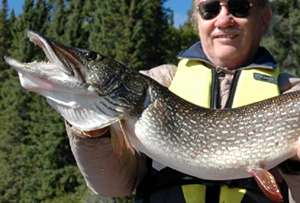
My daughter Dawn and her first pike (The pike was 27" long and blind in one eye). Dawn was apprehensive about those teeth but a good sport just like her mom Roger
-
Crystal clear water is tough to fish. I don't agree with sight-fishing though, because if you see them, they see you. Instead, I would back-off to where the bass are out of my vista, then use long casts. Thin diameter line is important, but not because of line-visibility but to assure a natural delivery. Scaling down the size of the lure can also make a big difference, because in clear water the larger the lure the more conspicuous are its flaws. In clear water it's also wise to stick with conservative colors rather than gaudy colors. Roger
-
When reading your post, two things came to mind: The first was to try side-casting with 'spinning gear', which is essentially done with a flick of the wrist. Since the wrist can be used chiefly as the fulcrum, it may greatly reduce the elbow action The other thing that comes to mind is 'naproxen', the most powerful OTC pain killer (e.g. Aleve). On the downside, naproxen contributes little or nothing to the healing process, where ibuprofen may help to reduce any inflammation. Roger