MickD
Super User
-
Joined
-
Last visited
Everything posted by MickD
-
My question relates to how weight is transferred differently between FWD and RWD. I believe that modern trucks MAY have a mechanical or electronic lock. . .but maybe not. But the point is that there is a significant difference between front two wheel drive and rear two wheel drive for pulling boats.
-
But it is not as good as a rear drive for pulling a boat. The rear drive gets weight shifted onto the driving wheels. The front drive gets weight shifted off the driving wheels. I love FWD for most driving experiences, but it is clearly not as good at pulling boats as RWD. As Tom says, if you want to be sure you have the issue covered, get AWD. I have FWD and it works fine for the ramps I go to. I had an AWD for two years and never went to a gravel ramp. So I was carrying around the weight and sacrificing the economy for 2 years and 24,000 miles without ever using the capability. I have not wanted to go to a gravel ramp since then, so I'm not missing anything. But if gravel ramps were important to me, I would consider that I had to have AWD. It also depends on the weight of the trailer and boat. For most of the rigs I see on this forum, an AWD is appropriate. It would be interesting to know the rig weight and the gravel ramp usage for all those who don't think AWD is necessary. When you are not in AWD your rear wheels are doing the work, not the fronts, right?
-
Rear drive or front? If 2wd front I would not use a gravel ramp. I encountered one and couldn't get the boat out, just dug holes. I'm not sure about rear drive, but I would be skeptical about gravel ramps with them, too. Concrete ramps, no sweat.
-
Deep Little N's are good, even better for me has been the Deep Baby N's, gel craw (now called spring crawdad) finish. There is a new gel coat craw finish that looks very good, Apocalypse.
-
I strongly believe this is good advice. Reels are so much more complex now that I stop after taking the spool out, maybe repack the drag, and let the rest of it be done by someone who knows what he is doing.
-
I have a sneaky suspicion that a couple posters here fish waters where crayfish are a big diet item. I think the bass in Sag Bay and St Clair eat mostly other fish, so the patterns that are most effective will be determined by the primary diet. I cannot remember the last time I had a SMB spit up crayfish on these two waters, but lots of white partially digested minnows. Which is why we often have a white tube ready to cast near a fighting fish.
-
I've done very well with the DT series, too. Ike's Smash and Live River Shad. I think the Helsinki Shad will be good since other lures in that color are good in Lake St Clair. I just bought another deep crank in a color very close to Ike's. Will report next fall. ? I've not used any suspend dots.
-
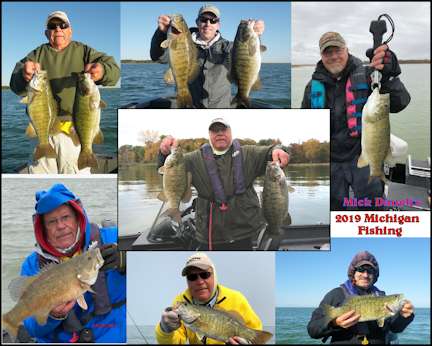
Typical year in that they were hard to find, but when I did find them, I did pretty well. Best day was Oct 20, fishing alone, tubes and Ned for the most part, a few by snapping swim baits off the bottom, took 28 with only a couple under 2 pounds. Largest 6 -7 with a couple over 5. Here are some from the year. The DNR came along, checked me out, and I recruited them to take a pic for me. No pic of the 6-7. In the pic below, the pic in the center was taken by the DNR about 9 AM on Oct 20.
-
Keep a few, especially green ones, then when your regular stuff strikes out, put on the ned. A guide friend of mine was skeptical until one day he and his clients caught nothing on everything else. Only the ned produced. (northern SMB).
-
30 if you're lucky, 60 if you're luckier. Right?
-
Serendipity is one of my most effective strategies.
-
Except for the fact that the colors are a lot like Ohio State, they look fine. Good job. When using cheap guides (or any for that matter) it's a good idea to check the bottom side of the foot for any burrs and clean up any found. I think that's what you meant, but I wanted to be sure.
-
For tying trebles , it is my opinion that 70 denier is way too small and fragile. The 210 is more like what I would use if I didn't have tons of 140 denier on hand for bonefish flies and bass streamers. The Wapsi head cement is very good, but it gums up along the top of the container and can "weld" the cap on. There is an applicator tool that allows one to pour a little into the applicator and eliminate the constant opening and closing that causes the problem above. Clean the cap and bottle edge when you re-cap it. https://www.jsflyfishing.com/crest-tools-head-cement-dispenser Stockard is an excellent source for everything fly tying.
-
Do an internet search for instructions. It is a knot for tying leader to braid, and I submit it is not smaller than the FG. Not much bigger, but not smaller. It may be stronger, but any knot that takes an expert 9 1/2 minutes (expert how to tie PR video is 9:47 long) to tie will keep it from breaking on me because I would never get it onto the water. It takes what appears to be dozens of half hitches, costs probably a foot and a half of braid for every knot. It has a strange lump/bend from what I think is the junction of a uni and a bunch of half hitches, is about 8-10 times longer than an FG, so doubt if it clears guides as well as an FG. I don't see it as being a practical fishing knot. 100% line strength vs 80% for the FG? So if I use 20 pound test line instead of 16, and use an FG, I'll have the same strength knot. And the knot takes about 6 minutes less to tie, about a foot less braid, and is less easy to screw up than the PR. The PR might be right for some, but not for me.
-
Not an elegant solution, but you can put a couple lock loops on opposite sides of the lockers and fit a rod whose ends (flattened slotted) can be locked to the loops. Anything in between cannot be lifted.
-
It could be that some of us are talking dynamics while others are talking statics. By the CCS definition of "slow", measured as the angle to vertical that the tip makes when the rod is loaded, weight will not affect action. But adding a couple oz a foot down fro the tip, sure seems to slow it down. Regardless, I think I picked the right material.
-
True, any weight will slow the action. Just tape some lead to the blank. Or, get the right blank in the first place. In this case, I think the blanks made from unobtainium are in order. ?
-
I believe the Alberto has a lower profile than the double uni. The double uni has 5 layers of the leader, which is the larger of the two lines. The Alberto only has two thicknesses of the leader. My problem with the Alberto is that with vigorous snapping of lures off the bottom it often unravels. Probably my technique-lots of people use it successfully.
-
I have never mastered the Alberto, something is missing in my technique. The double uni is just about foolproof, easy to tie right, reliable. Its only problem is if you use fairly heavy leaders and small guides. It is a big knot with leaders above about 15 pound test. The FG is a tricky knot and easily can be screwed up. I have finally developed a method that works for me, taking the braid out of my mouth where it always seems to slip before I complete the knot, and eliminating having it right up too close to my eyes. The secret to me is keeping the knot tight as it's tied. If that is accomplished the knot will tighten properly before putting on the half hitches. Done right it is very strong, the smallest knot of all, and durable since it clears even the smallest guides cleanly without getting beaten up. I use saltwater fly tippets in mono and FC. They are hard and tough, much more reliable than FC line used as a leader. The most reliable is the hard saltwater mono LEADER material. A side advantage is that its stiffness helps keep blade baits from tangling on the cast and retrieve. The correct answer to your question depends on your ability to reliably tie the knots and what your priorities are. The only absolute in this issue is that if you use a leader on your surface fishing rig, it has to be mono to prevent the FC from sinking and screwing up the action of the surface lure.
-
I agree with the above posters who say don't cut the tip. Not one inch. Do all the revisions if necessary from the butt. If you have to move the reel seat then you have a major rebuild that will be expensive - it won't be a move of the existing seat, it will be a remove and replace, not easy to do from the rear. Sell it? Trade it back to the builder for another, as suggested above? You can pretty easily feel approximately what will happen if you cut the tip- tape a guide at the proposed cut point and use it like a tiptop for some test casts and to feel it when flexed.
-
Yup. I was lucky enough to get two this year, the biggest 6-7. Ned Finesse TRD, for larger one, tube for the other.
-
You didn't specify what the diameter of the micros is. However, with an FG with the braid and leader you specify , almost any guide will work. But to really answer this question, all you have to do is try it.
-
"Moderate to slow action with power all the way out." How much power? You have not mentioned the weight of lure you're planning to cast. One of the most important characteristics of a rod is to load properly for the cast. If you are really looking for power "all the way out" , it won't matter what the action is. The tip will be very stiff. A broomstick has "power all the way out" and is a slow action. Problem solved. Sorry for the sarcasm, but I think this is a case of a not being able to describe what you want but you'll be able to recognize it if you ever see it. Or feel it. https://getbitoutdoors.com/batson-gaff-blanks/
-
Look at the Rainshadow Immortal ( RX8 ) series of inshore popping rods (getbitoutdoors.com) for a series of MF action high modulus blanks. Rainshadows never disappoint, and are good values. I will argue that the Revelation ( RX7) series of inshore popping rods will perform like they were higher modulus than RX7 probably due to excellent design.
-
For those believing that the rods are filled with helium and are looking for a method of recharging them, while you're at it, find the titanium in the Columbia parkas. And the titanium in the Fords. Keep me posted.