MickD
Super User
-
Joined
-
Last visited
Everything posted by MickD
-
How come braid is reputed to be so fragile on rocks yet we need special scissors to cut it? Maybe we should make the scissors out of rocks?
-
I would not consider this experience as "fluorocarbon line. . . failing. . ."
-
It really doesn't matter that you get the exact tiptop model. Any tiptop of the right size tube and ring, given that it's a good ceramic like Alconite, SIC, or Zirconia, will work just fine. If you replace it yourself make sure you don't apply too much heat to remove the current one. If it's not epoxied on you just put a rubber band through the ring, tension it, apply a little heat and it will slide off when the hot melt is ready. Only takes a few seconds. I don't even use gloves to handle them the heat requirement is so low. If it's epoxied on and doesn't readily slide off, take it to an expert or St Croix. The risk of destroying the blank is very high.
-
With the smallies in Saginaw Bay and St Clair going over 6 pounds on occasion (like yesterday, 6 # 5 oz-yipee!) I sometimes use 8 pound FC, but that seems a little fragile for these fish. I will use 8 when the water is really clear, but if it's not I go with 14 pound Hitena fly tippet material. Very thin for its pound test, and is tough stuff. Even if I were to convince myself that straight braid would work OK I would use a leader for a little cushion in the system and to save me from cutting my braid so often.
-
The AA is the angle relative to horizontal, and for the broken rod I almost can guarantee it will be lower than the intact rod. Measure it and you will see. The broken rod would have a higher AA if it initially was an XF rod and the intact rod was a very slow action rod. Higher means steeper relative to horizontal. 15 degrees is low. 45 is higher. 75 is even higher. Relative to horizontal which is zero.
-
And works for any rod. "Full length tip angle. . . " What does that mean? CCS has a process for measuring action and involves the whole rod, not just the "tip," whatever that is. CCS just measures what the rod is for two attributes ; it doesn't involve anything about whether the rod is acceptable or not. It's just a power number and an action number. You come to the conclusions regarding acceptability.
-
What you are saying is that in spite of subjectively describing many rods as having the same action when they don't, there is no problem with subjective descriptions. That is simply not logical. The fact is that CCS tells what the rod is, not what someone "feels" it is. While there is not industry wide agreement on what the objective definition of XF is, I do know that when I buy two blanks, both with the same CCS action angles, they will have very close to the same action. If I buy two blanks with subjective descriptions of XF, I don't know what I'm going to get. If you understood CCS, you wouldn't ask this question. The difference between 59 and 62 is minor. But the difference between 55 and 80, all being called XF, is major.
-
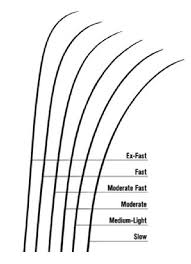
Then how do you explain a blank manufacturer having a line of ultralights, all called "extra fast," and their CCS Action Angles vary from 53 to 77? For those not familiar with AA, angles of about 55 are considered generally to be "slow," 65 to be "moderate," low to mid 70's to be "fast," and above that "extra fast." There is great inconsistency in the subjective descriptions of blanks and rods.
-
The only thing that doesn't work satisfactorily for both, in my opinion, is FC for line or leader for surface. It tends to drag the lure under on the twitch since it sinks (higher density than the water). Mono and braid are about the same density as water so this doesn't happen.
-
Yes, I am surprised. I would have thought taking that length off a rod would have resulted in a lower AA. Live and learn. I still doubt if it feels like a decent rod. Adding to Spoonplugger's comments regarding material, whether glass, bamboo, different grades/moduli of carbon fiber, it is now possible to measure another objective attribute of blanks/rods to further our understanding of them. True Natural Frequency, or TNF abbreviated. It is a direct measure of the recovery speed of the blank/rod and some argue an objective measure of sensitivity. It can be done easily and quickly with tools most people now have, an Android device and a way to mount the butt of the blank/rod securely. I find it does agree with my subjective conclusions on blanks and rods for sensitivity and response. It is encouraging to me to find that higher modulus blanks have higher TNF numbers, and the lighter the guide system the higher the TNF. Thus indicating that we are in fact getting something for our additional dollars spent. (in most but not all cases)
-
Depends on the knot you use, 30 leader can lead to a big knot in some cases. I would go 5.5, doubt if you could ever tell the difference in sensitivity or response time. I suggest the Alberto knot with an added safety-after tying it according to all the instructions, take the braid tag end and make two overhand knots tightly snugged up to prevent unravelling. Ever been able to get a braid wind knot untangled after it's been pulled tightly? That's the principal in the two added braid knots.
-
It is my opinion that missing 5 3/4 inches will make the spinning rod feel really stiff and while it might be good for flat line trolling, I think that's about it. 664 grams = ERN 22. The second rod would be described by most to be a moderate/fast action medium power rod. It should work OK for casting lures of about 3/8 oz and up. I would think it would make a good skirted jig rod, crankbaits, spinnerbaits. It depends a lot on personal preferences, but there is no reason to believe it won't fish well. In comparison I built two 6 feet 6 Point Blanks of ERN 19 AA 77 into baitcasters for my son and he uses them for all kinds of baitcasting, rattle traps, surface, chatterbaits, cranks. The faster AA means at the same power the faster actions will have softer tips. 77 would be described by most as being extra fast action. The 19/77 rods cast 3/8 oz and a little higher just fine, and will probably go lighter than a 22/73. I personally believe that extra fast actions cast a wider range of weight well than do slower actions due to the softer tips casting the lighter stuff well and the stiff backbones handling the heavier stuff well after the tip has bent out of the game. Most crankbait fishermen like the slower actions. Again , personal preference.
-
I am a big advocate of using CCS numbers, but if you take 4 inches off any blank it won't be very good for much of anything. Anything related to legal fishing. But give it a try.
-
Replacing grips from the bottom is easier than most people think. You just make the tapered blank into a cylinder with a few masking tape wraps which if done right will basically define a cylinder of constant diameter. I always totally encapsulate tape arbors in epoxy in case water gets in they won't get exposed to it.
-
Not impossible, but one may get a little more tissue damage since the barb cannot be preloaded away from the flesh. I would still do the string method if getting to a doctor would be a big inconvenience. Worst case is just a little more tissue damage. In the situation in the photo (if the point were not already protruding) I would cut the lure off the hook, cut the other two hooks off the treble, then YANK. In most cases. However I notice in the photo the point is already coming out, so pushing it a little farther and cutting off the barb may be the best approach to this specific situation.
-
Repairing the rod will result in an order of magnitude improvement over just putting a tip on it. That will result in terrible rod. One thing you can do is to repair it, buy a new cheap reel for it, and give it to some aspiring child fisherperson. Would be an excellent starter.
-
Might not work well if you have two breaks, which would mean two sleeves and therefore, more weight added. I just fixed one broken about 3 inches down a couple days ago I'm very confident of it. I had CCS numbers on a fly rod that shattered about in the middle and I fixed it with the method and rechecked the CCS numbers and they had not changed. It had to be a little heavier, of course, but it's not detectable. Since the repair was quite far down the rod I doubt if it slowed the recovery speed much if any. I carry it as a spare to the Bahamas. I would not sacrifice a Bushido. They are excellent blanks. If you want to try the repair find some junk rods in pawn shop, make a very low offer (they are always overpriced). That Shikari sounds like a great candidate for repair.
-
Compared to what? I think it's the size that determines barb size which determines how hard it would be to remove. I had a size 4/0 in my scalp and went to emergency to have it removed. It was not a job for amateurs. If you are not familiar with the string method of removing hooks, you should understand it and be ready to use it. I took a pretty big spinnerbait trailer hook out of a friend's hand way out in Canada and no problem. It depends on whether or not you can maneuver the hook and string properly, but it can be a Godsend. I've taken a couple out of myself using it. A couple things not clear in this video. First, you don't have to tie the braid to the hook, you can simply loop it through between the flesh and the hook and when you jerk, of course jerk both ends so you are using a double line. This makes it easier in many cases to do it on yourself if you are alone. Second, pre-load the hook down into the flesh so that the barb is somewhat forced away from the flesh-it will clear more cleanly. Kevin mentioned it, but didn't emphasize it enough-you have to really do a fast, very assertive, jerk. It's not a pull, it's a JERK! It is amazingly effective and almost painless. Forget about pushing it through then cutting it off. That is what pain really is. And much riskier.
-
Keep the blank for repair sleeves for other rods. This procedure works very well even with graphite instead of the preferred glass. I presume you don't have the "missing" top 4 inches? If you had it you could repair it and it would fish almost as well as before it broke. https://www.rodbuilding.org/library/repair-oquinn.html
-
If you like the aero, try it uplocking. There is an EVA "ramp" available that fits perfectly and it's even more comfortable that way. Not as ugly, either.
-
I like the switch for when I reel in too far and want to let out a little line without having to yank on the drag. Now and then I like to back reel. Different strokes. I like to mention that some brands are dropping them so buyers will not be surprised.
-
I guess I missed that one, but beware, most do not have it. Maybe the "new" Sahara isn't "new."
-
Shimanos don't have anti-reverse switches any more. Not for me.
-
I have no idea whether the rod manufacturers have CCS data or not, but I know that the blank makers do have it. They have been reluctant to publish the numbers, but that is slowly changing. One reason for their reluctance is that as soon as they publish something definitive, some of us will challenge their data when we don't get the same number. I know they have the numbers because I have asked for them and they have provided them. I take my own numbers so have asked only a few times to check correlation. You don't need expensive equipment or a lot of space. The link to CCS shows a big sheet of pegboard being used, and yes, this is the best way to do it. But you can do the numbers without it. You need to be able to hold the butt of the blank/rod so that it can be leveled (with 10 % of the blank length between the supports of the butt), then you load it to bend it 1/3 of its length, then measure the weight it took to bend it. (grams). This number is the Intrinsic Power of the blank/rod. Then measure the angle the tip makes with horizontal (while loaded) and you have the action angle (AA). The process in no way harms the rod, so one could buy a rod and return it if the numbers are not what he wanted. https://www.common-cents.info/ Message me with your email address if you want me to send you a file that shows my setup. It really doesn't take anything expensive and anyone sort of handy can cobble a setup that will work.
-
Agree on Tatulas, great, light reels. For me the size of the reel depends on what line I intend to use and how strongly I feel about weight for that setup. For panfish I would think that the line used would be pretty light and any size reel would work OK. If buying a new reel and if you like anti reverse switches, beware of some brands as they are discontinuing them. I have a Fuego LT and I really cannot tell the difference between it and the Tatula for fishing. I don't know all the details on the differences, but if you want a good reel for about $100, I think a Fuego will do just fine.