fissure_man
Members
-
Joined
-
Last visited
Everything posted by fissure_man
-
@bigbill why not just set a few trail cameras around your next cookout? If you can film the bigfoots (bigfeet?) those cameras would for sure pay for themselves. Or do you have any thoughts on why can't BFRO do the same? They are the experts that make their living bringing cameras into the woods, they have the budget to produce a tv show, and they can manage to get a bigfoot "encounter" or two into every episode... but they can't get anything meaningful on film?
-
I would put it toward a used fishing kayak. Getting off the bank will open up your fishing opportunities far more than any number of rods/reels/lures ever will. Congrats on your graduation
-
Check local regs before unauthorized transplant of a live fish into public waters - that's illegal in my area.
-
Unless I’m inside a tackle shop or BPS store, I think replicas and skin mounts are both tacky. Same goes for all the other animal heads one might hang on a wall. I’ll take a nice photo any day that shows the fish, the fisherman (or woman), fishing partner(s) if possible, the nice scenic location (or not), the weather that day, my era-appropriate hairstyle/fashion choices, etc.
-
What's its name?
-
OP wants baits to last longer..... GYCB senko is the solution? lol
-
In experiment #2 (no olfactory cues), bass trained to yellow or white often mixed up the two, which was expected under the initial dichromatic vision hypothesis. However, the bass trained to yellow also frequently approached/struck the blue target, and bass trained to white struck at both the black and blue targets. In both cases red and green were avoided. The physiological evidence doesn’t suggest there should be any difficulty in distinguishing yellow or white from black or blue, so this result was unexpected (I think). Maybe(?) this was covered under the statement “These results indicate that bass can more readily associate meaning to chromatic cues of high opponency” – assuming that white and yellow are both achromatic to a bass, not only can they not easily distinguish them visually, they may also be less prone to “learn” or be trained using yellow or white cues. But doesn’t this take away a little of the significance of first conclusion? It leads to the question, to what degree were those bass visually mixing up white and yellow, versus just not knowing WTH they were doing beyond avoiding red/green? It’s also interesting that the reverse was not true, i.e. bass trained to either black or blue did not tend to “mistakenly” approach/strike the white or chartreuse targets. Maybe there weren’t enough tests run in experiment #2 (4 tests x 2 tanks) to dive very deep into this. Any other theories? Good thread.
-
Would it be accurate to say that the top end bass in California have been caught disproportionately by a small population of folks actually targeting large bass, whereas other “big bass” states such as Texas or Florida seem to have a higher % of instances where “casual” or non-bass anglers have lucked into the biggest catches (such as Mr. McNugget)? If yes, what are the reasons for the difference? Is it just angler demographics, or do differences in the fish / environment have a role?
-
In addition to all of the above, the OP being low to the water in a canoe is a huge disadvantage vs. standing on the deck of a bass boat when it comes to spotting fish. Up here, sight fishing for shallow smallmouth is a pretty reliable and fun way to catch them on certain lakes (I’m not talking bed fishing). I drift or run the TM around on shallow structure in clear water casting a jerkbait, looking for followers, cruisers, or spooked fish. Then hit spot lock when I hook one or see a good one (or a group). Even if spooked, if you back off they’ll calm down before long and don’t usually go too far. If I’m not seeing (or catching) fish, I’m moving around until I do. I agree with the post above that most of the time if you see them, they see you (and are less likely to bite). I’ll see loads of fish close to the boat some days, but most bites will still come in the first 1/3 of a long cast. Groups of smaller bass on sunny days will sometimes even hang out in the shadow of the boat! (Erie smallies are dumb).
-
Agreed, my point was that the gripe some folks have with the “new” warts is that the inconsistency has been reduced, so there are no more “good ones." Considering opinions above (knockoffs are inconsistent), perhaps this is a worthwhile niche to explore. This is somewhat tongue-in-cheek, as I’m aware that sloppy manufacturing is not a universal key to lure-making success I can see both sides of the discussion and I understand not wanting to risk wasting time trying out “unproven” lures, but I do think that some would be surprised at the quality and consistency of certain knock-offs that are out there nowadays. IMO it’s not unlike certain low-priced Chinese rods/reels, which have pleasantly surprised some folks who would’ve first doubted them on principle. There are savings to be had by dodging markups without necessarily meaning a huge sacrifice in quality, and there is also a lot of cheap junk out there to avoid. How anyone spends their money is up to them.
-
I like the passion, @Bassun. lol Pre-Rapala wiggle warts have achieved cult status and are sought after for their irregular action, which (as the theory goes) was a result of inconsistent manufacturing of the originals. There are knock-offs available with allegedly poor QC – maybe this is the perfect niche?
-
There’s no single answer to the OP’s question – some knockoff blanks/lures are garbage, others are very good (“good” doesn’t have to mean an exact replication – there are usually differences in the details, which is not necessarily a bad thing). If buying straight from China in most cases you won’t find reliable or relevant reviews, so you just have to try it out. I’ve bought Chinese brand lures that looked interesting online and then went straight in the trash after holding in my hands. Others have turned out to be great. Some of the importers/custom painters have built a reputation for sourcing quality blanks, but you also pay them a bit of a premium vs buying more directly. A custom paint job in itself has no value to me, you can get lures pre-painted directly for cheaper (albeit sometimes in weird or limited colors). Despite what manufacturers would have you believe, lure making doesn’t have to be rocket science and bass will bite all kinds of different baits. If China can knock off an Iphone passably, surely they can also reverse engineer a Whopper Plopper In my (limited) experience there are “tiers” of quality – the cheapest should be avoided (true garbage) but spend a bit more and you will get a quality lure, pre-painted. Hooks are usually questionable, often very sharp and nice-looking, but brittle. Quality hooks can also be found from China, but like everything else you won’t know without buying. Split rings might be bad, but I replace them with strong flat-sided split rings bought in bulk (guess where they come from). I can see the value in paying for a “proven” design and a reputation for QC/consistency (vs. gambling on a knock off that might suck), and believe me, those companies get their share of my fishing budget. But I also realize that part of the price difference in originals vs. “direct from china” is owed to the brand marketing, packaging, and store mark-up. And we’ve all tried out “original” baits that turned out to be duds, too. I think many would be surprised by the construction quality of some of the Chinese brands nowadays. $3-4 typically buys you a much nicer lure direct from China than a $3-4 bargain hardbait at Wal-Mart, IMO. If I really like a knock-off and then lose it, will I be able to find an identical one? Maybe, maybe not. But I hope my fishing success is never that dependent on a specific lure, and 50% or more is a big price to pay for that assurance. Even originals get discontinued, and many aficionados claim to have “special” mainstream baits that are somehow different than the rest and can’t be replaced. Look no further than the crankbait sticky post for examples. I fish for fun, sometimes with kids, relatives, or non-fishing friends. It’s fun to buy and try lots of different lures, whether USDM, JDM, or Chinese brands. It’s no fun seeing a pike swim off with a $30 japanese topwater, or having a $$$ jerkbait bill smacked off against the outboard by an inexperienced caster. Best of all, it’s awesome to give a kid the lure he just had a great day fishing with (not likely going to happen if it's an expensive JDM lure ). For these reasons, “knockoffs” have a place in my box. YMMV
-
According to those links the HD spike is suitable for flats boats, bass boats, etc., presumably when used as a stand alone "stake out" spike. Unless I'm reading it wrong, the micro driver unit itself is still only recommended for boats up to 1500 lbs (total weight of boat + motor + passengers + gear). Anyone have experience with one of these on a big-ish boat?
-
Even more common than fake negative comments from competitors are unrealistically positive ones from folks on the payroll It could be a (very small) conspiracy, but is it really that hard to believe that Dustin from SC might have received a defective lure? lol The fact that Booyah includes a spare tail suggests that the tails aren’t indestructible… In this very thread there is a comment “The tail is very pliable, don't know how to judge if that is a good thing, or bad, as it seems very damageable.” True or not, one bad review wouldn’t be cause to write off the lures anyway – the thing's brand new and there are two other positive reviews and some first-hand comments here indicating this may be a one-off. Worth noting that there are a few reviews saying the Teckel tails fly off too – should we assume undercover Booyah staffers are responsible for those? IMO “Dustin’s” comment seems unusually specific, isolated, and restrained to be the work of a “troll farm” – not only stating that the tail flew off, but also the mechanism with which it failed (molded-in wire pulled out during a backlash). If this is a sabotage attempt they’re going to have try a bit harder than one “slightly disappointed” comment on one website. In any case, Dustin should have shot an email with pics to Booyah and they’d probably send him two free ones and a baseball hat.
-
@Brad in Texas Interesting analogy but I would add a bit more to it. “Thrust” is a characteristic of the motor, but “top speed” is a characteristic of the boat + motor + propeller package. To be fair to your analogy, a given TM does have an inherent speed limit based on the max RPM and prop pitch (anecdotally around 5 MPH, but I assume this must vary a bit?). If the OP is already cruising at this max speed, adding a duplicate TM isn’t going to do much. This is the “two linebackers pushing an empty shopping cart scenario.” People sometimes encounter this when putting a TM on a canoe or kayak with low drag – there is power to spare, but the motor speed is maxed out (same as running too low a pitch on a regular outboard). Changing to a higher-pitched prop should help in this scenario (conceptually); are these available? One of the posters above had a good experience by changing the prop. If the boat is under-powered and not reaching max TM speed due to drag, adding more thrust would help the top speed, the amount depends on how severely under-powered it is. In this case, reducing drag via weight would also help, and the trade-off of thrust vs. weight needs to be considered. Driving into a strong headwind is a realistic scenario where adding thrust with a second motor or bigger motor would increase top speed, possibly significantly if it’s very windy. At TM speeds, the boat is not on plane and is pushing water. Approaching planing speed, going a little bit faster adds a lot of drag. In other words it takes a (relative) lot of added force pushing the boat along to counteract drag and achieve small increase in top speed. Adding more battery/motor weight worsen(s) the drag vs speed relationship because it pushes the hull further into the water and this also needs to be factored in. The specifics of all of this depend on the hull and weight (+distribution) of the boat to begin with, but it’s a game of inches. All of this would be pretty onerous to calculate, but suffice to say, no number of stock MK or MG trolling motors is going to have you going faster than their inherent limit (~5 MPH?), maybe a bit more if faster propellers are available. An electric outboard like a Torqueedo is built for this purpose and is a better option, but $$$. A pair of oars would be relatively cheap…
-
The link I posted doesn’t go into much detail (maybe there's a more complete source?), but reading between the lines I understood it to be two different knots, grinner (uni?) and knotless (snell?), used to attach to the two ends of the test frame. I assume each test used the same two knots, and it was stated that 5 tests were averaged for each line. If this is correct, it’s a pretty reasonable approach I thought. If they were using different knots for different tests / line types I agree that’s questionable, not sure why they would do that. Adding any knot brings another source for error or bias, but averaging 5 tests should help (with the error part), and knotted strength is more relevant than intact anyway. It would be interesting to know the range of strengths observed in each set of five tests, not just the average.
-
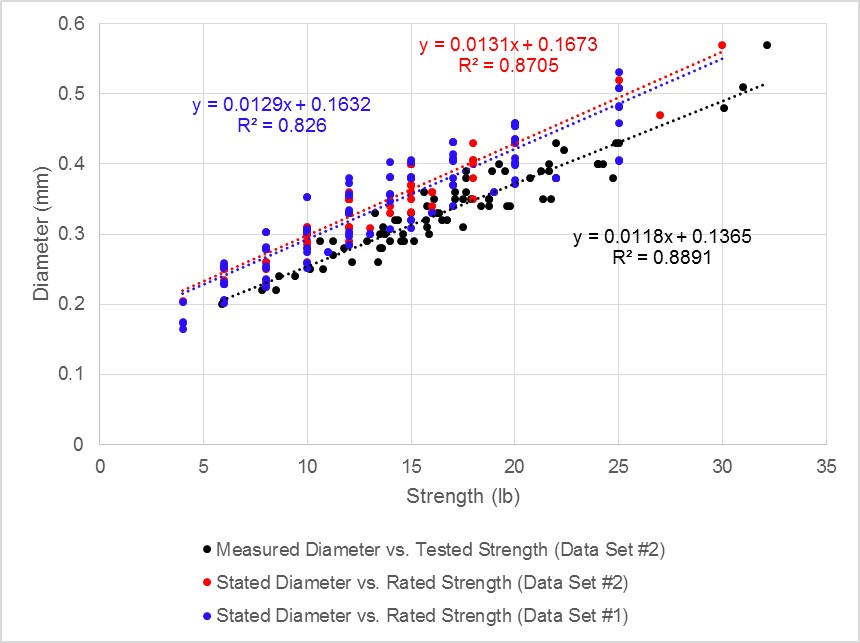
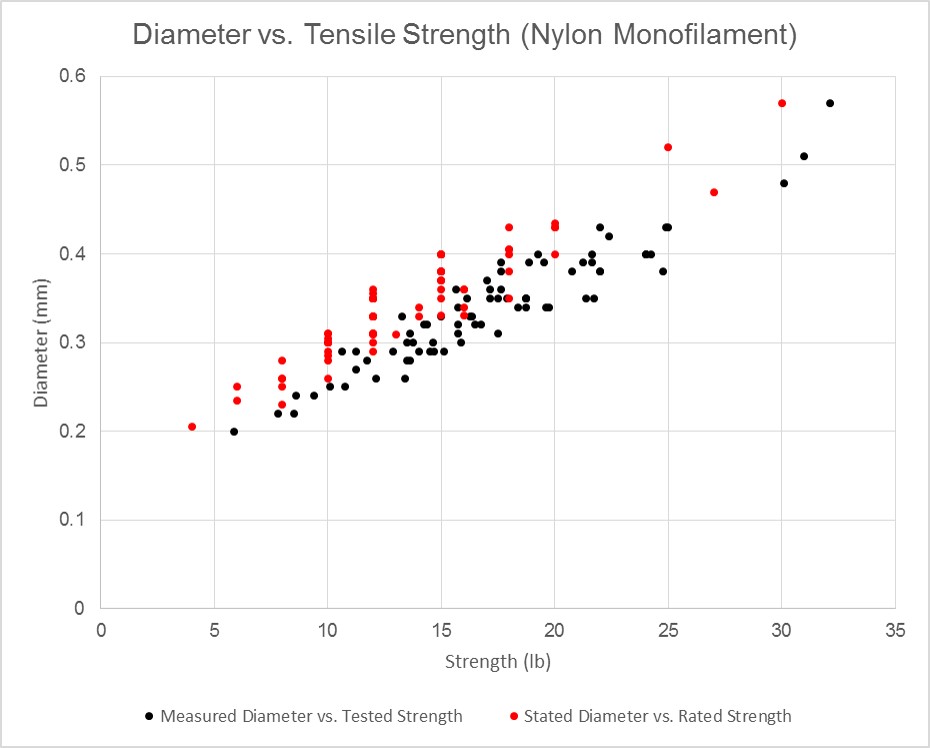
Thanks for the replies. @Team9nine – to be fair, the second set is presented differently than the first. The first set does show a pretty similar positive correlation between rated strength and stated diameter; I removed it by normalizing the data as % above/below the group average. I’ve grouped everything together in the plot below: - Average rated strength vs stated diameter is similar between data sets 1 and 2, data set 1 is somewhat more variable. - For data set 2, comparing rated/stated vs tested/measured trends (red and black lines) confirms the tendency of manufacturers to under-rate their lines. - Interestingly, the scatter in the relationship between ‘actual strength’ and ‘measured diameter’ is not significantly less than in the relationship between ‘rated strength’ and ‘stated diameter’ for data set #2. Some of the variance must come from test/measurement methods and limited number of samples, but it was reported that 5 samples of each line were tested – not too shabby. The rest should actually show the difference in material characteristics of the lines – the range of ‘true strength’ to ‘true diameter’ of the different line materials, as well as consistency in manufacturing.
-
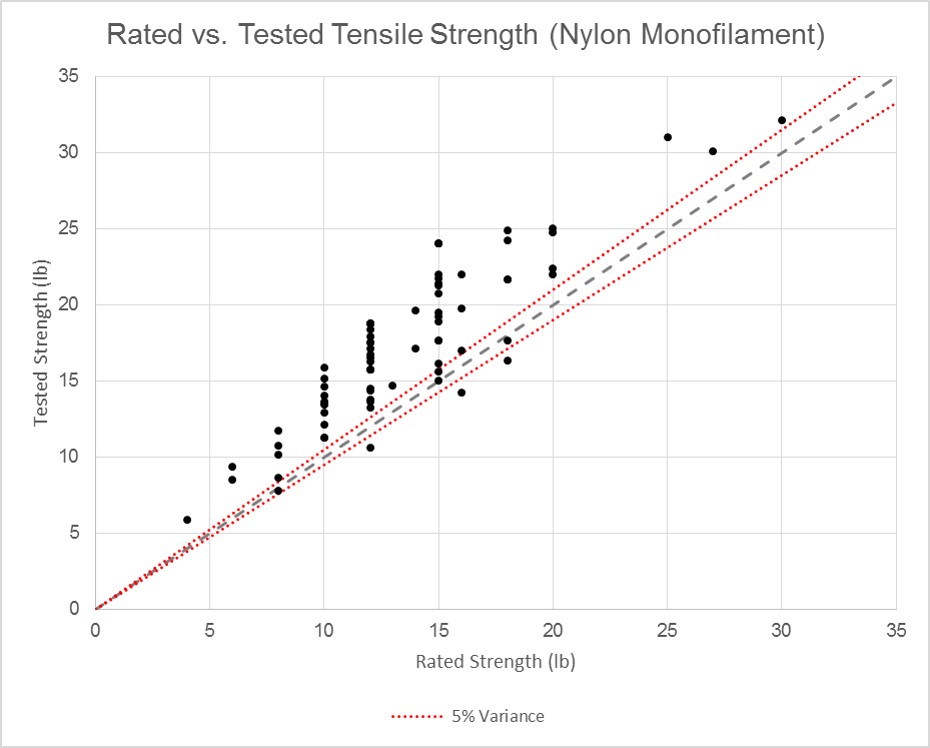
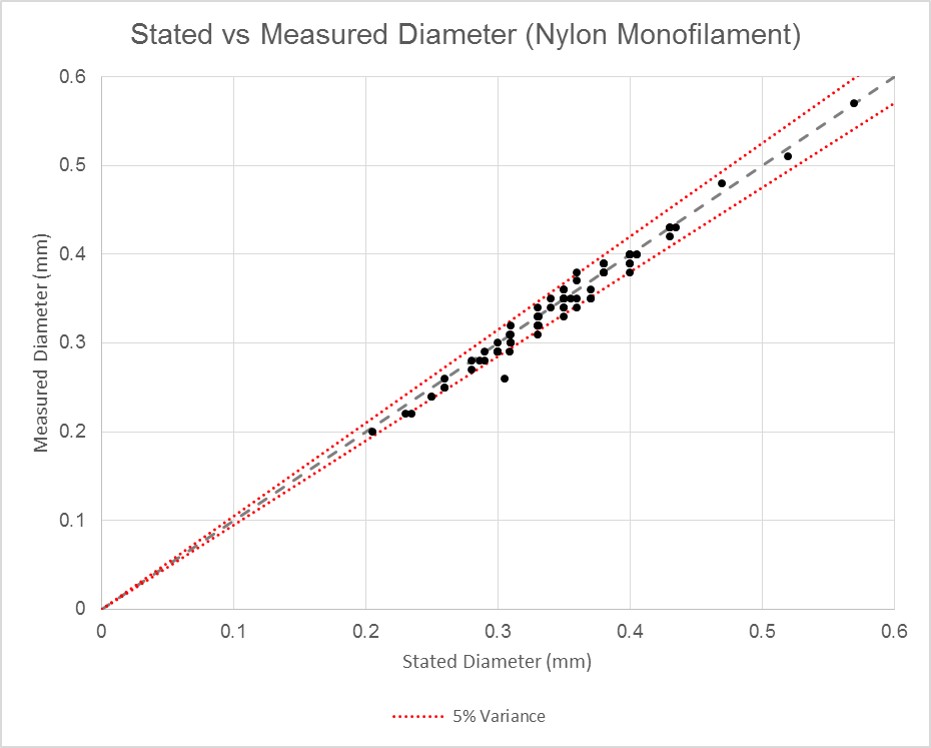
More examples, for those interested. (data source: http://www.tacklebox.co.uk/images/line-test/Tackle-Box-Line-Tests.pdf). Note that this is not the same data set as above, I didn't conduct the tests/measurements, and info on methods is available at the link.
-
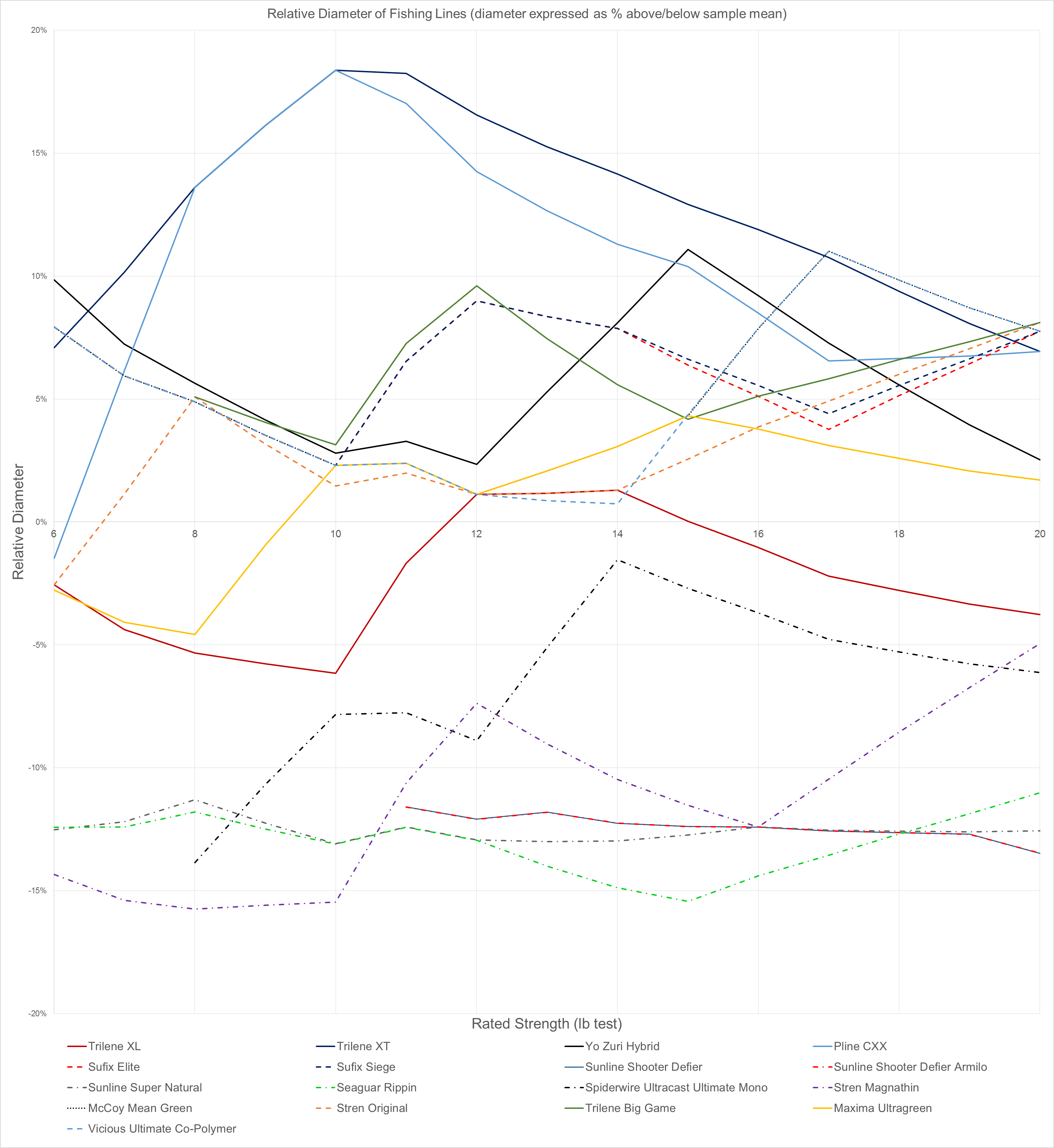
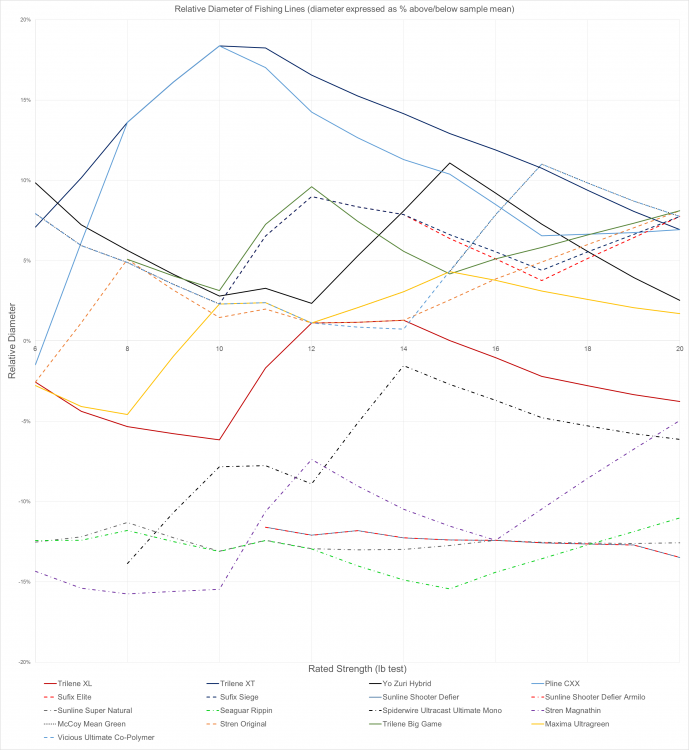
Agreed with the points above. To be clear, there’s no pretense that manufacturers’ rated strengths are equivalent, or even consistently proportional to actual breaking strengths. I don’t think this is a problem, though. Just throwing the numbers out there for discussion. I guess I am under the impression that manufacturers’ stated diameters are reasonably accurate, is there reason to think otherwise? As above, much of the difference in rated strength versus diameter of these lines has to do with their different marketing strategies and target markets – ‘tough’ lines (thick) vs. manageable lines (thin), etc. Presumably there are also differences in the material properties and consistency in thickness between these different lines that will affect “true” strength to diameter, but this data set won’t show that (nor is it meant to). Nonetheless, it’s frequently brought up anecdotally, so think it’s interesting to look at rated strength vs. diameter in a collective and quantitative way. I’m not surprised at the difference in diameters per lb test, but I am a bit surprised at how much some of the rankings change at different rated strengths. YZH for instance appears very oversized at 6 lb strength; decidedly average at 10, 12 lb; oversized again at 15 lb; and average again at 20 lb. Interesting... @WRB good point and one of the things I had wondered about. Not knowing much about the manufacturing of fishing lines, I might guess that premium manufacturers would be better able to control the variance in diameter of their product, and would therefore be able use a smaller diameter to achieve the same “true” strength as a line manufactured with less consistency. Edit: regarding Sunline Shooter Defier vs. Shooter Defier Armilo: they plot directly on top of one another and are tied for third in the ranked list. In terms of rated strength vs. diameter they are identical; actual breaking strengths may be different (as with all the lines). @Team9nine no argument here (though I do think the stated diameters should be reasonable, no?). In terms of a materials analysis the chart is fairly useless - not the intent. But the manufacturer stated strength and diameter are what’s printed on the box, and what most anglers are using along with all the other marketing statements to drive purchase decisions. From that perspective I think the comparison is interesting.
-
Inspired by a recent thread, I did some fact checking on monofilament/co-polymer rated strength vs diameter. These were my results: Notes: - 17 lines were selected, all available on TW, which was also the source for most of the diameters. Rated strengths from 6 lb to 20 lb were included – typical bass fishing range. - Diameters were reported in mm and inches, to varying degrees of precision. Attempting to avoid bias, both measurements were used in all cases – measurements reported in inches were converted to mm, and the two mm values were averaged. - Different brands offer different sizes – to directly compare, diameters were estimated in 1 lb (rated strength) increments for each line from 6-20 lb test by linearly* interpolating between the offered sizes. In 4 cases the minimum available size was greater than 6 lb test – these were not extrapolated beyond the range of offered strength, and were thus only compared at higher strengths. - At each 1 lb increment (6 lb – 20 lb), an average diameter for the set of lines was calculated (this average includes interpolated values). - For each line, at each of its offered strengths (not interpolated values), the difference between its reported diameter and the group average diameter for the corresponding rated strength was recorded (% above/below average). These values were then averaged to determine a representative “relative diameter” for each of the lines, between 6 lb and 20 lb test, which became the basis for ranking. - I cannot guarantee the accuracy of this analysis (but I tried my best) Thoughts, comments, errors? *Linear interpolation seems inappropriate because line strength should not be linearly proportional to diameter. But the curvature of the rated strength vs. diameter relationship is subtle between 6 lb and 20 lb test, even more so between line strength offerings. For this reason I think the simplification is acceptable.

-
We don’t really need to know the tested length if we’re describing “stretch” as % elongation. Linear stretch (i.e. measured in ft) is proportional to length, strain or % elongation is not. The loading rate is unknown, but there’s no reason to assume Sunline would be testing their lines so slow as to induce significant time-dependent creep (at least for the low-load portion of the curves, <30% ultimate strength). Doing so would make their line appear “stretchier,” counterproductive to marketing. Another example: Tackletour’s FC stretch tests used 12 lb Trilene XL mono as a control – static load of 3 lbs, “over a length of time just long enough to measure each samples’ change in length and write this down”. Results showed ~10% stretch after soaking, with 100% linear rebound upon unloading. If plastic creep was a factor in the elongation, the line would not have fully rebounded to original length. Agreed that 5 lbs is a lot of dead weight, but probably (possibly?) achievable momentarily on a strong hook set. In any case, my point was that the elastic stretch began immediately upon loading, not at 5 lbs or at 30% ultimate strength. I don’t have any dynamic testing results for mono fishing lines, but one can prove that it still stretches by just tying 20-30 ft to a sturdy tree and yanking quickly on it, right? @BobP the point that some are making is that the same qualities/differences you appreciate between XL and XT can arguably be found by just changing diameter of the same type of line. And if you look at lines marketed as “hard” or “tough,” they tend to be thicker and stronger than lines of the same rated strength marketed as “limp” or “manageable” (12 lb XT is the diameter of 17 lb XL, for example). So if you want a stronger, less stretchy, abrasion resistant line at the expense of poorer handling, just buy a couple sizes up from what you have now, cross out the rated strength and write whatever (lower) number you want to fish with that day. Or buy an “extra tough” line where the manufacturer has already done this for you.
-
How would you reconcile this with the chart I posted from Sunline? Those samples elongated 7-10% by the time they reached 30% of their ultimate strength. Does this not count as “stretch”?
-
Loosely relevant info from an intellectually honest line company Sunline Shooter Defier Armilo (SDA) “Designed by Morizo Shimizu to be a nylon with characteristics similar to fc products, especially low stretch for better hooksets.” 17 lb diameter = 0.0134 inches Sunline Shooter Defier (SD) “Designed by Morizo Shimizu to be a superior nylon specifically for use with hard baits. Has minimal line friction with allows easy, long distance casts. It has high abrasion resistance and knot strength for good strength going over rocks and wood.” 17 lb diameter = 0.0134 inches (note: exactly the same as SDA) Consider the following chart published on www.sunlineamerica.com: No labels or units; judging from scale I assume this “SS” (stress-strain) curve shows load (kg) on the vertical axis, elongation (%) on the horizontal. Don’t know the loading rate, or the test conditions (dry/wet, temperature). Maybe this is all published elsewhere. Anyway, according to my interpretation of this chart: - 17 lb SDA tested stronger than 17 lb SD: 9.8 kg (21.7 lb) vs. 8.4 kg (18.6 lb) - 17 lb SDA stretched considerably less than 17 lb SD for any given load (including loads far below breaking strength). Over the course of these tests, depending on the load, SD appears to elongate 30-80% more than SDA. At 2.5 kg for instance – SDA stretches ~6.9%, SD stretches ~9.3% (33.6% more). No real point to make, just that the above does appear to demonstrate significantly different stretch characteristics of two nylon lines from the same manufacturer with ostensibly identical diameters, under the same testing conditions.

-
So are we saying if a product is prone to defects, that’s acceptable as long as the warranty is there to replace it? Good warranties and CS are nice, but not having to use them is nicer. Any rod can break, but some are more prone to breakage than others (Carrot Stix, anyone?). Even if the replacement program is great, it’s a drag to break a rod and go without it for potentially weeks in the summer, and possibly pay shipping or replacement fees. Maybe others can chime in with positive experiences to reassure the masses that this is a one-off defect or mishandling during shipping, or even user error, all of which can happen to any rod. Otherwise, if people are having breakage issues with rods (especially new, relatively unknown companies) I’m interested to hear about it. @connorwallin you should know better than to have a negative experience with a sponsor product Hopefully Favorite takes care of you; let us know how it turns out.
-
Source?