


fissure_man
Members
-
Joined
-
Last visited
Everything posted by fissure_man
-
All else equal, to maintain a given retrieve: High gear ratio = turn the handle a little bit slower, with a little more force Low gear ratio = turn the handle a little bit faster, with a little less force It makes sense that as lure resistance increases, people are going to start to favor lower gear ratios to avoid having to apply an ‘uncomfortably’ high level of force to the handle all day. But where you draw that line comes down to personal preference (and there are other factors to consider, like keeping up with a hot fish). I’m with you 100% that most “power” claims related to fishing reels are confusing. It takes a certain (definable) amount of power to reel a crankbait at a certain speed, regardless of gear ratio. The real question is: how much effort does it take to deliver that power with different gear ratios? – or – which gear ratio lets me deliver that power most comfortably? For a lengthy and unnecessary discussion about gear ratios, power, and effort (that still won’t tell you which reel to buy), check out the last several posts in this thread
-
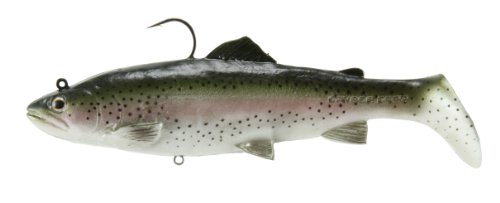
This is a great rig; it really does improve hook-ups (especially smallmouth) whenever you can get away with a treble, and it makes your baits last longer. If you use rivets and light line, make sure to check that the inside and edges of your rivets are not too rough. 1/2" long by 1/8" wide is the only size I've used, and for a lot of baits it doesn't reach all the way from the hook slot to the nose. Not reaching the front makes it a bit annoying to thread the line through, but you can use a sewing needle. Even better than a rivet IMO is a small length of a thin plastic straw (like a bar straw). Dirt cheap, no concern with line abrasion, and you can cut to the exact length you need. You can use a lighter and 'mushroom' the end that your hook eye will ride against. I first make a guide hole through the bait with a sewing needle, then slide in the straw from the back with a little superglue, then trim it at the nose (I do whole packs in advance). Use the leftover straw for the next baits. Wrap some lead solder tightly around the shank of the treble for added weight.I think by “throat” you mean “gap,” which is the distance between the hook point and shank. The “throat” of a hook is the distance between the point and bend. Just to add more options to the pile, “deep throat” hooks are available in regular and EWG styles as well. I’ve always called the separation between the point and “line of pull” the “bite” of the hook, but I’m not sure if that’s technically correct. With a straight shank, the line of pull is through the shank (especially with a snell knot), so the “bite” is maximized for a given hook gap. With some EWG hooks, the point and “line of pull” are aligned, so there’s no “bite.” Other styles of EWG and regular offset fall somewhere in between. Notably, a lot of the Owner EWG styles have significantly more “bite” than the standard Gamakatsu EWGs. As for difference in hookups depending on "bite," the concept makes sense to me. Then again, I don’t remember actually having problems with EWG hookups until the internet told me I did lol. With thick baits, insufficient hook gap is going to cause more hookset issues than "line of pull" IMO, so I'd say use EWG as needed. In heavy cover, I like the weedless-ness of the buried point on a straight shank or non-EWG offset hook, rather than a tex-posed/skin-hooked EWG.Very interesting discussion, especially the sharelunker stats. Can anyone provide a link to where I can download that data set? Is it just dates and weights? I would guess another contributing factor has to be the mass of eggs these big sows are carrying in the spring, right? I wonder how many 12.5's are caught in the fall that would be sharelunkers a few months later. Perhaps if sharelunker admission was based on length, not weight, the proportion of catches at other times of the year wouldn't lag quite as far behind pre-spawn/spawn. Conversely, you might expect the length of the average early fall sharelunker to be greater than for the average spring sharelunker, not having the benefit of all those fully-developed eggs to add weight. Fully off topic now Can't resist. Is camo your favorite color because it catches the most DD's? Or does camo catch the most DD's because it's your favorite color (and it's tied on most often)? Same thing. Do you fish around the full moon because that's when you catch the big ones? Or do you catch the big one's around the full moon because that's when you fish? *ducking behind wall* I'm NOT saying that these are poor fishing strategies, or that I have any contrary proof. Obviously your results speak for themselves. Just adding some food for thought to the discussionThat’s not what I’m suggesting at all, the example I gave is a scenario with a “less active” bass. I think sometimes we reach a little too far or we’re a little too confident in our explanations of “why” a bass bites a lure (or doesn’t). With so many unknowns, one can come up with a plausible explanation for anything: Inactive bass hits buzzbait: “Bass thought the buzzer was a panicked baitfish, switched on his hunting instinct!” Inactive bass doesn’t hit buzzbait: “Well, that bass was inactive, in no mood to chase down a buzzbait.” Bass hits silver crankbait: “Tricked him! My crank looks just like all those shad!” Bass hits firetiger crankbait: “That bait stands out, bass couldn’t miss it!” Bass hits dark lure in clear water: “Baitfish are darker in clear water, no-brainer!” … Maybe these are based in truth, or maybe not. “Going fishing” is not a controlled enough experiment to prove out many of these ideas. Not performing effective experiments makes many of these theories self-fulfilling, ie: angler reads online that watermelon is a good choice in clear water, angler uses watermelon lure in clear water, angler catches fish, angler concludes that watermelon is a good color for clear water, angler passes on his knowledge to the next guy. Maybe junebug would’ve worked just as well that day? For all the drama early in this thread about how speculation around bass perception is unscientific, there sure is a lot of speculation going on! (I like it though )Too many points to pick just one to respond to ... So I'll add another: Bass coexist with their prey in the same environment. How often do you think a bass sees a potential prey fish swim by and decides not to attempt to eat it, only to slam the next gaudy, chartreuse buzzbait that cruises overhead? In that scenario, if the angler had chosen to offer a lure that more closely "matched the hatch," would the odds of a bite be decreased? The actual "hatch" swam by, and was turned down!Not related to LMB or variable water clarity, but this is a cool video and article: https://www.bassmaster.com/video/why-smallmouth-dark Lots of interesting work coming out of Tufts lab on bass (mainly smallmouth). The FB page linked in the article has a bunch of neat stuff, in easily digestible format.Hooray! I think we’re about to agree The cause for ‘surprise’ or ‘unexpected result’ is a misunderstanding of bass behavior, not a misunderstanding of light. Studies of light are independent of bass behavior, and though it would be awesome to develop a unifying, comprehensive understanding of bass vision, color preference (or lack of preference), and light behavior, we don’t currently possess all the pieces of that puzzle. My argument is simply that the ‘light’ piece is pretty well understood, and any unifying theory should not contradict it.Catt, that is a color selection chart, not a chart illustrating properties of light. The jump from “red light is preferentially absorbed by pure water” to “red lures won’t catch bass in water deeper than XX feet” is not a claim that I’ve made. Here’s a relevant quote, and there are numerous others in the thread: Explanations of bass color preference are conjecture (still interesting, but we should take them with a few grains of salt). Measurements of light underwater are not. Measuring and understanding light underwater is a step toward piecing together what bass “see.” When you see a 400 ton jet fly overhead, do you say “Gee, that thing never read the book on gravity!" ?? Or do you rationalize that there’s probably an explanation for what you’re witnessing that doesn’t contradict well-established scientific theories, even if you don’t know what that explanation is. Humans did all the research, I'm pretty sure If I did a study that concluded something like: "the mass of this rock is 40 kg" - would you dispute the conclusion because I'm not a rock? lolThis is the crux of your argument, and it's fundamentally flawed. If scientists were only able to study and measure light "as seen by human eyes & interpreted by a human brain," how could they study UV light, or the UV reflectivity of objects? How could they study or learn anything about x rays, radio waves, microwaves, infrared, etc. None of these are visible to humans, yet we understand them very well and leverage that understanding constantly in our daily lives. I agree fully with this, which you can see in numerous posts throughout this thread. I brought up the deer example to illustrate the point. In normal daylight, we're (presumably) better able to differentiate 'oranges' than deer are. But if the red/orange/yellow light that lets us see that particular "orange" is taken away, we're not any better off than the deer, even though our eyes are different. In other words, it doesn't matter how well an organism can 'see' a color, if there's none of that color around to be seen.Clarify please, with actual example of a claim I've made. What have I said that you disagree with, and why do you disagree? That's not at all my 'belief'. Where have I said that I don't think situation-specific color preference is plausible? My stance is that if situation-specific lure preferences exist, they exist without contradicting the physics of light penetration in water. That's it. I disagree with: 1. Your dispute of the proven and documented behavior of light in water based on your fishing experience: "For whatever reason bass round here disagree" (referring to a chart showing light absorption in water) 2. Your insistence that light can only be measured "as seen through human eyes & interpreted by the brain." (referring to Francho's color-blindness post) I don't reject Francho's color blindness at all lol, read my response again.Great post. While I agree with the assessment, I’d add that proving color preferences don’t ever exist might be just as difficult, for similar reasons. When there’s a scorching bite the reliability of the experiment you described goes up, because the difference between “gettin’ em” and “not gettin’ em” is clear. However, only being able to effectively test for color preference during a scorching bite could introduce tremendous bias. Maybe that test only shows that color isn’t important during a scorching bite. Hypothetical example: Let’s say on a really tough day, there’s an unknown ‘magic’ color that would up your odds of a bite by 20%. If you threw the “wrong” color all day in your chosen locations, you’d catch 5 fish. If you spent the same day, same locations, same casts, etc, throwing the “right” color, you’d have caught 6. At the end of a day like that, with all the variables involved, how could anyone hope to deduce the “right” color? Tweaking any number of other aspects of your day (like location or presentation) could have had a much more dramatic impact on your success, even if you stuck with the “wrong” color. Never mind that the “right” color could be a moving target, changing throughout the day, by location, or even between different fish (personal preferences ). Even though it might be undetectable through the ‘experience’ of fishermen, a 20% preference is pretty significant. If we actually had convincing proof that such a preferences existed and we could predict them, we’d be nuts not to tie on the “right” color. Anglers go a lot further for advantages much less significant (I’m looking at you, 500 dollar reels )??? No idea what you mean by this... nonbelievers in what? lol Not sure what you mean by this either... All of the points I've tried to explain are falsifiable. Provide some evidence that disproves them. I've been wrong many times before. (edited for jerk tone). I'm struggling to say "I'm genuinely interested to see your evidence" without coming across like a jerk lol Before you hit 'save' on a one line response, please indicate which specific statement you're providing evidence against.So if someone’s fishing for a J Francho, it won’t matter if their lure is turquoise or teal. J Francho won’t have a preference. But the only reason we know that is because we know a bit about your vision – you told us. On the other hand, in a hypothetical environment devoid of all turquoise/teal light, nobody would have a preference between the turquoise/teal lures, because there’s no turquoise or teal light to be seen. In this case, we don’t need to know about the vision of our quarry to draw the conclusion, other than the assumption that their vision is based on light. (I’m assuming here that the turquoise/teal lures reflect only the visible colors that they are named for, and there is not a difference the reflectivity outside our visible range) Sorry this got weird. Thanks for bringing this back to reality I've also had some very compelling occasions where color preference seemed pretty hard to deny, mostly while vertical jigging walleyes with live bait. If there’s a few of us jigging, we always start with different color heads because of this.We don’t need to use words like “blue, orange, ultraviolet” to describe light frequencies. The differences between colors are measurable and can be defined mathematically, objectively. If a deer can’t see the orange color of my hat, does it mean my hat isn’t orange? If a color blind person can’t differentiate between green and red, does that mean there’s no difference between green and red? Individual perceptions don’t change the underlying physics of light and color. Based on what we do know, we can draw basic conclusions. If my orange hat is in an environment devoid of orange light, nobody (human or otherwise) can see its orange-ness. Your last point is a good one; mimicking forage is a way to side-step the whole debate. But many (including yourself?) would claim that ‘matching the hatch’ isn’t always the best color strategy. Why else would a 'color believer' carry 10” junebug worms, or bubblegum senkos, etc? Many successful lures look nothing like 'the hatch' My point was that a robust “theory of color preference” based on actually understanding bass vision/preferences/triggers is what would take much greater understanding than we currently possess (assuming such preferences even exist). For the sake of argument, I’d say you’re violating your own premise if you assume you can effectively match your lure color to a forage fish, using your own eyes. When you hold up a shad next to your shad crankbait and conclude that they look the same, how do you know that they would look the same to a bass? (I’d say that short of analyzing the full-spectrum reflectivity of both, a ‘visual match’ is the best you can do, but it’s an interesting idea to think about. Similar idea as WRB’s Eppinger story)Is this a photo you snuck of a competitor's secret bait? lolThis is all good info. If this is a response to me, I don’t think it conflicts with anything I’ve posted; am I missing it? Your first link hints at the same turbidity and water composition effects already mentioned: “Clearer water means bluer water, because if there is anything else in the water to absorb or reflect or scatter the incoming light, the apparent color of the water will be altered.” I agree we don’t know what bass see. But their vision is based on light, and so it must depend on the lighting conditions of their environment (they’re not carrying flashlights!). We don’t have to know everything about their eyes to conclude that they can’t ‘see’ red light where no red light is present, for example. That doesn’t mean you can’t catch a bass on a red lure where there’s no red light, it just means the bass won’t see the lure’s “redness” (or whatever “redness” would mean to a bass).This is a very interesting story, but I can’t help being skeptical. Based on my experience with fish color preference, I can’t imagine a difference in fish attraction so distinct and consistent that it could be independently identified by everyday anglers all over NA, for all kinds of species, in all kinds of waterways, lighting conditions, etc. Much more likely (IMO) would be a scenario where “word got out” that Eppinger changed their paint, leading to rumours that the effectiveness was compromised, leading to lost confidence and decreased sales. I wonder how many people that sent in those complaints had heard that the paint was changed, then had a couple lousy days fishing, then concluded it must have been because of the paint. I have no idea if that’s how it actually played out, just food for thought. I think the ebbs and flows of lure sales (especially color-specific sales) depend much more on marketing and hype than any actual objective measure of “fish catching-ness.” That’s not to say that the paint job couldn’t have had some real effect. It’s a really interesting point to consider how lures that look identical to us might look very different to other creatures. Quite a few posts talk about ‘matching the hatch’ with lure colors. A shad-colored crankbait might look like a very close match to the real thing in our eyes, but subtle or invisible differences (to us) might stand out like a sore thumb to a fish that ‘sees’ in a different spectral range, or is able to visually differentiate certain wavelengths more precisely than us. The same kind of logic is what has deer hunters fully decked out in camo, only to put on a blaze orange hat and vest. The orange is highly visible to humans (worn for safety), but apparently not so for deer. The Eppinger story feeds right into the hands of those promoting UV-reflective lures and lure coatings. Have you tried any of those? If I’m interpreting your school of thought correctly from your posts, it seems like those products should be up your alley when it comes to fine-tuning color selection.Savage gear makes a 5 inch real trout paddle tail swimbait (image below). I just got some but haven't fished them - water's a little too... hard. They look good and feel floppy enough to have decent action Full disclosure - I've never even seen a Hudd so I can't compare. I got them for under $7 CAD on amazon Their line-through trout comes in a 6-inch version; it's a soft jointed bait. Action is good, price is right. I have mine rigged up with wire for pike fishing.
 It’s off topic, but the sky isn’t blue because blue light is most penetrating – it’s the opposite. Light transmissivity is different in air vs. water vs. ozone vs. glass etc. Earth’s atmosphere scatters blue-ish light much more effectively than red, so much of the blue light that would otherwise ‘shine’ overhead in the middle of the day is scattered down to our eyes. At the end of the day (sunset), we only see what’s left of light that’s travelled on a long trajectory through the atmosphere, which is why the sunset appears ‘redder’ (blue light has been scattered away). Behavior in pure water is different, and blue-red hierarchy of ‘visible’ light transmissivity is well known. Bass rarely (never) live in pure water, so we consider other environmental effects. The effect of turbidity, stain, etc on light transmissivity depends on wavelength, sometimes to such a degree that the usual hierarchy of ‘penetration depth’ is altered. Yes, most of these charts and studies focus on 'visible' light, but the same logic can be extended to and tested on light waves of any frequency. We are certainly capable of measuring light that we're unable to see, and studying bass physiology gives us insight into what they might be capable of seeing. If we learned about the eyesight of creatures in the ocean’s abyss, why couldn’t we do the same for bass?Why can't Rapala/Storm just actually recreate the original wart? If I was at Rapala I'd be frustrated at seeing 'pre-Rap' versions of my lure selling for a huge premium. Even unpainted knock-offs that cost as much as an actual (new) wart. A bit of a kick in the nuts Seems like it would be worth throwing some R&D money at. Get a pile of the originals, give to a crankbait guru to pick the best hunters, then reverse engineer. If they don't want to replace their current version, release it as a 'pro' model in some snazzy colors for a couple bucks more. I guess the sales lost to the few die-hard pre-rap fans aren't hurting enough to bother.It would be really cool for a top pro to go all in on the 'color doesn't matter' stance - fish nothing but merthiolate colored baits for a tournament season. Maybe they’d do just as well as ever? It would be a cool experiment. For most people you might think there’d be a confidence handicap, but if they are truly convinced it makes no difference… I suspect sponsors wouldn’t be thrilled about an experiment to convince anglers they don't need to buy 10 colors of each bait. Then again, as in the Hackney quote, maybe that experiment would just have the masses running out to stock up on more merthiolate Catt, this debate will go nowhere until you open your mind lol. If scaleface's light penetration chart (or any other research on light transmission/absorption) was presented in a forum on physics, marine ecology, tuna fishing, etc., would you dispute it on the basis that we don’t understand bass eyes/brains? It has nothing to do with bass. Your stance is akin to disputing the theory of gravity, because a 200 lb angler feels more gravitational force than a 5 lb bass. Even if we had a perfect understanding of bass vision, translating that into situation-specific lure color preferences (that may or may not exist) would take another huge leap of understanding. We know that. Explanations of bass color preference are conjecture (still interesting, but we should take them with a few grains of salt). Measurements of light underwater are not. Measuring and understanding light underwater is a step toward piecing together what bass “see.”


Important Information
We have placed cookies on your device to help make this website better. You can adjust your cookie settings, otherwise we'll assume you're okay to continue.