fissure_man
Members
-
Joined
-
Last visited
Everything posted by fissure_man
-
yield =/= stretch
-
Stripping 20 yds of line for a 20% reduction in IPT (31 to 25) seems unlikely unless the OP is fishing with rope. Assuming ‘7 speed’ means 7.0:1 ratio, the reported IPT loss would correspond to a proportional decrease in ‘effective’ spool diameter from around 1.41” to around 1.14”. By volume, this outer 0.27” (~20%) of the filled spool should contain a minimum of 35% of the spool’s total line capacity, even if we assume the volume of the spool arbor is negligible. So if the stripped line (20 yds) made up 35% or more of the total line capacity, then the total capacity would have been less than 60 yds…? This doesn’t jive with the later comment that the reel still has 100 yds left. I’m guessing the OP’s spool wasn’t totally filled to begin with, and/or the 31 IPT was never correct, and/or the actual line stripped was much more than 20 yards. Dennis, is this close? In any case, it is true and easily demonstrated that either stripping line or swapping gears to a lower ratio will have the same effect on ‘felt resistance’ and handle RPM for a given retrieval force and rate, if the resulting IPT is the same. If you close your eyes, there is no difference. However, there are other downsides to fishing with an under-filled spool as listed by others. Lost casting distance is the biggest one (IMO), especially if the job of the ‘geared down’ reel is to sling crankbaits and spinnerbaits. Contrary to posts above, I find it’s easier to control an underfilled spool in terms of backlashes, for essentially the same reasons that cause the loss of casting distance: a) a smaller spool needs to spin faster to release line resulting in greater braking resistance, and b) a more rapid drop in effective spool diameter as the line peels off further slows the rate of line release toward the middle and end of the cast, and c) less weight on the spool probably helps with inertia issues/overrun at the end of the cast Because of the above, some recommend underfilled spools for skipping. But in general (IMO), the cons outweigh the pros. A properly filled reel with the desired gear ratio and properly set brakes is ideal. To clarify, this would need to be "half filled" based on spool diameter, not line capacity. Stripping 100 yds off a spool holding 200 yds will reduce its IPT, but not by half.
-
To counter the idea that concerns around bed fishing must be based only on 'emotion', here's an article presenting research findings that suggest that C&R angling during the spawn season did have an observable impact on year class success: https://www.outdoorcanada.ca/fishing-for-nesting-bass/ No doubt there are other studies from other organizations and locations (though not very many) that have reached different conclusions, and many lakes continue to thrive under year-round pressure. But it's not unreasonable to think that some fisheries could be more vulnerable than others, and I don't think the research to date supports a blanket statement around the harmlessness of bed fishing. Factors including climate, species, habitat, fishing pressure, stocking programs, etc. ought to be considered. Even if overall recruitment is unaffected by bed fishing, loss of individual broods is well-documented, and resulting potential for population-level selection against traits of aggression and size should be considered. Aggressive bass are the ones most likely to be caught, and large specimens are more likely to be toured around in a livewell or held up for an extended photo session. Even if their lost spawning effort is made up for by the success of others, are we selecting against desirable, heritable traits by disturbing the spawn in this way? I believe there is some research supporting this idea. Food for thought, anyway.
-
It think it's important to distinguish between bashing other fishermen (as in the OP example) and being critical of products that one feels aren’t up to snuff. Cracking down on bullying is one thing, but let’s not expand it too far. Shouldn’t there be a place on these forums for conflicting opinions and critical product reviews? If someone isn’t fond of a product that you happen to like, own, and use, that’s not a personal attack on you. Defend it if you want, or don’t. Who cares? Yes, the old guy with the cane pole catches his share of fish, and yes, the ugly stik has its merits. Fishing with either doesn’t make someone a lesser person, a bad fisherman, or worthy of ridicule. But on a fishing forum, are negative product reviews really out of place? Would you trust a film review site that ranked everything 10/10? IMO the ugly stik is an awful choice for a bass rod and there are better alternatives in the same price range. You might disagree and that’s fine – you can share your stance too. If I came to a bass fishing forum contemplating the purchase of an ugly stik, these are exactly the types of opinions I’d be looking to see.
-
@Mhan7 interesting… I am under the impression that when the reel is rotated in any orientation other than horizontal, the component of its weight acting parallel to the spool shaft is fully supported by the contact of the spool shaft against its seating in the side plate or cast control cap (or that plastic “t” thing for free floating spools). I.e. it’s not “hanging” from the bearings. If that is the case, then the remaining component of the spool’s weight should be perpendicular to the spool shaft, and in line with the design loading configuration for the bearings (purely radial load). This would be true regardless of the orientation of the reel, though the portion of the spool’s weight supported axially by the shaft tip vs. radially the bearings would obviously change. Is this too simplified (or incorrect) a view? Maybe in the case of my Lexa, I have the spool tension too loose and it does end up ‘sitting’ on a bearing when held with the handles down… don’t have it here to fiddle with right now. I don’t expect spool balance is an issue because I’m not convinced this would be orientation dependent…? (at least for handles up vs. handles down)
-
It’s actually a result of both – there is no precession or ‘precessional force’ by rotation alone when the body is symmetrical (balanced) about a fixed axis of rotation; it requires an additional force or disturbance acting to change the orientation of the rotation axis. In the video examples, the unbalanced torque caused by hanging from only one side acts to change the axis of the mass’s rotation, which is resisted by its inertia and results in precession. If the spinning gyro wheel was supported on both sides (like a reel spool), there would be no off-axis net torque, and no precession (or associated force). If you’ve ever held one of these gyro apparatus, you can feel that there are no unusual forces in play until you start trying to change its angular momentum by turning the axis of rotation. Like I said, you could create these gyro/precessional forces by rotating the reel throughout the cast (changing the spool’s axis of rotation), but there’s no reason to do this.
-
@BaitFinesse there is no gyroscopic precession of a spinning spool regardless of orientation during a cast – the spool shaft is supported by bearings on both sides so no net torque is applied by gravity, and any direction of rotation other than around the spool shaft is restricted anyway (by the bearings, the reel, and your hand). This is unlike the video examples, where the wheels are hung by string supported on only one side so they’re free to rotate and they have gravity (+ the string) supplying an off-axis torque. Unless you’re constantly rotating the reel throughout the cast (how?), I don’t see the relevance of gyro effects. I believe the gravity effects discussed above by @MN Fisher are referring to the centrifugal brakes themselves, and how they behave when the spool is held horizontally or vertically. Holding the spinning spool vertically doesn’t turn off gravity, but it does orient it’s force perpendicularly the direction of centrifugal force on the brakes. While I agree that any difference here is probably negligible, it’s not because of gyro effects. I’d wager it doesn’t matter because the centrifugal force driving the brakes outward is much greater than the (negligible) force of gravity pulling them downward. You could compare these easily enough with an estimate of spool RPM – mass of the brake tabs should cancel out. Even if this wasn’t true and gravitational force is significant, the result would be slightly greater braking force from friction against the underside of the brake ring, slightly lesser force from the upper side – still not sure the outcome be noticeable. I’d guess @Bass Turd is on the right track in that spool orientation probably mattered more in the days before high quality ball bearings – unloading plastic bushings and spinning on the spool shaft tip might have had a meaningful impact on friction. FWIW, I’m playing with a Daiwa Lexa that spins very freely held horizontally or with the handles up. With handles down it’s noticeably rougher. Not sure why, probably just needs cleaning.
-
@BaitFinesse teach us, what does the gyro effect in that video have to do with our casting form and the merits of casting with a vertical or horizontal spool?
-
@Jrob78 – thanks for the reply. Not meaning to be difficult but I still wouldn't agree with the statement “anything that moves the balance point closer to the reel seat is going to lessen felt tip heaviness on a given rod.” As you’ve indicated, the tip heaviness you feel depends on where you’re gripping the rod. Putting a heavier reel on a tip-heavy combo will always move the balance point closer to the reel, regardless of grip, but this only translates into reduced “felt tip heaviness” if you’re gripping ahead of the reel’s center of mass (as it sounds like you may be). Many don’t, and for those whose grip supports the rod at or behind the center of the reel, tip heaviness will be either unchanged or worsened with a heavier reel, respectively. Simply put (on paper, anyway): if you’re not gripping ahead of the center of reel, then the reel’s weight is acting on the ‘tip’ side of the fulcrum (or at best, it’s acting directly on the fulcrum). Only when the fulcrum is ahead of the center of the reel by using a forward grip (or by doing the “finger balance test”) does the reel’s weight begin to offset tip weight. Folks fine-tuning the balance of their setups (and installing heavier-than-necessary reels) based on the finger test, then reverting to centered or rear-biased palming grips are misleading themselves, IMO. (Does this really matter when it comes to putting fish in the boat? Of course not. What works, works) It should be said, it's certainly an oversimplification to consider one's grip as a single point around which the rod rotates, as I've done. In reality, your fingers are spread out, some of which may be ahead of the center of the reel, some aligned, and/or some behind (depending on grip style). Where wrist action is involved, say, twitching a jig with an upward-pointed rod, I can imagine the brunt of the upward force is provided by the foreward-most fingers, "dynamically" moving the fulcrum ahead (lightening the tip). On a "down-twitch" the opposite could be true.
-
Agreed - "Both options result in an increase to overall setup weight, Option B in particular. " Kinda outside my point, though. @Jrob78 and @BaitFinesse: While balance point is obviously not unrelated to tip heaviness, I stand by my previous post that demonstrates that it’s not always reliable for comparing the tip-heaviness of setups, and I’d challenge the belief that heavy reels cure tip-heavy rods (depending on one’s grip, of course). It’s difficult to come up with a more straightforward or relevant example than I’ve given above, but here’s another: Consider two pieces of lumber: an 8’ 2x4 and an 8’ 2x2. Weight (mass) per foot of the 2x4 is double that of the 2x2. Both pieces of lumber balance perfectly at the 4 ft mark. If you gripped both pieces of lumber (which have identical balance points) at a distance of 1 foot from the center, which one will feel more tip-heavy? Note: this crudely simulates palming or gripping a rod behind its balance point, as is typically the case with production rods. As with fishing rods, tip-heaviness here refers to the resistive torque you must supply at the grip location to prevent rotation under gravity. Let’s assume the rods/lumber are horizontal in this test. Let “m” represent the mass per foot of the 2x2. The mass per foot of the 2x4 is therefore “2m”. For both the 2x2 and 2x4, gripped 1 ft offset from the center mark, the ‘butt’ (behind the grip location) is 3 ft long, while the ‘rod’ (ahead of the grip location) is 5 ft long. The weight of the butt can be represented as a point load at 1.5 ft behind the grip (this is the butt’s center of mass), while the weight of the rod is a point load at 2.5 ft ahead of the grip. Tip heaviness (“T”) is calculated as the difference in opposing torques supplied by the acting of gravity on the butt and rod segments. The equations for both pieces of lumber are the same, only the butt and rod masses are different. 2x2: T = (“rod torque”) – (“butt torque”) T = (m x 5 x 2.5) – (m x 3 x 1.5) T = 12.5m – 4.5m = 8m 2x4: T = (“rod torque”) – (“butt torque”) T = (2m x 5 x 2.5) – (2m x 3 x 1.5) T = 25m – 9m = 16m Is it surprising that the tip heaviness of the 2x4 is twice that of the 2x2, given that their balance points are identical? Is there any reason that the same physical concepts shouldn’t apply to fishing rods?
-
For those concerned about tip heaviness, balance point is simply the wrong measure to compare setups. Take @ResoKP's example. The balance point shifted butt-ward maybe 1” with the addition of a few quarters to the butt (Option A). The exact same balance point could have also been achieved by switching to a heavier reel (Option B). Having achieved equal balance points, would both of these options have resulted in the same ‘feel’ in terms of tip heaviness? The answer is no, unless @ResoKP actually holds the rod/reel at the locking nut (i.e. at the balance point) in operation. Assuming the user’s grip is aligned with the reel’s center of mass or slightly ahead, Option A is less tip heavy than Option B. If the grip is centered behind the reel’s center of mass, Option A still gives the least tip-weight, and the tip-heaviness of Option B would actually be worse than doing nothing at all (despite ‘improving’ the location of the balance point). Both options result in an increase to overall setup weight, Option B in particular. Considering the above, why would we expect the balance points of different rod/reel combos, which are not aligned with our grip location, to be reliable indicators of tip weight (or at least, reliable enough for the level of hair-splitting desired in this thread)?
-
Cross dominance can be an issue in shooting sports because you are forced align your vision from one eye through an optic or sight to the target. When your dominant eye doesn’t align with the sights/barrel (i.e. left eye dominant, shouldering a shotgun on the right), you need to force your brain to focus through the non-dominant eye typically by just closing or obscuring the other. This works, but it’s not ideal (compensating your aim is a bad idea, but off topic). Better to align the sights with your dominant eye and keep both eyes open. For casting I doubt cross dominance would have any noticeable effect, and may even benefit..? A lure’s trajectory is not necessarily aligned with either eye’s line of sight (think of a sidearm cast), and even when it kind of is (pitching, maybe? Or overhead cast?), casting with a particular hand doesn’t mean you couldn’t align the trajectory with whichever eye you innately prefer. For most people, casting with the hand that feels unnatural to them is a huge hindrance, while the benefit of matching eye dominance (if there is any) would be insignificant. … For me, switching hands started with spin casting. For a young kid with small hands, palming is not an option and you need to grip behind the reel to operate the push button. Retrieving while keeping the same grip behind the reel is extremely awkward and strenuous, so some hand-shifting is required (we only had right hand retrieve spincast reels, anyway). Easiest way to do this is to cast right, grab the foregrip with the left hand at the end of the cast, and then start reeling with the right. To this day this is how I do it with casting/trolling reels that are too large to comfortably palm, while bass sized casting reels get the same treatment but are palmed during retrieve with the non-casting hand. The hybrid palming/casting grip that militant non-switchers employ surely works fine for them with ‘palmable’ bass reels, but is less practical for small (child) hands or big reels; I’d guess this is a part of why hand-switching remains common for baitcasting. With spinning reels of any size (and hands of any size), it is perfectly comfortable to cast and retrieve without changing the position of the hand that’s holding the rod. Not surprisingly, it’s relatively rare to see an experienced fisherman that switches hands with a spinning reel after casting. JMO
-
Locating the balance point is a poor way to compare tip heaviness of different setups. Rather than asking “where does it balance,” we should ask “how well does it balance at my grip location?” Mounting a heavy enough reel can make any combo balance near the reel seat, but won’t reduce the combo’s tip weight unless you’re gripping ahead of the center of the reel (and even then, the detriment of added weight needs to be considered against the potential improvement in balance). Instead of comparing balance points, it would be less ambiguous to measure actual tip heaviness as the torque required to prevent rotation of the rod held in a given orientation (horizontal) about a given axis representing the grip location (for simplicity, say this is through the center of the reel seat which should approximate the reel COG). Without bungling around with scales and weights, one should be able to easily calculate this knowing the weight of your reel and measuring the balance points with and without the reel mounted: T = (R*x)/(1- x/y) Where: T = static tip heaviness (torque to prevent rotation about the center of the reel seat when the rod is held horizontally) R = reel weight x = distance from the center of the reel seat to the balance point when the reel is attached y = distance from the center of the reel seat to the balance point with no reel attached Would be interesting to see how the various rods line up when measured in this way, in comparison to our perception of tip heaviness. … Worth noting that even though the above approach gives an objective way to quantify and compare ‘balance’ between different rods, the question remains: “what is best?” An 8 ft 2x4 with a reel seat dead center might be perfectly balanced, but can you imagine hopping a jig or working a spook with it? Inertial characteristics of the combo related to overall weight and distribution of weight will affect how the rod feels and performs while you’re swashbuckling it around, beyond simply affecting the balance point. Ergonomics of the reel and reel seat are important, too, as is overall weight from a sensitivity and fatigue perspective. If we accept a certain level of balance or tip weight as ideal (subjective), the way in which that balance is achieved matters: lighter blank, lighter guides = good; butt weights, heavy grip components, excess handle length = less good, potentially bad. The former qualities can be found in shorter, less powerful, and/or (typically) more expensive rods. The latter can be found anywhere - any rod could be balanced by weighting the butt, though whether or not the result is an improvement is subjective. Ultimately, trying out the setup to see how it feels (to you!) is still the best way to go.
-
Very delayed reply - Agreed that it would be difficult to exclude these factors and that they will strongly influence an individual’s catch rates on any given day - the problem is in quantifying them. However, I think it’s fair to assume that the anglers’ decisions aren’t correlated in any way with solunar times, so although the noise from these factors would obscure any solunar influence, it shouldn’t introduce a consistent bias. For example: an angler’s lucky hot streak coincidentally aligning with a solunar peak would skew the findings for a that day, but if the solunar influence is a myth then you would expect the occurrence of these streaks to be equally likely at any other time (including non-peak times), so the average effect measured over a sufficiently large data set should trend toward zero. On the other hand, if the data did indicate a statistically significant increased likelihood of ‘hot streaks’ happening during solunar peaks, that would be an interesting finding. Having results from multiple anglers fishing the same lake/time/conditions is a big advantage of the MLF data – right away this could help to smooth the noise in individuals’ catch rates. I would skip looking at results for individual anglers, and instead evaluate the overall catch rates for all active anglers on a given day. If the solunar theories are valid and have any meaningful impact on fishing success, then through the noise we should expect to see a tendency toward increased average catch rates during the ‘best’ fishing times. I would maybe break up each day into peak and off-peak fishing windows (keep it simple), and for each day come up with a relative statement like: “average catch rates during peak fishing times were XX% higher/lower than average catch rates during off-peak fishing times.” After applying the above process for many days of MLF fishing (and keeping in mind that each ‘day’ is actually the averaged day of multiple anglers), you could look for a trend – is there an overall difference in catch rates between peak and off-peak fishing times? The larger the dataset, the smaller the solunar influence which could be detected (or conversely, ruled out) using the above approach and following appropriate statistical rigor. I would still fully expect to find no significant difference in catch rates, but that would be a conclusion in and of itself. I think the most time-consuming step would be digging up the local solunar tables for the event dates/locations and attributing them to the dataset. And depending on how variable the difference between daily peak and off-peak catch rates ends up being, the current dataset of MLF results may not yet be large enough to produce a compelling result. As for your offer; this would be a nice project for a stats class but I’m not sure I would commit to being the one to process it all
-
Tipping in almost any context is archaic and we’d be better off without it. Why shouldn't businesses just pay fair wages, set appropriate prices, and tell customers the dang cost up front? As for variable expenses – this is the reality many businesses, and most can’t change their prices day to day (nor can they expect tips). Revenue needs to cover overall costs and make a reasonable margin, or it’s not a viable business. Some guide trips will be more profitable than others, but this is part of the business and not generally the fault of the customer (think of it in reverse, if gas price goes down 20c, could the customer expect to pay less for their trip?). The idea of tipping as compensation for going ‘above and beyond’ in a service is at least palatable, and arguably incentivizes good service. But for many services, tips are expected as an unwritten rule, almost regardless of the customer’s experience (heck, many servers make less than standard minimum wage in anticipation of tips… ludicrous!). Tipping a percentage of total cost also makes no sense. Is it twice the work for a server to carry out a $20 steak vs. a $10 hamburger? $5 beer vs. $0 glass of water? An expensive fishing guide might have the experience, demand, and expenses to justify their high price – but why should the dollar value of their tip be proportionally higher than you’d give to a lower-cost guide that worked just as hard? When you hire an expensive guide you’re already paying them for the above perks in their high base price. Could go on and on… why do some personal service providers get tips and not others? Why enable tax evasion with cash tips that will frequently go unreported? Why perpetuate traditions rooted in master/servant (slave) culture, which result in differing levels of service to customers pre-judged to be generous tippers, and which in restaurant settings are unfairly advantageous to conventionally attractive workers (and races) and contribute to a work environment with some of the highest rates of sexual harassment in any industry? Putting all arguments against tipping culture aside, the fact is that it is a custom engrained in our society. Though tipping is rarely mandatory or explicitly expected, you will make an arse of yourself by failing to tip in many circumstances, and when workers are underpaid with the expectation of tips (such as in a restaurant), you really are ‘stiffing’ the worker if you choose not to tip (IMO). In my experience, tipping of fishing guides falls under the ‘unwritten but expected’ category: barring extreme circumstances a tip is socially appropriate, and the lack of a tip would imply that you were unhappy with the service. But opinions on this vary as seen in posts above. If I was shopping for a local guide, I would assume I’d be paying a tip around 15-20% and factor that into my purchase decision.
-
@Team9nine thanks, you are much better-versed in bass / fishing literature than I, but that’s the outcome I’d expect. Plenty of theories out there (sometimes conflicting), but little in the way of meaningful evidence when actual data are brought to the table. @Catt I was not so much thinking of the source, but rather the basis for the theory. With due respect to old farmers, absent a plausible, causal explanation for why bass’ susceptibility to angling would depend on solunar activity, and without any factual indication that such a correlation even exists, it’s not clear why anyone should believe this stuff. Because the almanac says so? I wonder if MLF is collecting any data that could ‘shed light’ on this question, as they have multiple anglers, tactics, lakes, times, etc. and presumably are tracking the exact time that each catch occurs. Do the anglers tend to catch more bass during the ‘peak fishing hours’?
-
With the sharelunker acceptance window being timed around pre-spawn/spawn, most of the catches (91%) already fall within the Jan-Apr window (they don’t accept them in the summer). Here is the distribution: Filtering to include only Jan-Apr catches, 26.7% occur in the quarter cycle around the full moon, 22.9% around the new moon, 23.7% around the first quarter, and 26.7% in the last quarter. Compared to the full data set, this is a small increase in the proportion of catches around the full and last quarter phases, and a corresponding decrease in the proportion caught around the new moon and first quarter phases. While these differences could be taken as an indicator of some spawning-related moon influence, they could also be random. The filtered dataset of 520 catches is not large enough to confirm such a small hypothetical influence with much confidence. With an opposing hypothesis (i.e. moon phase does not influence sharelunker catch rates), one would still expect that in a sampling of 520 entries, one or more of the 4 quarter cycles would account for at least 26.7% of the catches more than half of the time, due to nothing more than random variance. For an individual moon phase (the full moon quarter cycle, for instance) one would expect the proportion of catches to meet or exceed 26.7% around one in five times. There are surely other variable to consider as well - I wonder if there is any meaningful correlation between angler-hours and moon phase (which would skew the above results), given that some folks do seem to pay attention to the solunar tables or other theories, perhaps especially around the spawn. In an earlier post you described major and minor periods for bass activity. Do you have any data to support these times as having an influence on angling success, which would stand up to analysis similar to the above? @WRB good info, and I've no basis to dispute your experience. Sounds like you have some pretty extensive logs, would be a heck of contribution to the bass world to leak them out

-
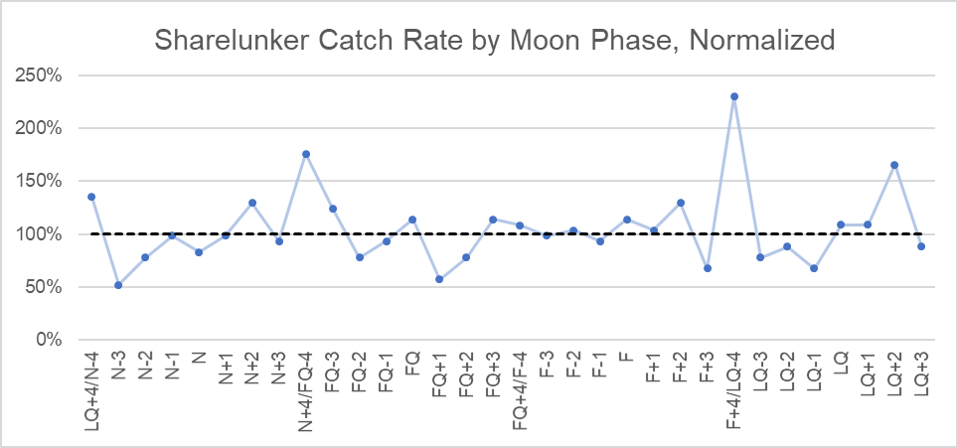
By my math, TPWD sharelunker records of 570 entries show 6.7% were caught on the full or new moon (not necessarily at night), a time period which makes up 6.8% of the moon’s synodic period. That rises to 20% if you include 1 day before/after the full or new moon (20.3% of the cycle), 34.9% within 2 days (33.9% of the cycle), 45.4% within 3 days (47.4% of the cycle), and 49.6% within the two quarters of the cycle surrounding the new and full moons (50% of the cycle). Looking at the phases individually: 26.2% caught within the quarter cycle surrounding the full moon. 23.4% surrounding the new moon. 24.1% surrounding the first quarter. 26.2% surrounding the last quarter. This is a sampling of only ‘giant’ bass by Texas standards (13+ lbs), and disproportionately represents angling for pre-spawn/spawning bass because of the limited window for sharelunker entry. According to some common theories, these spawning, giant bass may be among the most likely to have their activity linked to lunar phase; however, no statistically significant outcome in terms of catch rates is evident (at least not within my limited analysis). Note the spikes that tend to occur between +3 and -3 phases. Each quarter cycle is ~7.4 days long, so the +4/-4 phase designations occur intermittently dependent on how the lunar phases align with calendar days. This has been accounted for in the chart above, but the smaller sample size for these intermittent 'phases' results in greater volatility. I would guess that the apparent tendency for these spikes to be positive is random.
-
Long before? How much time are people spending threading a rod? Physical disabilities aside, for the average person using their fingers (target market?) this would save around 30 seconds, at most. That’s assuming it doesn’t need to be dug out of a box and then put it away when the job is done, in which case it probably wastes time. The way I see it: Fingers: Free, always on hand (HA!), haven't let me down yet (but can be darn stubborn in the cold) Fuji: $3, one piece, nice big slot to grab line (helpful for those who struggle with vision, dexterity), helps to thread line through a casting reel, works for micro guides and spinning rods, slow (compared to RTD) RTD: $30, multiple parts, small DS clip to hold line, doesn’t work on micro guides or some large spinning guides (as per website), doesn’t work for threading line through a casting reel, fast (compared to Fuji tool), and it makes a fun clicking noise as you run it up your rod
-
There is some evidence that pre-stretching mono can actually increase its ultimate breaking strength: https://bassblaster.rocks/science-do-you-pre-stretch-your-fishing-line
-
Worth noting that the IPT on some of the reels recommended above is very low, and gets lower when a long cast peels off half the spool capacity
-
Somewhat off topic, but if a company offers a lifetime over-the-counter replacement program, I have a hard time seeing it as “abuse” when the customer participates in it. If I wear something out through no fault of the product, but the seller will still replace it under warranty, why not return it? It’s up to the company to decide on the parameters of their warranties, and how they are enforced. I don’t know Cabela’s policies, but with other now-defunct lifetime replacement programs it was often suggested or learned through experience (but probably never actually written) that scrutiny of returns would be essentially zilch. The downside for the company is that they will need to cover replacement costs, but on the other hand the generous warranty might keep customers around and is a selling point for their products, potentially with little else to differentiate them from alternatives. Walk in with a beat up and broken rod, walk out with a new one, no questions asked – that is/was worth $$ to the customer. The company offering a “no questions asked” warranty makes a bet that the warranty will bring in more $$ than it will cost them to fulfill it (the associated sales boost, price inflation, customer retention, etc. offset the liability of replacement costs). Some of these bets didn't work out, so a company retroactively cracks down on previously unenforced fine print to cut losses... try that in Vegas I get it, but I don't feel sorry. I bought numerous rods under that “over-the-counter, no questions asked” sales pitch, and even though they are 10+ years old I wouldn’t feel guilty asking for replacement, though I’d probably be rejected – it’s what I paid for, right? If not for those programs, I might have been buying from somebody else. Prices don’t go down when companies quietly roll back their warranties, so value from the customer’s perspective is lost. I can empathize with the OP that the attractiveness of Cabela’s house-brand gear takes a hit without its former warranty.
-
“…over the course of a day it’s likely that more than a limits-worth of fish could be held and relocated.” Example: Bass tournament. Legal possession limit: 6 bass. Joe Angler blasts off and fishes a milk run of spots, catches an early tournament limit of 5 fish and culls 4 times before heading to the weigh in at the end of the day. 9 fish were held in the livewell and potentially relocated, but no more than 1 limit was possessed at any time. No harm done here as long as the bass survive the ordeal, but that brings us back to the original article.
-
Media over-stating study conclusions is the status quo, but beyond a couple of generously worded phrases IMO this magazine article doesn't go too far. Given the intentional use of the word “speculates,” I'd say the researcher is being clear that the proposed connection between winter mortality and relocation in the fall is an observation that's not definitively proven, what more do you want? That the connection is speculative doesn’t mean that it's unreasonable or that it was conceived in ignorance of other possibilities (give Corbett some credit). There are good questions raised above, and I would guess some are addressed (though not necessarily resolved) in the original studies. Has anyone found the actual LOTW tracking study? Skepticism aside, this could potentially be filed in the same category as fishing for deep bass, fizzing, fin clips, livewell care, time spent handling fish out of the water, damage to slime coats, jacking jaws, mountain dew etc. C&R only works if the fish survives. I agree with @mick, it doesn’t sound like the 35-50% mortality figures referenced in the article are pulled out of the air (though we don’t know much about the study conditions and should be skeptical); it’s the causal relationship to relocation that's speculated. If nothing else, those numbers seem surprisingly high IMO, worthy of discussion/investigation whatever the cause. I wouldn’t say this is broadly true, depending on what you mean by “sustain.” There’s little doubt that the quality of some fisheries has been or can be helped by successful C&R of adult fish which could legally be harvested, and this practice is often promoted by the same agencies that set the harvest limits. Bass held in a livewell for photos or in tournament scenarios are likely to be larger specimens, and over the course of a day it’s likely that more than a limits-worth of fish could be held and relocated. Selectively harvesting or indirectly killing these larger fish through delayed mortality may not wipe out the bass population (and may not break any laws), but it’s no way to support a quality fishery. In reference to the OP article, the concern is that trophy northern smallmouth are unusually susceptible to angling in the fall due to aggregation (true in my experience), and are potentially also unusually vulnerable to angling-related stress causing delayed mortality (speculative, difficult to prove definitively). Anglers that want to keep these fish for the table are free to do so within their rights and the study is irrelevant to them. But the for the well-intentioned folks planning to release those bass, doing what they can to improve survival odds makes sense.
-
The location of the balance point is a convenient but ineffective way to compare the “felt balance” of different combos, unless your aim is to actually grip the rod at that location (achievable, though not necessarily desirable, if you’re gripping ahead of the center of the reel or using a counterweighted rod). It can be misleading, too: a lightweight combo might balance further forward than a heavier combo, and yet still feel equally or even less tip-heavy depending on how you hold the reel. For example: a very tip-heavy casting rod will require a heavy reel to bring the overall balance point close to the front of the reel. A lighter reel on the same rod would push the balance point further forward, which could be interpreted as “less balanced.” However, if your plan is to palm the reel in a way that it (the reel) is more or less balanced in your hand, its counterbalancing weight is removed from the equation and you’re left with the feeling of a tip-heavy rod plus the balanced dead weight of whichever reel you selected. In this scenario, is the heavier reel (and overall heavier combo) an advantage? If the tip-heaviness is a problem, a better-balanced rod or an adjustment to your grip is what you need. If your grip is slightly choked up then the reel’s weight will reduce tip-heaviness (most obviously in applications where the grip location is fully ahead of the reel), while grip to the rear of or behind the reel will make tip-heaviness worse. As above, “ideal balance” comes down to how you hold/use the rig and how you prefer it to feel. As for the lighter ($$$) rods balancing further ahead of the reel – if that’s the case (surprising to see this as a general finding, but I’m not familiar with most of the rods mentioned), a lighter reel wouldn’t bring the balance point closer to the reel seat; it would do the opposite. Still, the comments above about balance point and grip location apply. Shaving weight in rod construction can improve balance but it doesn’t necessarily – it depends on where the weight came from. Most bass rods off the shelf are tip-heavy to varying degrees. Tip-heaviness can be reduced for a given rod length/power ideally by using a lighter blank ($) and lighter guides ($). In addition, some rod makers intentionally add butt-weight to reduce tip-weight at the expense of increased overall weight (whether or not the end justifies the means is up for debate). Maybe this is what you experienced with some of the heavier, better balanced rods.