FIN-S-R
Members
-
Joined
-
Last visited
Everything posted by FIN-S-R
-
Yes c-rig on bedders is a do-able technique, if the conditions call for it. EX: I was fishing bedding smallies in about 15ft of crystal clear water and had to stay back and make a real long cast as not to spook 'em, and in water that deep sight fishing for bedders can be tough because your lure doesnt want to stay put, but with a 3/4 oz c-rig, you can anchor out and wait em' out. My bed fish choices go like this: 1. Weightless 2. jig 3. shakey 4. t-rig 5. lipless crank 6. c-rig so a c-rig isnt my 1st choice, but I have also used a c-rigged little shallow diving crank by setting the weight in the bed and pulling such that the weight doesnt move, but the crank dives at the bed with a "charging" type action.
-
Aircraft paint...its tough stuff. Did a ski rig in black...figured out along the way that the most important step is sanding. The quality of your sanding job will dictate the quality of the finish...unless your doing white and then it doesnt matter as much. Wipe the boat down good, and then wipe it down better before your shoot it.
-
Thanks!!!
-
Seastar Hydro steering system. Has Play in it to the tune of about 1/2 inch either side of center. Can anything be done to tighten the steering? Any and all comments and suggestions welcome.
-
Had an early 90's dyna trak back when in college, toted the family around in it for a couple of years, it was a great boat and for the money I dont think you could probably get a better riding boat. Mine had a 150 johnson, and wouldnt win any races, but it had a great rough water ride.
-
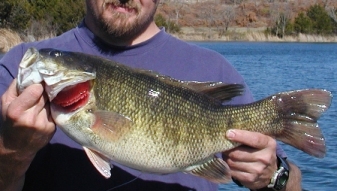
Here is the 8+ from veterans lake in south central oklahoma.
-
Different frogs have different best case scenario uses. The hard nose gives a very subtle ripple action...really good for super clear calm water and spooky fish. The zoom has slightly more obtrusive action, and works well in most situations where you have a little color to the water and/ or some wind action. The smaller Ribbit and the cane toad are good for situations with more wind and more water color or more agressive fish. The lake fork frog and the yum frog as well as the stanley bull ribbit are good for maximum buzz bait type action, They can be fished fast and make a lot of disturbance...good for windy/ colored water conditions. I have caught more and bigger fish using the zoom in black or june bug during low light periods than any other frog. Rigging-The problem with the screw-in hooks is that they kill the slow spiral falling action of the bait. Spiral falling action? You say???? Yes, probably 80%-90% of the strikes you miss on top with these frogs can be translated into hook-ups if you just kill the bait after the miss, the frog will start sinking in a spiral motion, and its a good wounded bait impersonator. I logged many many hours figuring out this frog thing last year, and found the best rig for durability and performance is to use an owner riggin' hook and position it such that the hook point sinks into the bait straight from the rear between the legs. Then take a 1/8 inch length of 20/30/...50lb mono or some other real stiff line and stick it through the bait..through the hook eye. this will keep the hook in place. When runnin it over thick vegitation, I will put 1 wrap of suspend strip on the curve of the hook to keep the lure right side up...if the lure is riding upside down (horny toad/hard nose tend to try and roll over), you will miss some strikes, and get hung up more often. Some folks say to cross their eyes on the hookset with a frog....this works, but you with yank the lure from the fishes mouth frequently if you use this type of hookset with braid....and braid is a must with these frogs. I always wait until I see my line move to the side (after the lure is obviously down below the surface in the fish's mouth) before setting the hook. And the hook set I use I learned from watching my son (8yrs old and cant give it a cross their eyes hookset if he wanted to). He was lazily sweeping his rod to the side after waiting. He was hooking up about 100% to my maybe 50%-70%. Now dont get me wrong, you will hook up nicely with the cross their eyes technique, but those fish (usually the bigger ones) that dont all out blast it need a little more "touch" to the hookset. I was a big proponent of cross their eyes until my eyes were opened by my #1 fishin' bud.
-
Meanmouth in oklahoma over 8 lbs....but that pig from cali seems to be all brown fish. The big ones (meanmouths) here in oklahoma have come from Veterans lake (small clear mountain lake), and texoma. lots of smaller ones in any lake that has spots and smallies, murray is loaded up with them, and they act more like white bass or stripers alot of the time, they just relate to structure a little more than the all out transient predator types.
-
We have 1 of those teams here in eastern oklahoma...The christie team. Jason christie is rollin...took my $$$ last week. I think he is about to go pro, so maybe we will get a break from him...until the next B/A comes along- he got 17th in the texoma open...he rules eufaula and grand....
-
Just bought the boat and have only driven it 3xs. My last boat had a top end of around 65 mph and wouldnt walk anyway...but I always had the stabilizer on it. Thanks for the info.
-
Got tired of looking for threads on this, so i figured Id just more than likely be redundant and bring this topic up. What experiences have you guys had with chine walk and the influence a hydrofoil had on it. I have heard or read all the info on shifting weight and tweeking the motor set-up to remedy this, but I know the hydrofoil gives you better bow control, but what can it do if anything for chine walking. I have a pretty light 20ft tidecraft w/ a 200 optimax that gets real squirrelly at around 70mph. Tell me the good the bad and the ugly
-
In murray down here in s. oklahoma, mid and down lake smallies tend to be brown and the smallies that think they are LMBs and live up lake can be nearly solid green. I caught a 6+ last year that was real green like that and had a distended gut with about 6 in of a 14 in LMB hangin out of its mouth, as well as a belly full of eggs. Having said that, It does look an awful lot like a mean mouth (spot or LMB/ smallie hybrid). A big 1 (mean mouth) was caught out of texoma (mentioned earlier in this thread) as well as an 8+ caught out of a little mountain lake north of murray (veterans lake). The mean mouths can exhibit both smallie and spot/lmb markings just depending on the water and vegitation they live around. I have caught a bunch of these mean mouths, and I am kinda leaning in that direction due to the prominant horizontal markings. They tend to exhibit a hybrid vigor and grow faster are more voratious than either the smallie or the lmb/spot. The ok dept of wildlife has stated that they are unable to reproduce, and this could explain the seriously distended gut due to the fact that eggs are produced, but not efficiently expelled, and no successful spawn cycle is completed. Anyway you cut it that is still a serious pig!!
-
Tryin to keep the momentum up...our last 6mos of 30+ boat fields go like this: 6th, 3rd, 2nd, 4th, 2nd, 1st and 1st. Im just waiting for the ball to drop.
-
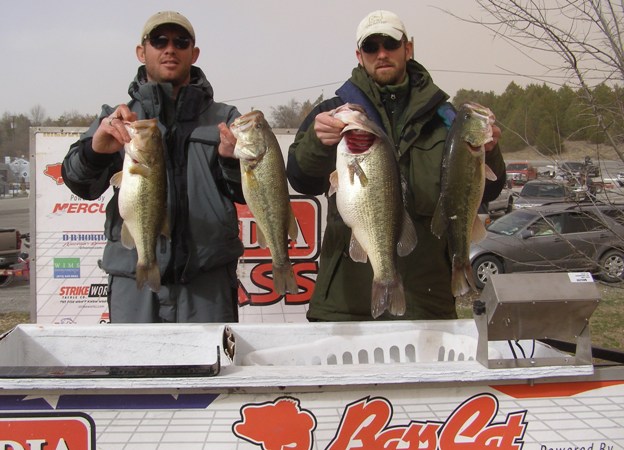
A week after our first win, here comes #2. The big un was a little over 7 and got us big bass. 50 mph winds about kept us home, but im sure glad we decided to go. Here is a link if your interested in the kind of fish being caught in the north texas southern oklahoma part of the world. http://www.mediabass.com/ Keep your nose down your knees on the ground and your hands folded.
-
I guess i should give credit where credit is due and say this. Say your prayers every night, keep the wife as happy as possible, make sure your kids know you, and then just maybe every once in while a blind hog will find an acorn. Keep your nose down, your knees on the ground, and your hands folded.
-
Red/ Ghost shad/ Chrome green back yo-zuri vibe
-
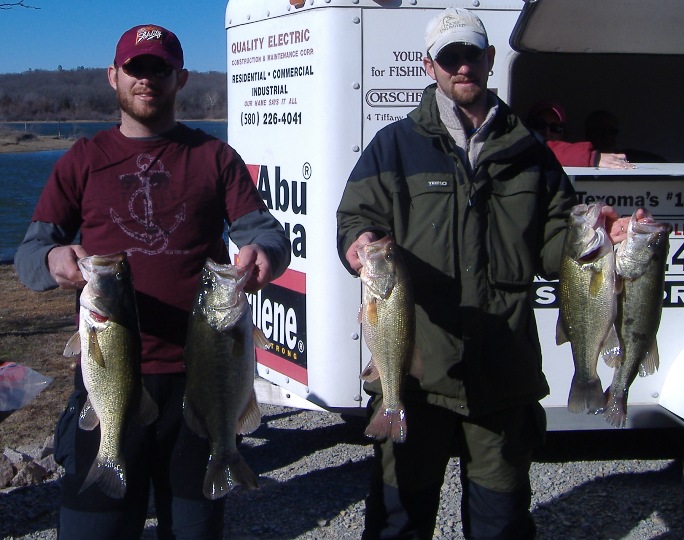
After 3 years of hours and hours on the water, it all came together and we finally got the first W to the tune of 20.34lbs on a day with sustained 30mph winds, and a near non-existant bite on texoma...for everyone else. We squeezed by the 2nd place team by nearly 10lbs. Its an awsome feeling to finally get that monkey off your back...and against some of the best sticks in the area. Thanks to Lance and Vernon of BackYard Bassin' for putting on 1 hell of a trail this fall and winter. If your in Southern/Central/Eastern Ok or North Texas U should check these guys out this spring on the Tracker trail. Ill let the pic say the rest...
-
Senko or horny toad
-
Clear water, cold water, high pressure, negative bite conditions, all favor finnesse techs. On lake travis you have all 4 going on right now, so it just stands to reason that finnesse is the way to go.
-
In the teens and snow on the ground in okieville, but theres not a snowballs chance in HE!! I wont be on the water this weekend. A bad cold windy snowy day fishin is better than a good day of anything else.
-
http://www.springerlink.com/content/w214538u93566h14/ This link will take you to a pub discussing fish community distribition and it is divided up into categories of larval/juvenile/adult components. The info in this pub is good, but what is even better is the info you can find in the ref.s. Man this is an huge wealth of knowledge from real statistically examined research.
-
I have done this with some old humminbird units, and with some new lowrance x series units, and some older x series units. A color unit really helps because you can tune your color settings to show "fish" type densities as a certain color. On the older units U have to set the ping speed at max, on the newer units you have to set the ping speed lower like 25-50. Setting your trandsducer just slightly angled toward the side of the boat you fish off of most really helps so you can make a short pitch cast and kinda triangulate the point you want the lure to hit. This technique has been used for a long time by the striper guides down here on texoma. My father-in-law has been doing this for catfish for a number of years also, so its not really a new technique, just maybe new to TV covered bass fishing. A guy who you dont hear alot about who is an elite series angler:Jeff Kreit is probably one of the best there is at this. He gave me a lesson one morning before a local tourney, and there are so many little details you have to really pay attention to in order to get to the level that Evers was doing it on TV last week. The main thing is learn to tell the difference between fish and other by getting on a spot that is holding fish and then adjust your resolution and sens. settings till you can really tell the difference. A couple of years ago my cousin and I won a few bucks doing this very thing on fall schoolers that would only come up about every 4-5 hrs. This last weekend after we both watched bassmasters, we went out and brushed up on the technique, but the only schools we could find were big blues, so we tried snaggin a few, and then found some gar and did the same thing. Its really hard to do this in less than 20ft of water becasue the cone is relatively small, but it can be done. What you didnt see on the show was that many times when you hook 1 fish doing this it will look like a fireworks display just went off down there cause of all the other fish that will just go nuts. There will be alot of fish you will never see until you hook 1. Anyway, its a pretty neat way to fish, and probably the most important thing in getting it right is super good boat control. The 1 thing I still cant figure out is why fish show up as arcs when your moving, and then just become blobs of clutter while your sittin' still on top of them?
-
Bi-Modal Specialist: Finnesse as the name implies and DEEP crankin. Bi-modal Depth: Greater then 20ft and less than 5 with a vibe Bi modal Style: Stick on the spot boring/ Trolling motor on high ripin' the vibe or dredgin' the bottum.
-
Seth is that you Nope not seth. All of you fellows that are commenting on making it too complicated are CORRECT. When im on the water, despite the large number of hours I have put into concocting my personal "system" I rarely if ever take the paper to the lake. I review the concepts and "rules" I have collected a couple of days or maybe even weeks before I hit the lake. I make a plan and as 1 guy mentioned pre-rig to the tune of about 10 rigs, then I go fishing. If I get stumped, I move my efforts left or right of central idea i planned for. This weekend it took me two days to catch 1 fish on largely unexplored cold slightly murkey water. So I essentially made the wrong call on some variables. this info will go into my log, and the new perspective concerning these variables will be calculated into my "system" to hopefully make it better. Bottum line: I have tried to come up with a good place to start. Anything that happens after that first cast is anybodys game.
-
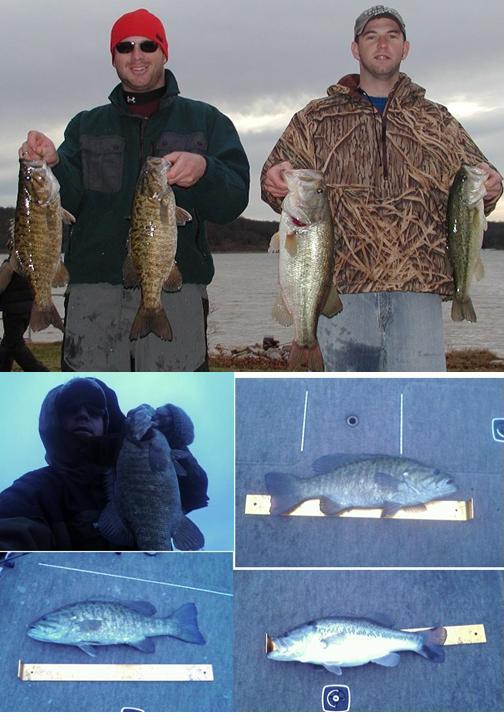
In a post I placed a little while back (NOT FOR THE WEAK OF MIND PART II) I had included a chart which I consider my probability calculator or guide. The first step in using the guide was to choose a seasonal pattern that was most likely to be in effect at the time you wish to persue the green or brown fish. I wrestled with the organization of this system considering what would be the largest defining factor for increasing an anglers probability for exposing his lure or bait to a fish. In reviewing my notes and recording the outcomes of many tourneys I realized that to realize your best probability for success, location was the single most influencial factor. It is simple reasoning that says "If you are in an area with fish you have a better chance of catching one than if your chunking at sterile water." This idea is fundamentally sound independent of depth, are here is why. Take for instance a pre-spawn/ spawn pattern. You would be working 2ndary points back to flats in order to find the largest concentration of catchable fish. You may pick up some on the points, and some in the spawning grounds, but depth would be an influencing factor on the same magnitude as available cover and structure (spawning sites/ holding sites/ etc.). The same idea holds true for post spawn, and fall. Depth does become more important during summer and winter, but the rule of mother nature's entropy dictates that there will be catchable fish at various depths in a particular area considering available habitat and food. That is not to discount the FACT that there will be fish any place there is water that will support life, so the importance of location is relative to food sources with the exception of spawn. This idea also bleeds over into your next probability factor: SPEED. In my analysis of the relative success of various lures (LIVE BAIT DOES NOT HAVE A VARIABLE SPEED IN GENERAL) composed of various speeds and reaction mechanisms, I realized that SPEED is just a part of a presentaions reaction level. Reaction level is made up of 3 components that are in my mind inseparable: Sound/Sight/Speed. Color is also a factor in reaction level, but is more of the fine tuned end of it and is more region or location dictated. A bass feeds by sight and sound, and if it can overcome the speed at which a lure is presented, it will notice then catch the lure. At any 1 point in time there is a range of sight, sound and speed combinations which will promt a strike at any number of depths, so its more the correct combination of the 3 factors than only the exact level of 1 which will allow for hookin up. Now I didnt assign values to the variables as a measurement of statistical probability in the chart I constructed, but in making the chart I did formulate an importance based on values which were derived from counting the numbers of fish taken from certian areas at certian times on certain lures. The figures were further explored by categorizing numbers of catches according to the calculated reaction values for various lures (color independant) that caught the fish. Then I reworked the numbers based on general fish size. Much of the data was dependent on people telling the truth, and ASSUMING that I got the reaction levels of certain lures ballparked correctly. I think I probably did due to the fact that the differences between the numbers and size calculatoins suggested little difference in areas or reaction levels, but there was a depth component that showed some difference though it was not significant statistically speaking. Overall, I CALCULATED that location was approximately 75% of the picture, and reaction level was about 15% of the picture in most cases, with the exception of a hard spawn where as reaction level and location split the bulk of the probability at 45% and 45%. Weather patterns can be broken into 2 categories, those that offer rising barometer with bright conditions (most often these two occur simutaneously), and dropping barometer with low light conditions (most often these two occur simutaneously). There are exceptions to these two categories, and everything in between them, but they are two benchmarks that serve as extremes and can be used to gauge values in between. This factor is worth 10% almost without fail...except during spawn where it many times is either everybodys game, or anybodies game. Color: We have discussd color on this forum enough to probably agree that there are a few colors that are mainstays. There will always be a regional or local influencing factor, but the science of light absorbsion and penetration dictates that in reality a generic set of colors are MOST VISIBLE...maybe not best, but most visible. NOTE: I do not claim to have discovered the magic set of rules that will always work, just figured out how I can figure out a good place to start Anyway, Its quittin time and I gotta go get ready for a tourney. Oh yeah. Ill include some pics of what my "Probability SYSTEM" has done for me over the past few outings.