FIN-S-R
Members
-
Joined
-
Last visited
Everything posted by FIN-S-R
-
$100 Entry Fee Payback 85% 1 in 5, Big bass $10, 10% goes to chp fund and 5% for misc puttin' it on expenses ie. lake permit, scales, blah blah blah. Payback Spread for 100 boats pot= $8500 Bigbass=$1000 1st place=30% of pot 2nd Place=10% of pot 3=9% 4=8.5% 5=8% 6=$500 7=$450 8=$300 9=$250 10=$200 Next 5 Places Get ($150) Final 5 Places Get Entry Fee Back ($100) $900 Contribution to Chp Fund + MemberShip Fees ($5000) $450 to Trail Fund or Club Fund And $1000 Big Bass I would fish this trail.
-
First let me say i am by no means a pro, or anywhere near it, but I have managed to accumulate enough experience in tourney situations, and spent enough money and time that I have graduated to the upper level of non-affiliated team tourneys. It went somthing like this, first find a good friend you can fish team deals with. Concentrate on 1 lake that is close and learn to be the team everybody hates to see show up. Then branch out to other lakes with different water types, and learn to be the team everybody hate to see show up. I heard it said by a guy who is currently on the elite tour say, if you cant dominate 80% of the time on your home waters you have no chance to compete against the top level guys. He wins probably 90% of the time on his home water...yeah he beats me and my partner...and we're not too shabby. Anyway, start out with the less than 30 boat type of tourneys, and then graduate up to the mid level deals with up to 100 boats. The mid-level deal is the one that will probably take the longest to get good at cause usually you have all the draw backs of the smaller and bigger operations, with few of the common upsides. Most of all, develop your techniques to a razors edge. Chunkin and windin' wont get you there past the 15-30 boat fields. And lastly, if you wanna get good, fish every single event you can possibly squeeze into your schedule and out of your billfold. There are no short cuts, but there are efficient ways to get this done. You just have to figure out how far your willing to go, and what type of competitor you are. And realize this, the more competitve you get about this stuff the less fun it is, you will become caught up and it will become work at a point. I cannot truely Bass fish for fun anymore, I am always tryin to learn, or figure out, or pick up on somthin' that will help my tourney performances. Honestly, I am in it for the paycheck second only to the quest for perfection (catching a fish on every cast). It has taken me 5yrs of involvement, 3 of which were made up of 600+ hours on the water...try selling that one to the wife...ouch, that fryin pan hurts!! And Im just now (over the past year) stayin consistently in the black. In the close to 100 events I have fished, I still have never won 1. I have 20 something 2nd place finishes, and a whole gob of top tens, but just cause you show up alot, doenst mean your gonna get paid. Big Boat/ Small Boat doesnt really matter. The pole holders are the key.
-
LMB over 10, SMB over 7, and 5 fish limit over 20...during a tourney (already done the 20 lb 5 fish deal while pre-fishin). Im sure I will do the PB upgrades while pre-fishin too, I can never pull em out during a tourney.
-
KVD would have won AOY if he weighed 1 fish when he was DQ'd. That being said, you have to look at versatility to deem the best current guy....notice the specialist guys didnt dominate or really even run at the AOY in FLW or BASS. I dont really give it up for the FLW guys since they have such long practice options. To be the best it means you have to be able to catch the biggest fish the most consistently on que, not be able to practice for a month before a tourney. So instead of picking 1 right at first here, Ill name a few and then whittle down. KVD, IKE, EVERS, CLAUSEN. None of these guys are 1-dimensional, and they all have had great success as of late. I figure if KVD did the FLW thing today, he would at least be top comp. Clausen has shown he is top comp on both sides. IKE won the AOY, and EVERS "shows up" every time he hits the water. They all fish junk and fish deep and fish fast and slow. KVD has made a ton of $$, but so has Clausen, and at a quicker rate. Btw Clausen and KVD who do you think would win. It depends on the lake. I think on average KVD would bring more limits to the scales. So who is it. another site says it is KVD, and Im inclined to agree. But by a very slim margin compared to the other guys mentioned here.
-
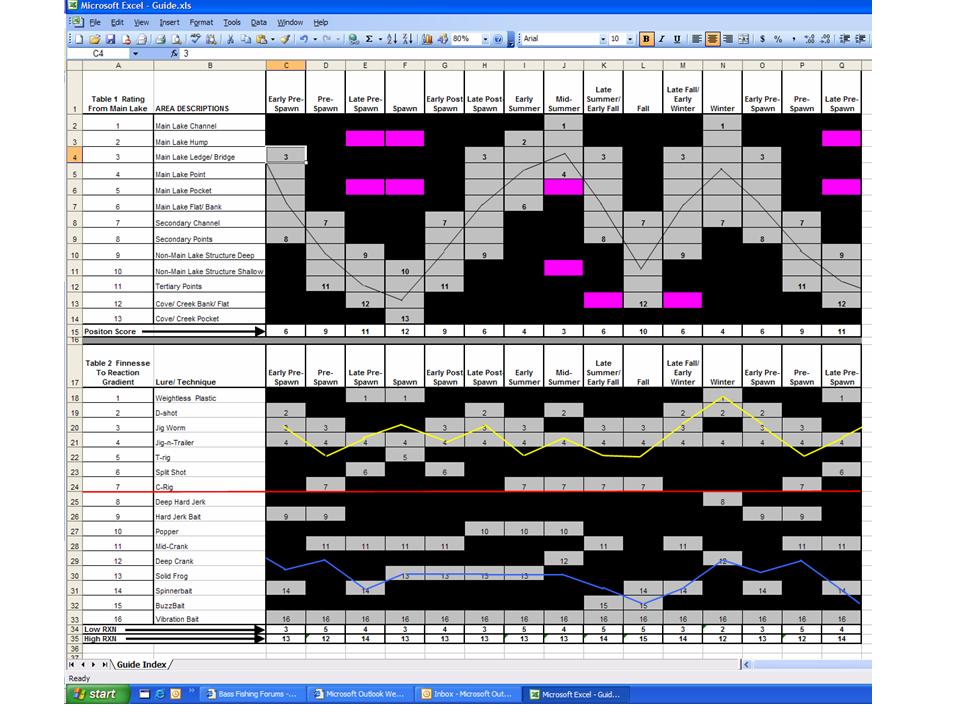
Back from vacation and lots of time on the lake with a couple of smallies in the fours and a LMB over six...winter crankin' is great. Anyway, there were some questions about the numbers and terms used in the chart, so Ill try to explain it as best I can...remember i made it and i know what it means, so that may make it hard for me to explain it very well, so if I leave somthin' out, just hit me again. The numbers on the left hand side on the top table in the chart represent arbitrary "ratings" for different areas of a lake. They are "rated" from the most main lake to the least main lake with a score of 1 being the most main lake location. The numbers in the gray boxes in this table are simply the extremes of the most and least main lake positions associated with the corresponding typical seasonal patterns. The line that runs through the chart from left to right going up and down respresents the calculated "middle" spot for that seasonal pattern. At the bottum of the table there is a row titled position score, this is just the middle position previously reffered to. The pink boxes represent the sort of places that dont exaclty fit the accepted pattern, but always hold resident fish, for ex. some fish spawn in main lake pockets...they dont all go to the backs of protected shallow coves off the main lake. So in short, the first table in the chart is a position prediction tool. The second table in the chart is for choosing a couple of techniques to try on the locations the first table pointed you to. RXN is just a chemistry abreviation for reaction. The Low and High RXN rows at the bottum give an indication of the mean technique reaction level for slow and fast moving lures that have some history showing they work well in the corresponding season. This is expressed in the title of table 2 "finnesse to reaction gradient". I split it into 2 types of techniques which are divided by the red line. Above the red line are slower plastic type tech.s, and below are hard bait type techs. The numbers in the gray boxes for this table are the corresponding numbers from the first collumn of the table (gradient from least RXN=1-weightless plastic to most RXN=16-vibration bait like vibe or lvr) Now Im not gonna claim this will make you catch fish 100% of the time, but it will help you eliminate unproductive techniques and ares quicker, so that you can find the fish and figure out what they are doing in a very effective and efficient manner. It worked for me to the tune of an 18lb limit this weekend.
-
No Critcism? I know this thing is far from perfect, and it is just a starting place for finding. Developing a pattern after finding the fish is more of a personal preference issue, ie..what you LIKE to catch em' on. In NOT FOR THE WEAK OF MIND PART I, I mentioned a technique of finding an average and working both sides of that average..ie, picking a spot and tecnique, then being able to work the more and less main lake ares, as well as the more reaction and less reaction sides of the presentation. Does this communicate that effectively as a tool for finding? Anyhow, thanks again for all the kind words, and if you decide to try this thing out, send some feedback.
-
Over the past few years, i have noticed that the arrival of 11hrs of daylight is the key in spring (considering you have acceptable H2O temp and quality) to getting the spawn moving for largemouth and btw 10 and 10.5 hrs for smallies. Has anyone else every noticed. Also, it seems the first period around the full moon associated with these day lengths are the hottest spawning times. Does this sound familiar?
-
I guess I should have mentioned...I dont claim this is anything new, or some whoppin' big "discovery". Its just an organized collection of what we all know, or will find...maybe
-
This data is about 20% from me on 5 lakes with lots of habitat, condition, and species variety in south and central, eastern Oklahoma. I didnt put dates or any real definative parameters on things such that it can be used on a wider range of latitudes. The data is probably 50% from Scientific and commercial literature dealing with seasonal trends and the corresponding commonly successful techniques. The remaining info is from tourney stats from A BUNCH of tournament results where I could confirm winning patterns and the corresponding lures and techniques.
-
Thanks for the kind words guys. Just to shed a bit more light, the data used to generate this chart is from multiple years, and each year was overlayed atop the previous such that the trend produced would reflect mean data positions, not specifically a year to year succession. In addition to this, accepted movement patterns and common lure applications were considered in picking data qualifiers.
-
Two ponds (1- 4 acres, 1- 12 acres), 2 people who know what they are doing. Fish 1-3 times a week= enough pressure to make the fishing go from great to fairly tough.
-
Tell me what you think. I have compiled this from a few years of taking very careful notes and reading quite a bit of scientific as well as commercial literature on seasonal behavior. This is my start out guide and my "Im gettin' skunked better change it up guide". The lines are for average values or trend identifiers. The lure selection is based on some constructive criticism I have gathered from this forum and from other sources, as well as those lures that have been part of a winning pattern for the respective season. The pink boxes are areas that tend not to be associated with the general trends observed for a certain season, but continue to produce. earthworm77, id like to hear your thoughts
-
I was intro'd to D/S using the nose hook w/ a "dropshot" type hook like the skeeter. I just about quit it due to the constant snagging. Then I had a revelation that a very small EWG type hook might just do the job and stay weedless. Not only did it stay weedless (hook all the way through bait and then skin hooked) but my hook up ratio went up too. i will outcatch my tourney partner 2 or 3 to 1 while he is using the nose hook method. The only time I go to the nose hooking method with an itty bitty D/S type hook is to wacky rig my dinger ;D or senko or worm when Im gettin' lots of nibble and no hook ups- Only happened twice. And lots of folks say to use the lightest weight possible , but i disagree. Ilike to use the HEAVIEST weight possible so as i can maintain good contact and control, and make it sit really still if in the middle of some fish. Also I vary the tag any where from 6-8in up to 5-6ft. A couple of summers ago I found a pattern where the tag had to be at least 4ft, and you had to keep the bait still as a cadaver to get bit. So set up and action will vary, just ask the fish what they want...eventually they will let you know.
-
Typically, i find as another had mentioned I catch fewer fish, but the ones I do catch are the good ones during winter. I dont think this means I am catching more big fish, I just dont catch all the dinks that confuse my perception. To further on that point: i typically fish the same spread of lures and sizes all year round. Now if i am catching the same number of big fish and fewer small fish in winter on the same lure sizes that I catch plenty of dinks on in warmer water, then there must be a slight preference for the size of lure in cold water by the larger fish. Since the middle of november I have not caught a fish shorter than 14in. I know thats not a monster, but usually I catch lots of smaller fish in the same areas during warmer water periods. Big fish have to eat more to maintain than little fish no matter what the water temp. If they can eat big they will, but if they are full, a big meal might not turn on the feeding response like a small finnesse bait laid on their front door. On texoma, there is a ton of bait (threadfin and gizzard shad as well as craws and bluegill, skipjack herring, and ghost minnows) bunched up in big schools during the cold months. Usually we dont experience die offs unless there is a couple of weeks of sub-freezing temps. Subsequently, there is always bait of all sizes and shapes for the bass to feed on. The guides for smallies and largemouth use the threadfins that are about 2-5in long for loose linin in winter, and catch the largest fish of the respective year doing this. During the warmer months they will use the larger threadfins and gizzards. They make a living doing this, so I figure there is somthing to it. The same even applies for the striper and catfish guys who go after the big boys in the winter. i figure a big crank can get you a reaction bite, and I have had the best luck in the coldest water (40 and below) with DD22s and Diawa draggers (big cranks) and 1oz spinner baits. I can cover the water and hook up with the fish that will bite, and leave the rest where they sit and move on. When the water is say 45-50, I like a drop shot or shakey head, and get bit better on it than the big cranks. Then warm up another 5 degrees, and its back to big cranks. I figure there is a correlation between consumtion size and water temp, but I dont think we have enough REAL data to figure it out..just empirical and anacdotal stuff.
-
Rock and water temperature change is all an issue of specific heat, physical material phase and density. For instance, have you ever built a campfire w/ rock around it. The rock will stay warm long after the fire has burned out and the surrounding area has cooled. This is because of the higher density of the rock in comparison to the material around it. So more dense=holds heat longer or holds more heat. Rocks in general have a bulk density, or just density for simplicty sake, of around 2.0 g/cm3 or greater. Water has a density of around 1.0 g/cm3. So in general a denser substance will be exerting stored energy (in the form of heat) to a less dense substance (which will be absorbing the energy) if the two are in direct contact. Now to further complicate the situation, you have to consider physical phase of matter and specific heat. These two factors relate directly back to the density issue. Water has the second highest specific heat (energy required to raise the temperature of a given amount of a sustance) of any common liquid. This is to say that water needs lots of energy input to raise the temperature. When dealing with matter in the liquid state, much heat energy will be diverted from "heating" into changing bond structures. In the case of water hydrogen bonds start getting "bent" in route to the water becoming a gas (steam). This bond movement absorbs energy that would be otherwise used for "heating" In the case of a solid material (rock), the more static structure of the material allows for less bond movement and more efficient "heating", but not always quicker "heating". The last piece of this puzzle has to do with energy absorbsion from light energy (ie. sun) Rocks are generally "darker" than the surrounding water meaning they absorb multiple wavelengths of light and convert it to heat energy, then this energy is translated to the water. This the case for both rocks at the shore line as well as dark colored rocks under the surface. For the guy who wanted to do an experiment, try this, put a glass of water in the fridge after taking the temp. After 5min in the fridge take the temp again. Then put a new glass of water into a warmed water bath at a constant low warming temp on the stove, or set it on a heating pad. The heat SOURCE doesnt matter as much as the fact that the temp must be CONSTANT and not extreme. Take the temp of the water before and 5min after exposing to the heating source. You should see that the water will drop further than it will rise in a 5 min period. It helps if you make sure the temps of the warm and cold places are about equidistant from the ambient temp of the water. Also the best results can be achieved if both the cold and hot exposures are done to the glass in water baths of the desired raised and lowered temps to get full surface exposure.
-
How did you get away with that, they always junk my good posts ;D ;D ;D Anyway, the Drop Shot: Cast it, Fishing it vertically is really somthing to do using your electronics after youve buffed up on the "general use" stuff Fish it with your rod, not your reel. I have found that I do best on a drop shot when I attempt to "feel" what is on the bottum with it (this bit of wit might make it under the radar ;D) What I mean by that is try to identify wether your encountering rock, sand, mud, a combo, or grass , or wood, or whatever. The fish will hook itself so dont hammer back on it. It can be fished from 1ft to 100ft of H2O I typically rig skin hooked t-rig style on a 1 owner wide gap for weedlessness (is weedlessness a word) no matter what type of bottum or cover your fishing, a long skinny weight will keep you snag free the best.
-
Palomar on FC is a lost fish waiting to happen. I have gone to the improved "clinche" or "cinch" for just about everything I throw. On a drop shot you have a nice big knot to pull through the hook eye so that the hook stands out really good with this knot. The california is also a good knot for light FC, but it takes about a year to tie and about 2 to figure out how to tie. I lost 3 keepers on the hookset in the span of about 10 min during 1 tourney this spring thanks to the good ol' 100% knot strength palomar. It doesnt seem to be a problem with mono, but there is somethin' about overlappin' a certain loop or somthin' with the palomar that will make it snap or get pinched and break with FC. And not to derail the thread, i have used the jigin' drop shot for a couple of years now, and it seems to be real effective for post spawners, but havent had much luck otherwise.
-
Id have to say Martens for Light Linin', KVD for Power, IKE/ Evers for a combination of the two, Denny B. and Tommy B. for Heavy sticks
-
The bigger the fish, the bigger the margin of error. If you could catch enough of 1 species of bass of enough differnt sizes and builds, then use your estimator to calc the weight as well as weigh them, then you could get an average percent difference between actual and estimated weights. At this point you would have a pretty good estimator correction figure. Then you could also figure up a length to girth relationship or ratio to characterize the average deviation from your average percent correction figure for Bass of different proportions...or you could just get a scale.
-
August 9th 2004 Lake Murray OK, approx 2:30pm Carolina Rigged rootbeer green/black flake baby brush hog. Hung the largest smallie in my short life to date. Got her to the boat...no net of course, and eased her along side (she was wore out from the 2-3 min fight). Belly grabbed her and with no trouble eased her into the boat. At that moment she gave it one last barrage of head slinging and tail flippin'. Threw the hook (which ended up sunk about an inch into my hand), and went head first back into the depths just slow enough to let me watch her laugh as I grimaced at the pain coming from my left palm (thank you owner for the very sharp hooks). Before she escaped I made a mental note of her length as she bounced off the boat...from my front windsheild screw to the cleat on the bow....a little over 25in. How big? Dont want to lie, but thats a big brown fish!!! My wife just started laughin' at me to add insult to (literally) injury. Never have caught another fish from that spot, but I give it a few minutes everytime I make it to Lake Murray. I have lost more than my share of decent fish in tourneys, as well as fun fishin' but none hurt...and literally hurt like that one.
-
I think time on the water by yourself is really the best way to develope your own style and find the little niche things that can make a difference between a pretty good day and a great day. My tourney partner and I are total opposites when it comes to style. this is a good thing sometimes, but a lot of the time when we practice together, we get absolutley nothing accomplished. This is because neither of our styles will be 100% invested in becasue he will be power fishing, and I will be trying to keep up, and then I will be finnessing a spot or disecting an area, and he'll be in the back of the boat goin' crazy that were not covering water. We both try not to step on one anothers toes, so we wont spend the necessary time concentrating on a technique or area like we should... out of politeness. The greatest strides forward I have made in my own abilities have been since I quit practicing with anyone else, and just concentrated on applying my own strengths and weakness to a situation.
-
Had lots of success this and last summer for smallies, LMB and spots from 30 -70 ft. Caught 1 very nice LMB @ approx. 80 ft.
-
COLOR DOES MATTER...even though I played it down in an earlier post. I got schooled by a black back w/ dark green scale pattern that worked when the EXACT same lure with black back only wouldnt catch a fish...how can they tell the difference. The difference was so subtle that I didnt even realize I wasnt throwing the same thing as my partner until I pulled his lure out of the carpet after netting a fish. Then BAM 1st throw= Fish. All I can say is what the f###? Also, this weekend a certain color crank was only good for dredging paths through the hydrilla when the exact same crank with just a hint of blue to it was almost impossible to dislodge from the mouths of the fish which were inhaling it. I will not claim to be an expert on anything ..especially fishing, but I will claim to be a student of everything nature. It seems there are a few folks that frequent this forum that could garner expert status as far as fishing goes, and what they have to say I soak up like a semi dry sponge. I am as stated before a student, or an observer of nature...this includes people and the "human condition". I have observed my butt get handed to me by guys who fish "their" color religiously. Is this because of persistance or science. I think we all have alittle scientist in us wether we know it or not, if you do something and dont get the desired results you change. That is scientific method 101. But how in the world does a person explain or predict what color will work or why a color has worked and then use that info in application toward producing a desired result? Is it just a persistance and replication issue...try try again, or can we take this info and other info, throw it in a pot mix thoroughly, bake at 350 and boom...big fish on the end of your line on every trip. It ussually doesnt happen that way, but could it, and what would you need to figure it out? Lots and lots of information or "data". We all store data in our brains every day and during every fishing trip, some of us even go to the extreme of actually recording and analyzing this data in a hard copy form. In doing this myself, I have "observed" that the only rule in nature is that there are trends and exceptions to the trends. Jelly shoes, Pet rocks, and many of bill dance's and Roland martins lures are trends, but they are human induced trends better characterized as FADS. Subsequently for the human mind to begin to understand a truely natural trend is a very unnatural thing. Largely because it (trend observation) is many times much more simple than we are willing to accept. Lure Colors and color variations are fads, if you notice, although there are new names, there are really as someone stated earlier in this thread no new colors. Colors follow trends ie. most colors "trend" toward a green or a red or a blue or a purple color, and so on. In nature colors trend toward only a few in any particular area, with a few exceptions...we just did a trend analysis..sort of. Most of nature is dominated by what we percieve as green or brown or white. Its a pretty safe bet that the food a green or brown fish is after will have as a major color constituent one of the aformentioned tones with some exceptional accents of brighter or darker colors. So now we have a baseline for lure colors, but as anyone who has spent much time on the water will tell you, those colors dont always work the best. Why not? Is it a visibility issue, or is it a reaction key. It can be both, and both circumstances can be dealt with with the introduction of a couple more colors, those being blueish hues (june bug to plum) and orange hues (yellow to red). All off the colors mentioed so far are relatively frequently occuring natural colors, so there is nothing new or complex about the colors we are dealing with and probably everyone has all of these colors in some fashion in their fishing arsenal. To recap: Trends teach you what you want to know about fishing, and the trend in nature is a group of roughly 5 colors There are mono tone lures out there, and they work..for instance the chrome on chrome on chrome rattle trap, or the white and silver spinner bait, or black worm. No argumant that these are good sound color options for many conditions and fish activity levels, but can you cover more ground (or water) with a few lures having a combination of key tones? I would say yes! How do you go about accumulating the correct tones, and subsequent combination of those tones? #1 Visability- as it has been said so many times, if a bass cant see it, it probably aint gonna eat it. A combination of black and blue is THE MOST visible color to anything in water...any water. As soon as light comes in contact with water it begins to be refracted and diffused. All light waves are not created equally, and some can penetrate with less diffusion than others. Black objects absorb every possible wavelength of visible light (400-700nm), and "violet" (400nm) penetrates water more efficiently due to the shorter distance between wave peaks. This means that objects that more readily absorb these wavelengths will be more prominently visible. So a good starting point is always a medium to dark purple color. If the fish will eat what they can see w/o differentiation you will catch fish on this color. Try it on deep spawning fish. They dont want to eat it, but they can see it really well= since they dont have hands they pick it up with their mouth. Shades of green have lots of blue in them, and since bass have a sort of yellowish greenish tint to their vision, greens will stand out as blue. Put on some shooting glasses and take a look at a watermelon senko. #2 Match the Forage- If fish are keying on a particular critter, try to emmulate that critter. First of all name 1 critter that bass eat that doesnt have a green or blue hue to it. I cant, but then again Im in OK, and not all the critters that all bass eat live in the sooner state, but as a general TREND this holds up pretty well. Now take the general pattern of natural colors (brown, green, white) and punctuate them with less commonly occuring colors like red, yellow or orange...now you have a blue gill, or a shad, or a crawfish with red pinchers. #3 Forget color and look at presentation. The right color in the wrong presentation will only frustrate you, or it does me. Try different techniques of the same colors. You cant ever go wrong with a senko presentation. It may not catch all the fish in the quickest manner, but it will give you an idea of what direction to go in. So how do you pick up on the subtle color differences that can make all the difference? Start out with Primary natural colors, and work lighter and darker as well as combinations of less frequently occuring colors, and get to know the forage. Junebug and blue flec are my starting point for soft plastics (cover relating blueish greenish critters), and Chrome/ White (white light reflectors) are my starting point for hard baits (Transient Baitfish). Keep in mind that the extent "chrome" can cover ranges from lowrider rim shiny to nearly black to irredescent, and purple can range from nearly black to nearly white. General frequently occuring color trends punctuated by exceptions
-
Spinner baiting Van Dam Style...Ill need to get a new wrist brace
-
flippin' shallow cover- Cant stand it...give me finicky fish in forty foot suspendin' anytime, but please no flippin'