TotalNoob
Members
-
Joined
-
Last visited
Everything posted by TotalNoob
-
I see tackle warehouse literally has exactly 40 colors of the Zoom Lizard (which comes in 4, 6, and 8"). I know texas rigged lizards are responsible for a lot of huge bass catches over the years. As a novice bass angler (and to keep things as simple as possible), if I had to pick just two -MAYBE three- colors for now (and just one size), what are the fundamentals colors I should be looking at, like the time-tested colors? Fishery Background to possibly help (?): My reservoir is a desert body of water with fluctuating water levels throughout the season. Most of the lake is a shale or shale/rock mixture, a few isolated areas of vegetation though nothing thick. Bass population is primarily Smallies and Spots, there is a small population of LMBs though nothing of size (4-5 lbs) is ever consistently caught. Visibility is literally anywhere from .5ft-10ft early in the season as far as I can tell. It varies greatly depending on whether fishing the inlet end (where the snowmelt/runoff brings a lot of dirt with it) or the very deep, crystal clear east end. As the season progresses obviously vis goes down pretty much everywhere. Right now where I'm primarily fishing (around the middle of the lake) visibility is easily approaching 10ft. I don't exactly know what the definition of "clear" water is but I know when standing on the pond prowler yesterday looking down at the glass calm water with polarized sunglasses I could see the bottom with decent detail in 8-9 FOW. So I'd think I'm looking for the color to best match clear (or mostly clear) water conditions and a color to best match muddy water conditions. Perhaps a third time-tested color for something in between. Any advice appreciated.
-
I've been using a 7' M/F and a 6'6" M/F spinning with 15 to 20lb braid main line connected to 8 or 10lb fluoro (.28mm and .30mm). Zero issues. They are terrific, sensitive setups. Tie a solid 22-26 wrap FG knot and 100% of your breakoffs will be at your terminal knot ?
-
Hello, I've been using Spiderwire fluorocarbon line exclusively ($10/roll @ WM) for the last couple years. The light bulb in my head has slowly been going off lately about the advantages of a smaller diameter line w equivalent or comparable tensile strength. I've been looking at the Seaguar fluoros and the two that stand out the most are the red label and invisx. I guess I'm not too concerned about the clarity of the line so much (aren't all fluorocarbons supposed to refract light the same as water, or at least all be comparable in that category?); fluoro to me is about sensitivity and abrasion resistance (vs mono). I use it typically as a leader to braid. It looks like the line diameters are the same between the two up to the 10lb rating, which is the range I'd be mostly looking to be in. With invisX coming in at $25/roll and red label at $15/roll I'm trying to determine if there is a substantial enough benefit to the invisx to justify the extra cost. I've read through multiple reviews on both, there seems to be a lot of good and bad chatter about each. I'm hoping to get some honest feedback from folks who've used both lines, or, if there are any other options recommended for my situation? Slightly off topic but pretty important ... looking around online I see that Amazon has red label for $10.87 Prime one-day delivery. That's pretty neat and all, but I read a review in there from a "top contributor" in the fishing category saying that he thought the line seemed to be a little old, perhaps having sat in an amazon warehouse too long. I've never really thought about that. Could explain the 1/3 savings? How do you know if you're getting "quality"/fresh line? Can tackle warehouse make that guarantee? Can any retailer? Where do you buy your line from confidently? What kinds of things would you look for when looking at a new spool of line to determine if it's old? I don't mind paying the extra money one bit as long as I'm getting what I pay for.
-
Great point. I'm by no means an expert but I've spent the last 18 months learning jerkbaits more than any other presentation and it's become my favorite. This is partly because my multi-species fishery includes Walleyes which jerkbaiting from shore in low-light or zero light hours can be deadly for. A lot of bass are caught, too. Jerkbaits seem to be exceptionally effective for multiple species, whether targeting them or not. There is a lot to jerkbaiting successfully, far more than I can possibly offer but here are some key things I've learned/experienced using jerkbaits on my fishery, things I wish I knew from the get-go: 1) It's most effective in Spring and Fall, though it does seem to work all year. The "jerk-jerk-pause" deal is associated with a wounded/dying bait fish or otherwise prey fish. This happens primarily in the cooler waters of Spring or, as I've found particularly effective, when the shad are dying off in the Fall. The "pause" is when the lure suspends in the water column and represents an easy meal with minimal energy expenditure, an attractive scenario for Spring and Fall fish when water temps are lower and their metabolisms aren't at their peak. 2) When paused, you must not reel up all your slack. Pick up most of it, enough to be able to get a hookset, but not all. It's crucial that the jerkbait sit completely still/suspended for the duration of your pause. The pause/complete suspension of the jerkbait is the most natural part of the presentation and often what triggers the strike. This can't be overstated. Additionally, you need to have some slack in your line when you begin your next set of twitches/jerks to give it the typically desired erratic/darting action. 3) Have a plan for your cast. What I mean is, make sure you're giving yourself the best chance to force an interested fish into striking. Active fish may hit it over open water or followers may strike when it speeds up suddenly as you reel it in. I've had the most success when bringing it across or near natural ambush areas. Setting yourself up on one side of a point and working it across or working it adjacent to some kind of cover or directly above submerged cover. From a shore-fishing perspective I can't begin to tell you how effective the shoreline itself is at triggering strikes. By this I mean that when casting out from shore and working it back toward the shore (typically ~45° angle casts) interested fish will pick up on it at some point in the strike zone and will be forced into a decision of whether or not to strike before it gets too close to shore/shallower water than they're willing to go. The majority of my jerkbait strikes come in the final 1/3 of the retrieve when shore fishing. The same concept of working it toward very shallow water can be replicated from boat I've found, typically something like setting up on a point and casting out at an angle that brings it back toward shallow water. The game of jerkbaiting is primarily converting interested followers into eaters; planning your casts around as many natural ambush spots and/or manipulating shallow water with casting angles will up your strike probabilities. Other things I've learned to consider when using jerkbaits: 1) If you use fluoro, count on your jerkbait being lower in the water column as you work it back. This can be used to your advantage or detriment. 2) Not all jerkbaits of the same line & manufacturer are created equal. Out of the box, some jerks will suspend, rise, or sink (some a little, some a lot) regardless of manufacturer or stated suspension. It's helpful to know what your jerkbait is doing when paused. You can quickly test them out of the box in a small tupperware/storage type container to see how it suspends exactly. Don't assume the same jerkbait you bought two months ago and lost yesterday will behave the same as the replacement you just bought. 3) Water temperature matters. Because colder water is denser, a jerkbait that suspends in 60° water will act differently in 40-50° water. 4) In general, I've found jerkbaits to be a little more effective when there's at least a little breeze or slight chop on the water. This is hardly a hard and fast rule though. 5) Fall Jerkbaiting: More and Faster jerks/twitches (a more aggressive overall cadence) can definitely be effective in triggering strikes. Fish still seem willing to move some reasonable distance to grab it. Spring Jerkbaiting seems to be a little tricker, at least for me. I'm not sure hard/fast rips are so effective in Spring. What I mean is, the fish don't seem to react to jerkbaits in 45° Spring water the same way they do in 45° Fall water (at least not for me). Perhaps the fish are more responsive to a more aggressive cadence in the Fall when there's a mass die off of shad happening. 6) Don't count out the night bite. Fishing after dark isn't for everyone but some quality catches can be had in the late evening or early morning hours (before sunrise) on jerkbaits. That's all I can think of right now and this response got crazy long, hopefully there's something useful in there for someone entering the world of jerkbaiting.
-
Can only speak to the Veritas and only because you mentioned its purpose would include jerkbaits - I have a 6'9" MH/F Veritas that was intended specifically for jerkbaits in the 1/2 to 5/8oz range. It's exceptionally sensitive but has very little give. I can feel every single headshake as they get tons of leverage against the stiff rod on jerkbaits. I don't use this rod for treble hook applications. I can't say how much better the Medium would be for jerkbaits but I'd definitely avoid MH.
-
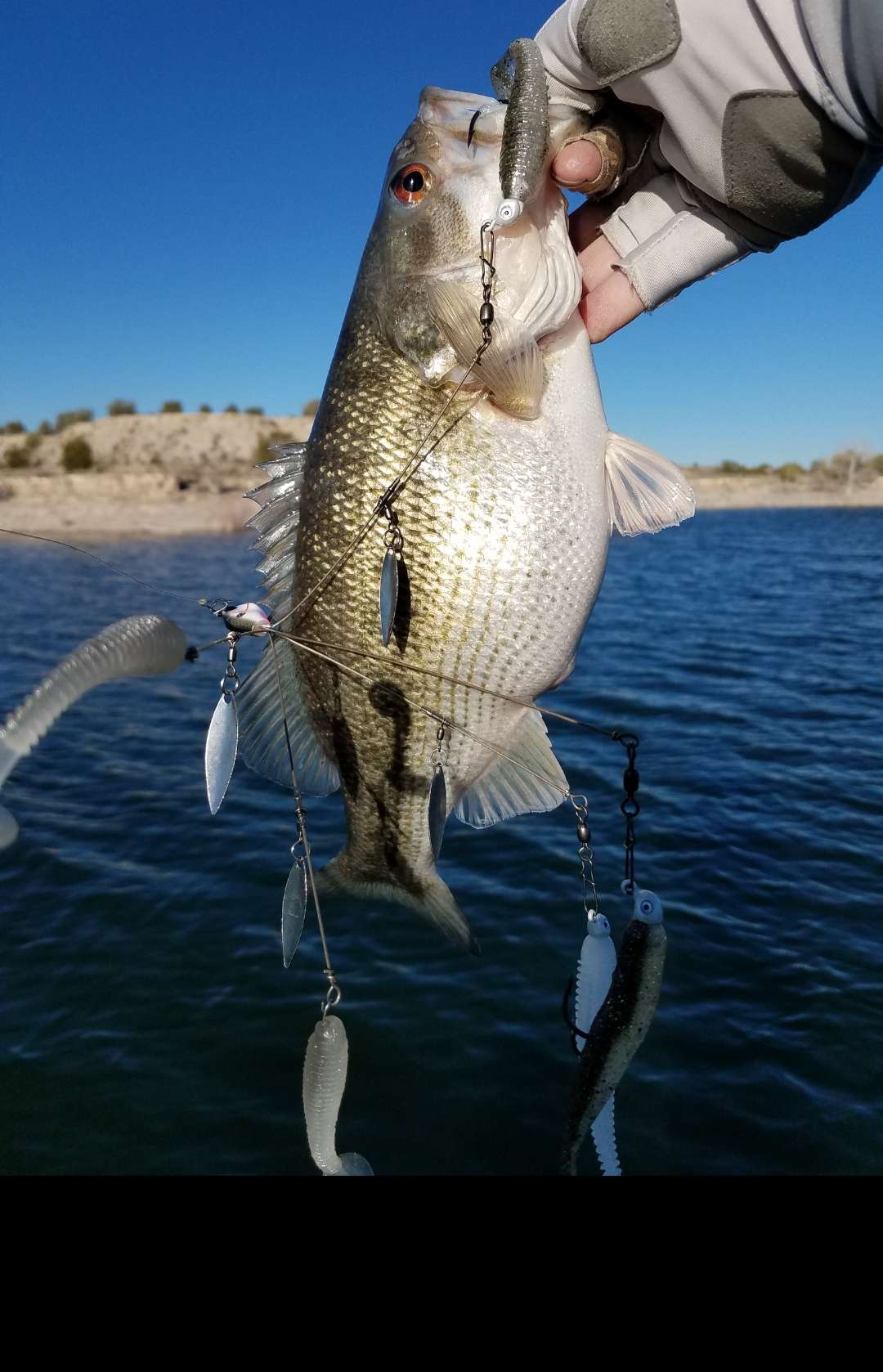
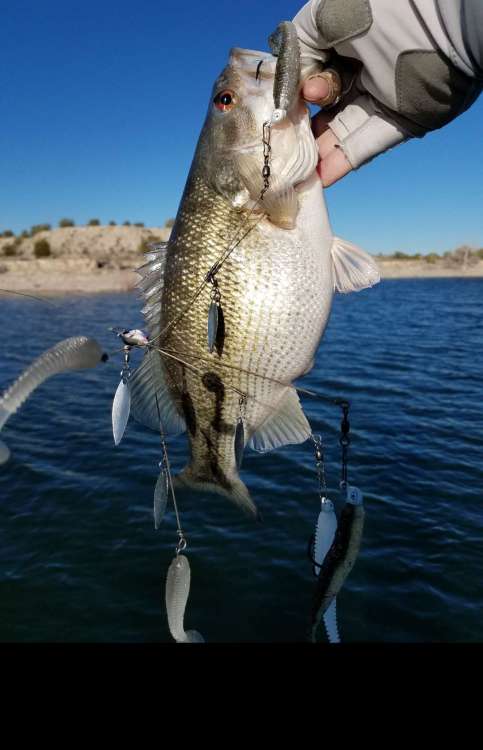
All very helpful thank you. You're right, I did hesitate I wasn't quite sure how to best "bring her in". I was trying to avoid a surface break. She was staying down and kind of surged up last minute on me. When I felt her surging up my heart stopped. What happened was exactly what I was afraid of. The hookset also bothers me. These jig hooks are pretty stout. Here is a pic of the smaller spot from a couple casts prior. This doesn't look like a real good hookset either. This reservoir actually doesn't have a large population of LMBs at all. It's mostly Spots and Smallmouths (and a wiper here and there). Do I need this thick a jig hook for this rig in this fishery? Can anyone recommend a good jig hook option for this kind of fishery?
-
Hello, I'm hoping to get some insight into why I lost a bass right at the boat on an A-rig. This is likely rookie mistake(s) on my part; hopefully some insight can be gleaned by watching the clip. I don't particularly think equipment played a major role but this is it: -BPS PQ2 7' MH/F -30lb power pro to 15lb maxima ultragreen mono leader (4-5 ft) -yumbrella flash mob jr -VMC 1/8oz Boxer jigs (all three; two dummy baits). I believe these are 3/O hooks?? Fishing from a boat (this pond prowler anyway) is new to me this year, as is the a-rig. I landed a smaller Spotted bass a few casts prior. I've had trouble in the past with treble hooked fish but my landing ratio on single hooks is typically pretty high. Even though I could tell this fish was bigger when it hit I was feeling pretty confident I would land her. I definitely understand every fish can't be landed but I'd appreciate any feedback about anything you see. Hookset? Rod angle? Looking for any critique to help landing rate going forward. Thank you.
-
That's what I was saying about that article I read in Bassmasters, in addition to the feedback here. In the article, it stated that a legendary spinnerbait fisherman caught more heavyweight bass with Colorado or Indiana blades. He also said he never caught a bass > 6lbs on a spinnerbait with willowleaf blades. It could also come down to quality over quantity? Perhaps willow blades are responsible for greater numbers of caught bass (and some quality size bass) and Colorado blades are responsible for more quality fish (in the bigger picture)? I don't pretend to know but I sure am excited to be throwing my arsenal of them this year! Hopefully I can start developing my own opinions/theories about what blades/combinations work best under what conditions on MY fishery.
-
You know it's interesting the responses in this thread regarding the Colorado blades effectiveness. After my purchase/creating this post I read an article about how spinnerbaits have generally fallen out of favor from tournament anglers in lieu of swimbaits. Anyway, my takeaway from the article was that 1) spinnerbaits are highly effective and 2) there was a lot of favor from longtime spinnerbait fisherman for Colorado blades over willow blades (generally speaking).
-
Hmmm, you said you have the PP1 right? I wonder if the prewiring is different in it. I checked the wiring in my PP2 and it's 10 gauge. Per the manual from minn kota for the 55lb thrust traxxis (below), 6 AWG would be the correct wiring size for an extension of 5-10 ft (see below). I have $335 into that brand new Traxxis and I expect it to perform correctly so I feel compelled to follow the guidelines as closely as possible. If the prewiring were 8 gauge or the trolling motor was 45lb thrust (or lower) I might feel differently. It seems like running the 55lb thrust through the 10 ft of 10 gauge prewiring is pushing it a little too much. Several pages back in this thread someone posted that they were using a 55lb traxxis at the bow and burned up their wiring. He also said he was a bigger guy ... I'm in quite the similar position here. Unfortunately nothing else came out of that post except someone stating that the extension wiring should have been thicker. Which brings me full circle to now. Edit: I went back and found that older post I was referencing. It's the last post on pg 110 of this thread (here) from Fish 247 - response on the following page. He was concerned he was pushing too much amperage through the 8 gauge prewiring on his Bass Raider 10E with his 55lb traxxis (which was confirmed in the response). I have the exact same motor and the prewiring in my Pond Prowler II is just 10 gauge and I, too, am a bigger guy.
-
I'd really like to. The prewiring is only 10 gauge. Per the minn kota chart above I need 6 gauge wire for the 55lb thrust traxxis. It makes sense, as I understand there would be resistance or power loss and possibly hot wires if I use just 10 gauge wiring to run the 55lb TM. I'm hoping the items I purchased are appropriate for creating a mechanical connection between the two different sized wires, and if not, any info on alternate items would be greatly appreciated.
-
I think this is the real ticket here. The fact that they suspend in the water column is the crucial operating factor. From the fish perspective, it represents an easy/high calorie meal with minimal energy expenditure. I'm sure studies could be done or whatever on optimal orientation per conditions but that is likely far less important than having it suspend in the water column at the right place at the right time. Plus, I've found it's not easy to find consistently performing jerkbaits out of the package. They hold up great. Own several and purchased them through various outlets. Durability is consistent. I threw the shadow rap more than any other bait last year. To be clear, I shore fish at night for walleye and wiper (and whatever else) in addition to daytime bass fishing - it's just something my reservoir offers. Shadow Raps are absolutely killer and possibly the best jerkbait for the money - helps us budget conscious guys, too ? ^^ Yup Yup. Hooks are extremely light wire out of the package. Because of the three trebles you'll probably end up with at least two of them hooked so that helps distribute the load away from a single treble. But you'll still bend them out quickly. I've found a couple plus sides to the light wire hooks: 1) Better penetration/hookset at a distance or if you don't feel the strike and 2) If you're budget conscious and tie good knots you can throw these confidently around cover - if you hang up you'll more than likely bend a hook out but at least get your shadow rap back. The below was actually a massive fish of some kind from an October night this past Fall. All the more reason to change out your trebles if you know there's strong fish around. Have a lot of them, throw a lot of them. No body or bill has ever broke on me. This one has landed dozens of walleyes - just needs new hooks and it'll be good to go again ? Sorry about the rant response here ... the mere mention of the shadow rap got me a little worked up!
-
I've completed what I hope is the final version of the dolly I'll need to get my Pond Prowler II down to the shore and back as easily as possible. It feels really stable and can fit upside down inside the boat (in the bed of my truck) as I'm traveling. I'll probably make a few minor adjustments to it including adding some carpet at all potential contact points. Some pics below. I have a 55lb Traxxis for the bow in addition to a 45lb Endura Max at the transom. Two batteries. Below is a pic from a quick test run of the Traxxis the other day. I added a rudder to the transom trolling motor and the control up front feels pretty good. I'm going the double TM/double battery route because I'm fishing a ~4000 acre reservoir known for random strong winds. Being cautious, not veering too far, staying close to the shoreline, checking the forecast, always wearing a PFD, and having backup propulsion are important to me ? There are more things I want to do to this but by far the most important thing to get done next is getting both batteries to the stern and I'm hoping some minds sharper and more experienced than mine can help me out a little here. I need to move the minn kota Power Center to the stern of the boat. As you can see in that pic it's sitting up front there with the 5 ft leads from the 55lb traxxis attached. That won't work going forward, I was just testing the traxxis there - I need to have that space clear. I need to extend the leads on the Traxxis by possibly up to 10 ft though I think something like 7 to 8 ft will be plenty. Minn Kota shows in their manual to use 6 gauge wire for extensions between 5 and 10 ft on the 55lb thrust. The leads coming out of the TM are 10 gauge so I need to connect 10 gauge to 6 gauge for up to a 10 ft extension. I purchased the following to extend the cables: -Dual Rated Splicer/Reducer (rated for #14 to #2 wire) -Ox-Guard, anti-oxident compound -Heavy Wall Heat Shrink Tube -Rubber Splicing Tape -15ft each of White and Red "6 AWG type MTW or THWN-2 or THHN or gasoline/oil resistant or AWM 600 volts .. 90(D)C.." I'm thinking this should be pretty straight forward but I wanted to check with you guys here and see what you think/make sure I'm not missing or forgetting anything or that another better option exists to extend the trolling motor leads. Still need to pick up 6 AWG terminal connectors to connect to the Minn Kota Trolling Center (which has a 60 amp breaker).
-
That's a terrific looking setup! ? What is the height on the butt seat pedestal? Was this something you already had or something you recently purchased for the deck project? I'm seriously contemplating doing some kind of seat in the front of my PP2. The ability to simply "swivel around" 360° without having to lift my legs over the seat bracket every time would be nothing short of amazing. Walmart sells some pedestal mount hardware, I think I'd be looking to mount it to a couple pieces of stacked 3/4" plywood at the front of the boat (no deck) ... but I'm not 100% on this yet. Definitely need the ability to move about from the bow to the stern as needed without the seat brackets always being in the way. Looking at your PP1 I feel like it's setup better than the PP2. The big thing I'm noticing now is that the PP1 has the metal or tin brackets over the plastic on both the transom and bow mount areas for the trolling motor. On my PP2 only the transom has the metal bracket - the bow is just naked plastic for some reason. This really makes zero sense to me as the intended design of these boats is to bow-mount the trolling motor. The other obvious difference is that the PP2 has more raises areas on the sides where I lay my rods down. The flatter design on the PP1 would definitely be preferable. Edit: Also was curious, you mentioned one of the compartments on your deck stores emergency items like spare electrical parts. What spare electrical parts are you keeping on hand in there out on the water?
-
I've been using 200yd spools of Spiderwire 100% fluoro from Walmart for ~$9.50/spool - I use 8, 10, and 12lb test (for leaders or as main line). BPS has 200 yd spools of Berkley Trilene Professional Grade 100% Fluorocarbon Line on sale during the Spring Classic for $10-$11 (depending on lb test). It's a substantial reduction in price from the $20-$22 retail price they sell it at. I haven't pulled the trigger on this because I don't know enough about it. The sale ends in a few days. I compared the line diameter of each brand at each lb test and they are identical. So there's no gain in line strength per diameter (for example, smaller diameter line but equal breaking strength). I've only used Spiderwire so I don't have anything else to personally it compare against and I don't think there are any other manufacturer-stated properties of each line to compare other than the line diameter and the fact they both say 100% Fluorocarbon. Is the Berkley Trilene Professional Grade so much better of a line than Spiderwire that it retails for double what Spiderwire does?
-
I was wondering this, too. Can the drag be upgraded/increased on a Daiwa Fuego CT?
-
Haha yea there's a long way to go for sure ... of course I have countless thoughts/questions on the terminal tackle front (like in your example). I don't think I've even begun to dive into that yet. I like your comment and I think it puts things in perspective. In my mind, I'd first rather lay down a solid foundation of understanding rods/reels/lines, their pros and cons, and their applications. From there, I think it's easier to make the transition to tackling the infinite details of color selection, retrieve, etc etc etc - the stuff that takes a lifetime to learn and probably nobody ever masters. I picked up bass fishing in mid-2017 so technically I'm starting my 2nd full year. My Dad used to casually Trout fish when I was a kid so I figure the fishing bug was bound to genetically bite me at some point. As to the learning curve, I suppose the internet is responsible for most of it.
-
My system as well, except I use the blood knot as my "quick lake" knot. Same. At first, when I'd snag up good, I was surprised that the failure always occurred at the terminal knot. Now, that's my expectation. I'll be pretty stunned the day this knot fails before something else in the system. That said, it's tough to tie anywhere else but home (for me). Stability and a controlled environment not always easy to find out fishing. I tie 26 wraps and pull crazy hard FWIW.
-
No offense taken. There is a little more to it than just putting a rod on a reel and going fishing. Like most folks I just want to give myself the best chances I can on the water this year with the gear I have and the presentations I'm interested in throwing. Hopefully you can see that's why I'm here. Better to seek advice and input now rather than potentially be scrambling in a month or two when the fishing really turns on ?
-
Yea I may have desensitized myself to mono to some extent by starting out with braid and fluoro. Heck, last Spring I couldn't figure out why anyone would choose mono over fluoro if given the choice. That was before I tried fishing topwater with fluoro... ? As I progress I'm definitely seeing the benefits mono brings to the table (especially as a leader material) in terms of knot strength, shock absorption, and buoyancy. More tools in the arsenal. Perhaps, perhaps not. Sound advice for sure ?
-
Yea, I guess there's two schools of thought on topwater, right? The mono approach for headshake absorption on treble hooks and the braid/heavy rod approach for the "pin 'em down tight and get 'em in quick" technique (or something like that). I think this rod was designed to be kind of a combination of both approaches. It has a lot of give (but a Fast tip for snapping jerkbaits). I think that softer rod helps with the no-stretch braid, allowing me to get the benefits of braid. Though I will say I have bent hooks on Rapala Shadow Rap jerkbaits easily on this rod with 30lb braid. This is part of why I want to drop to 20lb braid. Those Shadow Raps are killer ... a main staple in my arsenal in Spring and Fall. Note that I categorize "Small Topwater" separately from other topwaters that I wouldn't throw on this rod (Buzzbaits, WP 110, Spro Rat 40). Categorizing groups of presentations allows for the consolidation of multiple presentations per setup, thus maximizing efficiency (and keeping me from buying more gear ... for now ?) Anyway, I definitely can't spool that rod with straight mono if I use it for jerkbaits; I can't feel a thing on straight mono.
-
Starting my 2nd year of fishing. I'm definitely a Bass fisherman at heart but my reservoir is multi-species so I fish for what swims. Lots of Smallmouths and Spots, some Largemouths, Wiper, and Walleyes. Not much in the way of heavy cover. Primary forage base is gizzard shad and, for the big fish, I assume the stocked Trout are on the menu. I'm running a lot of new presentations this year (new to me). I'm looking for confirmation that I'm on the right track (or not) and whether or not I can reasonably "get away" with certain things (see Casting Setup #4). My gear is not the high-end stuff I often see posted about here ... I'm not comfortable dropping large sums on high-end gear at this point in my fishing life. I'm perfectly content with my "mediocre" gear while I continue to learn. An important part of fishing this year is expanding my understanding of correctly applying rod/reel/line combinations to specific applications. There are 2 spinning setups and 5 potential casting setups. Input is needed to match Presentations for the Rods and Reels I own and subsequently the optimal line-type for that setup. I mostly need input on the casting setups. I don't need to have 5 casting setups, in fact I'm fine consolidating a little here for the time being if possible. Four of the Five casting rods aren't yet matched up with the listed reels. I'm not sure there are any glaring differences in the characteristics of each reel, primary reel pairing concern is on Casting Setup #4. I've basically just copied and pasted my own notes as I was going through this in my head. If you've read this far (and are willing to read more) I'd very much appreciate any thoughts on matching up Presentations to Rods. I'm eager to start spooling line. Edit: Earliest Season Priorities are with Spinning #1, Spinning #2, Casting #4, and to some extent Casting #1 (as it applies to jerkbaits). Spinning #1 Rod: 6'6" M/F - BPS Pro Qualifier 2 Reel: Pfluegar President 30 Line: 10 or 15lb Braid Main Line/10lb Fluoro leader Potential Applications: -vertically ripping Blade Baits up to 1/2oz -vertically ripping Lipless Cranks up to 1/2oz -Jerkbaits (?) -light walleye jigs -light T-Rigged Plastics Spinning #2 Rod: 6'10" M/F - Wright & McGill (Yellow "Skeet Reese" Rod - rod is labeled "Drop Shot") Reel: Pfluegar President 30 Line: Application-dependent, TBD Potential Applications: -Countdown (sinking) Crankbaits for Early Spring Walleye feeding at the Bottom of the Water Column - this very important application might be best suited for straight fluoro (?); lack of stretch in braid combined with Fast tip can result in the lure being pulled away from fish's mouth before a good hookset OR fish being able to throw the hook due to leverage allowed from combination of Braid/Fast Tip -Jerkbaits - this is tricky depending on the main line; straight fluoro would result in 1) jerkbait sinking substantially during retrieve 2) result in less sensitivity to feel bite (vs braid main to fluoro leader) and 3) curtail ability for a good hookset at distance due to stretch in fluoro -Flukes (?) - weightless flukes cast well on this rod but in the limited time I threw flukes late last Fall I had issues with lack of backbone to set 4/O texposed hook, definitely not without a braid main line -Drop Shot Available Casting Reels: -BPS Pro Qualifier 2 in 6.8:1 (brand new; 10 lb max drag) -Daiwa Fuego CT in 6.3:1 (max drag 13.2 lbs, spool will hold 150 yds of 12lb mono - the same diameter of 40lb Power Pro .32mm) -BPS JMX10HFA in 6.4:1 (10 Bearing System, has a "flippin switch" - this is an older reel, probably ~10 years old. Can't find specs on the max drag of this reel but I did find a description of the reel stating the spool holds 120 yds of 12lb mono) -Lews American Hero Speed Spool (reel from combo rod) in 7.1:1 (non-aluminum frame, non-carbon drag system max 15 lbs) Casting #1 Rod: 6'8" MM/F - Okuma (rod is labeled "Jerkbait/Topwater") Reel: BPS Pro Qualifier 2, Ratio: 7.5:1 Line: 20lb Braid Main Line/10lb Fluoro leader (possibly mono leader rather than fluoro) Potential Applications: -Jerkbaits (with thicker hooks only, no Shadow Raps or other thin-wire hook jerkbaits) -Squarebills/Shallow Cranks -Small Topwater (Whopper Plopper 75/90, Spook Jr, Poppers) Casting #2 Rod: 7'0" MH/F - BPS Pro Qualifier 2 Reel: __, Ratio: __ Line: Application-dependent, TBD Potential Applications: -Spinnerbaits -Chatterbaits -Buzzbaits -burning Lipless Crankbaits -Crankbaits (deeper diving than Squarebills) - would need fluoro exclusively due to rod being MH w a Fast tip? -Jigs (large skirted bass jigs, not lighter walleye jigs) -Swimbaits (Keitechs) and Underspins -Whopper Plopper 110 (?) - no fluoro, braid only or braid-to-mono leader if on this rod -A-Rig (?) - "finesse" A-rig (Flash Mob Jr?) - for Wiper Casting #3 Rod: 6'9" MH/F - Abu Garcia Veritas Reel: __, Ratio: __ Line: Application-dependent, TBD Potential Applications: -Flukes (?) - rod is very sensitive, more than enough backbone to set hook (4/O skin-hooked at a distance) but tip seems really stiff to me when trying to cast a Zoom Super Fluke -Chatterbaits (?) .. rod is rated for up to 1oz lures but seems to have a super stiff tip, should probably use for single jig hook applications not exceeding 1oz -Buzzbaits (?) -Jigs (?) Casting #4 Rod: 7'6" H/F (telescoping) - BPS Bionic Blade Reel: __, Ratio: __ --Can I get away with the Fuego CT 6.3:1 here if I keep line diameters acceptably low for the spool? Will an FG knot cleanly pass through the line guide (.32-.36mm braid to .38mm mono)? Please let me know if this is feasible or if I really should get a dedicated reel here for the below applications. Line: 40lb-50lb Braid Main to 15lb Mono Leader Potential Applications: -S-waver 168 (and other misc glide baits up to 2oz) -6-7" soft Trout Swimbaits up to 2oz (Savage Gear & Storm) -5.5" GT360 Searchbaits -Alabama Rig (primarily thinking Wiper) -Spro BBZ-1 Rat 40 -WP 110s (on this rod? Or better on another casting setup?) Casting #5 Rod: 6'6" MH - Lews American Hero Reel: __, Ratio: __ Line: Application-dependent, TBD Potential Applications: -TBD - this rod is not sensitive at all, I tried using it for jerkbaits last year, had fish on and couldn't feel it at all, hard to imagine using this rod for any application where "feel" is important
-
?
-
There was a thread a week or so ago about underspins & recommendations. One of the responses in that thread mentioned something about the importance of the gap or distance between the blade and swimbait. Being new to underspins this wasn't anything I had previously considered and I'm hoping to expand on a little. I was purchasing the BPS baitfish underspin jig last Summer into Fall and felt like I was catching a lot of smallmouths on them (paired up with Keitechs ranging 3.3 to 4.3). But after seeing that comment last week I've been rethinking and reconsidering what little I know about underspins. In the pic below I matched up a BPS Baitfish Underspin Jig with a VMC Underspin (the only other one I own). I can't say much about this particular comparison except that the BPS Underspin clearly does not have much of a gap. My questions are: 1) Does the distance (or lack thereof) between blade and body have an impact on the action of the blade or swimbait? 2) What kind of gap is appropriate when one is trying to match up an underspin with a swimbait? Can there be too much gap? 3) Would the addition of a split ring (or two) between the jig head and the barrel swivel effectively add more of a gap? Or would the blade not spin correctly? 4) Are there any other key considerations or tips about underspin jigs I (or any other underspin amateur) may not be considering? I personally like those BPS Underspins for the very simple fact that the head of the jig is always a really good size match to the size of Keitechs I use. I ordered those VMC underspins online only to be completely disappointed by the size of the head; it's really huge and a total mismatch to the size of Keitechs I use (even a 4.8 Keitech looks silly on it). I don't even throw those VMCs. This is more a question about the properties of underspins not so much about particular companies - though feel free to mention brands as needed.
-
Thanks - I guess I should clarify that the wipers I caught last year were all "on accident" - caught randomly while bass or walleye fishing (jerkbaits, topwater, swimbaits). I figure my best shot at actually "targeting" them is in the early Spring but I'm coming up short on pattern-like information about them.