



Team9nine
Super User
-
Joined
-
Last visited
Everything posted by Team9nine
-
-
The trick is the metal keeper barb. Once inserted, it won't back out of Elaztech. Regular jigheads won't work well.
-
Save yourself the headache and either use a weighted jighead or take whatever weight/color ShroomZ head you prefer and cut the hook off just below the keeper barb, then insert into worm's head. Much faster and simpler.
-
ZMan Finesse WormZ 4"...I'm averaging 50-60 bass per worm hooking them right through the middle. Just keep rotating the worm every so often ?
-
1st pic - most likely air bubbles rising to the surface...very common on some waters and at certain timesof the year. And yes, most likely bait balls of some sort to left. 2nd pic - mostly all small fish and baitfish pods scattered throughout the water column. Could be picking up some scattered detritus in the water depending on exact lake and conditions. Things (fish) at the top of the water column will naturally arch smaller because the cone is smaller closer to the transducer. This is where it is good to have DI also to help interpret 2D. The fact that they are yellow suggests they were directly underneath you, whereas sone of the bluish colored marks suggests weaker returns from the edges of the cone. 3rd pic - baitfish clouds
-
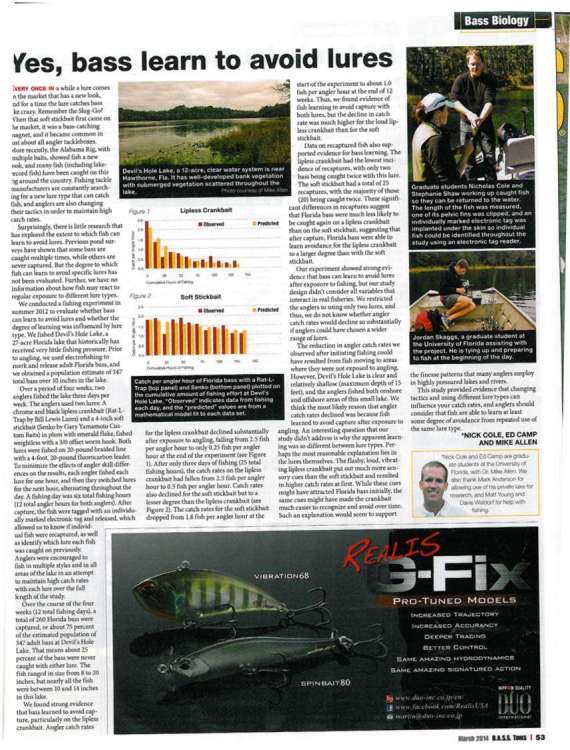
Here's another professional opinion on the subject from a recent BASS Times...all good stuff!
-
An interesting question, and one I think I would agree with you on. You could certainly make a strong argument that both figured out a part of the biology/behavior pattern before anyone else. A couple others that come to mind in this regard are Shin Fukae (FLW) and Buck Perry (non tournament). On the other hand, I think the "technique experts" excelled more on nuance and skill/experience than on biology, guys like Ricky Green and Jimmy Houston (sp'baits), Larry Nixon (worm), Zell (Pop-R), Denny, Hank, Biffle and Thomas/Gliebe (flipping). Then there are guys like A-Mart that might be equal parts of both. In reality, all the greats probably have a mix of both, the interesting question might be to what degree/ratio.
-
Other than a liitle verbiage liberty on the first point I'd say that covers it. Keeping in mind your original post/question specifically referenced the question from a tournament angler perspective. To that end, I agree with point 2 being the better answer up to the point of tournament competition. At that point, arguably everyone entered pretty much has all the biology/structure stuff covered well enough to say the playing field is pretty level. Yet certain anglers still tend to come out on or near the top more frequently. At that point, point 1 becomes the bigger determiner in my mind. Not that it is anything mystical, but it is very hard to quantify and explain, and is not very likely repeatable. That is the difference between science and art. Science is based on repeatability, art is not. You can buy the exact same equipment the best guys use, the same baits, boats, rods, reels and line. You can read every article they've ever written, or watch every video they've ever made. But you can never duplicate their experience, their history, the way their brain works. It's what makes every one of us unique. No matter how well they try and explain what makes them so good, it becomes a meaningless answer, because the real reason can't ever be duplicated by you or I. All we can do is create our own version of a great angler. Roland did it by creating "pattern fishing." Clunn by "seasonal patterns." Brauer by flipping/pitching. Vandam by pure "power fishing." And on and on. All very great, but all very different. There is no "secret sauce" ingredient to being a great tournament angler. For everyone else who wants to be a better angler, there is point 2 ?
-
^^This exactly^^ Braid is of very limited practical use on my baitcasters ?
-
Not completely, because no one seems to be able to define or explain exactly what makes them great, and subsequently, no one seems to be able to duplicate their success by following or mimicking this secret commonality. As I commented earlier, if it were that simple, we all would have read about it by now, and we'd all be doing "it," and we'd all be great, too. I tend to think it is more art than science... ? Beyond that, they mostly just drive around and look for fish on their sonar screens, then drop down and catch them - lol. Just need to find and fish enough schools until you figure out which ones hold the better quality fish these days.
-
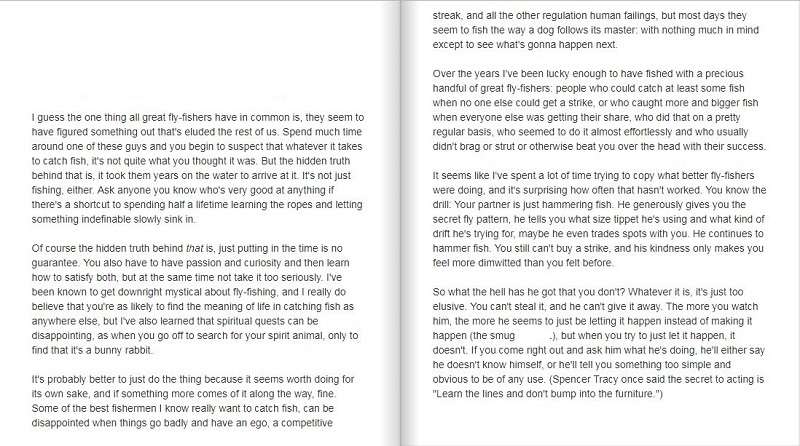
If you haven't read the book, this is my favorite commentary on the subject, written by John Gierach. Overlook the "fly fishing" references (think bass), and I think he pretty much converted my thought to match on the subject.
-
Interesting and timely that Randy Blaukat just posted his thoughts on this exact subject over on his FB page, and the ensuing discussion in the comments section pretty much reads just like this thread...
-
I agree overall, but even then, you'll find "success" all over the map. Some try to target bigger fish first, while some target a limit, then change tactics for a kicker fish. Still others simply go fishing and let the chips fall where they may. We could probably all name local "sticks" who fall into each of those categories. Most all agree though that "luck" creeps in a bit more in one day events compared to multi-day derbies. Note: In Indiana, a limit is a rare thing in many tournies as we have some of the toughest fisheries in the country. As such, where you fish (base your answer/strategy on) will change the answer as to what approach might work best.
-
I think trying to define or quantify "this special something" is a bit futile myself, because more than one guy has "it," but everyone has their own theories, experiences, approaches and techniques that make them who they are. Asking them (personally) what makes them so good usually leads to some non-inspiring answer. If it were simple and straightforward, we would have all read it somewhere already and all be just as good, competing against these guys on tour instead of hanging out on a fishing forum. Forge your own unique style and path.
-
Since you're specifically referencing tourney situations, I'm going with your answer of a lot of "trial and error on the water." It's one thing to specifically target big fish on your own time and water, but a completely different scenario to do it under the constraints of a tourney. Looking at the recent Elite event that just finished up, some of the best pros in the world ended up at the bottom of the pack because their average was just 3 pounds per bass while the winner and top guys averaged 4.5-4.75 pounds per bass. While some guys are a little better overall in the stats dept. (KVD, etc.), the bottom line in my opinion is nobody really has the answer to your question figured out...and if they say they do, they're either fooling themself, or their name might be "Angler X" (subtle FLW reference for those that know their tourney history)
-
To my knowledge, there is no "fix" per se, as most all units are set up this way. Hard to drop an accurate waypoint on a moving screen target. So that leaves you with a couple "workarounds." One is to not mark a boulder until it shows up on the screen right in line (90 degrees to either side) with the cursor. This makes for the shortest distance to move the cursor over the object, then quickly enter the waypoint and continue, minimizing "lost" screen coverage. The other option is to simply pause the boat, popping it in reverse for just a sec to stop forward progress. Then, mark the waypoint, and go back into gear and continue.
-
My "office view" on Thursday...
.jpg.e0402e0c4879278604e10b3b9b396bff.jpg)
-
Left the green fish alone and went after crappie with a good friend on Thursday. Kids back in school and a weekday made the lake pretty enjoyable. Catching just over 300 crappie didn't hurt anything, either. They were grouped up pretty good though as you can tell in the second picture. .
.thumb.jpg.9b84522a1d332bbc59e602b1a9e792f7.jpg)
.jpg.b25cb29a7c38c42a76db342a8028ed28.jpg)
-
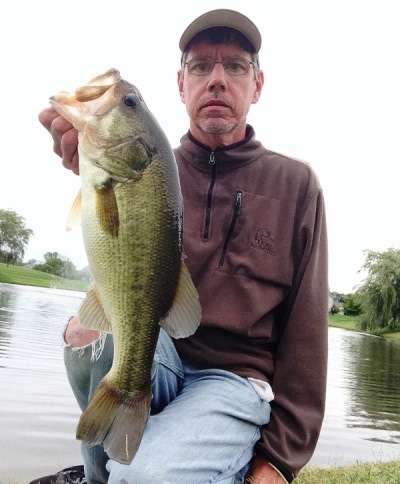
Still biting with the cooler weather we had come through the past few days. Back to near 90 again starting tomorrow after a big line of storms moves through. Half on top last night, half not...
-
-
Sounds like it confirms the "no dead zone" theory and we can ignore the split cone diagrams they all like to show ?
-
Can't say for certain since you added it to the picture but it doesn't really exist. If it was in the actual screenshot, you would use its shadow to help tell height and location, as well as its base as a reference point along with which side of screen it showed up on.
-
I would agree...depth shown is distance from transducer, which is why you can mark fish that appear to be deeper than the water depth you're in.
-
The discussion on the coverage split is interesting because nearly every manufacturer shows the coverage split as depicted by J Francho, but some curious anglers have produced enough anecdotal evidence to suggest otherwise. In the OP's screenshot above, if you only look super close at the tree and the fish marking in its branches, both sides (images) appear to be practically the same, right down to branches and individual fish location among them. If there is a true "black hole" beneath the boat as manufacturers often depict, how could this (the image above) be? My guess is that in ideal settings/conditions, there is no "black hole." Ideally, we'd need something smaller but easily identifiable (perhaps a cinder block) to see if you could get even small objects to split onscreen. Doing so would suggest coverage overlap.
-
Believe it would depend on how they are calculating cursor position, and what true SI coverage is. I've seen suggestions that the split J Francho diagramed above doesn't really exist on some units. They might also be calculating distance from transducer (angular measure or additive measure) as opposed to horizontal distance from boat or centerline. A little more time on the water and a few marker buoys would get you an answer next trip out ?



.jpg.ba450bcbcb5ff06b65f5cc5df1d13d6d.jpg)