TorqueConverter
Members
-
Joined
-
Last visited
Everything posted by TorqueConverter
-
It's probably worth a shot. There is some stiff competition at that price point though. I have an Accurist PT and it is essentially the same reel with a different color scheme. My Accurist is a very quiet and smooth reel but due to them being a farmed Chinese produced reel, there is a strong possibility that some of the reels are going to come out of the box screwed up. The Korean Doyo stuff has better quality control so you might want to look at the BPS Pro Qualifier or Lews reel.
-
Open up the side plate and turn on, as in slide forward, 4 brakes. This should solve your problem.
-
I'm not sure what a Black Max style and operation means, but the BPS Nitro Tournament Z is nearly identical in shape and how the side plate removes. The Nitro TZ is also an aluminum framed reel and has an externally adjustable centrifugal brake system. Normal retail is $100 but they are on sale now for $60. The BPS Pro Qualifier is also a good choice as it has both centrifugal and magnetic.
-
I'm hearing a lot of good things about the Lews reels. Who's their OEM?
-
I like mine a lot. I prefer it my Pro Qualifier because I like the breaking system and drag better. It's also much lower profile and handle is much better. You really can't go wrong at that price.
-
Magforce is your best bet if you want to go purely magnetic. I think it's better to go to a dual braking system that makes use of both magnetic and centrifugal forces rather than going to 100% magnet from 100% centrifugal. Magforce Z 3D is best dual braking system I've found, and yes, it is dual braking. Centrifugal forces generated by the rotation of the spool extend the inductor closer to the magnet to increase breaking.
-
I like the Rapala DTs a lot better but when I'm looking for a cheap plastic crank to throw, Norman baits work without issues and have been around long enough to trust their products.
-
The PQ has a reel handle side aluminum side plate and breaking systems are different. Both braking systems are essentially dual breaking with the difference being that Bionic uses a new, weird system that applies brake tension to a tapered drum controlled by the dial where as the PQ uses a magnetic brake controlled by the dial. The PQ is the safe bet, but is also really boring. The Bionic is the unknown but the braking system is really neat.
-
I like them much better than the Rage Craw Chunks as a trailer. The Rage Craw Chunk durability was so poor that the act of placing in onto the bait keeper was destroying the baits. The Rage Space Monkey is much more durable and has really changed my opinion of Rage Tail Products. I swear the Rage Craws use a different plastic formulation.
-
So "can I use braid for crankbaits" is actually "give me a link to an article where pros use braid for crankbaits". I don't have that information, but a repost more accurately titled in the Rods, Reels and Line forum may yield some results. Good luck!
-
Line dig in can be an issue with Power Pro at the #30 and sometimes #40 diameters. It's an old guard 4 carrier braid that was the gold standard in it's day, but that day has come and gone. The modern 8 carrier braids are much better. It's like comparing a Pinto to a Porsche.
-
I've been down this road and to this day I scratch my head as to why people think you need a slower ratio for deep cranks. I understand deep cranks pull pretty hard, but I just can not perceive any difference in effort between a 6x:1 and 5x:1 deep cranking 20 foot divers. I say gear ratio selection should be based on line recovery. A 6X:1 is a good middle of the road point and if you are inherently a fast cranker than slow yourself down with a 5x:1 or vice versa with a 7x:1. I'm a slow cranker by nature so a 6x:1 suits me well but I do have 5x:1 that I use when cranking really cold water temps to slow me down ever further. Only you can know what ratio is best suited for you.
-
You shouldn't need to follow some pro to see why braid is desirable as a crankbait line. Right off the bat a couple of thing come to mind: 1. Hooksets at great distances. People speak of "casting further than you can set the hook" with plastic lines, but with braid 2 or 2000 feet, it makes no difference. Big deep cranks require big long casts. 2. It posses in great amounts two of the most important criteria of a deep cranking fishing line, castability and diameter. When deep cranking, casting distance and the depth the bait can be fished are very important. The two properties of a line that help to maximise this are how far it can cast and how small of a diameter the line can be. 3. Give. While braid does not have any stretch, or give, this is actually a positive property for a crankbait line. If your rod is up to snuff then the give it possesses should be all the give you will ever need. Rod actions and powers have a tremendous affect on the ability of a fish to throw a crankbait, whereas stretchy lines have very little. You can put stretchy monos onto moderate graphite sticks and it won't transform them into crankbait rods. I've done it and they're inferior to a true crankbait rod paired to even braid. 4. Power and control. Braid will give you the exact same amount of give, the rod give, at all times. I'm not going to struggle to hook into a fish due to lots of stretch from the lots of line in the water, then suddenly loose a bunch of my give because the fish is by the boat and there is now less line out to stretch. The ability to crank and pull logs off the bottom, big pike, or whatever else is something a #30 braid can do, but certainly not a #8 mono. The power advantage of braid is obvious.
-
#30 8 carrier braid with a #17 translucent, single filament, plastic leader.
-
*** ***
-
If this is directed at my post, then the jig head I like is the Buckeye Mop and Mini Mop head. I like every thing I see in the Siebert jigs better than the Buckeye Mop Jigs, except the head design. The head and the way that jig fishes is the only reason I pay more for what is, outside of head design, an inferior jig.
-
Lighting can be a big deal at night. I have a Bass Pro suction cup LED lamp that I stick the flat portion of the bow behind the trolling motor. It has 3 settings, a white light, green and black light. A lot of the time i use the green and as I approach shore line cover, in my case docks. The light illuminates the shoreline just enough to pitch to targets without flooding the area with bright light. LED lighting on the casting deck and in storage compartments is also very nice when searching for equipment. If on a tight budget, peel and stick lights in storage compartments and a clutter free casting deck with glow in the dark handle knob inserts can go a long ways.
-
I've seen big, and mean big, bass crush a bullfrog at my frogging hole. You're fishing the right location when frogging and bullfrogs are present. It seems that during twilight is when the big fish become active and actively roam the shallows looking for a big meal. I bought a Spittin Wa 70 and am taking a serious look at some of the pike and musky sized frog soft plastics after setting and breaking my personal best three times at my frogging hole lats summer. Big bass east bullfrogs.
-
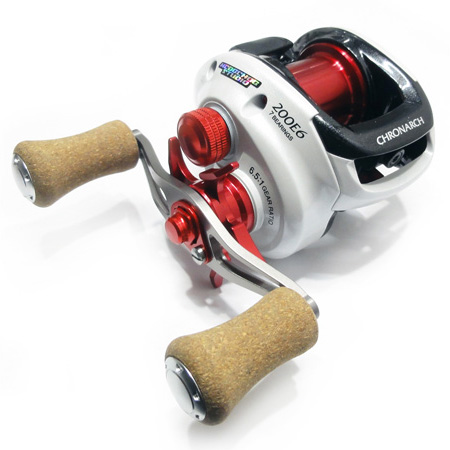
Your wallet probably don't want to hear this, but there is a lot of Shimano aftermarket including these finesse spools. You can turn that Chronarch from a dog to a super star at tossing light baits with a finesse spool and some good spool bearings.
-
I stay on the same presentations that are producing in the day. As the evening progresses I'm switching to darker colors in my baits and by the time it is dark I've switched over to black and blue colors. Night fishing is something I do to stay on a hot bite and because I've already gotten things figured out during the day, it's just a matter color changes and lighting. I keep a junky baitcaster and spinning reel around with Stren Clear Blue Florescent so I can line watch at night with a black light.
-
Like any new lure, you start small, gets lots of bites and confidence, then move up to the larger baits. I recommend using 5/16 and 1/4 oz jigs with 3 and 4 inch creatures baits on back. Head design in jigs is more of an advanced topic where specific cover types, casting type and retrieve all factor in. To keep things simple I like a head that encourages the jig not roll over, the trailer to be off the bottom, doesn't get hug up in rocks and dragged on the bottom.
-
Those aren't half bad rods for cranks and topwater. When I broke my last crankbait rod on a fishing trip, I bought a Cherry Wood to use temporarily. "Temporarily" turned out to be a couple years.
-
Diawa has great aftermarket support. While it does not exist now, there will be shallow "JDM" type spools made available for the Tatula. These spools are very light weight and this reduces the "start up time" of the spool making them great when casting very light baits. You can't go wrong using a TWS daiwa product for tossing light baits
-
The original spybait.
-
1/2 oz Buckeye Mini Mop jig with a trimmed skirt and 3.75 inch Yamamoto Flappin Hog II in green pumpkin red flake. Rapala DT4 in Bluegill