Everything posted by MIbassyaker
-
Day one....meh, could be worse: Hite -- 68 KVD -- 47 Wheeler -- 20 Christie -- 5 Combs -- 72 I tried to go with pure value per bucket while so many top guys are still spread out, ignoring ownership (which it turns out is almost exactly the same as directly picking highest ownership). I at least I had nobody catastrophically tank yet, for once. Lets see if that holds up...
-
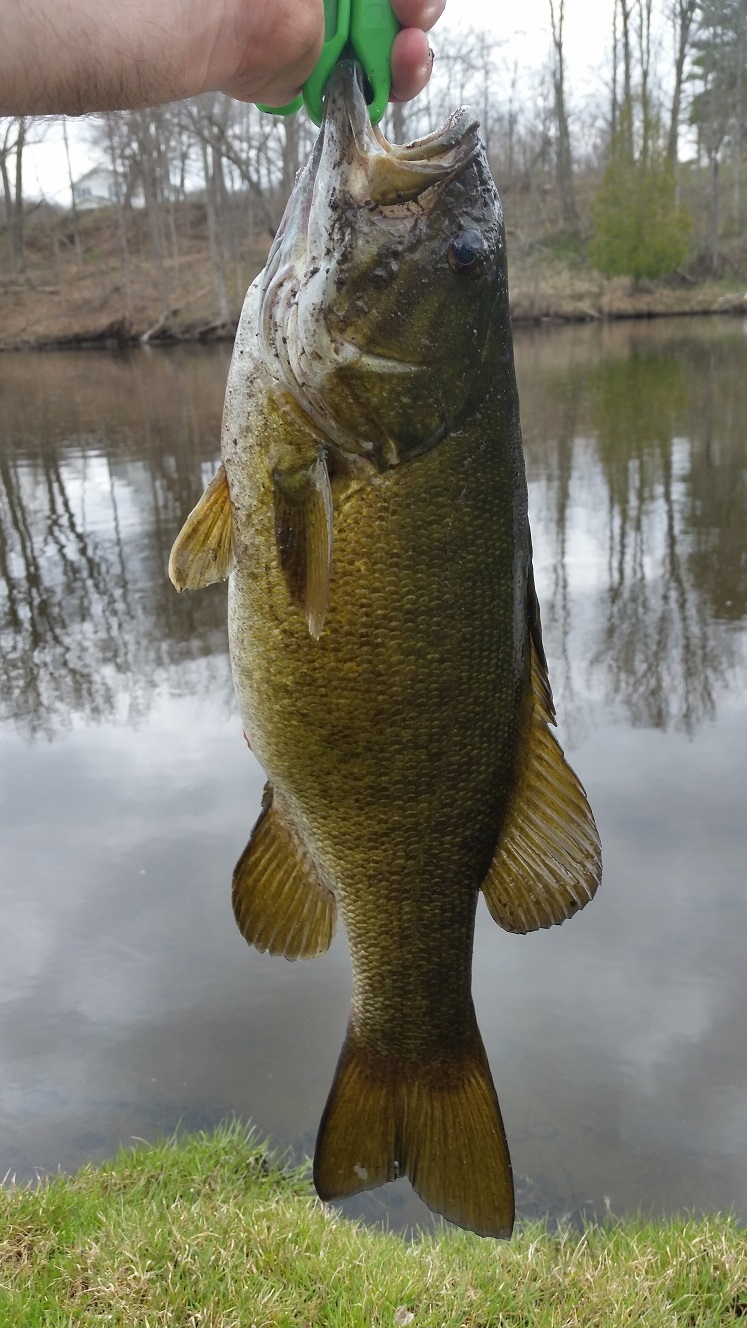
So just to be clear -- we are looking at a picture of you holding a new lake record smallmouth on St. Clair??? There are no words... I mean, "congratulations" is a word but, somehow that doesn't seem sufficient.
-
Beautiful fish and a nice setting. Your catches never fail to impress me.
-
yeah, I was able to locate the paper -- they tested for opponency with intensity held constant (or pretty close, at least). I expect when it comes to on-the-water experience seeming to contradict the findings of the study, a major culprit is variations in the intensity of different colors found on lures. Unlike the study, intensity of colors on your lures is not held constant when you're on the water changing from one to the other.
-
All true -- there are several forms of colorblindness, but some are much more common than others. The most common is inherited red-green colorblindness, in which an individual sees colors, but red and green look the same. As far as we can tell, most instances of this sort of color deficit are abnormalities in what is known as the opponency stage of processing. When the cone cells in the eye respond to light, those responses are passed to a network of neurons that combine the responses and communicate them to brain. As @Team9nine says, there are three subsystems, each of which combines information from the cones in by calculating a difference signal. The difference signals have the effect of organizing color perception into opposite pairs. The red-green pathway, for instance, contains cells that are excited by the response of the "long" (L) cone and inhibited by the "medium" cone, or vice versa, while both are stimulated equally by the short cone (i.e., an L-M+S signal...probably not as simple as that exact equation, but that's the basic idea). The result is a pathway that provides information about "greenness" vs. "redness" depending on where the calculated balance of the signal lies. Red-green colorblindness is thought in most cases to be an abnormality in how this signal is either calculated or communicated to the brain. There is also yellow-blue colorblindness, which is much rarer, but probably an analogous disruption in the calculation of the yellow-blue opponency signal in another pathway (i.e. an L+M-S signal). And then there are really rare conditions like Achromatopsia, which is loss of color vision (in severe cases, literally seeing in black and white) due to brain damage in an area of the visual system called V4.
-
I'm trying to think of a way of saying this that makes sense, but one way to think about the blue and chartreuse thing is to understand that, in humans, the perception of "white" as different from "yellow" depends critically on our ability to see "blue" (or more precisely, to detect short wavelengths of light, which we perceive as blue). In emitted light, as in a TV or computer monitors, if you add blue to yellow in the same region, you essentially get white light As @Montanaro says above, we see white when the full spectrum of light wavelengths hit the eye. Physiologically, what this means is all three cones are being stimulated to about the same degree -- the three kinds of color detecting cells in your eye register the presence of light, with each one "tuned" to be most sensitive to particular ranges of wavelengths that are relatively short (S), medium (M), or long (L). "White" occurs when all three ranges are registered at once. By contrast, when there is more S than L or M, you see blue. More M than S or L, and you see green. More L than M or S, and you see red. All color perception is ultimately based on the distribution of responses you get out of the three cones at once. Yellow is, essentially, the experience of having your M and L cones stimulated to about the same degree, but both more than the S. This happens when light hits the eye with a wavelength somewhere in-between the peak sensitivity of the M and L, so you get a moderate response out of both cones. But color yellow is not just that you get equal response out of these cones, it is also that both responses are greater than the S cone. So what's the difference between the perception of white and yellow at this level? It is entirely due to what's happening with the short cone -- if the response is a lot lower than M and L, you see yellow. If it is about the same, you see white. So, in other words, the consequences of having no third short-wavelength detector are that (1) you lose the ability to detect any light in that range, and therefore there is no basis for seeing blue as different than black, the absence of color, and (2), you also lose the only cone response that differs in the perception of "white" and "yellow". However, even if bass cannot distinguish blue from black or white from yellow/chartreuse, they certainly can still detect differences in light intensity (and are very good at it), and various shades of blue may be greater intensity than black within part of the bass's detectable range, while yellow or chartreuse may have greater or lesser intensity than a shade of white.
-
Yes. have a look at the Booyah pond magic spinnerbaits -- they'll do fine on a M or even ML spinning rod. Just be sure to check your line frequently for nicks and abrasions, and re-tie as needed, as 8lb won't hold up to contact with weeds/logs/rocks etc. very long.
-
Speaking of UV.... Some chartreuses have fluorescent properties, which means they reflect UV light in long-shifted, or elongated form, so that the reflected wavelength tips into the visible spectrum. This is what makes fluorescent colors so bright -- they reflect greater intensity of visible light than is coming in from the environment. So while bass may have trouble distinguishing chartreuse from white all else being equal, in some darker or murkier environments, a chartreuse lure may still have more intensity than a white lure.
-
Excellent! I'm going to have to look this up -- is the indiscriminability of chartreuse and white also verified from behavioral testing in this study? There are mechanistic reasons why this would be the case when you have a red+green form of dichromacy, but it's one thing to say, "here's what should happen based on physiology", and another thing to actually show how this translates into behavior.
-
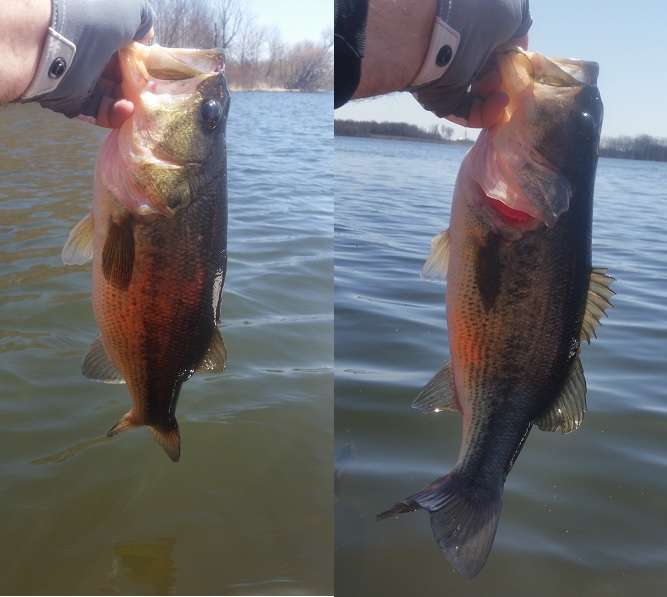
Pair of 17"-ers on a Siebert spinnerbait today:
-
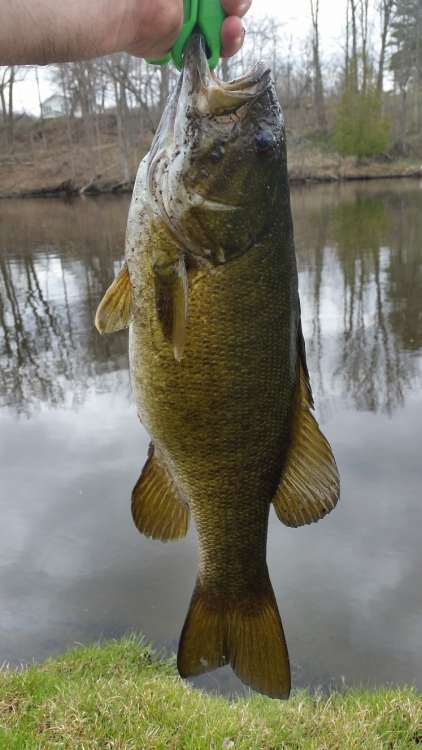
Finally got out Tuesday to bank fish at one of the area rivers, and nabbed my first several bass of the year on the move from wintering areas to spawning grounds (at least that seems consistent with the particular location I was at). Best of 10 on small swimbaits: Less successful was a short kayak trip thursday to a small lake that usually warms pretty fast --54 surface temps, but only one 12.5" (but fat) largemouth in the shallows on a chatterbait. But that at least tells me where things are sitting at the moment...2018 is on!
-
Looks cool, but can I be honest? I can't think of a single place I would throw it.
-
In-line spinner and a 3" curly tail grub on a 1/8 oz ball jig head.
-
My first thought: "Why didn't I think of that!" My second thought: "wait a minute -- how would this be any different than my typical experience with a drop shot or a neko alone, other than the (off) chance of doubling up?" My third thought: [shrug] "heh, why not?"
-
-
Wowza! Of course, he learned everything he knows from his old man, right?
-
Heh, must be a different draft -- notice the pointer to Sand Lake in Kent county for the 8 pounder. The one published on the DNR site is mostly identical, but locates the catch to a different Sand Lake in Lenawee County. The other thing worth following is the master angler listings: http://www.michigandnr.com/MasterAngler/ Apparently, somebody pulled a 26.75" largemouth out of Fletcher's last year (and released)
-
You're probably thinking of the MTIFS summary report for 2017: https://www.michigan.gov/dnr/0,4570,7-350-79119_79146_82441_82442---,00.html Not very detailed, unfortunately, other than a handful of summary facts. Here's what it says about the big fish; no mention of whether it was LM or SM: "Heaviest bass reported by any tournament was an 8-pound fish caught-and-released from Sand Lake (Lenawee County - July 2017)." And then there's this: "Overall, tournaments reported catching-and-releasing 43 bass exceeding 6 pounds." and "Total fish entered in tournaments was estimated in excess of 90,000 fish (70,000 largemouth / 20,000 smallmouth)." So only 43 of 90,000 bass (.048%, or less than 5 hundredths --1/20th-- of one percent) weighed in tournaments across the state in 2017, LM or SM, were over 6lb.
-
Ajay just needs a 10! The current record is 9.98, and a little under 2 years old. The michigan smallmouth record may actually be one of the more breakable records right now nationwide. We'll recognize it here, at least!
-
DNR hosts survey reports online for some lakes: https://www.michigan.gov/documents/dnr/SFRR_Waterbody_363630_7.html Although they clearly conduct more surveys than get written up and posted; for instance, reports will sometimes cite comparison figures from other lakes don't have a report posted, but must have come from a survey of some sort. Also, occasionally, you can find surveys commissioned by lake homeowner associations posted on the association's site.
-
Which, of course, immediately raises the question: Where exactly are the results of the surveys on which record-breakers were spotted?
-
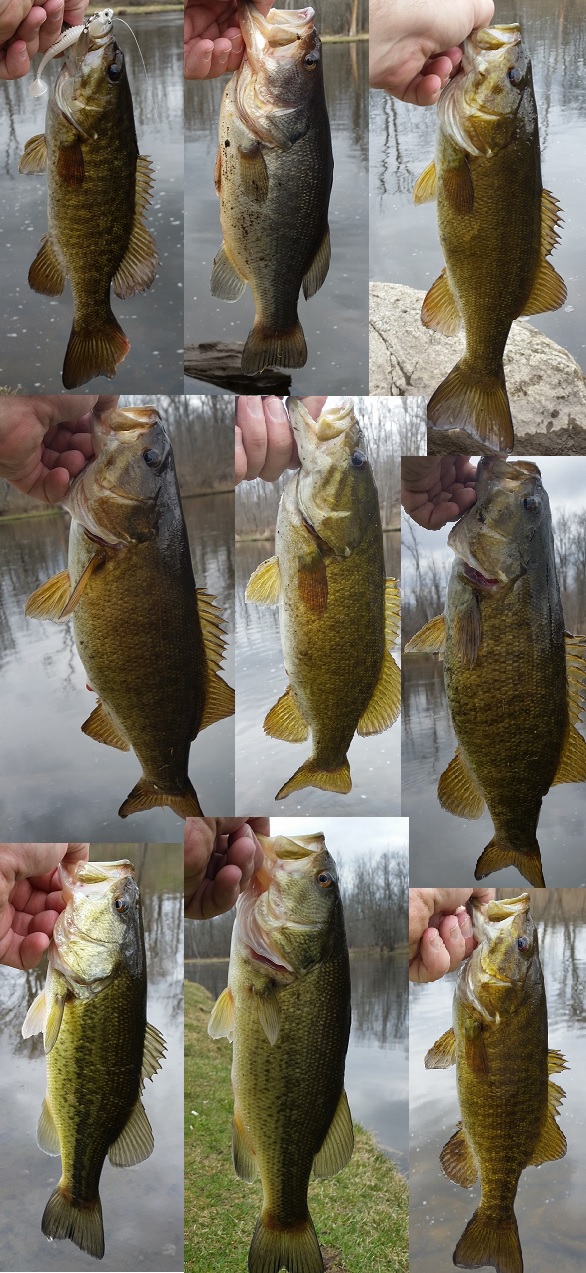
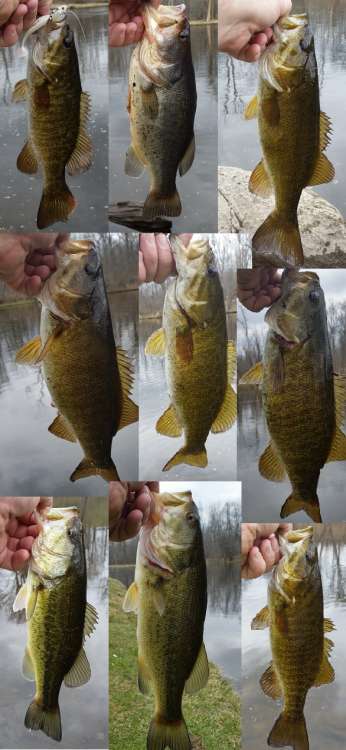
Finally! Warming trend, at long last + free afternoon = first bass of the year! 2 hours on the riverbank, 10 fish total, some brown, some green...biggest one (bottom pic) went 2.34lb: All damage done with 3.5" cane thumpers and 4" swing impacts
-
Some good threads already with lots of recommendations:
-
I have so many curly-tail grubs, 2" to 5", in every color imaginable -- they have got to be the all-around fish-catchingest artificial lures on the planet. There is a time, place, and species for every color. Nowadays I use them mostly for river smallies, who don't seem too picky about color in my experience. White, smoke, & green pumpkin should about cover it for most general purpose bassing. If you want more (who doesn't?), black is always useful all-purpose, all-conditions. Pumpkin/amber colors I use to match the crayfish in my area. Yellow, orange, and chartreuse are old-school recommendations for dingy, low-visibility water.
-
I got one a few years ago. I have also had hook-up problems with it, and have found it only marginally more weedless than a trebled topwater. Between frogs, toads, buzzbaits, and the whopper plopper, I can't think of any situation where the Buzz Plug would be a better option than something else I have, so I don't really use it anymore.