MickD
Super User
-
Joined
-
Last visited
Everything posted by MickD
-
Fish don't break rods, fishermen do. Previous posts have it right. Try this link for info on proper rod handling to prevent breakage. Sounds like that rod is a high quality graphite rod, and if it is, it is more fragile than glass rods and lower tech graphite. Most likely it was designed for sensitivity, not max power. But it will still work fine when properly handled. http://www.rodbuilding.org/library/rodusage.pdf
-
Which McCoy? Green, X clear? Some "clear" lines are not that clear in the water, sort of light up, unlike FC.
-
I don't argue with taking it apart partially, but I find these new reels so complicated that I don't take them down very far any more. I leave that to the pros. A few minutes in the water, unless it got sand into it, is not a big deal. If it were mine I'd open it up to the level I feel comfortable with, let it dry thoughly, a couple days, then lube the stuff youj can see sparingly. The stuff that had grease still will, and a drop of oill here and there should suffice. If there is any sign of sand going through the gears, I would have a pro do the whole clean and lube routine.
-
I think you asked the third question first. First, for "no-weight" fishing you want a system that will cast and fish well under these demading conditions, and that means the right line, rod, then reel. My recommendation for the most important element, the line, is to use 10 pound nanofil or braid, maybe up to 15 if you think you need it. You will have to be very careful to tie the right knots, especially with nanofil, but both will go onto the reel smoothly, have great sensitivity, and show no tendency to loop off the spool. Other lines often don't stay on the spool well when reeled on with little or no tension. The rod should be a very sensitive rod that will load well with the light weights you will be casting. Faster actions are more sensitive, but you want to have the right power to load properly when casting. Lastly, get the best reel you can afford from the ones already suggested, in a size that feels right for the rod you've chosen. MOst likely, a size 2500. Really small reels have small spools that don't handle loosely tensioned line very well (unless it's nanofil or braid or really light mono).
-
If you lay the spool on the ground it can either be the right way in which the twist put in by the reel is taken off by the line coming off the supply spool, or it can be the wrong way in which the twist put on by the reel will be doubled. With 4# line of any variety I find it hard to believe that the line quality is the problem. Exc for some Shimano reels the recommended way to spool them is to have the line come off the supply spool (lying flat on the floor) opposite the way it goes onto the reel. If the reel puts it on clockwise (facing the reel spool) then it should come off the supply spool couter clockwise (looking down at the supply spool). Apply a little pressure on the line using your other hand up the rod a ways, pinching the line lightly between your fingers. Some Shimanos recommend that it come off a spinning supply spool like you do for a casting reel. They must think their system doesn't impart the normal one twist per rotor revolution. Check your owner's manual.
-
Good treatment of the topic, in my opinion. Pluses and minuses. One more disadvantage, drop one of those when building a rod and you may never find it. Best way is to take your shoes and socks off and walk all over the possible area it could have dropped into. It will stick nicely into your foot. Just thought of another, many micros have such small feet they are more fragile than bigger guides. My opinion is that the advantage of micros is in two areas: finesse rod sensitivity and length of casts. Having said this, if you don't use braid, you may not feel the difference in sensitivity, maybe not even then if the blank is not a truly high quality blank. And for increased casting distance the guides have to be set up right, and how to do that is highly debatable whether for spinning or casting. I would not go to micros just for a possible small casting distance advantage. With spinning rods the biggest thing you can do for both increased sensitivity and casting distance is to use 10-15 pound nanofil or braid and be very careful of your knots. IMHO
-
For those of us who have concluded that the modern reel is just too complex and expensive to take a chance with on our own, and with the passing of David Green, does anyone have a reel mechanic who compares with David to recommend?
-
The modern baitcasting reel is a wonderland of applied physics. Magnetic brakes, centrifugal brakes, coloumb friction, lubrication, gear ratios, dynamics, and more.
-
I put 14 Trilene XL on it today, and had no problems, even though it was about 30 degrees and the line had been in the pole building all winter (better to store indoors-nylon tends to get brittle in cold/dry environment). No centrifugal weights were engaged. I stretched it heavily to try to eliminate some of its natural stretchiness. The 14-XL is what I use on my Curado 200-E that I use for surface lures. I was hoping to get a lower stretch line (without resorting to line to line knots - the rod has micros) but this will certainly do. Thanks again for your help.
-
I never said the reel I was trying to use was a vintage reel. I have plenty of vintage reels, from my first free spool, a J. A. Coxe/Bronson narrow spool through a number of Pflueger Supremes, both narrow and wide, and on and on. But I don't think I could get any of them to cast anywhere near as well as the Calcutta and later reels. I may be crazy, but not a masochist. Tried even cranking one lately? The crank diameters are so small it's like using a toy instead of a tool. It appears that many others have trouble with FC on baitcasters, like I do. I'll give the monos recommended a try; I'm pretty confident I can make it cast satisfactorily. You all have mentioned some brands that I've not even heard of, and it is good to use a new line that comes with positive recommendations. I'll give the line conditioners a try also. I expect things will get better when I get the rod on the water, out of 30 degrees F, and the line wet. I put the reel on a new rod I just finished and had to give it a try in the yard. thanks again.
-
Thanks for the responses, everyone. Sounds like the consensus is with a good grade of mono, which was what I suspected you would say. Not familiar with Sunline, and many mentioned it. Worth a try. The reel is a Calcutta 100 that was rebuilt by the late David Green into a 150, ( the reel was butchered by another reel repair/tuner and had to be rebuilt into a 150 because no 100 spools could be found) and it is now really fast and I cannot get it to work well with any flouro I've tried. I'd like to use it on spinnerbiats because I tend to overcrank them, and it has a 5.4 ratio, if I remember correctly. It is not that I'm new on baitcasters; I've used them for many many years, ( I do have a workable thumb) and I've had good luck with monos in the 12-17 range and braid of about 30. I've been trying to make flouro work on this reel because of its lower stretch, but think I'll have to go the mono route.
-
I'm trying to make an old (sentimental) baitcasting reel work for spinnerbaits and am having trouble with backlashes. What do you consider the best line and pound test for the best chance of casting without backlashes? For bass, so probably above 10 pound test. I used to use a high quality 30 pound braid and it worked well, but I'm trying to avoid knots going through the guides so would like a mono or flouro if I can make it work. thanks,
-
I forgot to mention that all flouros are not created equal, and some are so stiff they are real pains in the butt. And I have trouble making them work at all. Even 8 pound flouro can be a problem. The most forgiving line for a spinning reel is braid. I use a lot of braid with flouro leaders (doesn't matter how stiff the 3-4 foot leader is) joined with double uni knots. If you want a really sweet casting setup try 10 pound Power Pro with a 15 pound flouro leader. If you are not a braid user you need to know you don't want to break off snags by wrapping the line around your hand and pulling. You can get cut that way. Point the rod directly at the snag, lock the spool with your hand, and then pull. No cut hands, no broken rods.
-
I have always been taught to have the line loop off the stationary spool in the opposite direction as the line goes onto the reel. Meaning if the reel rotor is going clockwise looking at the front of the reel the line should loop off the line spool counterclockwise looking at the spool face. However, I do remember that some of my Shimanos recommend spooling up off a rotating spool. It was described in the owner's manual that came with the reel. Check out your instruction manual. Also, when adding line to the reel, do it while tensioning it a bit while cranking it on. You don't want it really tight, but you also don't want it loose.
-
My son's best fishing buddy used to kid that Vanish is called Vanish because it causes all your fish to vanish. Seriously, though, I will not use it. With all other flouros I've tried the improved clinch knot works fine if you 1. lick it, 2. carefully help the knot slide tight by "sliding" it with your fingernail while tightening the line, and 3. when it's all tightened up, really give it a strong, but slow pull to "set" the flouro (make sure it's still wet). Flouro tends to take a "set", which I mean it will not recover from being tightly bent, so if you pull the knot very tightly it will set and not slip. If you're still having trouble with it, put a couple more wraps on it. I think I use about 6 turns.
-
When I first posted the pics I couldn't get them to size up to the point that they offered a good view. No problem today, so I need no tips. thanks for the coment on thread work. The pearl metallic lost a little gleam with the "no CP" treatment. It might look better with silver metallic, but maybe not. Next time I'll test both.
-
I certainly don't have the size thing down yet. Any tips?
-
trying to send photos, missed last try.
-
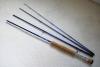
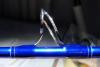
I just built an Eternity 2 4 piece 9 wt fly rod, and I am impressed. Lighter than the RX8 8 wt in spite of using the Alps alum reel seat. The Alps titainium two foot guides are very well finished, look great, match the reel seat well. CCS data shows it's a little faster than the RX8 (70 vs 67 AA). Both are on the high side of their wt class for power. Dark blue thread without CP looks great, same color "tone" but darker than the blank. Pearl metallic trim.
-
I have made tons of peel and stick decals using Paint Shot Pro graphics program and ink jet printers. I like the waterproof vinyl media from papillio the best, easy to handle, takes detail well. One warning, if you use inkjet printers do not use refilled ink cartridges. You have no way on knowing the quality of the ink and you may encounter very fast deterioration of the color quality in the sun. 1. Design it. 2. print it- let it dry a few hours. 3. Spray it with fixative, papillio has one that is excellent, but if you buy from the paint store get a fast drying that says it offers UV protection. Let it dry a few hours. 4. Measure the blank circumference and cut the decal to fit that dimension. A little overlap is not a problem since the media is so thin the overlap gets hidden by the wrapping epoxy. 5. If the background of the decal is dark, darken the edge of the decal with a sharpie to prevent a thin white line from showing. 6. Install it. Position it carefully and install on the blank, the center first, then work it down from the center to the edges. 7. Take a hard smooth tool, like the winding buffing tool, and with a protective sheet over the decal (the backing works well) give it a good, firm rub down to force the adhesive into intimate contact with the blank. 8. Put a little color preservative along the edges to help seal the edge from the epoxy and prevent lifting. You need not put it over the rest of the decal as the fixative protects that. 9. I design my wraps and decals so that I wrap over the ends of the decals. You may have to play with your printer settings to get the color/quality you want. I don't recommend trying to match the blank color-it's almost impossible. Better to choose a contrasting color that doesn't rquire exact matches. Follow the instructions of the media supplier. Papillio offers a clear decal media, and I have used it with success. It doesn't have the shelf life of the white, though, so I don't trust it unless I use it soon after purchase. It tends to separate from the backing in storage. If you plan on using the same decal design multiple times, like a standard logo, I would recommend Decal Connection. They are great to work with, can do any color, even metallics, and you don't have to worry about fading.
-
Except for trolling rods and really heavy duty rods, like salt vertical jigging rods, I've never found a detectable advantage for spiral wrap for any fishing action. And they look goofy. I know, pile on, guys; sacrilege for sure. Regarding spiral micros, with micros so close to the axis of the rod even the supposed torque advantage is minimized. The recipe for the simple spiral is to place all guides in the same position as you would any casting setup, with the second guide from the butt at 180. Halfway between the first and second guide put a very low guide at 90.
-
there is no reason to epoxy them together. Nothing will be gained. You'.. lose the flexibility of easy travel.
-
There is a little more to it than preference. Ergonomically, the 17 or 18 are better for most hand sizes, but each adds about half an ounce of mass relative to the next smaller size. I use 17's on all freshwater spin rods exc the ultralights. About 8 hours in, you'll appreciate the difference. For all but the ultralights, unless you're building a really heavy power rod, I recommend the 17.
-
If you have a good builder remove and replace guides it will cost nearly as much as a new build. I suggest keeping the old rod for when you want to use a setup that requires knots to go through the guides. The new rod could be a blank optimized for a different technique than your current rod and you would have two different rods for two different techniques. It really does help to have technique-specific rods. Drop shotting and cranks need different actions, for example. Also, it is not a given that the optimum spacing of the guides will be the same for the different types of guides. I think rebuilding compromises too much for little savings. Finally, you just cannot have too many rods. It is impossible.
-
Very hard to beat the American Tackle Bushido blanks for the money. Excellent blanks, as many of the others recommended are.