MickD
Super User
-
Joined
-
Last visited
Everything posted by MickD
-
Good news because sleeving the butt end will probably make no significant change in the action or power, the repair should be easier and reliable, and usually can be to some degree "styled in."
-
I've never liked a rod with even 2 inches cut off its tip. If you cannot get a new tip section for the rod this process works as well as any. Original action is almost maintained, just a little added weight. Hardly noticeable. https://www.rodbuilding.org/library/repair-oquinn.html
-
Read this whole article for an effective repair procedure. Brass is not the answer. https://www.rodbuilding.org/library/repair-oquinn.html
-
I like the fact that my Lund doesn't have carpet on the floor, just on the upper surfaces. Agree on the retractable tie downs. They take a 3 minute job with the possibility of broken nails and bruises and make it into a 15 seconds easy job. Also spot lock, wouldn't want to do without it. Another really nice feature to me is the remote stowing and deploying of the trolling motor. I can do it with the remote control from anywhere in the boat. At my age it is a real bonus. Finally, don't be tempted to skimp. It's a long-time investment and with inevitable inflation, if you decide to add later it will cost a lot more.
-
If you're going to wrap over a ramp, keep the angle of the ramp pretty shallow. I'm sure that when the thread end is pulled through on the bottom photo, if the wrap goes much farther, that the threads will be knocked off the ramp.
-
Maybe not trimmed closely enough.
-
A "slip" fit, you don't want them a force fit, and you don't want them sloppy. You will move some epoxy out, so if the shape allows it, use masking tape to protect as best you can, remove immediately, then clean up with alcohol. Clean multiple times until when the alcohol dries there is no shiny look from epoxy. I don't think you are using cork on this one, but you don't want cork to be stretched into position as it will in time probably split. It doesn't like tension and a force fit puts it into tension.
-
This is definitely wrong! Many feel that giving the epoxy grooves to fit into makes the bond stronger, but that is not the case. Do it like the link recommends. Don't skimp on epoxy. The biggest failure I've seen in factory rods is from not enough epoxy bonding the seat either to the arbors/spacers or from the arbors/spacers to the seat.
-
You can do as few wraps as you can get away with before going up onto the foot. I think my KT wraps are only about 1/4 inch total length. Wrap all the way to the eye of the guide inserting your pull through thread at an appropriate distance from the end. Are you familiar with the locking loop and prepping the blank and seat parts before epoxy? https://www.rodbuilding.org/library/forhan.html https://www.rodbuilding.org/library/waterfree.html I use three loops around the eye of the guide but often do not always use the blocking wraps which I really don't think add much if anything. If I do blocking wraps I only do a couple 2 or 3 . I think with really small guides like the KT's that the locking loops can prevent pull out, although they are so small they don't get caught on anything very often.
-
I build my own and have tried a number of keeper locations. The one you mention is not a great place, puts the lure near the hands when picking up the rod, hands get into it too much when fishing. Best place I've found for spin and cast is about an inch in front of the front grip/ramp at 180 degrees (on the bottom). Any line that might contact it falls free, and I never contact it when fishing . I tried 90 degrees on a couple rods and both my son and I found that loose line often caught on it, so I don't do that any more. Using the first guide frame has problems with using a rod sack while having a lure attached, and if the rod is placed in a vertical rod holder when not being used, puts the lure possibly into a position where it snags clothing of someone moving near the rod.
-
I use the same ring size as the guides, but others go up or down a size or so and they all work fine. With your priority on weight, go the same. I wouldn't go smaller since you are pretty small now.
-
Now let's see the graphic of a uni knot with 20 pound braid and 15 pound mono leader. Yes all practical lines will go freely through any available guide size, but not all of the knots will. A uni tied with 15 pound mono will be about .075 inch diameter. The ID of a 3mm guide is probably about 2mm, or .080 inch. My numbers can be off quite a bit and there still is a problem.
-
From my experience and that of others you only need two sizes of guides on baitcasters, the first guide, like a double foot 10, or RV 6 (to get the height) then runners of all the same size. I would use at least two KB's, the rest KT's unless a pretty heavy class rod, then I'd probably use KB's all the way.
-
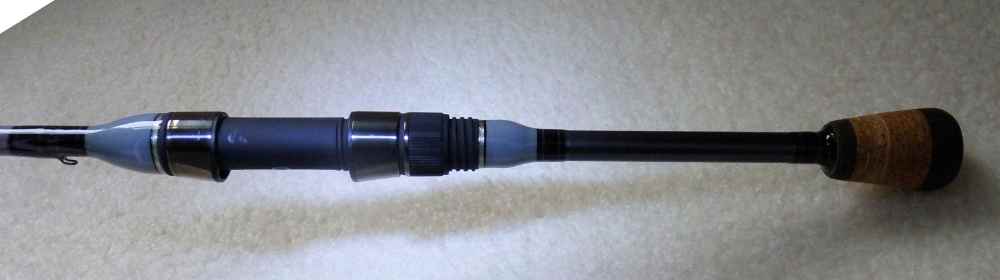
SKSS skeleton, right, with nothing between the pieces? That is the type of ergonomic compromise I'm not willing to make. Since the hands don't have a lot of contact with the grip outside of the seat then you don't need much out there. A carbon fiber butt knob and a couple small ramps off the seat, they can be made of rigid polyurethane seat arbors and weigh almost nothing, and they feel nice and smooth to the fingers. Easily machined if you have a drill press.
-
I can message you the process. The tiptop can be significant if stainless, from my experience. It will depend somewhat on the power and action of the blank. I would definitely, with your priorities, go titanium. The running guides are very significant. You should be going small titaniums to minimize the drop in natural frequency. If the blank is XF action or close then the reduction guides (KLH or equivalent) are either insignificant, or of minor significance. The DS 6100 has the two larger reduction guides in stainless to use them up, (had them on hand-hard to tell the titaniums from stainless in this finish-they look fine) all the KT's are titanium (KT4's). I think I've said it before, but the highest natural frequency blanks I've tested, and I've tested a number of premium and less premium blanks, are Point Blanks.
-
To give an idea on weights: NFC DS 6100 blank, 6 ft 10 inch, called "Medium" power by NFC, measures ERN = 12.6, which is hardly what most would expect from a medium power blank. Weighs 1.6 oz. Fuji DPSSD size 17 seat and lock nut weighs .84 oz. 1 inch exotic burl ramps off each end of the seat + butt knob of same material weighs . 66 oz. Guides weigh .141 oz (KLH 16-8-5.5M, 2 KB's, 4 KT's, the 16, the 8, and one KB are stainless, the rest titanium). Rod so far weighs 3.245 oz. The guide epoxy and the epoxy at the grip needs to be added yet. So this rod will come in probably just under 3.5. A lighter seat and lighter ramps/butt knob would easily be possible to bring it down to 3.0. BUT, this blank is probably not powerful enough to be called ML power, IMHO. A Point Blank at about ERN 16.2 would weigh 1.7 oz. ERN 19.8 would weigh 1.76. The problems with most claims of sub-3.0 oz rods is 1. The builder doesn't know the actual power of the rod, and most will most likely be pretty low. 2. The compromises to lower the weight will cost ergonomics. My ERN 19.8 Point Blank 7 foot complete rod with size 17 Fuji seat weighs about 3.6 oz. Has good power and fishes great.
-
Yes, very much so.
-
Mod-fast also does a nice job snapping 4-5 inch swimbaits off the bottom for walleyes and smallies. There is something about it that yields the right acceleration off the bottom. And they work well for slow/steady retrieve that smallies often like.
-
Won't be limited, M-F can do anything .
-
It's easy, free if one has an Android (Kindle works), it's still new so I'm learning, we can learn together. I've yet to find a fallacy.
-
Try the process, then come back and give us the answer. I have come up with the process on my own, not through any published info. I adapted a free app to answer a question that only those with expensive equipment have before been able to answer. I'll only answer this one question. How can the tip velocity not be proportional to the natural frequency? If I deflect two blanks to 3 inches, and let the tip go, and one has a higher natural frequency than the other, how can it not have a higher tip velocity (recovery speed from deflection) ? I don't mean to be rude, but I've been through this hole before. And until one tries the process, gets the data, and thinks about how it correlates with not only the years' old opinions of experts, but also with how it correlates with one's own experience, I'm wasting my time discussing it. I invite any curious fisherman to try it.
-
How to get bait monkey off my back? Why would one want to?
-
From what I have read both braid and mono have very close to the same density, and they are basically neutral density. Meaning they don't float and they don't sink. Braid has much smaller diameter than mono or FC so it cuts the water more efficiently. So you can easily get deeper with braid than mono. And probably deeper than with FC, too. I have used all three types on cranks and have to say they all work fine as far as getting the depth I want. Both spin and baitcasting.
-
I said no because this process does not measure stiffness. If it did I could get an answer with units of measure of something like inches per pound of deflection. But I cannot. Yes, as stiffness increases without a mass increase, the stiffness to weight ratio will rise and the natural frequency will rise. I am actually measuring the time of one cycle of free vibration of a blank/rod when its butt is restrained and the tip deflected and let go. From that the natural frequency is calculated. And the units I am using are cycles per minute as derived from a period of vibration measured in milliseconds. Respectfully, I'm not going to get into a long debate about what the process is or isn't or its relevance. It is clearly a method of measuring another important objective measurement of a blank/rod physical characteristic which can be used to better understand the blank/rod. A characteristic that experts for many years have agreed is important to rod performance and one that until now has not been measurable without expensive equipment. If someone wants to know the TNF of their blanks/rods and how it changes with how they configure their blank into a rod then I will share the process. All it takes is a method of securing the butt (forces are very low-a rod wrapping machine is adequate) an Android device, and a free app.
-
Yes on response to less mass or more stiffness. As the equation for cantilever beam indicates. Not sure what you mean by ratiometric. Have not measured under load, don't know how that can be done. By recovery I mean the velocity of the tip in recovering from a deflection. Blanks with a true natural frequency (TNF) of 600 cycles per minute have to be recovering faster than blanks with a TNF of 500 cpm. It is impossible for it to be otherwise. Most rod experts for many years have argued that sensitivity is proportional to natural frequency, but there was no inexpensive way to measure it. I am using Android devices and a free sound analyzer app to measure TNF. It correlates with my experience-generated evaluations of blanks/rod. Of course that is simply an opinion and not provable. It shows how the TNF increases when the mass of guides, tiptops, and wraps are added to make the blank into a rod. It shows the advantage of what I call premium blanks in most cases and shows the advantage of titanium guides and tiptops relative to stainless steel of the same size and design. I am not arguing that it answers all questions about the properties of blanks/rods, but it does offer one more objective measurement (TNF) to the ones we already had, length, weight, power and action (CCS). I submit that if one can match all of these objective measures from a blank he likes, he will find the new blank to perform very much like the first one. Your skepticism is similar to others who have heard of it, but like them, you have not tried it. I suggest, if you are interested, that you try it. I will be glad to provide a quick tutorial/description of the process. You can message me.