
bulldog1935
Super User
-
Joined
-
Last visited
Everything posted by bulldog1935
-
@FishTank Daiwa and Shimano spool bearings are both 1034, 10 mm x 3 mm hole, x 4 mm thick. You can replace the spool bearing sleeve with an 1134 bearing, but I think that bearing can go deeper into the frame (farther away from the spool), while the shouldered sleeve positions the 1034 spool bearing just right. The Daiwa bearings are more like "intermediate" bearings - they're not full diameter steel, but have aluminum sleeves at both diameter extremes. Since it's tough to get a good google from KTF website, here's what they wrote about them - they're talking about their single-race microbearings, and giving credit to Daiwa (also looks like they pay for Daiwa patent license) : IXA MBS (Micro Bearing System) is a patented technology owned by DAIWA, and maximizes the characteristic of "low inertia" that is excellent in starting rotation even with small force (lightweight lure), which is the greatest advantage of small diameter bearings. It's a bearing system that makes the most of it. By adopting and combining IXA ceramic ball bearings that rotate smoothly at high speed with low resistance in this system, the synergistic effect realizes further low inertia and low resistance spool rise. Already in the KTF reel, the system was introduced in advance from Alpha Finess Version 1, but now we have increased the size variations and can be installed on your own reel! The housing is made of stainless steel with high precision and high durability design. Therefore, when the bearing wears out, it is a modular design that allows you to replace only the cerabear. It is a system that even heavy users can use for a long time. I have the KTF/IXA microbearings in all my salt reels, and this is the first time I'm trying the IXA dual bearings. Logically, the lower-inertia inner race moves first with the spool and may be the only part of the bearing moving with light lures. Heavier centrifugal loads cause the larger balls in the outer race to spin. ps - to order from KTF, I use my Japan broker, noppin.com - I've been using Masamichi as a broker for 20 years - since before you could buy direct from Japan. Because of direct competition, brokers like Noppin and Zen Market have low fees now, about 5%.
-
Wind knots occur when multiple line loops come off the spool at the same time. Line twist is one possible cause, since twisted line helps to pull up big bunches of line. Believe me, I've seen it in the old days when friends were fishing big braid without good ball-bearing line rollers. Certainly loose line lay from bad habits is the highest probability. Hour-glass line lay can be another cause.
-
@FishTank I'm back with first cast trials on the stock Silver Wolf spool and stock Daiwa shielded microbearings. Casting the same 2 g jighead with plastic body I show in my post above. I was consistently casting 80 feet with incipient backlash at a mag setting of 7, so 8 was as low as I could safely set the mag. (Same lure with Roro in Steez casts much farther and incipient backlash is at mag setting 4) Don't get me wrong, the SW spool and bearings are smooth, and 80' is plenty for most fishing. Just not for my tide passes, and not in the league with Roro and Ray's spools. The line that was on my Roro spool is now on the SW spool, and I won't have the new braid on the Roro spool at least until tomorrow afternoon. First thing I did removing the SW spool was swap palm plate bearings for KTF/IXA, which are unshielded, and salt-resistant. After some more time, I'll try the SW spool again with a bearing swap. This shows the stock Daiwa microbearings, Roro microbearings, and KTF/IXA dual microbearings. The IXA bearings include a smaller inner race, larger outer race, and are only 3 mm thick, so they include an o-ring spacer for the other mm. The o-ring goes first into the palm plate or the spool bearing sleeve, and places the thinner bearings in the same spots as the stock 4-mm-thick bearings. They're also rated to cast higher weights than most microbearings (excepting Daiwa). It's been argued before that the Daiwa bearings aren't microbearings, but that's what Daiwa calls them, and KTF website gives credit to Daiwa for patenting the first microbearing, which are these.
-
@Fishingmickey The dome in the front is like a clear lens, that gathers as much light as possible to send it through the transparent color. Especially trout under the dock lights at night could read it as a ball of half-inch glass minnows and slash into it. While we mostly prospect deep in the winter, change-up is really important, and I've seen periods when schoolies would only take a lure in the surface film. On Plat, INX had a pretty good video of it being fished - dog-walk it like a surface jerk bait, and it's an evading shrimp - of course, the click is built in. When you pull hard, there's just enough plane on it to make it dive (reds in skinny grass). Steady retrieves turn it into a wakebait.
-
If you use manual bail technique, you pretty much can't over-fill your spool, and it's the best solution to wind knots. Keep your free hand close to the spool. Use your fintertips to feather the line at the end of the cast - like thumbing your baitcaster. Close the bail with that hand - do not use crank-auto-bail-close. Turn with the rod and take up the slack before you retrieve. Solved. I can't think if a problem or complaint about spinning tackle that proper manual bail technique doesn't solve - loose line behind the spool, slack line at the end of your cast, runaway line in the wind - solved.
-
I was ordering braid and leader for my new Zillion Silver Wolf, always check the Sale lures, and couldn't resist these 3.5-g salty finesse prop plugs from INX. I did swap the #10 trebles for BKK Fangs #10, which always measure a size larger (#8). Orange for low angle light, blue for dark.
-
Kind of an antique, but I could fish that light frog nicely (from kayak) on my Falcon Glass FCG-6-158. It's about 6' and rated 1/4-1/2 oz, and fast for glass. Narrow lure weight rating indicates a para-taper rod, which will have a faster tip, with flex distributed along more of the rod blank. That's basically the taper you should be looking for, narrow lure weight range, with your target weight at the bottom end.
-
I haven't played on this thread in too long. Finally got this bike project where I want it to ride with a bar swap to Cinelli 64 Dream Bars.
-
smoked venison backstrap breakfast taco getting the papas right is important aluminum foil is an essential ingredient for breakfast tacos - the oils have to steam together. You eat this on the drive to the fishing.
-
The only way the thread is going to work the way you expected is to Purchase the rod, then explain the process you used. Help me spend my money threads almost never focus in on any forum, rather they always shotgun into people espousing their wider ranging recommendations. Part of that, they rarely read the OP details. Also, marketing has Palov'ed us from the cradle to feel smart about having made the right purchase choice. Aside from that, you have a process that will help you focus in on what you need, while this thread goes all over the place.
-
Roro...............................................Rays................................................Stock Daiwa All 34 mm dia., I can mix and match in Zillion and Steez. The AMO spools from Express website are also very good spools, also made for full-spindle Daiwa mag-force reels. Others on the forum have recommended inexpensive Billings spools, also on the Express site. This one for Tatula and Fuego is AMO spool available from a US vendor on ebay You can improve them further by swapping in spool micro-bearings - spool and palm plate. .
-
@T-Billy is exactly right - the reel seat already has the right offset. I think it would work best on a round reel.
-
it won't hurt anything. Tournament casters spool their reels with the distance they expect to cast, plus an extra wish - they cast all the way to the end. They don't care about backlash at the cast end, and the less extra line, the less they have to clean up. By keeping the mass down even a little bit, the spool is faster you get equivalent braking at a lower setting.
-
I have a tiny 1.5-g Lure Rep diving plug that gives me time to slow retrieve and acts like a wake bait in close pools and tailouts.
-
I just picked the number of shims to hit zero end play - that's the Avail cap. I have the same 1520 spool, Roro bearings, Avail single-BB worm gear, Avail alloy LW flier, BB idler, and BB pinion. I'm casting 1.5 g as far as I need in tight creeks, and 3 g farther than I need in wide spaces. I'm using the Haneda Craft fiber drag, and love it. @redmeansdistortion ok, and I have the Avail alloy frame that drops the spool 7 mm closer to the rod. but I wish I had your IAR. You pilfered that reel compared to market value.
-
I've gone the other way on my 1500C, no centrifugal, the spindle cap won't even add friction at full close, and internal Avail mag brake (only 2 magnets needed w/ Avail spool). And since we need a photo.
-
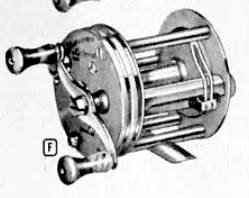
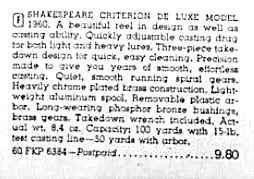
Not much to add, but have this I cropped out of a 51 Ward's catalog listing. Probably the most interesting info is the 1951 price ($105 current price index). This is likely a model GE, making yours closer to the prewar versions. Those holstein handle knobs are beauties, and very 1940. I gathered from a quick scan of the Carl Covey posts I searched on ORCA there were 22 different model year designations for Criterion. You may be able to find a 1945 Shakespeare catalog linked or posted somewhere on ORCA. ______________________________________________ @walleyecrazy If you're looking to match in a rod, in 1945 there was only cane and steel - an offset handle like below is also your best choice. These old American Fork & Hoe (later TrueTemper) square-section steel rods fish quite well. by 1948, Shakespeare had glass rods in the market, though this example is 1958. Also Harnell, and there's argument about who sold the first. Rather than mono, the best line to use on those old reels is 10- or 15-lb soft braid. In modern lines, you can use ice-fishing nylon, which is teflon impregnated, Green Spot dacron, or Gudebrod Meatmaster. You can also back it with a heavier line, and top with a finer working line. I add short nylon leader for tying on lures by putting a perfection loop in each and loop-to-loop.
-
Thanks @A-Jay how about the level wind on this Shakespeare B, s/n 127, made in 1909 there's a pin for the pawl in the LW rider - when it gets to the end of the ramp, it's pushed into the opposing worm gear. Not for the faint of pocketbook - $25 in 1909 is a price index of $750 today. Marhoff, a Shakespeare employee, got his patent for the worm-gear LW we're used to seeing the year before, but the B followed the earlier C and was still in production. I have this thing for all the LW patents that had to compete with Shakespeare Marhoff before the patent expired in 1928. Pflueger and Shakespeare were in court continuously over each other's patent infringements from 1915 until Shakespeare bought Pflueger in 1966.
-
Model GF is 1945, immediate postwar. The oldest reels were dated the year they were made, beginning 1910, and in 1932 began using model change year date code: 1 2 3 4 5 6 7 8 9 0 K J H G F E D C B A here's two pages of posts on ORCA that will get you started. apparently Carl Covey wrote an article on Criterion in The Reel News You can match hardware store screws (different head, but standard thread, probably 3-48 or 4-40), but if you contact Dick Janak through ORCA website - reel repairmen, he will have the original screws - he bought the antique parts stores from Col. Milt Lorens.
-
I went to college in '75 and here's my International from college, now on its 4th rebuild. 10,000 mi on this rebuild. Five bikes, all steel, all built from bare frame (or rebuilt), and this remains the most perfect.
-
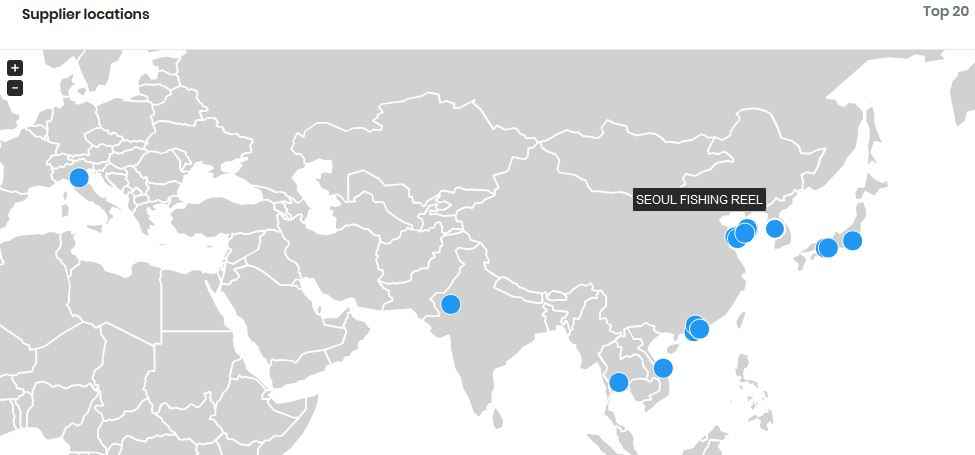
@redmeansdistortion I have no idea what parts they make for Daiwa, but found listed as a supplier on the website where I also snagged this map, which I flagged Doyo, also a supplier for Daiwa. Every dot is a supplier for Daiwa, and the list was Much longer than the number of dots. Momo is one of the suppliers on the China coast on the map SSW from Seoul. (it would take a long time to find the link I posted with the map before)
-
Ray's Studio SV spools are made in Thailand. (If you buy them from the Express site, tracking shows they're first imported into China before being loaded into a shipping container) Billings spools are made in China. Both have moving SV rotor. Momo (AMO) spool is also made in China with fixed rotor. Momo is a supplier for Daiwa. Roro spools (titanium spindle) are made in Hong Kong, and Jun Sonada recommends them for casting the lightest weights (he's done the casting trials). RoroLure has their own website with inexpensive post from Hong Kong to US.
-
The new line matched with the right tackle is a plus in fishing. Even the PE#1 in 22-lb test cuts veggies well, and nothing gets down quicker for bottom contact because it has no hydro drag. It doesn't stretch, it extends cast distance, which you can also read as less effort to fish. As far as knots to a shock leader, you can learn clean knots. Catching big bass is about paying your dues to know how to find them, and what to do when you get there, whether you're using mono, braid, or a Teeny sinking shooting head.
-
Using "PE Line" to represent all braided lines is the same as using '74 Impala to represent all automobiles. Most USM bait and spinning reels, most braid users over the past 20 years, and most people using the words "PE" and "braid" are talking about 45- to 65-lb braid, same diameter as mono, and made to fill the same deep spool. A dozen years ago, I laughed to myself at my friends fishing braid who were stuck with all the limitations of that product. It made good backing on trolling reels. I've only been using braid for the past 4 years. Sufix 832 works well on a stacked spool if you stack it right. In 2018, PE lines made a paradigm change. The new generation of X-braids use finer fibers, denser wrapping, advanced coatings and most important, a center higher-strength strand that is 80% of the total test. The whole thing is fused smaller when the coating is applied. They cost $1/yd in 2018, though that's getting better fast. These lines are down to thread size for 20-lb test. You need the right tackle to use and appreciate them, The old PE lines are still out there - except for Japan, where most have gone to X-braid, and they build JDM reels just for it.
-
@PhishLI Quickly set up macro on rigged rods, and not exact perspective, T-wing not in the exact position, but you can see the pitch difference in the worm gears. more nodes across the width on the slower-pitch SVTW fewer nodes across the width on the faster-pitch Silver Wofl Crop from Japan Tackle listing for Silver Wolf