
bulldog1935
Super User
-
Joined
-
Last visited
Everything posted by bulldog1935
-
@Big Hands silly me, I thought my first post answered everything - vertical fishing, big weights, unlikely to break the blank.
-
@MN Fisher - since we know @redmeansdistortion doesn't own any Tatulas, he's working on OP's gunk.
-
Something else regarding solvent choice - acetone is absorbed into your body directly through your skin (specific risk to liver). We covered solvent use earlier on the thread discussing ultrasonic cleaners. If you wash your parts in matching-size beaker and watch-glass cover, you both use minimal amounts of high-grade solvent and keep fumes to a minimum. I collect the spent alcohol in a separate bottle and use it for non-critical cleaning. Regarding anhydrous isopropyl - it doesn't remain anhydrous after the bottle cap is removed.
-
Actually, it's the catalyst from production - I've done years of alloy-phase digestion and analysis on electron microscope. Technical grade ethanol is simply filtered, and leaves residue - lab- and reagent-grade do not, because they're distilled to leave the residue behind. Alcohol left open to the air will absorb more water than acetone, and isopropanol will absorb more than ethanol. This can leave a watermark residue. Regarding bearings, if you're not using ultrasonic, you're leaving a significant film of the old grease regardless of solvent choice. The two solvents I use are mineral spirits for cutting dirt and grease, and ethanol (denatured alcohol) for final clean and flash dry.
-
@Banned User Zirconia ceramic has limited use, and noisy as heck, as I quoted. Maximum contract stress is limited to 80% of steel, silicon carbide, or silicon nitride. For most BFS application, hybrid ceramic micro (air) bearings will give you the best light-distance result, measured on casting range in direct-swap tests. Ball diameter and inner-race mass are 2 main factors in bearing inertia. Spendy, quiet, high-load-range, lowest-possible inertia - full silicon nitride are a boon, especially for salt use. I ran silicon-nitride loose balls in a Super Record bicycle hubset for 10,000 mi.
-
All reels are a gearbox - you and the handle are the engine - the torque comes from the input - handle length. Without varying handle length, all you're comparing are gear ratios and stock handles. The response of the gearbox to the added handle length - increased input torque - is what matters for durability and long life.
-
The first level reel that rejects water ingress using labyrinth seals defines the word Upgrade, especially if you ever have an interest in fishing fine braid. Shimano Stradic. Mine have been in salt finesse service for 5 years. I'll edit-in this - if $75 is your price point, you don't want a Shimano - at that price end, Daiwa builds a stronger reel.
-
@PhishLI - yep, a lot of that going around
-
top and bottom are still in the same phase - so no change there. I have a long (8-1/2') 7-pc cheap-A/E shore rod that doesn't have enough tip guides for rings up, so I assemble it spiral, and it works great. I bought it because the butt-guides were spaced right to make this work. I added yellow paint dots for spiral alignment. It has a perfect (wide L3) reel seat for my 4500CT micro-jig reel.
-
Thing is, @FrnkNsteen - load any "rings-up" casting rod, and you'll see the line Always touches the rod blank in the tip-third.
-
@FrnkNsteen - the torque is not in your hand, it's in the rod blank. High-stick rod-blank failure with "rings up" is always torsional overload. (multiple splits, 45-degree break) Spiral wrap prevents this by keeping the top-third of the rod in pure bending - rings on bottom lets you use fewer guides and wider spacing in the upper-half of the rod. Rings on top needs more guides to spread out the torsional strain and hopefully prevent torsional overload. And yes, where spiral wrap is most useful is in trolling and offshore jigging, where you are lifting big loads. Torquing your grip-hand comes from offset weight of reel drive and a heavy reel handle.
-
Not exactly true. The gear diameter on Ryoga gives it a 40% drag capacity increase over low-profile Daiwa. When you get to big spools like 37-mm-dia medium-frame Ambassadeur, lower gear raio gives you comparable line pick-up to higher-geared LP reel, and you get it done with a larger, tougher pinion gear. Also, swapping corundum drag washers into C3 drag stack gives you massive drag numbers.
-
Haneda Craft is offering a limited run of both brass and stainless 5.3 gearsets for my older '77 Ambassadeur C. (also for older non-C bushing reels) Because of the bearing configuration, the older C reels can achieve a slicker BFS result than the later Ultracast C3, etc., and why this is my favorite Ambassadeur result. In salt shore niche, 6'6" 2-hand Smith SPX rod, this bench '77 4500C casts 3-g microjig past 150' - it got extras, full-zirconia LW bearings, full-SiN spool bearings.
-
The reason fluoro makes a difference over mono is because mono absorbs UV and creates a UV shadow, while fluoro transmits UV, making it transparent with no shadow. This alone suggests a bright-colored line is less visible to a fish looking up than a dark-colored line.
-
Same is true with fly lines - it's more important to see the line than to fret over fish IQ.
-
@redmeansdistortion probably knew this - for C3 Ambassadeur, RocketReelCo also makes ball-bearing main shaft. (also Mikes's in BC) For all my surf reels, I found buying RRC loaded brake plate is cheaper than buying the stainless gears and mainshaft parts separately. Though to get centrifugal, you have to move the new parts over to the old brake plate - their brake plate doesn't have a centrifugal race.
-
hmm these two get names - Candy Apple and Black Cherry.
-
blank-through-handle killed round reels. Offset grips go back to Fenwick Champion and all the separate grips and rod blades made in the 50s/60s, and Fuji offset grips made in the 70s/80s. The Japanese keep this going in their home market, Bright River and Smith Super Strike - what I call the Japan Underground. @rboat - they're more than cared for, they're bench-custom. All my surf and shore reels are NLW (non-level-wind) CT round reels ok, one surf-lure LW, still bench custom. The round surf reels have barstock frame that brings the spool 8-mm closer to the rod.
-
I like my medium-frame round reels best with offset rod grips and generally shorter rods - all of these are set up for close kayak fishing, salt marsh river kayak Small-frame round reels work well enough with straight reel seats and, again, this is for close fishing limestone creeks - water you otherwise might wade with a short glass fly rod.
-
@Fishingmickey - current status of tariffs makes a recommendation difficult. Bright River is the king of Japan Underground rods. Headhunters Lure Shop is the largest vendor for this brand in Japan. Gizmo is another brick shop with a Yahoo store. I can give a very strong recommendation to Smith Super Strike FO-56 S-glass as the ML rod everyone with this interest should own. Though low-end is rated 5 g, I routinely fish below 1/8 oz, and it horses big bass at the boat. Smith grip also has the advantage of magnesium MOC, which doesn't have an aluminum-derivative tariff. Asian Portal is a good place to shop for Smith SS rods. A Japan broker where I've found good buys on separate Smith grips and blades is ZenPlus. Note Smith SS-WS51-TM was designed as a kayak rod. Hope this helps. ps - last duty I paid on rod blades was 21% - current aluminum-body reel tariff is up to 65%.
-
The history of the reels that became BFS goes back further in time than the short para-UL rods of the '70s made for trout and panfish. Threadline fishing in general goes back to Atlantic salmon fishing in the 30s. On our shore, prewar Shakespeare Tournament Freespool, alloy spool, shallow cork arbor, matched with 4-lb silk braid and a cane casting rod, would fish 1/8 oz all day. Easy to argue this was improved-on by postwar Langley, which made a great finesse match with the tippy fiberglass rods of the 50s.
-
Pretty sure even Don Iovino is personal about his finesse bass fishing. I have one of his bench small-frame Ambassdeurs that I've taken a few steps farther than his mods. On this reel, Don used the Avail worm-gear and LW rider upgrades. But stock, deep (heavy) spool, and spindle/bushing polishing on the idler gear. It uses the stock centrifugal, and is a somewhat slicker version of the stock 1/4-oz reel. Performance is very different from a modern BFS reel. My staged upgrades made it full Avail with light shallow spool and mag brake, fishing PE#1. Mr. Motoyama coined BFS c. 2000 - Bait Finesse System, for reel mods including light, shallow spool, low-inertia spool bearings, and threadline (line diameter nominal 4-lb mono). His earlier books took the unnamed reels to mountain trout - his later books all aimed BFS at shore bass fishing to take advantage of long-light casts. The Japanese have moved the reels and matching baitfinesse rods to inshore, salt shore, and offshore vertical jigging. (Inshore tackle generally equates to reservoir bass tackle) My choice for reservoir kayak is a single versatile rod, wide range for neds and finesse baits to medium cranks. Generally in finesse tackle, I don't give up fish-turning butt power. My reel choice here is bench mod mag-brake, shallow spool, IXA MBS bearings and PE#1.2. For closer fishing in river kayak, I've found I can get better results with 4000-size medium-frame Ambassadeur with full BFS - the medium frame reaches best on offset-grip Japanese rods. These shorter length rods perform very well in close spaces.
-
Drag grease and gear grease have two different purposes - gear grease viscosity is to prevent mashing contact of metals. Drag grease is lower viscosity and formulated not to decompose with heat.

-
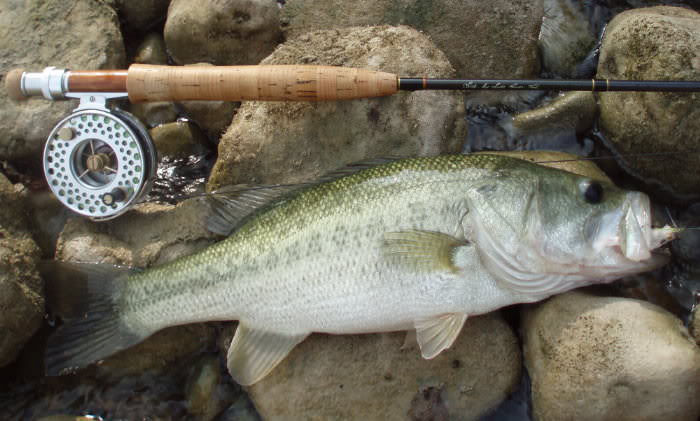
Our limestone headwaters have endemic bass - Texas Brook Trout. (he flipped water on my lens)
-
Boeshield T-9 is not lubricant. Like WD-40, the carrier is mineral spirits. But where the latter leaves oil residue, T-9 leaves a corrosion-inhibiting wax. It was developed by Boeing for quick wipe-down maintenance of airframes, which live in a filthy, corrosive environment. I've used it for decades on OP's valuable antique pot-metal and duralumin fly reels.