you
Members
-
Joined
-
Last visited
Everything posted by you
-
Catching "plenty of dinks" while floating a clear river on a beautiful day sounds. . . great? I tend to catch bigger fish in worse (mainly windy) weather. This certainly held for river smallies back when I lived in MI.
-
^^Agreed^^ Should be no problem. I've used inexpensive shimanos, daiwas, and 13s (all spinning) for saltwater fishing from a kayak, where they frequently get sprayed/splashed. When I get home, I take off any lures or tackle, spray the rod and reel down well with a hose, dry everything off with a rag, and give the reel about 50 cranks afterward. With regular saltwater use, you'll probably want to re-lube more often. Good opportunity to spot check for rust on any steel parts.
-
Same here. If I'm alternating frequently between a couple of rods in my kayak, I'll keep the other one 'dangling' in a rod holder. The tip is away from the hull and other rods. No danger of snagging unless I decide to paddle into a bush. I've never had an issue with guide damage, either.
-
-
I wonder how common skin reactions to fish are. I usually wear sun gloves while fishing, and they get pretty slimy after a good day. The day after a good day, the skin on my hands can get irritated and start peeling. This only started a year ago (after about three decades of fishing). I'd ditch the gloves, but they still beat reapplying sunscreen 10 times. I get small welts from fin pokes, too, more so from saltwater species.
-
I use the "second hook" almost exclusively for soft plastics, so probably not ? Mechanically, the first hook's point is off axis from the hook eye, which could increase hook-up ratio? I just prefer the ease of texposing with EWGs.
-
If you compare nylon and fluoro lines of the same diameter and color. there is not much difference in visibility. The refractive index of fluoro is closer to water than nylon, but close is not the same. There are still reflections. Reflections can also come from minor deformation in lines caused imprecise winding. That's why I prefer lines wound in neat layers (e.g. sufix siege, seaguar invisx) for leaders. I agree with others here that diameter is much more important than material. I also think that line tint can make a difference depending on the application: are the fish looking up or down when they approach your lure? How well does it match the background/lighting? The clarity of nylon will also decrease with damage from UV and water absorption. For leaders this doesn't matter too much. Just tie a new one. I'd opt for fluoro mainlines, though.
-
If you want a mono (fluoro or nylon) mainline, spool width will be more important then spool depth. A well-filled, wide spool will (generally) cast farther and give you fewer loop/tangle issues. It's why I tend to put larger spinning reals on my combos. I agree with @WRB's diameter recommendations. Of course, braid to leader will be easier to handle in most scenarios.
-
Agreed. I love the keitech shad impact for twitchy, walking retrieves. It also rolls nicely on a slow retrieve and on the fall.
-
There are a couple of lakes by me with two largely separate LMB populations: offshore shad-feeders and nearshore swamp residents that likely feed on invertebrates, fry, frogs, lizards, etc more than shad. The offshore fish seem to have much sharper teeth than the nearshore fish. I've always assumed this was a response to diet. Whether it's genetic or not is also a good question. If the trait is primarily hereditary, that would imply that offshore and nearshore fish are not interbreeding randomly, even though they are probably utilizing the same spawning habitat. Could they have different spawning windows or courtship behaviors that keep them reproductively isolated? Cool questions. I'm not up to date on the research.
-
I think they were just making a joke. They are agreeing with you. Correct. I think the 'literally' debate is pretty funny. The word can be used precisely or imprecisely (i.e. for emphasis). It's up to the speaker/writer to provide context and avoid ambiguity, if that is the goal. Language evolves quickly. Of course, I only use the literal definition of literal. Interpret that however you like :)
-
Perspective from fishing FL lakes and gulf inshore: -Nearly all of my freshwater baits are dark (and usually purple) -Nearly all of my saltwater baits are white (or off-white) Black (and dark) baits work great on bass, but does anyone prefer white baits for bass, even beyond 'match-the-hatch' baitfish scenarios? I've tried dark baits for reds and trout in the gulf without much success. And for bass, a white speedworm or trick worm just seems silly to me. Does it all come down to confidence?
-
Really? Doesn't literally actually mean figuratively? But seriously, for any given application, knot strength seems to depend more on practice and familiarity with a given line (or lines) than the exact knot used. Lots of knots work, but they all take practice. Not sure who's putting down the FG knot from a failure standpoint--it's super strong. But I do think that many other knots are easier to tie quickly and effectively, especially for small-diameter connections
-
Same here, I have had a couple of angry pre-spawn fish break me off and then immediately bite again. It's a good lesson: always cast again after a lost connection or break-off. Sometimes they are too fired up to care. When I catch other people's rigs, its usually live bait gear connected to a bowfin.
-
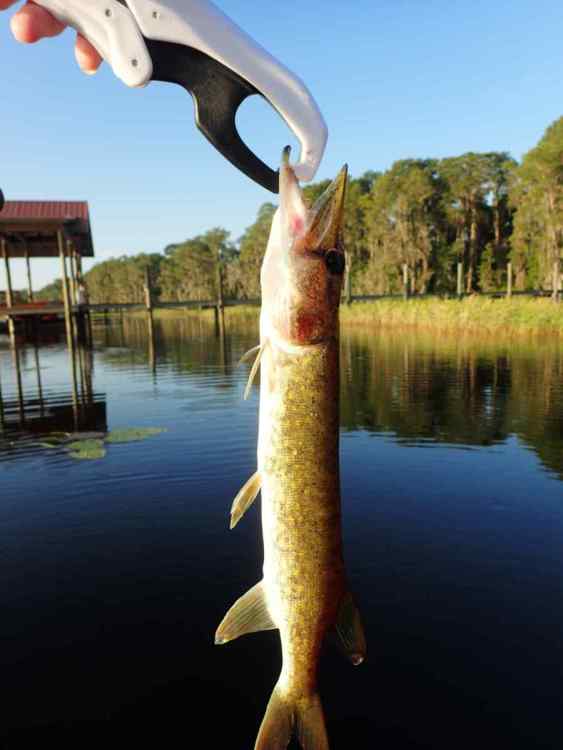
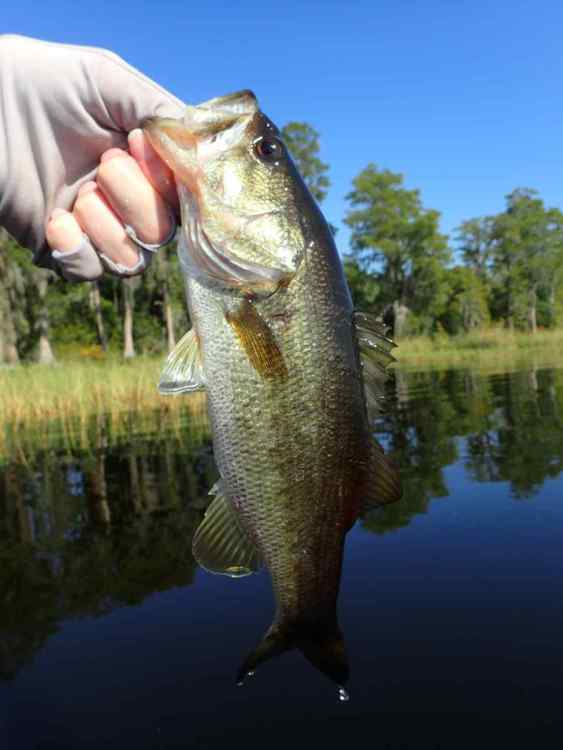
A couple pics from Sunday: These feisty dinks were a welcome sight. The sun was bright and the water was hot and glass-calm. I was praying for wind. Then Idalia showed up a few days later ?. Be careful what you wish for.
-
Agreed. It especially makes a difference at small diameters where abrasion builds up fast. If you're finesse fishing with 0.008" line, good FC stands up to rocks and teeth much better than nylon. It's simply a harder material on average. With thicker lines, I don't notice a difference. And knot strength is definitely an issue. You have to adapt your knots to FC, and even to different brands/types/diameters of FC. Differences in visibility, density, stretch...meh. I think most of this is marketing except for a few specific situations, at least when your are comparing lines of the same diameter. Test strength vs diameter is all over the place.
-
Looking at the damage in Steinhatchee and Cedar Key...wow. Not unexpected, but still a bummer. Always impressed by what these storms can do and by how resilient the residents are. I know folks often say they shouldn't build towns along coastal lowlands, but for me, these places are gems and crucial infrastructure for gulf anglers and wildlife lovers. I'm not saying they should be built up like the Atlantic coast. Help to keep them like they are and respect the culture. If you're passing through, buy some bait, eat at the restaurants, learn from the locals, and have a great time.
-
All set here. We are inland and mostly afraid of downed trees and power lines, as others have said. I'm curious to see what it will do to the local rivers, which recently returned to normal levels after a long drought. I'm thinking about the folks on the coast. This will be a rough one to recover from.
-
The albright knot works well for me, too (usually 10# braid to 6-8# nylon or FC). The uni-uni does not work as well with FC, IMO, and it's a thicker knot. The FG knot is a bit fussy for those diameters--not sure it offers a significant advantage for the effort. I also use the surgeon knot, but for tippet connections (mono to mono) on fly rods. It works as long as the line diameters are not too different.
-
Nice fish! My PB was just a bit smaller at 23". That one hit a topwater. I've been meaning to try chatterbaits again. Thanks for the tip.
-
My priorities are action, then balance, then handle comfort, then looks. I would only consider one of my rods a 'looker': a lews custom speed stick. The covered real seat looks sleek and feels amazing in hand. I like the matte blank finish, too.
-
Same. It throws off my focus and casting accuracy. Bad idea in hot weather, too.
-
Agreed on the M/F spinning setup suggestion. Also, braid (and probably a leader) is a must for weightless plastics.
-
Usually bring a banana and a sandwich, then completely forget about eating until the drive home. I like to joke that my kayak gets about 10 miles per sandwich. Time to get a fitness tracker and see how accurate that estimate is.
-
If its for all species (not just bass): Keitech. Great colors, great scent, great selection.