


Fishing Rhino
Super User
-
Joined
-
Last visited
Everything posted by Fishing Rhino
-
Carmen?
-
That is a bummer, especially since you had an agreement with him. But, these things have a way of working out for the best. Here's hoping it does for you, and you find an even better deal.
-
For future reference, does that Gaston/Kerr deal apply to non-resident licenses as well?
-
I'd think the two states would "honor" the license of the other in cases where a body of water borders both states. There are two bodies of water I fish that border two states, MA and RI, Sawdy Pond and South Watuppa Pond. A license from either state allows fishing "privileges". As for the resident, non-resident differences, I do not have a problem with that. A state is responsible for "maintaining" its waters. It includes such things as water monitoring, stocking programs, law enforcement, maintaining ramps, etc. This is paid for by taxation as well as licensing fees. Since residents of a state contribute taxes within the state, they already contribute beyond the licensing fee to the maintenance of the waters within the state. Folks within the state that don't avail themselves of that resource also contribute to its upkeep. It's only fair that those outside pay a higher, but reasonable fee to avail themselves of another state's resources. In your case with Weiss lake, I'd agree that either a GA or AL license should allow access to the entire lake. It does pose another question. What about rivers that run through several states? The ocean is another similar circumstance. State waters extend a distance of three miles from the coast. There is a boundary line that delineates between states. Commercial fishermen from one state cannot intrude into another state's waters. I believe that is determined by federal law.
-
Can't a protective finish be reapplied? Yes, it could. The problems are, I'm out almost everyday. As soon as you chew up a few spots, the wood fibers begin absorbing water. They'd have to dry, then be sanded and filled, and sanded again, then refinished. It's just not practical for the way I use the paddle. Plastic is not subject to absorbing water, even when it's dinged up. I'm partial to wood, because I've done a lot of woodworking, as a job and a hobby, plus home projects. It has its strengths and weaknesses. Using it to poke around in rocky water is not one of its strengths. By the way, do you know that pound for pound wood is stronger than just about any other material, including steel, aluminum and fiberglass. The problem is it has a lot more bulk, pound for pound. Prior to the development of carbon fiber and kevlar, many racing hulls were made up of thin layers of wood veneers. They were very light, had a lot of inherent stiffness, and very fast. In fact, many if not all PT Boats were made of wood. Two layers of wood planking literally formed a "plywood" hull. The design competition and seaworthiness trials for the PT boat was nicknamed "The Plywood Derby" and took place prior to the United States entering the war, in early 1941. The Navy Department held these competition trials around New York Harbor. This was a shakedown to see which company would be contracted to build the Navy PT boats. At the completion of the trials, the Navy was impressed with all three designs, with the Elco 77-footer coming out on top, followed by the Higgins 76-footer and Huckins 72-foot boat. Although Elco came in first, the Navy saw the merits of the other two boats and decided to offer all three companies contracts. Elco received the lion's share of the contract (385 boats by the end of the war), Higgins was second (199 boats by the end of the war) and Huckins with the smallest contract (18 boats by the end of the war, none of which would see combat, being assigned to home defense squadrons in the Panama Canal Zone, Miami, Florida and in Hawaii at Pearl Harbor). Huckins was a tiny yacht-building company in Jacksonville, Florida and was unable to build the number of boats needed by the Navy. Although they built a few 78-foot (24 m) boats of the PT-95 class, the 80-foot (24.4 m) Elco and the 78-foot (24 m) Higgins boats became the standard American motor torpedo boats of World War II. By war's end, more of the 80-foot Elco boats were built than any other type of motor torpedo boat (326 of their 80-foot boats were built). Elco also produced 49 of their 77-foot boats and ten 70-foot boats. [edit] Elco The Elco Naval Division boats were the largest in size of the three types of PT boats built for the US Navy used during World War II. The 80-foot (24.4 m) wooden-hulled craft were classified as boats in comparison with much larger steel-hulled destroyers, but were comparable in size to many wooden sailing ships in history. They had a 20 ft 8 in (6.3 m) beam. Though often said to be made of plywood, they were actually made of two diagonal layered 1-inch thick mahogany planks, with a glue-impregnated layer of canvas in between. Holding all this together were thousands of bronze screws and copper rivets. As an example of the strength of this type of construction, the hull of the PT-109 was strong enough that airtight compartments kept the forward hull afloat for hours even after being cut in half by a destroyer. Additionally, damage to the wooden hulls of these boats could be easily repaired at the front lines by base force personnel. http://en.wikipedia.org/wiki/PT_boats
-
Anyway, look at this goofball's rig, I'd just build something like LBH's jon. http://www.kayak-charters.com/html/signature_kayak.html I have to admit, that's quite a rig. I don't know that I'd care to fish out of it however. I like 360 degrees of nothing but open space around me. The only snag on my rig is when I'm using the fish finder. The transducer is suction cupped to the side of the hull. I also got a kick out of the stabilizers. The "pontoons" are 7 X 14 Carlon buoys. When I was lobstering, we used them on "high flyers". http://store.vernondeon.com/index.php?opt=detail&ID=141&PID=2654 I do like the guys creativity however. Thanks for that link.
-
How many on here remember what I think was the first popular fishing show, "Gadabout Gaddis, the Flying Fisherman"? http://gadaboutgaddis.com/
-
Not necessarily fishing shows, or everyone's cup of tea, but Bass Pro Shops has a plethora of how to videos on their site. They might serve to ease the symptoms of withdrawal. Over a hundred fishing videos to watch. Check it out and decide for yourself. http://www.basspro.com/webapp/wcs/stores/servlet/CFPageC?storeId=10151&catalogId=10001&langId=-1&template=video.cfm&cat=Fishing&subcatID=14&option=2&cmid=OLSUBCATEGORY_14_0_
-
OK, I did not make it clear. When one end of the paddle dips into the water, the other is higher than my head. Any water carried by the paddle then runs down the handle to the ring, then off the ring, into my lap. As I said, it may have been my technique in using the paddle. It wasn't a waterfall coming off the drip ring, but after a few dozen strokes, it was probably a couple of cups. This video shows water coming off the paddle onto the deck of a kayak. In my canoe. there is no deck, and that water ends up on my legs and lap. http://search.live.com/video/results.aspx?q=paddling+a+kayak&first=21&docid=221996056647&FORM=TVVR14
-
That's what drip rings were made for: http://www.kayakfishingstuff.com/Merchant2/merchant.mvc?Screen=PROD&Product_Code=Can-DripRing&Category_Code=pdl They have drip rings. Maybe it was my paddling technique but hands or drip rings, when the paddle passed over me, the water ran from the drip rings as well, and ended up in my lap. I tried extending my arms forward, but that was awkward for me. I wish I could have made it work. It did propel the canoe faster.
-
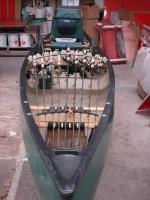
I think you are correct. When it's cold, and snowing, and blowing, and the ponds are frozen, I do not look at them with an urgent desire to wet a line. I am anxious for the return of warm weather, but I'm not going to wish my life away. However, when it's a bluebird day, and it would be great to be on the water, but other commitments prevent it, it really eats at me.Color is an interesting topic. I think color matters. But, that goes back to years ago fishing for stripers in Cape Cod Bay. I'm talking the late '60s early '70s. Don't see 'em any more, but Hoochie Trolls were a popular bait that were supposed to resemble squid. They came in all colors, red, orange, black, pink, and fluorescent versions. I had a red and an orange, but not fluorescent. One day the bass were being slaughtered in the bay on anything fluorescent. I could not catch a cold, despite trolling at the same speed and depth as the other boats around me. It was like a circus with dozens of boats in a small area. Finally I buzzed back to the dock, got a couple of fluorescent Hoochies, one red, one pink, went back out and could not miss. Caught several up to 42 pounds where I had caught nothing only a short time ago. Let the line out, flip the free spool lever to lock the spool and not go more than a few feet before having a fish on. After catching several, I switched back to a non-fluorescent out of curiosity, and they wouldn't touch it. Switch back and instant hookups. Does that apply to largemouths as well? I don't know. It's just ingrained in my psyche that color matters as a result of that and a couple of other experiences. One where the only Rebel lure the stripers and blues would hit was a mackerel finish. In the event color is not critical, then it certainly would not hurt to try different colors. The important thing to remember is, if what you are doing is not catching fish, try something different, be it color, lure, or technique.First goal. Have fun. Others: Learn to use jigs, jig n pig, drop shotting, shakey heading, and crankbaits. Most of my fish are caught in shallow water of five feet or less. Try new places. Last goal. Have fun.If you have windows, check for updates. When the window for updates opens, click on express, and the program will check your computer to see if it is current. You can pick and choose the updates you want to install. I select them all since they deal with security and performance issues. I had a problem a while back playing videos on Internet Explorer. It kept telling me I needed to install flash player. When I tried, my computer would not install it. Even though it had been installed and videos played in the past. I had to download SublnACL from the Microsoft website (no charge). It fixed permission issuses that prevented the flash player from being installed. I'm no computer geek, but managed to get the problem solved. If you try to install flash player, and it doesn't install, there is a troubleshooting link that will get you to the appropriate Microsoft page for the above download. An easier solution if you have AOL is to open it on the AOL site. AOL has it's own video player. Go to AOL.com. When it opens, paste the URL for the Lunkerville show in the address space and click go. That might work.1500 - 2000 That's figuring in gasoline for my truck, but not including a trip to Georgia and Alabama in March. Will be visiting our daughter in GA, so it's a combo trip. Shouldn't need any rods and reels, since I have 5 baitcasters. One can handle lures up to 6 oz. Another up to 3. The remaining are one 1.5 oz and two 3/4 oz. Four spinning rods of medium to medium heavy action. But, never say never. I don't have an ultralight, so.................. Pretty well set on terminal gear. Maybe a trolling motor. Might build a jon boat. If so, that will push my spending higher.No better way to spend a profit sharing check. Enjoy it in good health.It should work just fine. Square stern, ready for trolling or small outboard motor. I notice it has a bit of a keel, which is also good. It will greatly reduce sideways drift in a breeze, and also help it track better when under power. I'm guessing, but it looks like you could stand in it to fish. I'd suggest doing it in shallow water until you get your sealegs under you, just in case. Looks versatile. I'd say it will work just fine as long as you stay within its limitations. It'll give you many, many hours of pleasure.The chatterfrog is my lure du jour. It comes with two frog leg trailers. Make sure the trailer is straight, and does not follow the curve of the hook. When you've got it in place, a drop or two of super glue will lock it in place permanently. I fish it in shallow or deeper water. The frog head loses its paint from bumping over rocks. Fish it fast enough to feel a good throb in your rod. As was suggested by another member, vary your retrieve 'til you find what the bass want.I just picked up two. Christmas gift to myself. A great bargain at 30 bucks off the regular price, and an 80 dollar savings over buying them separately. Nice selection of rods and reel with different ratios and one flipping model. I got the 7' 10" extra heavy and a 6' 6" medium heavy. The first is for casting swimbaits up to 3 ounces, and a backup to my Nitro combo which can toss lures up to 6 ounces. I plan to try them on Stripers chasing herring into the Westport River next spring. I'm curious to try some of the stuff I've got for largemouths to see what happens. The other makes number two of that combo. Will be rigged with a different bait for ease of switching.Too cheap to buy a drift sock. Yeah, I know all that spent on equipment and too cheap.......................... I use a five gallon bucket with a three line harness to its mouth. Really slows the drift and keeps the boat from swinging back and forth. Costs nothing, plus it provides storage for bottles of water and miscellaneous stuff. Drilled four one inch holes in the bottom. I figured a round parachute spills air through a hole in the top for some reason, possibly to keep it more stable. It should work on a bucket as well. It is stable. Because of the holes? Who knows?Thanks. While not being able to stand has its disadvantages, the advantages more than balance it out. I do everything right from the seat. When you catch a lunker and get it to the boat, it's right there beside you. Easy to lip or net it. I rarely use the net for bass. I usually use if for large pickerel. Funny, years ago, I thought nothing of handling them. Now, the large ones look like barracuda to me. I want no part of those teeth until I get it under control with the net. The other thing about handling fish that makes the canoe handy is that I always wet my hand before handling any fish. A wet hand does less damage to the slime coating on a fish. Though I plan to have a platform boat, jon or otherwise to complement the canoe, I cannot get the image of me taking a couple of unplanned swims as I lean over the side out of my mind.Thanks. My wife thinks it's absurd with all those rods. I'd hate to go back to just a couple of rods, but would if necessary. It is eye opening to see how the catch goes up when you can put one rod down and pick up another that is rigged differently. When I had a couple, I'd set up my tackle box with the lures I wanted to try 'til I found what the fish wanted. Changing lures is time consuming, for me anyway. I now do it at home. With that number of rods I can rig with an assortment of baits. The center rod is for handling wake baits. It will handle lures up to six ounces. The rod to its left is also extra heavy and will handle lures up to three ounces. I'm anxious for next spring. When the herring start to run in the Westport Rivers, it isn't long before large stripers chase them into the runs. I want to try some of the large swimbaits that look like herring, and some of the larger worms, just to see what happens.Here's a site to give you a start. http://www.trackerboats.com/segment/jon-utility-boats.cfm While I'm not a fan of riveted jon boats (I'd prefer the welded), I had one years ago from Sears. The problem is, that after pounding around, and on Lake Norman, that's quite possible, the rivets will loosen up. But, if you treat her appropriately by fishing calm waters, which means the sheltered shores and coves on windy days, it will take years for that to happen. I used to take my jon onto Cape Cod Bay, and beat it around chasing Stripers and Bluefish. I know, not too bright, but it was all I could afford back in the late 1960s. Keep in mind, riveted jon boats, while not being as sturdy as their welded kin, do have the benefit of being lighter and easier to handle, on the beach and on the water. The price of a riveted Tracker, will also allow you to get a new electric trolling motor and battery for the budget you quoted. Granted, it won't be the most powerful, but you don't really need that on a jon, and the entire unit will be new and guaranteed. In addition, being new means that you should get a few years of trouble free use out of both. I've been by Lake Norman several times on trips to the South. I'm guessing there are several public access ramps available, based on its size. If that is the case, you should always be able to find a ramp on or near a sheltered area. Start by using it as is, then modify it as budgetary considerations allow. The prime consideration is that you'll have something to get you where the fish are, or at least where you think they might be.I've used a canoe for two years now. Yes, the wind can blow me around at trolling speed, but that's one of the tradeoffs. Anchoring is a PITA, but I fish shallow, soft-bottomed water and the anchor holds very well. Also, slime mats or thick lily pads can serve as anchors. I agree, even though John can carry a lot of stuff in his kayak. I also like the fact that I have such easy access to everything I bring. Mine is pretty wide and I can stand in it, but I don't very often. The width makes it very stable, but the tradeoff to that is paddling inefficiency. I don't want to get into the canoe-vs.-kayak thing, to each their own, but for me my two choices were either an ultralight Kevlar canoe or nothing. The pond I fish most has a rocky shore. The east side of the pond is mostly farm fields. The west side is heavily wooded with a few homes. However, there are stone walls running through the areas around the pond which tells me that the woodlands were once all open fields. I suspect the rocks around the pond are the result of farmers clearing those fields. On average, once you get 20 to 30 feet from the shore, the bottom is soft mud. There are also a few "jetties" that run out from the shore, which are obviously man made. But not recently. The shore is thick with vegetation. One of my tricks, if the wind tries to blow me along the shore is to back the canoe into this vegetation (thick lily pads, and water hyacinth work as well), then fan cast the area thoroughly. Move 30 - 40 feet and repeat the process. It works very well.
Important Information
We have placed cookies on your device to help make this website better. You can adjust your cookie settings, otherwise we'll assume you're okay to continue.