Fishing Rhino
Super User
-
Joined
-
Last visited
Everything posted by Fishing Rhino
-
Thanks. It works better than I ever imagined a canoe could.
-
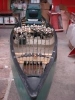
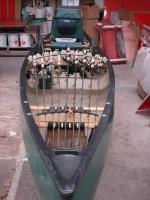
I do fish mostly alone. When I do fish with another, removing two screws is all that is necessary to remove the rod holder from the center cross brace (thwart). The unit for the rod tips is held in place by two hand spring clamps. As set up in the photos the boat is set up "backwards". I paddle with the stern facing forward. The reason for doing so is that the "front seat" is closer to the middle of the boat to allow leg room for the forward paddler. There is little difference if any between the bow and stern. By paddling stern first, I am closer to the center of the boat which keeps the bow from rising out of the water and having the stern squat. It also provides room behind me for the sea anchor bucket and the anchor. That is the one drawback to the setup. It is a one person rig.
-
The seat is from LL Bean. It works great. There is an adjusting strap on the right side to adjust the back tension to your liking. The orange (ammo style) box houses the fish finder. It is the portable Eagle Cuda model. The transducer has a suction cup mount. The mount in the box is for use on the stern. I used a couple of lengths of 1/8" x 1" aluminum to make it work on the side of the boat right beside where I sit. This allows me to remove it when I'm in shallow rocky water, or to remove the weeds it harvests. I'll post a photo of it mounted on the boat so anyone interested can copy it. http://i135.photobucket.com/albums/q155/HomarusAmericanus/Picture034jpgedit.jpghttp://i135.photobucket.com/albums/q155/HomarusAmericanus/Picture034jpgedit-1.jpg
-
There are two types of "private lakes". One type amounts to a hatchery or fish farm. The other is a natural pond or lake which is surrounded by private properties with no public access. I am fortunate enough to have access to one of the latter. The fishing is better than the public access waters around here only because it is not fished as heavily. But, they will not hit anything that moves. There are days when you can count on the fingers of one hand the number of fish caught/landed. Other days you can catch five or six per hour. Their average size is also larger than the public access waters. You still have to work for 'em. Working weedless lures through the grass and lily pads or casting into small pockets in the water hyacinth, or under trees along the shore can be a necessity for success. Catching fish not only keeps the interest and enthusiasm up, it also keeps you focussed, and alert.
-
As it is now, they won't. The tips are kept in place with bungee cords during transport. The butt ends by plywood pieces with a hose along the edge. These are held in place with vice grips. The plan is to make a strip of wood with an edge cushioned for each side that can pivot and be held down by a bungee or some quick acting arrangement. I have made a couple of modifications to the original which held all the rods in a straight horizontal line. I like the curved style better. It's not as tall at the sides. At the rod tips, the plywood with 1/4 inch dowels pins is held in place with a couple of hand spring clamps. I put a piece of reinforced clear plastic hose from the hardware store over the edge, then drilled through it into the plywood for the dowels. The dowels are glued in place. I should get with it and make the retainer for the butts, just in case.
-
Thanks. That's what my canoe is. I also carry three tackle boxes with me. I've got to get another to replace the large one in the photos. It's too tall. The plan is to get one that will slide under the gap between the bottom and the center brace. I'll attach a cord to each box, then push 'em forward out of the way using the paddle. Then I can drag 'em back to me. Now, I have to lean forward, over the cross member to access the large box. Behind the seat is the mushroom anchor which is stored in the drift anchor bucket. A small net is stored beside them with the handle resting on the seat to my left. A couple of bottles of water are also kept in the bucket. The bucket also stores the pfd. A watertight rubbermaid container is used to keep keys, cellphone, etc. to keep them from getting wet, and it will float should the canoe ever be capsized. Use a sharpie to put your name and address on it. Then, trace your name and address on the underside of the transparent lid and you don't have to worry about it wearing off on the outside. The other item I would suggest is a heavy duty boat cart. I got one from LL Bean, and it is great. Center the canoe on it and it rolls as easily over the ground as a shopping cart in the supermarket. The one I have has what looks like knobby small bike wheels. It handles uneven ground well, unless you go too fast. Push or pull, it works as well either way.
-
Thanks. Like everything else, a canoe has its niche where it is better than other boats. It is best on small, or sheltered ponds/lakes and some rivers. It is at its worst when exposed to windy conditions. When it is calm, the resistance of a lure as you retrieve it is sufficient to pull the canoe through the water. Some, spinner baits in particular really drag it along. The technique I use is to work the shorelines of the ponds I fish. The canoe is positioned twenty to thirty feet from the shore. This allows me to work the lure in an area right up to the shore up to sixty feet or so from the shore. I fan cast that area with 5 - 7 casts. When that pattern is completed, the canoe will have moved 10 - 15 feet forward, provided there is no wind. This allows me to find where the fish are holding, and then to work that area. When it's breezy or windy, I have a five gallon bucket rigged as a sea anchor. It slows the drift of the boat considerably. The downside of the canoe is that it gets tiresome sitting in one position for a few hours. When fishing in windy conditions, I spend up to 80% of the time keeping the boat in position, especially when fishing upwind. Where I fish, it's too rocky to use a trolling motor. On some windy days, I'll back the canoe into the water hyacinth and cast along the shore and outward. After a few casts, I move the canoe thirty feet or so along the weeds and back it in again. Some days require the use of the anchor. On those days, a jon boat with a trolling motor would be preferable. On larger ponds and lakes, I'd prefer some type of bass boat.
-
I went to the FAQs about posting multiple images in one post, but I'm still having problems. Here's another.
-
I wanted to post more than one image. Hopefully this works.
-
Yes, it can. In fact, a canoe has some advantages (and disadvantages) over a full fledged bass boat. I spent considerable time thinking about how to make my canoe as efficient as possible. I can have eight poles rigged and ready to fish within arm's length. Each rod is entirely within the canoe. No need to worry about plants or branches snagging them while working tight to the shore. It's easy to fight a fish from a canoe. Nothing in the water for a line to get wrapped around. When the fish is at the boat, you are already in position to grab or net it. With a canoe, you can fish in extremely shallow rocky water, where few other boats can go. Here's my creation.
-
While your at it don't forget to run some plastic pvc pipe down each side (one for pos and one for neg wires & drill a few din holes in the bottom side to let moisture out) & fiberglass that in for electrical wires and such (makes running wires so much easier), i would also plumb in my live well stuff along with a drain for a cooler (run it to the back of the boat where the main drain plug and bilge will be located) since the process you are using will make a perfect built in cooler some place in the boat. Please post pics of ur build process. Good Luck!!!! Thanks for the great suggestions. If and when I get started, I'll post photos as the job progresses.
-
If I did it myself, the materials for coating the boat with the plastic material would be over two hundred dollars. Carpet would be less than that. If it is good for 5 - 10 years (I suppose it depends on the product's quality) that's good enough for me. I know carpet would definitely have the advantages of sound deadening and comfort (better cushioning). Then, there is always the potential for making a mess with the coating. Kick the pail over, dribbles from the rollers, etc. If I do the project, I will be building the boat from scratch. I do fiberglass fabrication so it will be a natural. The jon I envision will be 12 - 14 feet long, have an inch thick foam core on the bottom and half inch on the sides. That will provide stiffness, and save weight. It will cut the thickness of fiberglass needed significantly. It will be four feet wide at the bottom. Must fit between the wheel wells of a pickup. I'll need a trailer for the finished product, I'm sure. But, a lighter version without all the decking, may be light enough. I've got a roll of Kevlar with enough material to make a few hulls. So................... I don't know if you've ever seen a damaged Boston Whaler. I've repaired a couple for some guys, and the "skin" is not even an eighth of an inch in thickness. A sixteenth would be more like it. Yet those boats are very stiff because of the foam core. Extra thickness at the chines and wear runners on the bottom will protect the thin skin. The bugaboo for me will be planning the layout for the compartments under the decks. Once those sizes and layout are determined, I will be able to partition off those compartments with fiberglass over foam panels. These will support the deck without the need for a lot of framework. The planning will be the most difficult part.
-
Thanks. I believe that's the same material as Rhino Linings. It seems to me that could be preferable to carpet. It would be easier to apply/install, not as subject to being snagged by hooks, and damaged or worn areas can be touched up by applying a coat to those areas. The downside is that it won't dampen sound as well as carpet. Got some serious thinking and research ahead. Do you know if carpeting is installed with an adhesive?
-
Well........................, look at the positive side. It would make a great winter boat in the cooler climes.
-
While commonly associated with "yuppiedom", L.L. Bean has great products, and they stand behind them without a hassle. They are a good company to buy from, and their shipping is prompt. On their winter clothing, their catalog will tell you the temp ranges for each garment. Granted, that will vary from one person to another, but at least you get a reliable indication as to their servicability for your needs.
-
According to the bass the fish are healthy. They have adapted to the changes in the lake and are continuing to find the food they need to stay healthy. According to your description the symptoms indicat that the fishing stinks. At the moment, with the algae bloom, it does indeed stink. One or two fish per two hour outing. A couple of weeks ago, it was five or six per hour, sometimes more. It isn't just the visibility. Some areas of the pond are clogged with brown gunk (another form of algae?) that floats on the surface buoyed up by gas trapped underneath. From a distance the "bubble" under the brown matter makes the mess resemble a cypress knee. Those bubbles can protrude a couple of inches above the surface of the pond. Some areas are clear of this stuff. It tends to be found along the northeastern shoreline, probably because it is not anchored to the bottom, and the prevailing wind is from the southwest. I've given up on that pond until the bloom dies off when the weather cools, probably in September. A few hundred yards to the west is another pond which is about twice the size but has always been similar in character. It has no such problem and the water is sparkling clear, and it remains much as it was forty years ago. If anything, there has been more development along the waterfront of that pond, so it can't be attributable to the use of fertilizers for lawns, etc. In fact, when I fished Devol Pond forty years ago, there were active farms with livestock that had access to the pond. My father-in-law's cows would wade in the pond in the summer heat. Today, only one farm, on a smaller scale remains, so there is considerably less runoff from manure. The fields, by and large are only used for haying. Supposedly, the state has recently taken water samples. I don't know what action they will take since there is no public access to this pond. Usually when the state spends money on something it comes with strings attached, such as providing access for the public. Sawdy Pond, which has no noticable problems is on the Mass, RI border, and drains into South Watuppa Pond, bordered by Westport and Fall River, MA. Devol pond drains into Sawdy Pond via swamp and marsh, which apparently filter the cause of the problems in Devol Pond. Regards, Tom
-
LOL, no. But I still have it. It's missing an eye or two. One eye is held on with a band aid, and another with electrical tape. The winding on others is unravelling, and the female part of the coupling needs to be reglued. I'm thinking about getting it "restored", just for old time's sake. Even the ultralight stuff on the racks is nowhere near as flexible as my old Wonder Rod. At the butt, the blank is not much more than 1/4 inch in diameter. Who knows? If I do get it fixed up, I might try it just for giggles. I doubt it could cast half the stuff in my tackle box now. Regards, Tom
-
It depends. Not all jon boats are created equal. Years ago, I had a 12 foot Sears jon boat. It was riveted and thin gauge aluminum. I doubt it weighed 60 pounds. Today's welded versions are much heavier. I believe that a twelve footer might weigh 125, or more. You will want to get foam that goes over the gunnels to avoid metal to metal contact between the boat and the roof rack. It is available at most large sporting goods stores, but a better choice would be the high density roll bar padding that can be found at shops that cater to automobile racers. Regards, Tom
-
A bit of history, circa 1968. In the summer of '68, my wife, our daughter, and I took a trip with my parents to visit my uncle who lived in Huntsville, Alabama. Since my uncle had said he would take us fishing, I brought along my trusty Shakespeare Wonder Rod, a seven foot two piece job, and my Pflueger Freespeed spinning reel. This rig came from the S&H Green Stamp "redemption" center. I still have that rod sans a few eyes. It is about as limber as a piece of well soaked linquine. If you wiggle it back and forth, the rod will flex into an "S" curve. My uncle, who had all the latest and greatest, fast taper, heavy action spinning and bait casting rods, laughed at my limber stick, as he called it. If memory serves, crank baits were all the rage at that time, and my uncle's assortment was matched only by well stocked tackle shops. Even so, the day before our fishing expedition to one of the TVA waters, maybe Wheeler, the other escapes me, south of Huntsville, we stopped at the tackle shop for a fishing report. The fish were hitting on something my uncle lacked so he stocked up on them. Dark and early the next morning we were off. We launched his boat just as it was getting light. For the next couple of hours we got not so much as a nibble. My uncle and dad were tossing everything in the arsenal, while I was going through my Daredevles, Mepps, plastic worms, Jitterbugs, Hula Poppers, Creek Chub Plunkers and what else with no luck. I was down to the only lure I hadn't cast, a three inch gold rebel. My recollection is that the entire lure was gold, no black back. First cast, a strike, and a two pound Kentucky Spotted Bass. Second cast, another even larger. When we were done, I had boated 17 Bass, my uncle and dad, zero. On the way home, we stopped at the tackle store. We had kept about ten bass on ice, and my uncle showed them to the proprietor. He made a comment that we'd had a good day fishing. My uncle corrected him that I'd had a good day fishing. He and my dad had struck out. It turned out that the tackle shop did not have my lure in stock, but the owner was going to order six for my uncle and six for himself. I don't know if my uncle had any success with them, or if his telephone poles would impart the same action as my "limber stick". Even a blind squirrel finds a nut now and then. Never hesitate to try something new or different. Regards, Tom
-
It is available in colors to match your vehicle. But, I hadn't thought of that. The bottom wouldn't be a problem, but the sides and the other surfaces would be for sure. Thanks for that input. rhinolinings.com/products/solarmax Regards, Tom
-
I've had great luck with the Luck "E" Strike perfect finess worm rig orthe Luck "E" Strike perfect worm rig. Rig them with a worm to be weedless and they go through the thickest of junk and gunk without a problem. Occasionally the tag end of the knot will grab a very fine filament grass or algae, but not often, and just a strand or two. The head will allow it to dart downward as it falls off the pad or down into an opening in the weeds. I fish it in rocks and weeds with good success. Good luck. Regards, Tom
-
Had a 12 foot jon boat years ago. Have a 15 foot canoe today. I had the experience of capsizing the canoe earlier this year when I reached over the side of the boat with the paddle to poke at something. Good thing the water was warm and shallow. It happens faster than you think. Keep in mind. A fishing boat is never large enough. You can always use more room. Go with the jon boat. It's more stable. It has more room for gear. The canoe is working for me......for now. But I'd prefer a jon boat, so I'm going to build one. Regards, Tom
-
Take the cover into consideration for the area you are fishing. Are there weed beds nearby or even worse, vegetation such as water hyacinth a big bass can get into, making it impossible to "horse" them out if you are using light line. Or, is the bottom rocky? Does it have submerged snags? If you are fishing open water, or a fairly smooth bottom with light vegetation, you can probably get by with light line. I've caught smallmouth over five pounds on two pound test line, but that was in open water with no known obstructions. It can take as long as thirty minutes to wear down a big smallmouth on two pound test. That may not be a good thing. It's considered sporting when compared to winching 'em in. But the lactic acid buildup can be a death sentence, while winching 'em in does little, if any long term harm. It has been mentioned, but cannot be overemphasized, drag setting is critical with light line, or any line when a fish can exert greater force than the tensile strength of the line. It takes patience to land a fish on light tackle. So, be patient when you finally hook that lunker, and resist the temptation to tighten that drag. I speak from sorry experience. Be sure to run the last few yards of your line through your fingers regularly. You will feel any nicks. Be sure to trim the damaged line. One other thing. Try larger bait. If you are using small bait such as Mepps spinners, they appeal to small fish, which seem to beat the larger, warier fish to the bait. I've used a Storm, Tails and Scales, four inch swimbait, which caught several bass. A few weeks ago, I hooked into ten, landed eight which ranged in size from 2 to 6 pounds. (Chartreuse color) Never got a "tap" from a small fish. BTW, those lures have a lead weight in the head which makes them dive. You can real them fast, slow, or jig them. Whatever it takes. Their action is incredible. I've also used the Storm four inch Goby along the edges with good luck, and to my knowlege, there isn't a Goby within 200 miles of the waters I fish. Ya never know. Regards, Tom
-
That's an interesting concept. However, it poses the question, why the shortage of forage for the bass? Could it be something other than too many bass? I'm concerned about one of my favorite ponds, and the majority of bass that I catch average better than two pounds. This pond, when I fished it forty some years ago contained no largemouth and plenty of smallmouth, pickerel, perch, bluegills, crappie/calico bass etc. My dad won a tournament with a smallmouth that weighed just shy of eight pounds. I had caught several smallmouth in the five pound range, primarily during the spring when they were on the beds. I also caught a 36 inch pickerel and a 16 1/2 inch crappie back in the 1960s. The pond is about six feet deep with three small areas of about nine feet. Back in the day, the entire west shore was lined with lilly pad beds from a hundred feet wide to a hundred yards or more. The water was always clear. Now, the pond suffers from tremendous algae blooms which reduce water clarity to zero. The only way you catch a bass now is if you land the lure or bait on its nose, and it strikes as a reaction. If you don't get a hit in the first crank or two of the reel, odds are you should retrieve as quickly as possible and cast again, working every inch of the weed cover along the shores. I have been told that the algae blooms have gotten progressively worse over the years. Will there be a bloom of sufficient magnitude that it will deplete the pond of oxygen, wiping out or seriously reducing the fish population. Right now, by your fish size standards, the pond is healthy. But different symptoms indicate otherwise. Regards, Tom
-
I'm in the planning stages of building a fiberglass jon boat. It will be a foam core construction to provide adequate stiffness without excessive weight. The inside of the hull will be smooth, and the runners/wear strips/ stiffeners on the bottom will be on the exterior (glass over foam). I dont like interior grooves or ribs that can make cleaning a pain. The foam core will provide rigidity while affording a smooth, obstruction free interior. I'm wondering if anyone has experience with Rhino Lining or similar material on the inside of the hull to provide sure footing and deaden sound? I know some who have had it done to their pickup beds, and they have nothing but good to say about it. It occurs to me that carpet can have some negatives such as hooks snagging it, or grit getting into it. I may be wrong, however, thus my query regarding the pros and cons of each. It also seems that carpet when it is wet may add significant weight to the boat, while the rubberized liner will not. How long does carpet last? Any input will be valued and appreciated. Regards, Tom