spoonplugger1
Members
-
Joined
-
Last visited
Everything posted by spoonplugger1
-
I agree, but the SJR6400 he spec'd is rated 2 to 6 lb. line, when dropshotting returned from Japan after disappearing here, those rods were short and light lined to go with a little light weights and fine wire little hooks, coupled with a vertical only initial presentation.
-
All the reel seat parts you see are all off the shelf Fuji components. If you go that way I can help set you up.
-
St. Croix XLC70MHF, will get the job done with no guesswork on anyone's part. Best of everything at a decent price with a super warranty. Same for your spinning rod. Get a custom when you have a specific need that's not met and you have a good idea of what's wrong.
-
Being a custom rod builder that fishes everything, all gear types, fresh and salt, maybe I see things more broadly. I know I was using bass and steelhead/salmon rods on the flats and on wrecks before anyone else I knew was in Florida and Georgia. Now those same blanks are used in the salt, just look at the Greenwater series rods from G Loomis for almost two decades. Same blanks, different components to fit the situation. That's how I build my kayak rods, because no matter where I'm fishing, whether it's my inflatable whitewater, or sit on kayak a shorter graphite tube handle comes out of rod holders so much better, whether it's the vertical ones behind me, or the ones in front of me, the rod always comes out slick and easy because of the material and length. NO a graphite tube handle is no slicker than the hammer and ax handles you' ve used without them flying out of your hands all these years. A shorter handle also makes a shorter, lighter rod that still goes around the bow of the boat because the rod's length is in front of you not behind you. Same for casting performance, rod length in front of you is better than behind you. They also don't hang up on you, or the boat while fighting the fish from many odd angles and positions from a kayak. Both Paco and I use composite or Lamiglas Triflex type blanks when we can because highsticking, a no-no for any rod is pretty normal procedures from a kayak. With the new materials and designs, at times you are hard pressed to distinguish blanks anymore, at least the ones relevant to kayak use.
-
My 5S76MLXF mentioned above has a tip that reminds you of the tip on an ultralight trout rod that finishes with the backbone you'd expect on any nice finess bass rod. Tackletour reviewed that rod. The United Composites blanks are built with the same layup the company uses on the all graphite heavy saltwater blanks. It's called an aviation layup and makes a much more durable blank than the layup we see used by he industry in general.The dual helix layup has been used for everything from heavy saltwater rail rods to fly rods and everything in between.
-
The original was the SJR700, it's been around for decades. If you know who Stan Fagerstrom is, it was his favorite stick. I have an original in the old IM6, so I've now dated myself. The one's you mentioned are nothing like it, the 6400 is stiffer tipped and was one of the original dropshot design rods. They were all short originally, to decrease weight and increase sensitivity. Well back to a light, long, x fast blank. The IMX material is IM7 graphite, 47 mil modulus, it was originally graphite scrimmed till they discontinued, but no longer, since re-introduction they are glass scrimmed like the Lamiglas IM700 rods always were. Many X-fast long, light powered blanks are made now of better materials and just as durable in a fishing environment, you just got to get past discriptions that are not universal in the industry and never were. Suggestions, the the St Croix 7ft. 6 in. blank rated 4 to 10 lb line, another the United Composites UC66LXF, or UC70LXF rated 2.to 10 lb. line. There are others, but harder to find and I have someplace else.to be to continue this conversation
-
Have you looked at the Lamiglas Paco rods? Kayak rods built from a famous kayaker's designs.
-
Wright & McGill Skeeter Reese cranking rod, or the Ardent Denny Bauer 7 ft. 4 in. cranking rod.
-
Not surprised either, the Batson clan has a long history of making a blank of that design in RX7, RX8, and RX8+ that everyone loved, before the new lineups. After fishing many other sticks from many sources, I'm covinced my RX8+ stick is about as good as it gets in that blank design.
-
Looks like this may be a foregrip with really poor fit and finish, an awful lot of daylight there, it may have a tape arbor just behind where the break is to take up the slop which left you no support on the end. Add cheapest grade of cork material, and Bob's Your Uncle as the Brits say. Since it's on the end, the fix is easier for you to do using the insructions from above. EVA is a great option, but if you can't spin the rod, shaping is more difficult.
-
You can also still buy the old metal ferrules if you want to go that way.
-
Have you considered asking the local tackle stores? Howell Marine and Tackle has been around a long time, try there.
-
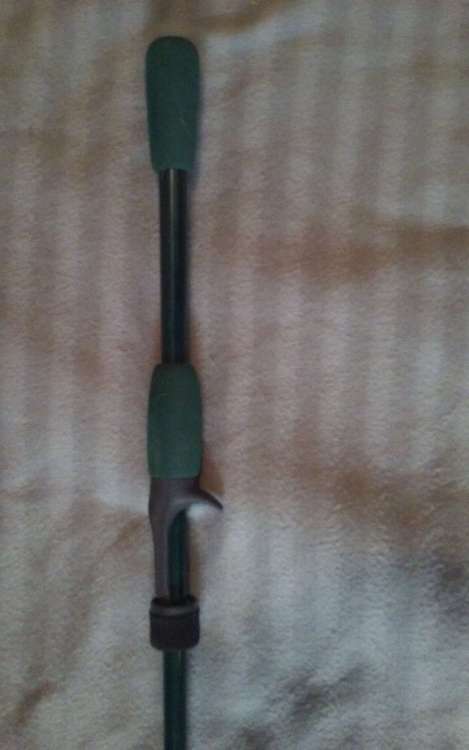
This is a Fisher/Kennedy crankbait build from the 80's.
-
You'll never get away from knots being noticable, if you're not snagging, or hanging up your golden.
-
Pac Bay has the info on their guides on their site, the tables are right along side the guides in each guide series. If you don't know much about them, they were used by G Loomis when Gary Loomis owned the company. Others have used them also, but not as consistantly.
-
The inside diameter of the guide frame is how guides are measured, so measuring the outside diameter of the ceramic ring is way to get guide size down, different ring materials and how they are installed makes a difference big time on the inside diameter you experience.
-
A lot of low end commercially built salmon rods have this problem when you try to install a reel such as a Shimano Tekota that has the full sized saltwater reel foot, not the smaller compact reel foot. The Abu C3 reels still have the small foot as the bass reels so people get confused when going from one to the other. I always take my reel shopping so I know, and the good shops will put their demo reel on to check for you before you buy the rod. I've used a dremel with a small burr to open up these reel seats some to fit the longer/wider saltwater foot over the years. 1/8 inch you'll probably get away with, but no more, only take the absolute minium. The info I'm passing on was given to me by Todd Vivian, former rod designer for Lamiglas Rods, he now works at Mudhole. Another way, measure your blank diameter at the foregrip, measure the OD of the reel seat at your point of work, do the math, how much room do you have? Remember it's a centered hole so you have half the thickness left after sutracting reel seat diameter from the blank diameter.
-
A lot of the Matagi dealers are small outfits that order when they have enough customers to warrant the shipping and customs costs and than they spread out the costs between all the orders, a single order you pay the full freight. Most are great people when your in a niche market, you were probably getting cut a break and not realizing it. My experience is you get better than twice the time we got from soft touch reel seats before you start seeing any evidence of wear, if you've used a painted Mudhole seat, it's in the same ball park. My wife's GUSA rod is 10+ years old and still looks great, but she's about the easiest person on gear I've ever seen.
-
If you want to reassure yourself buy a 5 guide, tape it on one of your rods between two guides near the tip and go out and test cast it with your setup. You never have to build a rod, or have one built on a guess. You can find the right position for your reel seat by simply spinning up a bunch of masking tape arbors on the blank and sliding the reel seat back and forth to get your right rear grip length for your presentaion. Tape the guides on and go see how your line flows through them before you build it. A dollar's worth of tape and an hour of your time can teach you volumes with no consequences.
-
The HPS nut has no notches of any kind, it just a threaded collar. If the threads are the same it will work.
-
We've been hiding threads with the Fuji HPS and cutting and reshaping the corresponding cork or EVA foregrip since I believe the 80's, and they weren't the only ones making this for casting and spinning (pipe) reelseats. Split grips we were building back than were built threads back and covered. Some of my older S-glass rods have these non-discript reel seats that looked very much like the old Berkley Series One reel seats, closest seat now is the CUI Benchmark CRST3 seats which look very much like the Castaway seats of years past. That said unless they've changed the thread pitch on the Alps seats, they should fit. I've switched nuts on Fuji, Pac Bay, Forecast, and AmTack reel seats for years. One of them, can't remember which right now, could at times be a bit snugger because the centering notch was minutely smaller, easy to fix though.
-
Your equipment doesn't have anything to do with rod quality. It's on you alone, fit and finish is all in the hands of the builder. Used to be with high end fly components, you could make out. Using the components the average builder buys for bass fishing you'll be lucky if you break even. You do best when you have a need that's hard to come by in a factory rod, or if you want to think outside the box and think you can get ahead of the game.
-
Scrimless design has been around for some time, the Hydra Fishing site explains it pretty well, they've been scrimless for many years. No lateral layup is necessary now days, that also decreases blank modulus, they are trying to negate that with srimless construction.
-
Just the reason, d-cam, the reason G Loomis doesn't use micro guides is they have no idea how you're going to use the rod, with what line, etc. Micro guides came out of the custom rod market where the builder knows exactly the answers to who, what, when, where and how? You don't know those answers you build the "Jack of All Trades, Master of None" rod. It's really visible in the spinning rod market, they use the latest guides, they just don't use them in the correct way, as they have no idea which reel and line is being used. Like I said earlier, Gary Loomis has never had anything against small guides, he uses the smallest REC guides he can get away with on the Black Widow rods. So do I on my rods, weight is more important than just about anything else, weight off the tip is more important still.
-
I don't know, I have no problem with reamer sizes, go to your neighborhood garage sales, buy that old beater large butt fiberglass rod in the corner for a buck, go to your hardware store and buy a small can of Weldwood contact cement and a roll of medium grit emory cloth, strip the rod except for the rear grip that makes a nice free handle, put the contact cement on the rod and emory cloth and let it tack dry, than spiral the tape up the rod blank. You now have a very good reamer that will last forever and you can use right away. Some of my reamers are 3 ft. long, much easier to store one than a bunch of little ones and easier to find one that does the job of three little ones. One thought though Sloppy, on a crankbait rod the rod in used wiith the tip down, along with most other presentations. A balanced rod here is of little importance as the pull of the lure while retrieved overrides everything. Many of the pros that use custom rods will have shorter rear grip lengths than you expect because they know every bit of rod length in front of the hand is improving castability, the reason they went to a long rod in the first place, everything behind the hand is an expensive stick and of little use, most will not exceed a 9 inch rear grip length even on 8 ft. rods and many are in the 8 to 8 1/2 inch length on 7 ft rods, mine are 8 inch, more than enough of my fore arm is anchoring the rod, at least for me. Just someting to think about and try maybe. Many posts in forums say they installed a 20 inch grip, this is the length of all the grips and the reelseat, great in the catalog, worthless to builders, or someone trying to learn. A 16 mm seat is 1 inch shorter than an 18mm seat, one model in the catalog may have a 2 inch foregrip, or a 4 inch one listed in a 20 inch discription, see what I mean? Much better to break it down so people can use the information correctly. Just another obscure thought while I wait for the morning coffee to kick in. Have a great Father's Day Dads.