spoonplugger1
Members
-
Joined
-
Last visited
Everything posted by spoonplugger1
-
Edge/NFC doesn't sell their products at stores, until recently the only place you could get one was at the factory, they now have a few pro shops, one at the factory where I do business with them and another I have heard of in Houston, there may be others I haven't heard of as they are a new addition, there are also have some internationally. I have no idea how you expected to go to a store for warranty as there never has been one. I haven't heard any "horror" stories and I have been a rod builder using their products and watching what happens on rodbuilding.org for 22+ years, NFC is super well regarded, there is more info about the products on that site from builders/tournament anglers then any others company, it isn't even close by a factor of 20+. It wouldn't be that way if the number of complaints weren't minuscule compared to pleased customers, it would surprise me if it exceeded 2%. In 40+ years of building rods, and 65+ years of fishing I have broken 4 rods. Rods just don't break on their own, we do stupid things that break them. The biggest problem about their products is that no one seems to get their business model that has been with them for near their whole existence. They use a boutique business model, if you don't know what that is, try asking your wife/other, they have never built rods for massive markets by other stores like G Loomis, St. Croix, etc. They aren't the slightest bit interested in it as it ruins innovation and the use of superior materials that are always in short supply because they and all rod builders are a minute market of the suppliers' sales, our use of materials has never exceeded single digit percentages of any market. Because of this just who are the high-end material makers going to cater to? Lastly being a rod builder and lover of the "light sabers", would I wait 9 months? In a heartbeat. There is a reason there are more rods made form IM8 and lower materials than any other, it is old materials made by many companies, near 40 years, by the way Hexcel quit using IM numbers at 9 and that material is lower modulus but tougher than IM8, there is no such thing as IM10 and even if there was it wouldn't necessarily be a good rod material, very few really work well for our needs.
-
Just drag out your old Color-C-Lector and you'll have your answer on the most visible colors at any bass fishing depth. Don't pick that one, frankly I use white on surface and near surface lures, back in the day that was all there was and it worked as well as now for me as I played around with colors.
-
Tom Mann Sr. used spinning gear for his bass fishing all the time, even on his old TV shows. The show with President Jimmy Carter, he used a spinning reel and Jimmy used his fly rod.
-
That's easy running everyday stuff for jet sleds, wait till the rocks are peaking above water, and everything starts at near basketball size, nothing is smaller than your fist, and it goes up from there in current like you see the kayaks and canoes run in vids, going up is easier, you lose some perception running downstream but you probably noticed that already. The island I ran up on was fist to double fist sized rocks mostly.
-
It's not rocket science on knowing what's on your reel, put a piece of tape on the underside of the reel foot that has what you put on written on it, it can be changed easily at a moment's notice. Been using Curado reels since 1991, still have some 201s from that year in use, along with some Calcutta 251s, simple maintenance, a few of the simple, cheap, normal parts were replaced but they keep going on larger fish than bass. I have other later Curados also and other brands, but none have replaced the warm feeling I get with these reels, heavier? Yep. Clunkier? A bit but worlds they were better than what they replaced. One broke side plate but I superglued it back together and it runs fine still.
-
Unless there is a huge difference in wire size, going up one hook size on a brand you already know is failing on you, is just asking for more failures and they may even increase in instances. I'd change brands in a heartbeat over trying to stay within a company.
-
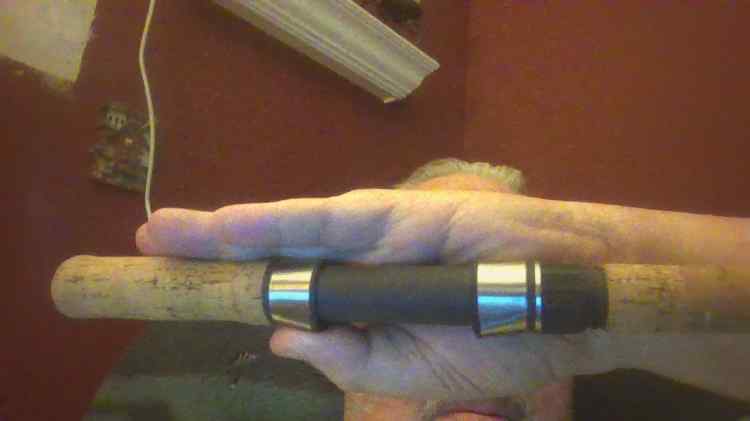
When was the last time a wood handled hammer or axe went flying out of your hand every time you used it? Being smooth or textured has little to do with actual grip, size and shape however do, when you go to a set of monkey bars and hang from the rungs or the side of the bars, which is the most comfortable? If you are like most the side rail is the easiest to hang from, size matters as far as grip and comfort, add a cold day with or without gloves and a larger grip wins every time. I don't know if you noticed but the older Fuji IPS grip is larger than the newer VSS used today, throughout the early years G Loomis, St. Croix and other quality rod makers never used a 16 mm spinning reel seat on any rod, the minimum was always 17 mm for comfort reasons, I myself even with my short fingered hands have always preferred a reel seat that is as close as I can get to the diameter of the rear cork grip which 27 mm or a bit over 1 inch diameter ergonomically it is just superior, if I remember right the reel seat diameter for the VSS style is 25 mm, I find at least two disadvantages to this, the size and most importantly I have special cork grips around, the rear diameter of the standard Fuji style casting reel seats we have all used up to 20 mm have used 27 mm diameter cork, I don't have to have anything special sized around to build a rod at a moment's notice and I can buy a grip easily in virtually any other material without a concern as to how it will look, work or feel. How the G Loomis rod felt in your hands was every bit as important as the other stuff, you just didn't realize it. This is an 18 mm shortened reel seat standard front and rear diameter store bought cork grips used, it's a 5 ft. S Glass, 4 piece, 1 to 4 lb, line test UL blank, I used a short fly rod fighting butt as the butt cap.
-
That shape a design has been used by St. Croix off and on since the early 2000's, Google for instance the St. Croix rod catalog from 2009. Turn the reel seat around and put a full grip on it and it's been used by virtually everyone one time or another for over 30 years successfully, many times with a foregrip that is directly attached to the threaded section so when you install a reel you virtually have a smooth uninterrupted grip back to front.
-
Just because the rod is GLX doesn't change the value that rod would have if it was made from IMX or any other material. G Loomis, historically anyway, has always been pretty good at not making a material change throw things out of kilter to much. You bought a better material for lighter weight, improved component, and maybe better response to inputs you do and sensitivity. Whether or not it was still a good rod for a presentation was not the issue.
-
I've run my Duckworth 16 X 65 inch bottom tiller open sled with a .160 inch hull for 30 years with no need for UHMW of steel plating, she flies along on an 85/60 Suzuki, there is absolutely zero flex or oil canning in this hull, it's built like a brick outhouse. I've even accidentally ran her hard aground on a barely wet rock island midstream at speed when I went to long before returning to my trailer during last light of the day, ran a cable from a truck winch across the river in fairly heavy current to drag her off. There are wants and needs, so far; a fancy bottom has not been a need.
-
Everyone seems to worry about holeshot, and max speed, even though they will probably spend more time between 4000-4500 rpm than 6000, after being in the Coast Guard for 20 years and being on a multitude of different boats they have and all the fishing on other boats I experienced, from a my prospective I care less about that and more about what the boat does and responds in seas, just what it can do between the seas to keep you safe, the CG boats are great designs and well built, but it's what the powerplant lets you do to get where you need to go, to keep you safe in the trough between waves and to bow up to the front wave if the rear wave curls and sloughs off towards your stern, you can't climb the front wave, you just don't want that wave curl in your back pocket, more motor can help here unless the weight affects stern height, I believe there is a 100 lb. difference between a 115 and 150 but a 92 inch stern width is pretty substantial at your length and hull weight. What you see in Australia, New Zealand, etc. when they need to improve seakeeping is to go to a high thrust motor in the lower horsepower to get the immediate response they need and to keep the stern weight down, they lose 2-3 mph on the top end, but they get better fuel economy, stay on plane at slower speeds, and save some real money in the process. This is the way many guides have gone in the PNW and the way I went on my 16 ft. tiller boat that has a heavy gauge aluminum hull and 65 hp max. capacity. I run a Honda 60 hp. high thrust that easily lets me carry max. hull weight capacity at faster speeds than the standard 60 hp will do, gaining back that 2 - 3 mph difference from when it's lightly loaded.
-
Buy the boat you need, not the boat you want. Did that 30 years ago and I still smile every time I step aboard. No wood to go bad, never a need to reconfigure, .160-inch aluminum hull, goes anywhere.
-
A lot of the Suzuki shops have spent enough time on the water with these motors, especially the 250 SS, to really get them to put it to the water. Getting better all the time.
-
If you are running lead acid batteries, you don't need a DC to DC charger. You can even charge your boat from the rig going home.
-
20 years or better you would have had zero problems finding info on your question, they even made things called suspend dots to add, and people were buying the sticky backed weight tape they use on golf clubs and cutting to fit, the only issue I can think of in your hook idea is that as hook wire or hook size goes up, along with drag, it affects lure presentation while weighting the body strategically has not be known to do so. Rapala and others probably still have suspending baits. A lot of swimming pool testing was being done back then.
-
If you look back in the different line class records, they had a big clump of them happen in a relatively short time in the 80's and early 90's, the rods that were catching these fish were not UL in power, they were custom made by custom rod builders to have the right action and power to flex just enough in the tip to protect the line while the fish did their thing, then get the fish to the boat to be weighed for the line record you were trying to break, we're talking down into the two pound test class. Fish have power and mass but don't weigh anything in the water to speak of or they would sink like a rock instead of suspending in the water column. Of course, the reels were worked over also. We're talking marlin, etc. also. I found the1, 2 and 3 power SJ blanks 4 - 8 up to 6 - 12 lb. ratings to be an excellent choice when we were fishing the mini bass cranks and baits with modified casting reels that came out in that time period, 1/8 oz. cranks and the soft hand poured finesse on mini weighed large gap thin wire jig heads that were coming out at the time, you had to usually go to spinning gear for the small soft baits back then. One of my and many other people's rods/blanks at the time was the G Loomis SJR700 rod/SJ 700 blank, I have extended these blanks into the 6 1/2 ft. range as needed. Light tip with more but correct backbone for the lines used, I've had mine since the IM6 days, NFC makes one now the SB 5100-1.
-
Unless you are throwing baits on one of the reels designed for minimum weight with the skeletonized aluminum gears, hollow shafts, etc. I don't think any of the reels are out of the realm of use, after all we have been throwing the weighs involved with other species, presentations and similar presentations in other species, larger species without issues for a very longtime, fresh and saltwater.
-
I have a St. Croix SCV 76 MLXF the tip on that rod is a 3.5 tube, way on the thin side for US made rods, since I built it, I insured the line path was already straight before I got to that part of the rod, so it can't do that, 12-13 years and counting. From the look of it your guide train is to big for your applications, I run 4 mm running guides and tip top. Myself, Gary Loomis and others have been using them for 40+ years with no issues. If you do decide to get a new rod from St. Croix switch the tip top to one of the newer snag free designs, it might help. If your rod also has a 3.5 or 4 tube tip top, they can be a bit harder to find, but they are out there.
-
Bought some Okuma Hakai reels back in 2022, they have been making me smile ever since, I bought them on sale for $89.99 at a local worker owned company who bought their end of year stock, I quit when they ran out of lefties at the store. I think they were originally in the $150 range and were a good reel to have at that price. Okuma has gone up in quality and technology in the last 3-4 years. They were under 6 oz. back then, haven't looked at the recent offering to compare.
-
Catching the silver fishy is what excites me the most, how it happens and what with is way down on the list, my frog rod is on the Castaway blanks when you could get them through Swampland. I custom built them using the bare minimum of components and ornamentation to get them light as possible, I changed the color of the hook keeper wraps to identify the rods quickly, it's a great rod for frogging, but not exciting in any way to look at.
-
Why don't you just use P Line Hydrofloat? It's been around for years now, and the salmon/steelhead anglers have used it for their float fishing presentations in rivers and tributaries. It also has a low stretch rate. Being a multi-species angler, I have found there is more cross-species uses for rods, reels, line and other tackle if you just look past the word "bass".
-
The plan nowadays is that so many of our electronics have planned obsolescence built into them, sooner or later they send out an update that 'accidentally' nukes the older models, seems to happen after warranties are gone also. Make seems to make little difference; the same boards are in all of them in a plant in Mexico. Also, many are no longer able to even be opened, they are both glued and screwed. Same with a screen if you crack one, they are now priority parts and not replaceable.
-
Slow setting super glue. installing a 5-turn blocking wrap in front of the guide foot and then extending the rod finish can help.
-
As noted before you don't need to completely remove the rear foam grip/s. Just turn the foam down to the inside diameter of the cork grips you decide on and just slide the cork grip over now foam arbors put on a butt cap, done.
-
I'd move the winding check, put the rod vertical, apply a bit of Permagloss in the little pocket that's probably there, spin the reel seat and watch the Permagloss flow between the blank and reel seat adding as needed, if the people at Megabass did their job there shouldn't be need for much, if the tube is hollow and they just used tape arbors it could take a bit, if foam cored not so much to get the job done. I'd anticipate a bit of excess cleanup if they used tape arbors due to how well Permagloss flows from both ends of the reel seat since you used more, but it sets fairly fast.