Randall
Members
-
Joined
-
Last visited
Everything posted by Randall
-
No need to apologize. We all have different opinions and experiences and can learn from all of them. There really is no right or wrong way in fishing many times anyway but I am highly opinionated on the ways I have found to work better. My point in naming the fishermen was that I took most of the ideas from them since they were the best at what they do and it worked for me in my style of fishing as well.
-
WHAT?????? Using that set up, at least for me, would be asking to never land a nice bass on a trap. Using a heavy rod is bad enough for trap fishing, but to be using braided line with it, which has no stretch, is a great recipe for tearing those treble hooks out left and right. More power to ya if this way of fishing works for you. For me though this make absolutely no logical sense at all I however do agree on the larger hook. I always switch out the hooks for a larger size. Especially the front one. From my experience skin hooked bass where the hooks tear out easily are usually the product of not having the heavy set up in the first place. The bass clamps down on the bait and your rod and line setup can't move the bait in the mouth of the fish so your hooks don't set until the bass opens it's mouth. Sometimes the bass will open its mouth and the hooks miss everything and you can't figure out why the rod bent and the hooks didn't hold. You think the hooks ripped out but what really happend was the hooks just missed after the fish opened up and let your bait go. If they do catch that way often they just barely catch on the way out of the mouth. When I set the hook with my set up the hooks almost always penatrate deep where they can't be thrown and the bait is usually deeper in the mouth of the fish. It's like jig fishing with a flipping stick when you move up to that type of hook. The hooks are big enough to hook deep or fit around a big jaw bone and the line will not break. I can usually drag a big bass through hydrilla without the hooks coming out this way. Also, I am not the only guy who fishes traps this way or a way very close to this. Ever heard of Kelly Jordan(Braid), Rick Clunn(Heavy action long rod), or KVD (one big hook) ? They all have used a method like this on shallow cranks or lipless cranks. I just took parts of what they do, adapted it, and applied it to my current setup. I also learned alot fishing big swimbaits and seeing fish throw them or spit them out. I fish the same hooks on many of my swimbaits and they will hold a twelve pounder being dragged across the surface without straighting out.
-
I don't think the problem is the rod. You have that part of the set up right but are missing two key parts for my style of lipless crank fishing. You need heavy enough line to bring the fish to the boat with authority and a big enough hook to hold the fish while doing this. For me soft forgiving rods and tiny hooks = lost fish since you are asking the rod to hold the fish and praying that the rod does it's job and keeps the tiny hooks that are to small to start with to hold. With traps I prefer to take the fight to the fish instead of letting the fish do all the fighting while I watch and pray the fish stays on powerless to do anything with wimpy equipment. I can see no good reason to have small hooks on a trap. Put a size one or two Owner Stinger 2x strong hook on the front hanger and leave the rear hook off. When the fish hits start reeling and don't stop or try to play the fish. If the fish starts to jump then reel even faster and use the back bone and fast tip of the rod to keep it from jumping. If the fish gets his head up I ski him into the boat so fast with his mouth open catching water that it can't shake it's head. Since changing the way I fish most larger crankbaits to this style I lose very few fish compared to how many I lost in the past. Most of the time I use 50lb braid or heavier fluro and my 7'6" flipping stick. This set up will clear itself better in weeds also.
-
I haven't seen any recent studies but the LM have always appeared to be northern stain to me.
-
If you want to come East let me know. I have been there a time or two but like to keep it quiet. Too late for that if it's on TV. Ok , I will tell the truth. I have been fishing it since I was a teenager. ;D They will eat a Hudd there. There is a better lake than it though here in GA with trout eaters. Trout fed fish aren't just a Cali thing.
-
The actions on the two baits are different. The Spro action isn't as tight and works better at slower speeds. The sebile in that size has a tight action like most shad and many other prey fish do at a fast speed. On the casting action the sebile baits cast much better and don't roll. To be fair I was one of the guys who can't stand the way the Spro casts. But,my first versions were all sinkers. I found a floater hung in a tree since then and have found it casts better than the heavier versions. Kind of crazy but it doesn't do the spin on the cast like the others. Is your Spro a floater?
-
The eyes in a bass continue to grow after the skull stops growing in older bass so they simply out grow the eye socket and bulge out.
-
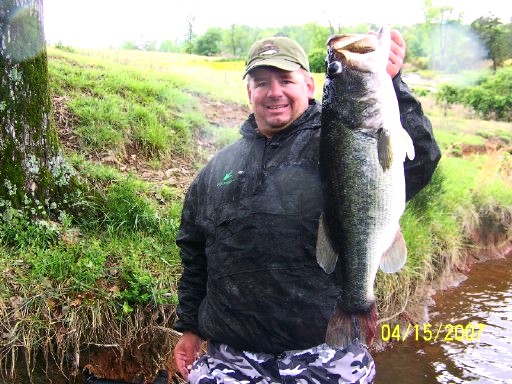
I also have to add that just from observation of thousands upon thousands of bass on beds I have never seen a female do anything as far as building a nest. She will often dart off and come back as she drops eggs which stirs up the bottom but thats it. That's with me doing almost nothing but sightfishing from mid March to early May almost every day for years. Often once I find a big female cruising looking for a nesting site I watch that female off and on until she gos on a bed. Unless it happens at night when I am sleeping it don't happen from what I have seen. I would have seen something by now even if it was a rare case. Also the big bass in the photo had the tail injury before it came on the bed twice. I knew the area where it lived and watched the area for the fish from mid March till April 15 when I caught it. In that time I saw it spawn twice and it had the tail injury the first time I saw it shallow in water around March 15. The injury never looked worse than it did the first time over the period of a month and I never saw it help build the bed. Also the fish stayed suspended shallow where I could see it over 15-20 feet of water most of this time and I could see the fish most calm days and it wasn't living on the bottom where the overloaded truck theory would apply. So after following this fish and it's movements (actually for years until I finally caught it) and seeing thousands of other fish spawn It would be real tough to convince me that spawning causes this on most female fish.
-
I asked Ralph Manns and he didn't say it and I can't remember or find the source where I read it but here is Ralph's reply: I don't know the source of that report. I've long noticed, however, that most of the bass I have watched spawn did not have either red tails or worn-off tails. If anything, most post-spawning female bass I've caught just appear well-worn and generally beat-up without red or worn tale bottoms. The males do most of the nest building and seldom have worn tales. That noted, some waters seem to produce lots of red and worn tailed females during and after the spawn. I have no good scientific explanation. Sorry. Perhaps it has more to do with the nature of the substrate in nesting areas. Likely abrasive nesting bottoms do more damage to tails. than softer/siltier nesting areas. Or, perhaps, males nip the tails, although most of the males I've watched mainly body-bump the females.
-
Most of the baits I use can't be found at Bass Pro. If you want swimbaits go on up to Hammonds in Cumming. They have a big selection of good swimbaits that work well here in GA. Right now I am catching most of my fish on Mattlures hard bluegill and Triton Mike's six inch Bull Shad. Hammonds carries both baits and a lot more good swimbaits besides those.
-
I can't remember the exact source but read it somewhere at some point. I studied biology at a school that had a fisheries program so many of my college professors had a lot of knowledge of fisheries science and included it in all their classes although I was just studying general Biology. It could have came from one of them or something I have read since that time. I am always reading anything I can find to learn more about bass biology. I do remember it was a study done by fisheries biologist where he was studying metabolic rates for bass in cold water vs warm water and noted that during fast warming water the capillaries in the fins burst during warming periods and that it had little to do with spawning. It was worse when certain diseases like lymphocystis were present and I have noticed the same thing when I catch fish with lymphocytis which causes tumor like growths that can burst. Lymphocytis is more prevalent in older larger fish which is why you see more large females with the bleeding conditon of a bloody tail. I also believe I recall something written by Ralph Manns that backed it up but can't remember exactly. If it wasn't Ralph it was a credible source since I wouldn't have though much of it if someone who didn't really know had said it. I will ask Ralph and maybe he can shed some light on it since I can't really remember.
-
Nice bass! Floater or sinker? Nothing else like it when you can see them, make the cast and then watch them slam the gill.
-
I just read Ryan Coleman's www.lanierspots.com report and he said topwater walking baits and spinnerbaits on windy points. Shakey heads later in the day. If you are going Monday I would be worried more about the boat traffic than the weather. LOL
-
One of the biggest myths in bass fishing is that the bloody tails are from nest building and now the overloaded pickup truck theory. ;D It's caused by fast warming water that causes capillaries in the tail of a cold blooded bass to burst and cause the bleeding. Nest building may add to it but is almost never the cause.
-
The down side to the 6" kickin' minnow is that it doesn't swim well on heavy line so I use 12-15lb fluro line. Braid helps but keeps the bait up higher in the water than I would like sometimes. So with flurocarbon line I am somewhere between playing the fish and forcing it to the boat. When it tries to jump I put my thumb on the spool and try to pull the fish harder and when it's swiming away and down I just let it swim. If I lose a couple I just put the bait on 20lb-30lb braid and force it in. I have lost a teen size bass twice on that bait and if I had braid on I would have probably landed it both times. But I like to fish the bait at seven to eight feet over the edge of pond weed and I might not have got the strikes with braid since the bait runs shallower. Right now I have braid on that rod since I don't want to lose another fish that size.
-
Nice big bass Paul!
-
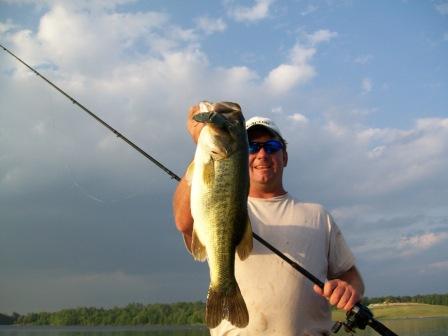
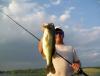
The photo here is the biggest I caught last week during the full mooon when the bluegill were on the beds good. We caught tons of two to five pound fish on both the floater and the sinker and one seven pounder. The one in this photo weighed around eight pounds.
-
The past few weeks nothing has been better for quaility bass at lake Varner than the Mattlures gills. Shock studys done in late spring on Varner indicate bluegill and other panfish make up most of the diet of the bass here. So once April hits and the bluegill are shallow it's time for some exciting swimbait fishing with bluegill baits. Some of the fish are caught swimming it over beds of late spawning fish. Others are caught when the males up to three and four pounds are guarding fry and think the bluegill is eating the fry. Others in early May are caught fishing where big bass are feeding on spawning bluegill. No matter how you catch them it's always fun with most of the strikes coming in shallow water on the surface. Here's just a few photos of some gill swimbait fish. In the first photo on the top right the big bass hit a soft Mattlures Bluegill on a bed. It hit so hard going at full swimming speed into the bed from about ten feet away. It never did stop or slow down. It just inhaled the bait at full speed and almost pulled the rod from the hand of the guy in the photo since he wasn't expecting such a reaction from the fish after trying to catch it on a jig with less results. All the other bass in this group of photos hit the floating hard gill when I went out just throwing the hard gill all day for some fun topwater strikes. I ended up with ten bass on the gill for the day.
-
I will take the Reaction Strike bait of those two baits. The RS bait doesn't roll or spin on the cast and I like the action better. Also, I just got a look at Triton Mike's new five inch bait at Natures Tackle Box today. It's the best looking small shad bait and it's going to hold up to big bass better than the others so that will be what I am throwing over the hydrilla in the fall. More expensive but I would rather buy one bait that will hold up and be done with it.
-
Here are a few more pics from the last week of April. All of these were caught on Mattlures swimbaits except the two smaller fish on the left of the first photo. They were caught on a jig and a worm.
-
Water Clarity: 4 feet or greater Fishing at Varner is really picking up now over the past few days. The fish are still scattered from the spawn but feeding pretty well. The big fish are starting to show back up after the spawn and feeding again Water temps are 75-76. The bass are mostly on structure from four to eight feet deep and there are a few staying very shallow and taking advantage of spawning bluegill. There are still some bass spawning deep and near deep water and I found a bunch of them Saturday afternoon between the boat ramp and the dam. I am seeing huge amounts of fry moving into deep open water on my depthfinder over the past couple of days and the water is clear so the open water schooling bite on fry will start any day now. There are some spawning shad in the am but the threadfin population is still pretty low so you have to look hard for the spawning shad. The hydrilla is about four to six inches tall where I have found it growing and there is still some pond weed that's looking good so it is looking great for summer fishing. The bite has been real simple for me over the past three days I have been on Varner. Straight tail worms like senkos, trickworms, and pork pins are getting both numbers and quality fish. Numbers on the worms are running between twenty and thirty fish on a good day with two or three people fishing. The Mattlures Hard Bluegill in both the floating and sinking models are producing some incredible topwater strikes from fish between three and eight pounds. We have also caught a few fish on lipless crankbaits. The photos are some of the fish caught Thursday, Friday and Saturday. Thursday I took a couple of ladies out so they could learn how to bass fish. Their goal was to catch some fish and be able to go home and teach the kids a thing or two about bass fishing. They caught more and bigger fish than they had ever caught before and had a thing or two to teach the kids when they went home. They have two bass caught at the same time in one photo and another nice fish in the other photo. The photo on the bottom right is one of my clients from Saturday. They just wanted to learn a little about the lake and how I fish it so we moved around and hit a lot of spots and caught fish on most. I lost count of how many we caught but the best five was around fourteen pounds just skipping around the lake after catching one or two in each spot. I went back out to a good spot where we had seen a lot of bass shallow after taking them back to the ramp in the afternoon. I caught the big bass in the middle left photo. I also had four more fish between four and seven pounds that I didn't photograph. The photo on the bottom left is our best fish from Friday's trip.
-
The biggest I have ever caught that I could comfirm was a male by it's spawning habits was six pounds. Four pounders are common on one lake that I fish but I see very very few over four pounds.
-
Inside Stone Mountain Park right at the bottom of the mountain in the larger lake.
-
Fish at Stone Mountain are in all three stages of the spawn. Best baits have been soft plastics, and swimbaits fished in spawning and prespawn areas. I am using the V&M baits Super Pork Pin, Mattlures Bluegill in both the hard and soft versions and a jig for bass on the beds. Best five fish each day have been going between twenty and twenty five pounds. Lots of four to five pounders are being caught with the occasional six to seven pounder. The fish in the photo was around six pounds and hit a Trition Mikes Bullshad prototype as I swam it over a deep bed.
-
Water Clarity: 4 feet or greater The bass fishing at Varner is looking better than it has in a while. Water temps in the morning are running from 63 to 73 depending where you are in the lake. The fish are fat and healthy there are big fish up in just a few feet of water crusing the banks looking for a bed to spawn on. I am guessing we saw over twenty fish over eight pounds on Saturday up in the shallows. We caught one that was just under the eight pound goal my client had before the trip. He had his shot with a fish that was over ten pounds but lost the fish on the way to the boat. We also caught one around five pounds and lost one more big one on the Mattlures hard bluegill on the way to the boat. Sunday I put Bass Resource member Chris at Tech on multiple fish over eight pounds but it just didn't happen since the fish wouldn't cooperate and we had to settle for catching one six pounder and a few smaller fish. With the warming temps I would say we have one more week of heavy spawning activity through most of the lake then probably one more week around the deep water which is where many of the big ones come up from. Lure choice is simple for me right now. All I need is a V&M Super Pork Pin in any green color, a Mattlures Hard Bluegill, a Mattlures soft Bluegill, and a jig. All of our fish are being caught on these baits and nothing else. It is time to add some topwaters in the mix though.