
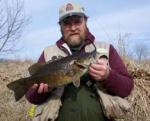
Scott F
Super User
-
Joined
-
Last visited
Everything posted by Scott F
-
Most of the baits I have I have caught fish on. Or at least I caught fish on a particular bait, and bought some more of them. I may not use them much anymore because I found baits that work better in the same situations. I'm a smallmouth guy. Years ago, when I was learning, I found some tiny crankbaits that worked really well. I did find that they had their drawbacks. Very tiny hooks and you couldn't throw them very far. But the smallies did like them. I then changed to larger cranks. so I still have a box of very small cranks that once in a while, I'll get out and throw in creeks or If I'm crappie fishing. I don't have a ton of baits I never use anymore, but I won't get rid of them. I don't walleye, pike or lake trout fish much anymore but If I do go on a Canadian trip again I don't want to buy those baits all over again. I don't know when I'll find myself in a place where they might be just what I need.
-
The Canadians commercially fish The Great Lakes, Lake of the Woods, Lake Nippegon and Eagle Lake among others.
-
I like to eat fresh water fish immediately after cleaning them. That's when they're the best. After they've been in the refrigerator for a day or two, or after they have been frozen, they are just not quite as good. I won't eat fish from a store. To me, if it smells like fish, it's not good.
-
I've been using it on my baitcasters. I'm a braid only guy, so I can't compare it to fluoros or mono. I like it a lot. The best thing I like about it is that I don't notice it. It does what it is supposed to do without any problems or issues. I can think about catching fish and not about my line. I'll keep using it.
-
What kind and how big was the bait you caught him on? From the picture, I was guessing the bait was 4 to 5 inches long, and the fish is about 3 times that length, which would make him 15 to 16 inches. If the bait was 6.5 to 7 inches long, then he'd be about 20.
-
How long was that fish? 15, 16 inches? That's about a pound and a half. Not real big for a walleye. Those are the easy ones to hold by the back of the head. Holding them there or under the belly between the front fins is the way I've been doing it for many years. If you aren't comfortable with that, you could get one of those grabbers so you don't actually have touch the fish. Just don't let your friends see you using it.
-
That is a walleye. You can grab them with one hand just behind the head, then put your other hand underneath the belly. Good eatin'!
-
Several of my friends used to go to Mexico to fish but due to security issues, they stopped going. One trip had armed guards in the boats with machine guns to keep "banditos" away from the guests. In many areas, tourists and fisherman have become targets for robbery. Were there any security concerns in the area where you were?
-
I always ask a guide if he fishes while we are out. If he expects to, I find someone else. If I'm paying, I want him to concentrate on making sure I am catching fish.
-
Palomar.
-
It all depends on how much line you have out. If a lure runs 6 feet deep and you have 50 feet of line out, McClelland's testing showed no difference. Once the lure gets closer, and you don't have much line in the water, or you never let the lure get as deep by holding the line above the water, yes, you can affect the depth by the rod positioning. The point is that the lure will always run where it wants to as long as there is enough line out.
-
No one is really sure about how deep most baits really run. That is why Mike McClelland, way back in 1989 put out the book "A Guide to Casting & Trolling Depths of 200 Popular Lures". He spent a lot of time casting baits past a marked pole and noting how deep they ran. The length of the cast had a lot to do with how deep the lure would run. A lure eats up about 25 to 35% of each cast to reach it's maximum depth. Adding 10 feet to the cast let the lure run about 10% deeper. Conversely, a cast 10 feet shorter let the lure run 10% shallower. Retrieving the lure faster actually made the lure run shallower. Another interesting fact is that aside from when there is not enough line out, the position of the rod had absolutely no effect on how deep the lure ran. He found that while trolling, you could raise the rod over your head as high as you could or put the rod in the water up to the reel and the depth the lure ran did not change by an inch. Mike McClelland was a walleye fisherman and the book was geared a lot to guys who troll for walleyes. Many of the 200 lures he tested are no longer being made. It would be nice if he or someone else did an updated version of the book that included testing with newer lines like braid and fluorocarbon and newer lures. Many people believe that the sinking or floating lines have an effect on the depth a lure will run. I'd like to see some controlled tests run to determine what really happens.
-
Before fluorocarbon lines were introduced, no one used leaders with braid. The line manufacturers through their marketing department, convinced everyone that fluorocarbon lines were invisible (they are not) and that invisible line was required to catch fish that are not smart enough to avoid artificial baits. They also said that fluorocarbon lines had less stretch than mono (also not true). When you repeat a lie often enough it becomes fact. Even after it has been proven incorrect. http://tackletour.com/reviewfluorocarbontest.html Enough fishermen are convinced that the claims made in order to sell FC lines are true so leaders are very commonly used. If you like extra knots in your line and believe bass won't hit a bait that has braid attached to it, use a leader. One claim about fluoro that is true is that is more abrasion resistant than braid. Some use leaders for that reason. When you add the fact that fluorocarbon line has poor knot strength, it kind of negates the abrasion resistance benefit.
-
The range a bait will run depends on the diameter of the line being used and how much line you have out. According to Steve McClelland's book "A Guide to Casting & Trolling Depths of 200 Popular Lures", a 3/8 oz Wiggle Wart will run 19' tolling 120' back on 8lb mono and will run 14' deep on 17lb mono. When cast using 12lb line, it runs 12 feet deep. It will lose about 1 foot of depth for every increase in line size. Using braid, the lure will run deeper, but when McClelland published his findings, braided lines were not available.
-
I don't have the Hiber net, I have one of the Frabill conservation series nets. Like they say, you get what you pay for.
-
That's what I paid for mine.
-
Side imaging transducers can't shoot through the hull.
-
It's a sheepshead fish.
-
I'm surprised no one has mentioned the Johnson Silver Minnow. Put on a yellow or white 4 inch twister tail, and it comes through thick weeds with no problem. Fishing for pike, you should always be near weedbeds in the spring. Rapalas are great, but not so good in the weeds. The single hook with the weed guard makes the silver Minnow a must have. One mistake many anglers make with early season pike is using lures that are too big. Even though pike will eat big bait, you'll catch a lot more fish if you stick to 4" spoons and not much larger. One of my top producers for big pike early in the spring was a 4" twister on a 1/4 to 3/8 oz ball head jig attached to a beetle spin arm.
-
I was on a fly-in fishing trip to a remote lake. Our cabin had no running water and an outhouse. One morning, one of my buddies was on his way to the outhouse carrying his fishing rod. "Why are you taking your rod to the outhouse?" I asked. "Well", he said, "My raincoat fell down the hole and I wanted to get it out" "Man, your raincoat is ruined now, why not just leave it in there?" "I would" he said, "But my lunch is in the pocket!"
-
If it's on the inside of the wheel, that's not good. You could have too much grease and the pressure forced the seal open. You'd probably have to remove the hub, clean out the excess and start over. To be safe, I'd replace the seals. A damaged seal will let in water and cause the bearings to rust.
-
I use Charlie Brewer Slider heads on tubes and all my other soft plastics. They just don't snag as easily as ball head jigs do. I rig them with the weight on the outside of the tube.
-
As you can tell from all the posts, there are a lot of lures that will catch smallies. But, if you don't put the lure where they are, you come up empty. When I'm river or creek fishing, I'm looking for breaklines. Anyplace you have faster water moving past slower water. A point of an island or the shore, a big rock, a log, or a bridge piling will disrupt the flow of water. Right behind the obstruction the water will be still and there will be a line where the faster water is moving up against this still water. If you just fished those areas on a river or creek with any of the lures mentioned, you WILL catch smallmouth.
-
-
I use Dr. Slick scissor clamps. They aren't cheap, but they are multi-taskers. Besides cutting braid, they are also good hook removers. They clamp shut so I clamp them to my shirt where they are always handy.