coryn h. fishowl
Members
-
Joined
-
Last visited
Everything posted by coryn h. fishowl
-
I've heard of balls of steel, but ones of lead, sounds like a bum deal.
-
Yeah, it has worked, but unfortunately I've only been able to test in my local Isaak Walton pond, which, as far as fish size, has nothing to brag about.
- 5 replies
-
- NewRig
- Tips
- Soft plastics
- repair
-
Tagged with:
-
I've got mats so thick, there's barely room for a bass to hold. I fish from shore, so I get very few opportunities to pitch into water deeper than three feet given the shallow banks I work with. Try working a swim jig overs the mats, works for me.
-
-
if used in gravel areas, even round headed jigs will stand up
- 5 replies
-
- NewRig
- Tips
- Soft plastics
- repair
-
Tagged with:
-
I've decided that, that for three days I will disclose three new rigs I've discovered (two of which I've developed myself.) Day Two's new rig is the shaky wacky combo. It is a great twist whether fished as a finesse shaky head presentation, like a wacky rig, or with a walk the dog retrieve. One note, though, if fished like a wacky rig, it can be fished faster. Todays tips: Never throw away a torn up plastic. If ripped up from hooks, take a chunk of plastic, like those strips of material that bind appendages on a bait, stuff them into the crevice and expose to a flame. Most external damage can be fixed by stretching/bending the "wounded" area and exposing to a flame in short bursts. A good goal to aim for is to, for baits such as worms with ridges on the body, you repair the lure without liquefying said ridges. As for ones beyond repair, cut them up how you like, and via a lighter/stove top, combine them with other baits. Some good examples: I will take torn up senkos, slice them lengthwise (after repairing it) and take the tails from torn up rage tail anacondas, and melt the tail along the senko. This creates a leech type bait that is great for drop shoting in current. Finesse worms are the easiest to repair. The tail is where the action is, so if the head is ripped, melt on another head. BE CREATIVE, after all you have nothing to lose and everything to gain. Tune in tomorrow for day 3.
- 5 replies
-
- NewRig
- Tips
- Soft plastics
- repair
-
Tagged with:
-
-
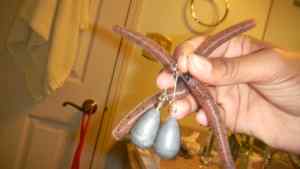
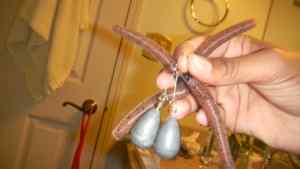
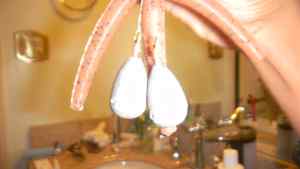
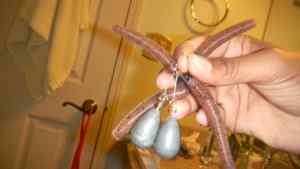
I NEVER USE WEIGHTS THAT BIG, those just happen to be what i had at hand
-
I just use them in place of a wacky rig, it's something bass haven't seen very often in the pressured places where i fish Works well for me
-
-
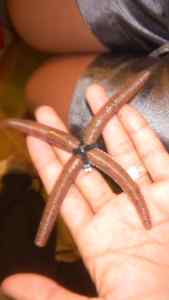
It is, but rigged with full size senkos or shim-e-sticks, and with a clacking component. wire hooks with vertical line ties are the best, but those are hard to find, so usually I'll use the smallest moaner stroker-swimbait type hook (with the coil removed) I can, or use pliers to bend the line tie on soft siwash type hooks. I rig mine with zip tie not only to preserve the bait, but to keep it in an x shape. Japanese finesse anglers have been using octo rigs for a while, but i prefer it with o rings/zip ties because then the bait moves out the way (without ripping) when setting the hook. P.S. There is a trick to reusing zip ties; just jam a hook/ pin into the ratchet mechanism and pull out the cord.
-
Ta da, I finally figured how to upload pics on the post above. Yay for the computer illiterate teenager.
-
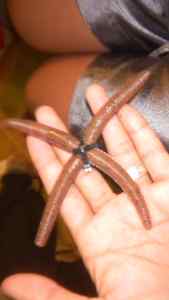
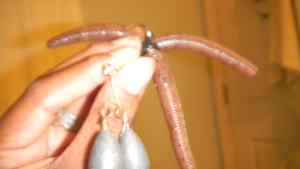
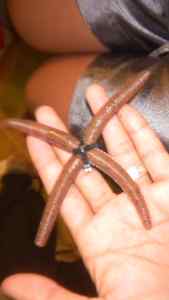
i rigged these with zip ties so as to not tear up the baits and I would never use weights that heavy, but this is the general idea. Fish it like a wacky rig. It is great in warm, stained water.
-
not quite the audience i imagined
-
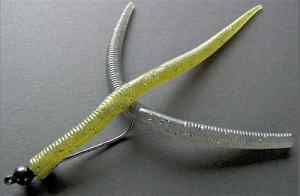
I've decided that, for that the next three days I will disclose three new rigs I've discovered (two of which I've developed myself. Today's rig is the clackin octo. It consists of two senkos/ shim-e-sticks rigged at 90 degree angle from each other, in an octopus rig. Using a hook with a vertical line tie thread a short piece of line, say two inches long through the eye of the hook. Take 2 of the lightest brass casting sinkers you have. Tie one on one end of the line the sinker, then cut off extra line so it is now one inch long and loop it several times through the hook eye. Tie the other brass sinker to the other end of the line. If done correctly, you will have a octopus rig with two casting sinkers hanging from the hook eye. When you pop the line the sinkers clack against each other and, if done with light weights, will not impede the action of the worms. It is a way the fish this rig faster, with more audible appeal. I will post a pic of this later These are just the lightest weights I had, I would never use ones these heavy wire hooks with vertical line ties are the best, but those are hard to find, so usually I'll use the smallest moaner stroker-swimbait type hook (with the coil removed) I can, or use pliers to bend the line tie on soft siwash type hooks. I rig mine with zip tie not only to preserve the bait, but to keep it in an x shape. Japanese finesse anglers have been using octo rigs for a while, but i prefer it with o rings/zip ties because then the bait moves out the way (without ripping) when setting the hook. P.S. There is a trick to reusing zip ties; just jam a hook/ pin into the ratchet mechanism and pull out the cord. Today's tips: 1 try using shim-e-sticks instead of senkos, they are cheaper and more durable, with the same action. 2 When the head of your finesse worms get torn, cut off the head, take the end and heat it over a flame, and attach it to the head of any thin worms. As long as it is not wacky rigged, it is the tail that provides the action anyway, and therefore the action won't be impeded
-
Good point, personally i use toes.
-
No bullfrogs, but i've had a leopard frog latch on and try to mate with a koppler
-
This is simple, buy a johnboat/ aluminum boat off ebay. My cousin has a perfectly good aluminum boat, that came with a motor that he snagged for $200
-
YES, finally i have found someone who knows of the power of honey. Good Man
-
I have never used one, but if it levels the playing field that much I kinda want to get my hands on one. It does look like a nightmare to cast though.
-
the now dying weedbeds that once offered O2 and a cool sanctuary are now rotting, warm and poor bass cover. Focus on still living weedbeds, and shallow flats, preferably thaose with boulders. As it gets colder, gravitate more to shallow, clearer rocky areas and very shallow muddy flats, as these will be the warmest places with the most food and the most hungry bass. CRANKBAIT, SPOOK, AND JIG SEASON NOW YALL
-
no kidding
-
Topwater zaras, skitterpops and frogs on matted vegetation, then sight fishing flats and weedbeds, t-rigs/jigs, and crankbaits bounced off stumps, in that order. I'm a bank angler, so I take what I can get, after all, any bass fishing is good bass fishin.
-
In a word, bluegill, at least until your arm is better. I've had my arm broken 3 times, and during each I just found a way to make bluegill fishing more challenging (i.e. woolly buggers and water bobbers, using a ribbon instead of a lure, etc.) and my personal favorite was to use an ultralight rod and a dry fly cricket.
-
I have to agree with markho24, the man gives sound advice. I just started using swim jigs in a stained lake and a mixture of chartreuse, greens and blacks, all bluegill representing, visible colors, has helped me a ton. I haven't used rattle bands before, but a combo willow leaf Colorado blade spinner bait (which comes through thick veggies just fine), with a visible curly tail grub/ split or paddle tail worm trailer has worked wonders, though if you are adamant about sticking to swim jigs, I would say to used a decent trailer (paddle tail/ crawfish tube for vibration) and noticeable colors should be your first move before tying on rattles. Just see which works better, with or without noise and compare.