MIbassyaker
Super User
-
Joined
-
Last visited
Everything posted by MIbassyaker
-
Same study I mentioned in my post -- technically, reward-based operant (instrumental) conditioning: Bass should strike colors they have been trained to, and not colors they haven't been trained to, unless they have trouble telling them apart (or, more broadly, trouble telling that the color makes it NOT the same as what they were trained to). Notice they do this easily with red and green, but they show some confusion between blue/black, and between yellow/white. In fact, they show some slight confusion among all four of those, which is consistent with all four being registered mostly as variations in black/white intensity. Personally, I think most bass anglers make too much of color as a visual cue, and too little of size, profile, and pattern of movement. I suspect size, profile and movement carry more information, under more conditions, about whether something does vs. does not make a good meal than does color. Which features bass attach meaning to may also vary --possibly substantially-- from place to place and time to time based on reward history and recent conditions.
-
OK, I did not know there was a Cajun Werewolf. Learned something new. All we got up here is Bigfoot.
-
-
I think MLF definitely makes for better TV, and I appreciate the fish handling rules and immediate release. I also appreciate they go to some lesser-known and smaller places. But I find it impossible to actually follow what's going on round-to-round, which event is which, and why it matters. I put it on to watch some action and antics. And then when it's over I completely forget who won, who fished well vs. who didn't, and who qualified for what. I don't think there is anything special about a traditional 5-best format, but BASS events seem more like real Events, where I can understand the stakes.
-
I still have, I think, three top props, and I feel like I must have paid more like $5 or $6 for them rather than 10...? that was several years ago, but still. In any case, i've always had trouble with these not hooking up very well.
-
Cavitron! Try the megabug too.
-
Indeed, indeed.
-
My smallie fishing is mostly done floating and wading small rivers and streams in late summer. Some of the old-school options still rule here: -4" Yamamoto or Kalins Grub + 1/8oz head -4" Berkley power worm + 1/8oz slider head -4" Senko or Ocho -Heddon Tiny Torpedo -KVD or LC 1.5 squarebill -#3 Mepps Aglia
-
Sorry, this will probably be tl; dr....I'm procrastinating again from something else I should be doing, but here goes: My background is neuroscience, not fisheries biology, but I can add a little about principles of vertebrate color vision. Most of what we know comes from work on humans and other mammals, although all vertebrate visual systems follow the same principles (yes, with many variations in parts and tuning, but the same basic rules are followed everywhere). The first thing to understand is that color is your brain's way of telling the difference between different wavelengths of light. We cannot know how bass experience color subjectively...but by exactly the same logic, I cannot know how you experience color subjectively either. However we can find out how well non-humans like bass can distinguish between differently-colored stimuli the same way we can with humans: Get them to make different responses for different colors. So it's not helpful to get hung up over what bass "see"...let's worry about what they can detect and what they can distinguish, both of which can be determined from behavior in visual discrimination experiments: Train the fish to select a visual target in order to receive a reward (or avoid a shock). Then, test whether they can tell the difference between the rewarded target vs. a different one by giving them a choice. A good example is this recent study, which has generated some discussion on these boards and elsewhere (freely-available study, no subscription needed -- hooray for open-access publishing!): https://academic.oup.com/cz/article/65/1/43/4924236 This study found that bass easily detect and discriminate red & green (or more precisely, reflected light off objects that we see as red and green), but have difficulty telling the difference between blue and black, and between chartreuse-yellow and white. The same thing has been suggested repeatedly by prior studies, although this one upped the ante by testing both visual choice behavior, and light-sensitivity of cells in the actual eye tissue upon dissection. How can we make sense of this? All animals with visual systems have a light-sensitive cells in the eye that are tuned optimally to detect particular light wavelengths (with a smooth drop-off above and below that optimal wavelength -- giving the cell a range that it is most sensitive to). A single such cell supports the ability to detect the degree of light shining onto it, with a wavelength falling within its sensitive range. Most vertebrates have two types of cells that do this: Rods, which are tuned to a broad range and support low-light, but monochrome (black and white) vision, and cones, which are tuned to narrow ranges. Rods can tell us about the level of light, but not color. It is the cones that support color vision because their narrow ranges make them sensitive to only some wavelengths and not others. Species frequently differ in how many different cones they have. If you had just one type of cone, that wouldn't do much. You'd see differences in light intensity, but you wouldn't tell the difference between high vs. low wavelengths. But if you have two cones tuned to different wavelengths, that gives you some ability to distinguish wavelengths from each other: Say, a "high" wavelength cell and a "low" wavelength cell. They would give unequal responses depending on what the wavelength is, and if the cones give different responses, you now have enough information to support a perceptual difference between colors. Essentially, the difference between the responses of the two cones is a color signal; the difference can be large or small, and can go in one direction or another...you have a range of responses that reflect a range of wavelengths, as long as those wavelengths fall within the sensitive ranges of the cones. There is one wrinkle though: The two cones would give the same response under two situations: (1) there is more than one wavelength of light present, thus stimulating both cones, or (2) there is one wavelength falling directly between the two cones' peak sensitivities, where the ranges overlap and stimulating the two cones equally. Because these two situations result in the same response of both cones, the color signal is identical, meaning there is no way to tell the difference between the two. However, with three cones rather than two, this difference can be resolved, because three cones support an additional color signal beyond that supported by two cones. And this is the key to understanding the findings of the study linked above: the results are consistent with bass having two types of cones, whereas humans have three. In humans, long wavelengths generate a perception of red, medium generate green, and short generate blue. White is based stimulation of all three at once. Yellow is based on about equal stimulation long and medium, but both greater than short. The human visual system calculates two signals based on wavelength detection: Long vs Medium and (Long+Medium) vs. Short. Perception of red and green is based on the first signal, while perception of blue and yellow is based on the second signal. The distinction between these signals is the basis for color afterimages: staring at something red for about 30 seconds or more gives you a green afterimage (and vice-versa) when you shift your gaze. The same is true of blue and yellow as a pair. It is also the reason why the most common kind of colorblindness affects red and green selectively -- most people who are colorblind are "red-green colorblind", where they see color, but have difficulty telling the difference between red and green.....this is a selective dysfunction in the first of the two signals. In bass however, the experimental evidence suggests they have the first of these two signals, but not the second. They have two cones with maximum sensitivity at similar wavelengths as our long and medium cones, giving them good recognition of red and green. However, in a two-cone system like this, yellow and white should produce the same response (high response out of both cones), and blue and black should produce the same response (low response out of both cones). That is a prediction that falls naturally out of this kind of 2-cone system, and the study cited above verified that prediction by experiment for largemouth bass. So what about your lures? In the study cited above, and others like it, the intensity of light reflectance was held constant for the purpose of control. Of course, your actual lures do not reflect light at the same intensity. Bass can of course detect differences in intensity, even when they cannot detect differences between two wavelengths. I don't have a citation in front of me, but I recall encountering evidence bass have very good "twilight" vision, supported by very sensitive rod cells. That same sensitivity would apply to subtle distinctions in intensity, as long as the environment is not too bright. In many cases, I suspect that when anglers feel bass are distinguishing between subtle differences in color (beyond variations of reds and greens, perhaps), what may really be going on is the bass are responding to intensity: levels of overall "bright" vs. "dark". Many versions of Black & Blue, for instance, may simply be "Dark, but some variation in how dark it is". Also, some variations of chartreuse may be more greenish than yellow, creating a distinction from white. And many baits that look otherwise similar, may differ in degree of contrast between light and dark; bass may be especially attentive to countershading contrasts, for instance. All this is to say, in actual lures, a color difference may not actually be about color itself.
-
If anything, the average fish/hour across all species would be dragged upward by panfish which is both more popular than any other kind of fishing, and can yield ridiculous numbers. I reckon if bass anglers kept close track of their number caught per actual hour fished, most would find their real average --which includes all their 0-fish days and hours too-- to be somewhat less than they thought it was.
-
My average number of bass caught per hour fished, across all the places I fished for each of the last three years was 2.17, 2.19, and 1.88. But it varies greatly by location. At an average place, for the duration of a 3-hour or longer trip, I'd say less than 1/hour is a disappointment, 2/hour is satisfying, 3/hour is pretty good, and 4 or more is great.
-
I have a couple Jackhammers. They catch fish. Do they catch more fish than other bladed jigs, including the ones I've cobbled together myself? Not that I have noticed. If anything, I tend to prefer homemade bladed jigs which are just a snap, blade, split ring, flat-eye jighead, and skirt.
-
Even with your smallies on the river? I'll very frequently have river smallmouth blow up on plastics as I'm reeling them in quickly to re-cast.
-
-
I'm such a topwater & plastics nut that I neglected jigs most of the year... but had a couple outings at the end of 2020 where almost every fish was caught on either a pitching jig or a swimjig. Couple months later, I've still got jigs on the brain; probably going to be the first thing I throw this year.
-
Yes, and the same argument can be applied to every other feature of a lure -- why not just put a blade on everything because it can't hurt? Or rattles? Or 27 more appendages? When it is convenient for anglers to believe something else might "hurt" --too much action/noise/etc. -- they readily accept this. Quite aside from whether (some) scents enhance strikes (sometimes), or make fish hold on longer, they also pretty clearly work as fuel for superstition: even If they did nothing at all, it would still look like they did the moment you caught a fish after applying them. And if they were harmful, there would always be another factor to blame it on.
-
It's less about human scent itself and more about what other substances you may have on you -- detergents, sunscreen, & deet for instance, can be big turn-offs. A little about this from Berkley: https://www.berkley-fishing.com/pages/berkley-ae-perfume-to-some-odor-to-others
-
I use on occasion the spider heads in 1/16 and 1/8oz for 4" worms (I use the 4" Berkley power worms with curl tail a lot for the swimming and dropping retrieves) and the ewg heads for small creatures. I also second the recommendation of the book -- still in print, inexpensive, & available on the brewer site. While it's about sliders specifically, a lot of the discussion is relevant to all kinds of finesse fishing.
-
Check it out: https://www.bassresource.com/fishing-lures-articles?field_tags_target_id=153&items_per_page=20
-
Heavy tubes or heavy shakyheads in open water are good uses for MH spinning. I also like it for t-rigs when I'm trying to get a vertical drop at a distance. Because the line comes freely off the spool, I find it easier to minimize the "pendulum" effect as bait drops through the water compared to baitcasting. So a typical situation for me would be clear water, where I want to avoid getting on top of them, but I have an underwater target that I want to hit vertically. Often this is the edge of a cabbage bed, where stalks will rise up vertically through 10-15 or more feet of water, and bass may be positioned at any depth in the forest. I want the bait to drop as vertically as possible along that edge, while keeping my distance. That's a pretty specific application, but it occurs where I live frequently enough to get regular use out of a rod that's well-suited for making that kind of presentation.
-
5-6 on a lake or large river outing, 3 for a small river float.
-
I don't know about all the exact components you're looking for, but Barlow's Tackle is a pretty good source for most things. I get Hildebrandt blades from them, at least.
-
Good info, all -- thanks. I'm running with a rudder on the back of the Lure 11.5, and it improves tracking so much I can't imaging doing without it now. So rear mount, which would otherwise be an ok solution, is out. I'm leaning heavily toward a side mount. I'm expecting the transducer will need to go deep enough that being able to pull it out of the water easily will be a big benefit, as I fish a number of places accessible only by really shallow connecting waters. Of course, I'm not going to be able to test out anything by trial-and-error for a few months yet...
-
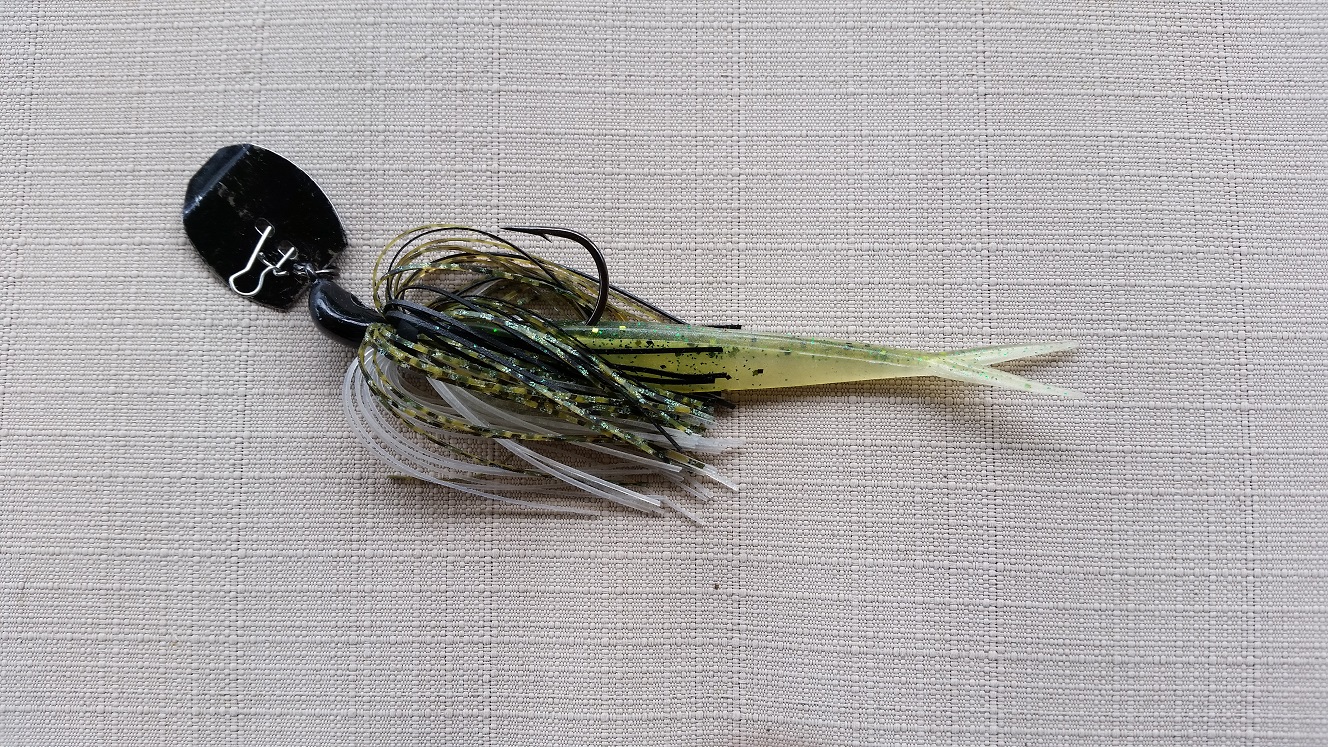
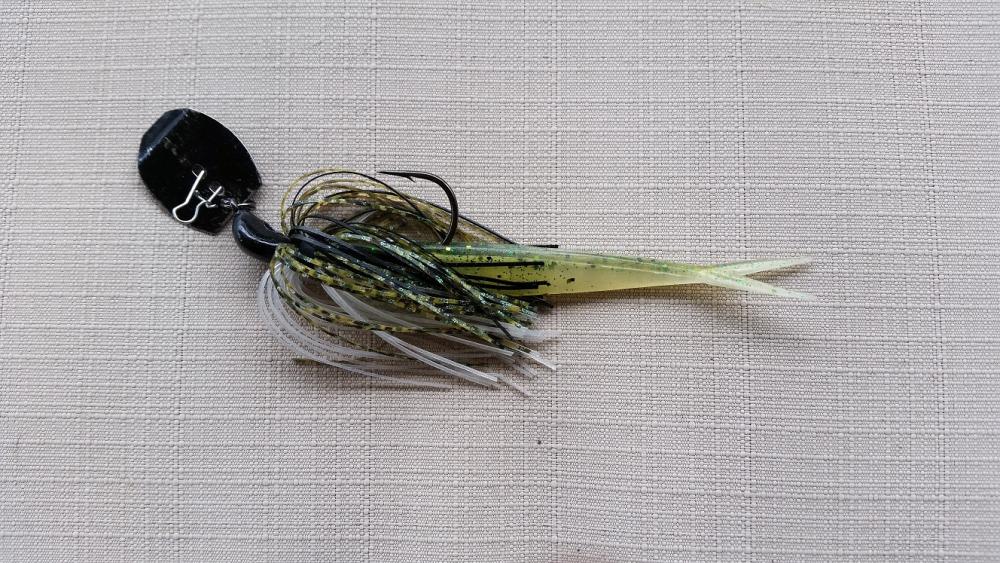
A few years ago I wanted a bladed jig in a baby largemouth color and couldn't find one. So I made my own, and it works really well -- my secret weapon:
-
Any perch, bluegill, or sunfish color usually get the nod. I also like Clown, Ayu and Ghost Minnow.