MickD
Super User
-
Joined
-
Last visited
Everything posted by MickD
-
As stated before, there are two things about my line to line knot that are important. One of course is strength. The other, for me, since I use a lot of rods with micros or other small guides, it that it goes through the guides easily. It turns out that the FG is better at both than any other knot. The only disadvantage to the FG is that some people find it hard to tie. With a reasonable amount of practice, it can be tied easily under any fishing circumstances without having to set up your rod to tension the braid or do other out of the hand tricks. It just takes an understanding of how it is to be tied, and some practice.
-
The experts on Rodbuilding.org forum maintain that one should never put WD40 or any other lube on a ferrule. The ferrule in question has been freed, and two good methods suggested that should work without compromising the performance of ferrules that need to be freed in the future.
-
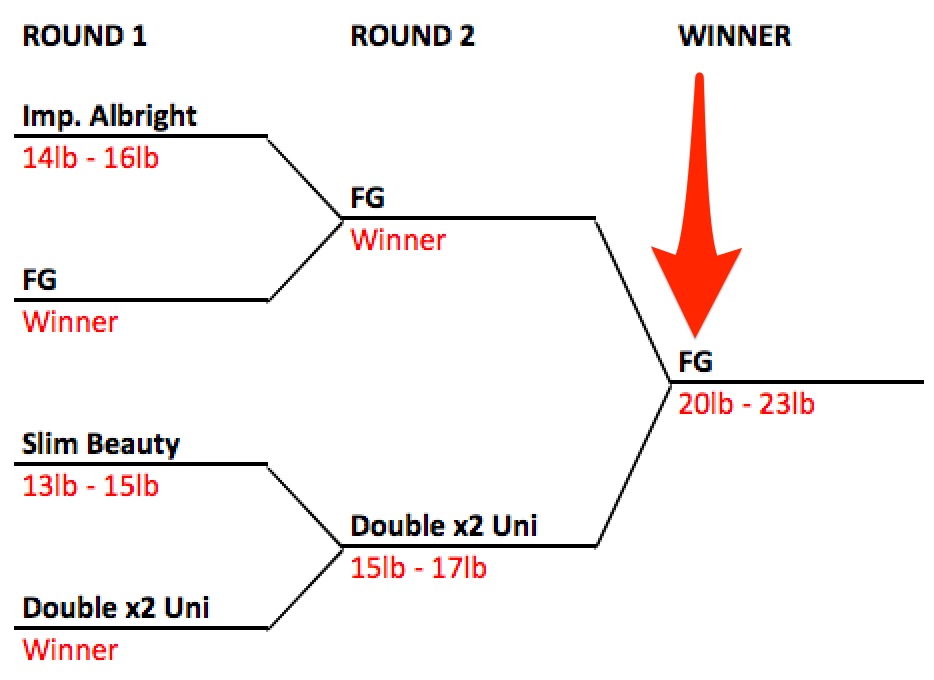
If all works well, I'll have a file here that shows the data from the contest finals.

-
A tip some of our "newbies" may not know: If multiple piece rods are properly designed and built, and if the sections are put together properly, they should not come apart during fishing. The proper way to put the sections together is to push the sections together, and just before they finally seat, rotate the section you're adding about a 1/4 turn as you finish the "push." . On taking them apart, reverse the process. It is best to not add any lubricant, wax, anything to the surfaces.
-
Chigger craws and Rage tail products.
-
Write to a pro reel service station-they may know what other mode's knob will fit and sell you the parts. Mike's Reel Repair has schematics for a bunch of Triforces. He may be able to help. This is a Japnese-marketed reel, right? Not usually sold in US? Ebay? If Ebay, one thing you can do is mention to the seller that they will be getting a negative review from you if you cannot get the parts to complete the sale satisfactorily. Ebay sellers will do almost anything to keep their seller ratings high.
-
CCS was developed initially for fly rods but was expanded with a rating scale that goes way up. It is entirely valid for all rods. While it's probably futile to influence the rod makers to publish it for each of their offerings, I think that with enough pressure from custom builders we can get the blank manufacturers to publish it IF WE TELL THE ONES WHO DON'T PUBLISH IT THAT WE WILL GO ELSEWHERE FOR OUR BLANKS. Pac Bay publishes CCS on their blanks, and I believe a couple smaller outfits do too. I recently got CCS data from a major company when I asked for a specific model's data. I then reinforced the importance by telling them that the providing of CCS data resulted in my buying the $150 blank + all the components from them. I think they don't want to provide it because it takes time to measure (think of doing it for a whole lineup of rods) and they don't really WANT an objective system for comparing blanks. They would rather keep it subjective.and keep using their subjective terms to describe their blanks.
-
If that had not worked, or if anyone has a similar experience, the most reliable way is to use ice at the ferrule. Try to rotate as you pull. The ice shrinks the wall thickness of the blank increasing the ID of the female ferrule and usually relieves the sticking problem. Believe it or not.
-
I have used the almost instant dry polish (Sally Hansen) that is intended for plastic nails on the heads of flies and it seems to work just fine.
-
http://rodbuilding.org/read.php?2,241080,241080#msg-241080 Check this string of posts out. A lot of background/info.
-
Then finish the wrap with nail polish. You can go with the pro fly tying stuff, but nail polish is inexpensive and does a good job. And it comes in clear and colors.
-
The spiral rods I've built have been the "simple spiral," and they work fine. All you do is set up all the guides as you would for a regular casting rod, all on top, do the stress test and test casts for spacing. THEN reposition all but the rear guide at 180 degrees. Don't move any other guides for rotation or axial position. Now add the lowest (OK to bend a guide) double foot guide of the same size as guide #2 at 90 degrees half way between #1 and #2. Your new guide's function is simply to keep the line off the blank, so the lower you can get it the better. There are other layouts, but most builders believe the simple spiral works as well as any of the others, and it does not have the problem of loading the line to one side of the spool of the reel as some designs with the first guide not at 0 degrees rotation sometimes do. The second (90 degree) guide can go either to the right or left, but I prefer it to go on the right side so that when my rod is resting on the boat casting platform that guide is up instead of down (with the reel handles up). If you have left handed reels you may want to go the other way to keep that 2nd guide off the casting platform. Many believe spirals cast farther than conventional; I think the only advantages are in eliminating any torque induced from the guides on top of a bent rod (felt as twisting torque in the hand) and eliminating any tendency of a highly bent rod to twist. However, since we are using such small guides these days, I don't even feel any torque on conventional builds. I build conventional simply because I don't feel the torque and I don't like the looks of a spiral wrap. If you haven't experienced a spiral wrap, I suggest you try it. You may find they have compelling advantages, as many people do.
-
Great question. I've always wondered the same thing.
-
With any high frame/small ring design, keep in mind that the rod may not fit into your tubes. If you want the rod to fit fairly tight tubes check the finished heights before building.
-
Some reel servicers won't work on off-brand reels, and down the road parts may be hard to find for them. Having said that, and now only buying Shimano or Daiwa, I have had some off brand reels that were quite good.
-
Riley Rods has a very nice small scale that I use with their epoxy which is mixed 2:1 by weight. Keep in mind that some epoxy components may not be the same density so measuring by weight may not be appropriate. Oviously, it's OK with Flex Coat as mentioned above, but with other brands I would check with the source before using weight instead of volume. I agree that proportioning by weight is very accurate, and I've never had any problem with Riley epoxy. The Riley scale is less than $15, if I remember right.
-
Lots of opinions on Microwave, I suggest you try a set and make your own conclusion. I guarantee you will not see a deficit of any type with them, and the setup for them is a piece of cake. Just follow the Amtak directions for the first three guides, then position the others with a stress test.
-
Here we go again! I used to use the double uni, but since learning the FG knot, I am using it. It is much smaller, goes through my micro rods really smoothly. A lot of guys have ridiculed it since it looks so complicated, and I had trouble at first. But like learning to ride a bike, it doesn't come instantly, and learning it is well worth the effort. I practiced watching TV and after a few days, it has become very easy and reliable. This video shows the easiest way to tie it, IMHO. You can tie it in your hands, a little help from the teeth, and can easily be done in a boat. The main thing to keep in mind is that the three sets of weaves have to be pulled tight, each set at a time, before finishing the knot. Do that, and keep the weaves right (the tag always ends up on left of the leader and the running line always ends up on the right) and you will have a good knot, easily tied. The FG will last until your leader needs to be cut off because it gets too short. Since it is so small it does not get damaged by passing through the guides as does the double uni.
-
I wonder what the definition of "same" is?
-
I like 4-6 feet. No science to it, just what I do and it seems to work. Keeping in mind that the leader has two functions, one to keep the fish from seeing the line and two to provide a little stretch to the otherwise very "hard" system, I think that length makes sense. If you don't have a knot that will easily go through your guides you need to go short to keep the knot away from the guides. If you have a good compact knot or fairly large guides, you can go long.
-
If threadmaster 1 dries so fast it is hard to use, then it is a moisture curing polyurethane and not an epoxy. The polyurethanes do not turn yellow as the epoxies do, but as stated, they have problems of their own. The epoxies are really casting resins, and they make a wrap look great, like the insects you've seen in the clear plastic cubes or rounds. But they will not resist UV forever, and will turn amber with time. The polyurethanes will give a different look to the wraps, usually taking many coats to create a smooth build. But they do not turn amber.
-
Have you tried their lipless cranks?
-
One reason I don't use ProKote any more is the drama in figuring out if you have a problem or not when it goes on and on without curing hard. It can really take a long time, like a couple days. Wait it out for at least that long, and if it still isn't "dry" do as suggested above and add another coat. If it won't dry, then you most likely did not get the proportions right or didn't mix it long enough. 3 min is plenty. 2 is right. If you did not use syringes, then this is what you will get, sooner or later. ALWAYS use syringes, and if you do, you need not mix large quantities to get good curing. It is all about proper proportions and adequate mixing. With epoxy, like concrete, it is a chemical reaction, and you need the exact number of "molecules" of each component to match up. More of one or the other does nothing but screw it up, leaving unmatched "molecules" which means it stays tacky.
-
You've just illustrated why I prefer glossy blanks.
-
Cup and "popcicle" stick. I cut the round ends off the sticks so the squared off edge can scrape cleanly, measure with syringes every time, Use the small Dart cups (can use them over and over), warm the epoxy under running hot water to take the chill off, mix for 120 seconds (as gently as possible), gently puff on it to get bubbles to break, wait a couple minutes for more bubbles to surface and break, then apply it. If all is done well, very few bubbles on the wraps. Gentle puffs usually break them, a quick flash with a butane lighter if needed, but NO HEATING WITH THE LIGHTER.