MickD
Super User
-
Joined
-
Last visited
Everything posted by MickD
-
Measure the diameter of the line with a micrometer and compare with published data or other spools of line you have-will give a fairly good idea of the pound test.
-
I've used both drop shot and Ned both slowly and quickly moving, static, at different depths, and I don't recognize any kind of "must always do it this way" requirement. The fish determine what works.
-
If you have the old tiptop measure the ring outer diameter and order the same size. If you don't have it, measure the outer diameter (in millimeters, or convert to mm) of the topmost guide and order that or something close to it. Size is not that critical to function, but if you go far off the right size it will look goofy. The tube size is measured in 64ths of an inch or millimeters. Measure the diameter of the clean blank at the tip and order the next size above this diameter. You can order the exact size, but might get into a "too tight" situation, and better to get it a little larger and just use generous adhesive. The first number in a tiptop size designation is the ring diameter in mm, the second is the tube diameter in mm or 64ths of an inch. They come in different finishes, try to get the finish that best matches the guides. Most builders like to use hot melt designed for tiptops as it makes future replacement very easy, but some prefer an epoxy. Epoxy makes the next change, at times, very difficult. You don't need to use much heat. Best way to take the old one off is to apply a little heat from the side of a butane lighter flame while applying tension (string, rubber band) to the tiptop and it will come off when the adhesive is ready. If it doesn't come off with just a little heat, stop and get help from a pro builder. It is easy to ruin a blank with too much heat. I usually can remove and install while handling the tiptops with my bare fingers. That's how little heat it takes when you know what you're doing. To install the new, cut little chips off the hot melt stick and insert them into the tube of the tiptop. When you get a generous amount in there, apply heat to melt it and put the tiptop onto the blank, rotating it to the proper orientation before the hot melt solidifies. I should have mentioned before that you should "dry fit" the tiptop to the blank before using adhesive. This is to make sure it will fit properly when you do add the adhesive. Do not sand a blank tip to make a snug tube fit. Open the tube with an awl/ice pick kind of tool, or order the next size up if that doesn't work.
-
I've never noticed the water level in the live well having anything to do with how the boat performs, dynamically or statically.
-
I don't get it! My Lund 1650 Rebel has no tendency to get unruly at speed when I let go of the steering. In time I suppose it would turn, but it's basically a neutral kind of thing. It is a very forgiving boat. As I said, I don't get it that a similar or the same boat gets somewhat wild quickly. I have a Merc 60 4 stroke on the single console Rebel 1650. Great boat/motor. Regarding trim and plane, I start as most others do with the engine down, then attain plane, then I back off the throttle to about 5000 rpm, about 24 mph (not sure the numbers are absolutely accurate) where it runs on plane comfortably/easily/effortlessly, and I might or might not trim. For max speed, yes, I trim up to get max speed of about 32 mph. If one trims too high the boat will start to porpoise. If one is not interested in max speed , one doesn't have to trim off that full down position at all.
-
Depends on the water. For fairly open conditions 12 is fine. If really weedy or wood-choked, I go heavier. There are many who use no leader at all, especially in water that is not that clear and open. I always use a leader because I don't want to be cutting my braid off very often. I use FC fly tippet material usually in 14-16 , mostly in open water for spinning. For BC I go 20.
-
If a "plug" is the spray solution it has to be a piece of cake to cobble one to try it out. But I have never found one necessary when the transducer is located properly, as in the sketch above.
-
Most likely the transducer is the problem with the spray. I have that boat so I know it's not the boat. But the dealer was a total "no-help" with the transducer. Depending on the transducer, the depth of it can be critical to both the spray and its performance. When on plane it should be placed such that has solid water beneath it, but it's not throwing water. Experiment with it. Start with its height such that a line coming directly back from the plane of the boat's bottom splits the transducer, then go from there. Regarding having a tilt or lean, are you talking about static or under power. If static, there is loading of the boat that's causing it, regardless of what you might think. If under power, then it's most likely the little tab on the engine that's designed to offset the torque of the prop to make the boat go straight. You may be getting the lean as a reaction to the correction you're adding to the steering to get the boat to go straight. Try changing its attitude.
-
FG doesn't work as well with lighter leaders as it does with heavier ones. One thing to keep in mind is that with lighter leaders there is no need to do the FG. Just use a double uni, very reliable. I also think there is no need to go as light as 8 pound test on the leader. Try 15 and see how your luck changes. 8 is just too fragile.
-
If I go to the river to fish smallies I use the same lures you mention in your first post, especially the Kietech. You might add a surface lure, but what you are using should work fine. Are you sure there are decent smallies there? Focus on the deeper areas on the outside turns, where current meets still water, in the current shelter of rocks, weed edges, depending on what is there. I just noticed Mepps being mentioned-good suggestion for river smallies.
-
I personally don't feel any torquing anyway on my bass casting rods. I see the spiral wrap thing as important on heavy duty rods like boat rods, but agree that for most rods it's much ado about nothing. I've made a few, but am not hot for the look. However, my granddaughter thinks hers is pretty cool. I use the "simple spiral" and believe that the advantages of the more complex systems cannot be of any real significance. As for the "line straight path" argument, that is sort of destroyed by the first guide, the reel's level wind guide. If the bend in the line produced by that "guide" doesn't matter much, then how much can the alignment of the other guides matter? With the micro guides I'm using now they are so low that the torquing induced by them cannot amount to a lot. But for rod-makers who live off their craft, whatever sells is important, and I'm all for it for them.
-
Total agreement on FC exc for leaders. I like stiff FC for leaders, especially on lures like blades where it can help avoid tangles on the cast and snap. I don't like to use straight braid even if the fish cannot see it as I like a little stretch in the system and I don't like cutting my braid off when changing lures/snaps/etc. I'd rather cut the leader, replacing it when it gets short or when I judge it's been on long enough so that the leader/line knot may be getting a little old. Yes, that knot is an extra risk in the system, but worth it in my opinion.
-
I agree with the comments that recommend the double uni for light leaders-the knot doesn't have to be small. I have had trouble withi the Alberto unravelling, so have improved it by adding two half hitches of the braid after finishing the knot. That prevents unravelling. They should be pulled tight. Ever try to get a tight knot of braid out of the line? About impossible. I think the problem with some knots is that fishermen don't tighten them enough when finishing the knots. Since the double uni is a slip knot, it will usually tighten itself (if loaded by a fish) without any problems even if not set properly when tieing it. That is not true with the FG or Alberto or many other knots. They have to be set really hard at the finish in order to be successsful. I agree that the FG works much better with heavier leaders than with lighter ones.
-
I've tried the 3 o'clock position with a drop shot keeper and the line keeps getting tangled on it. My son reported the same on a rod I made for him with that position. I've never had trouble on cast or spin with 180 degrees. I don't really like the one rod where I put the keeper just in back of the reel seat. Using the frame of the first guide is fine except that that guide will be inside rod socks. I'm all on board with 180 just in front of the ramp/front grip.
-
Agree that Texas Tackle makes good split ring pliers.
-
Most enjoyable, designing and constructing grips/seats assemblies. Least enjoyable, wrapping micro guides. I don't grind feet nearly as much as many other builders do. I seldom do more than use a little 150 sandpaper scrubbed lightly across the feet to gain a little "purchase" for the thread. I'd rather not disturb the surface any more than absolutely necessary.
-
I'm not soaking any reel or reel part, like the spool which includes the drag assy, in water. While some may argue with this logic, I see no reason to do it and there is risk of damage involved. Why take it when there is no necessity. I was at one time advised to soak the fly reel attached to the rod in a bucket of fresh water after using it in salt. I refused (and just rinsed with a hose) and had no problems. Others who followed the advice were not so fortunate. One $600 fly reel had to be rebuilt and a big name fly rod had its grip loosen.
-
St Croix.
-
I think I saw only one mention of swimbaits, the Keitech Fat. That's excellent in 3.8 (I think). Also the Strike King KVD perfect plastics coffee shad in 4 or 5 in (5 is not too big for smb). I fish them on darter head and long shank ball head jigs, 3/16 oz, most often in white. For rip rap I would try a Tokyo rig with a skinny tungsten sinker to eliminate snagging as much as possible. Try fairly aggressive lift and fall and also slow steady until you find what they want. When they are "on" these things they hit fast and aggressively, often on the fall. Make sure you leave a good hook gap-only down side of these things is that hook sets can be a problem. Last week I caught about 6 of the 9 that bit. I forgot to mention that one reason I like these is that you can cover a lot of water efficiently with them. Some of the other options, while good, take a lot of time to figure out whether or not there are any fish there. And a lot of time to cover water as you are searching for them.
-
It is my experience that they move in and out, often a couple times a day, and I cannot predict it. Unless you can find some warmer water, then I would expect the fish to be there. Otherwise I think you just have to keep looking, keep moving.
-
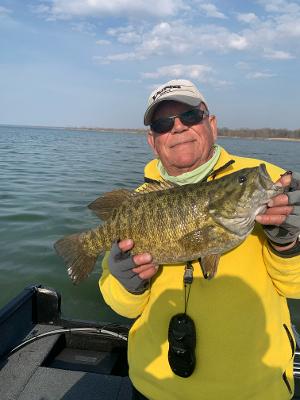
Personal best smallmouth after 8 hours without a bite or even seeing evidence of fish. Finally found them, took 8, best five 25 pounds, PB = 6-11.
-
Stop worrying and go fishing. Fish don't break rods; fishermen do.
-
The distance towed is the least important consideration. If you can tow 20 miles you can tow 200 miles. The other issues, especially braking, are the important ones. But if the manufacturer of the vehicle says it can tow 6800 pounds, or whatever, you can be sure they know that it can-there will be no cooling issues, no durability issues, no stability issues. But braking is special, and if you're towing anything over about 3000, in my opinion, you should have trailer braking regardless of the vehicle. I am a retired automotive engineer with a lot of power train experience, including towing, including engine cooling, including transmission cooling. If you get the towing package it will have the cooling equipment to handle towing in very hot weather, grades, etc.
-
I have found that chatterbaits are really not that effective in most situations. In spring, for largemouths, fairly shallow water, OK, but not better than spinnerbaits or swimjigs. Most of the time I'll go with swim jigs or spinnerbaits, in blacks/blues, trying different trailers, especially boot tail swimbaits. The boot tail swimbaits are often white.
-
There are many other factors in the quality of rods and their cost than just sensitivity. Sensitivity is not the only way to justify higher prices. Cork quality, for example. Or other grip materials for better grip, lower weight, etc. Integrity of the build, as in not using cardboard for seat shims. Higher quality guides for better corrosion control. Higher quality seats that don't have plastic hoods that break in a few years. Lighter for better comfort, if not sensitivity. Better quality control to eliminate problems from getting into the field. Yes the buzz word now is sensitivity, but it's not the only factor in the quality of a rod.