MickD
Super User
-
Joined
-
Last visited
Everything posted by MickD
-
My problem with super glue is that when I use it on a torn swimbait, which is wet, the water from the swimbait gets onto the super glue dispenser, sealing it shut. I think the solution is to use an intermediary mechanism for applying it, like some toothpicks. Put it on the dry toothpick, thus not contaminating the dispenser, and then from the toothpick to the jig, then slide the swimbait into position. Just have to remember to put the toothpicks into the boat.
-
I've done it too, same result. Even if some glue leaks out or you get a slight mismatch a little sanding will improve it.
-
No tape needed. Worst case scenario is that it would break again. Then use tape over it. But I really am confident that either epoxy or titebond III will be plenty strong without tape.
-
Rodbond will work, also TitebondIII woodworking adhesive. Many builders use it to glue cork rings together, and because of the shape of this, it will work even better than it does with rings.
-
Covering the area with a tape like Winn's wraps, tennis grip tape, should fix the problem without introducing other problems. It will be temporary if it doesn't work for you, then you can try something else. Another possibility, if you can find a piece thin enough, is to wrap the area with the soft polyurethane foam that electronics often come packaged in.
-
My son and I were fishing on a sunny day on a lake just inland from Lake MI and I noticed my line (mono at the time, probably about 8 pound test) entering the water vertically, not with the normal gentle slope. I lifted the rod trying to figure out what was happening and immediately noticed an audible buzz. As I lifted the rod higher, it got louder; when I dropped the rod it went away. We quickly left the water and in a few minutes a severe electrical storm hit. We had almost gotten struck by lightning on what we thought was a normal sunny day.
-
Spiral wrap changes nothing with respect to knot clearance, but it does offer the opportunity to use fewer guides, so you can go bigger with less weight penalty. Or none. I doubt if you can tell the difference fishing 4.5's vs 5's except when the knot gets too tight in the guide. Then you'll tell a big difference. I think you may be setting yourself up for a problem, and with what you're planning to fish, taking knot clearance chances to enhance sensitivity doesn't make sense to me. I would build this rod with 5.5's.
-
A good way to locate the seat is to use the same distance to the reel stem as another rod you like. Longer is better for balance but if it gets too long it can catch on clothing at the elbow when going between tip up and down. If a cold/wet weather rod you might go shorter than you would on a rod you know will not be used with rain gear or other bulky clothing. I build for ergonomics first, don't even consider balance. I use the smallest guides possible for the application to keep the tip light and responsive. People building for kayak fishing often build with shorter distances between the reel and the butt. Most people ask the question based on the seat when they should be asking it based on the stem of the reel. Not all reel seats are the same for reel stem to the end of the seat dimension.
-
If I wanted to fish it this year I'd use the band aid. Fix it right in the winter. It will fish just fine.
-
While I respect all the great work as a builder than you have shown here, I don't think there is any chance of that guide crushing the blank by bending it back while attached. But Fishy, if the force seems pretty high, then back off and take the guide off. If you do that then you might as well replace it with new. I think you'll find that it takes very little force to bend it back into it original position.
-
No, super glue is not the right material to use here.
-
You don't need to to take it anywhere. Bend it back into shape. It and you will never know the difference. It will cast as well as it ever would have. The comment on epoxy making it hard to repair later is in my opinion wrong. Epoxy is on the wrap now. A little more won't hurt anything. If we were talking using epoxy on fastening a tiptop to the rod then I'd have another opinion. Another option to seal the crack is Sally Henson "hard as nails" clear, UV resistant, nail finish. I have used it many times and had no problems. I would seal the crack so water doesn't get in and fog the existing epoxy.
-
Don't forget Craig's list. I sold my last boat for what I asked, many bites fast. Go high on your asking price, don't be bashful. You can come down, but not go up as the process progresses.
-
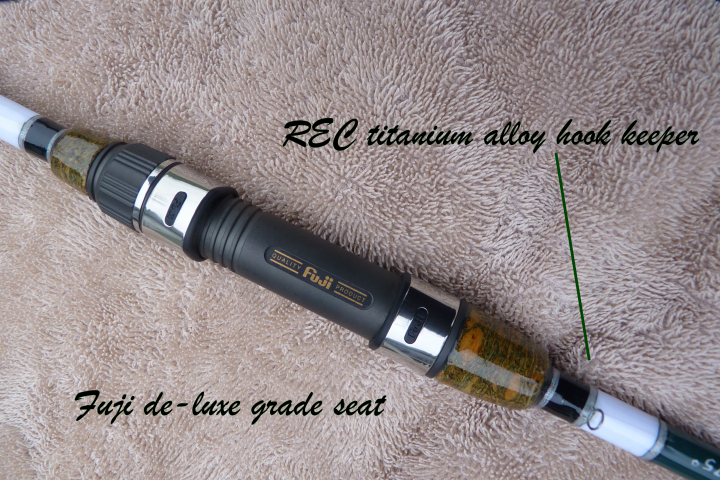
I understand the point, sometimes cut the seat, but weight and (in my opinion) ergonomics and looks are not adversely affected, I sometimes don't. I think the biggest gain from cutting them off is simply looks. Yes he does. Uplocking Thanks, .ghoti Uplocking simply means turning the seat around compared to the orientation that most builders use. It works well with this type seat, not with all types. With the Fuji seat, size 17, I make the ramp off the front close to the same diameter as the hood so that the transition from the hood to the ramp is seamless, and very comfortable. I build that ramp from cork or polyurethane reel seat shims. In the case of shims it has to be coated with wrap epoxy for durability. With cork they can be covered for aesthetics or not, as one chooses. I have heard from builders that uplocking results in reel loosening, but I've not had that problem with the Fuji seats. If one is worried about that include the Fuji jam nut in the build, as I sometimes do. If you are buying components rather than turning your own cork then you'll have a hard time getting the right diameter. If you have a drill press I can show you a way to cheaply adapt it so that cork grips can be turned very easily and safely. I have not bought a cork component in many years, other than fly rod grips.
-
This is exactly why I build all my spin rods with up-loading orientation on the seats. It puts the threads at the back and out of the way of my hands. It allows me to build a short ramp from the seat hood onto the blank. Very sensitive and comfortable.
-
The issue is finding a rod with 1/8 oz in its lure recommendation, and length enough to make long enough casts. However, length has its tradeoffs. Too long and it gets sort of sloppy, and unless you have a lot of room, it may not be best to go too long. From my experience I would recommend a 7 1/2 (or 7-3) foot rod which includes 1/8 oz in its lure recommendation, and preferrably with a mod fast action, although action is not the most important attribute. Power is. This rod would double as a good Ned rig rod. The reason I always include matching the lure recommendation of the rod to the lure weight one wants to use is that matching will set up good loading of the rod when casting. This will enable easier casting and longer casts since the rod will load well on the cast.
-
Keep in mind that a rod can cast a much heavier lure than its optimum if you lob it rather than "snap" it. If your main object is to cast light lures then a rod with light lures in its lure range is going to work. Lob the heavier ones.
-
Go to a grocery store that has a meat section, buy a gallon of water, take the water to the meat section and have the meat person weigh it on his meat scale. Write down what he says it weighs and then weigh it with your scale. Compare. The water will weigh a little over 8 pounds.
-
Depends on the knot. I use size 4 Fuji KT's with 15 pound leader and Alberto knot with no problems. The weight difference between 4's and 4.5's has to be negligible. I'd go 4.5, or even 5 unless you know how to tie a good FG or Alberto. 25 pound leader with a double uni makes for a big knot. I finish my Albertos with two half hitches of the braid pulled tightly to prevent unravelling.
-
Good that it's working for you. The changes must be subtle enough that you are not noticing them. But they did change. Notice the data in my earlier post where I simulated cutting about 4 inches off the tip. If I were to do that again simulating the cut from the butt the power would change less than cutting from the tip, and the action would slow a little also. I've lost a couple inches off the tips of a couple blanks and never liked them after that. Different strokes for different folks. But the fact is simple: When you change a blank's dimensions its physical characteristics (weight, balance, action and power) change.
-
I agree. I understand your point. But move the seat to where it belongs ergonomically, and the power and action are affected. And if you use two hands to cast, they will be affected even without the seat moving. The amount they are changed will of course depend on how much is cut. A little cut and one might not sense any change.
-
This is absolutely untrue. But go ahead and do it to find out for sure.
-
But if you measured it with CCS rules, it would change. I agree that the change you mention is very benign, but it will under the protocol of CCS change the power/action. What you mention is probably not significant to the real world. Depends on how much you cut off.
-
Boy, looks like data shuts the topic right off! Ghoti, I'll take your comment on rare disagreement as a compliment. From an expert like you, it certainly is. Gonna nail some big smallies tomorrow. A 6-10 on Friday, thought we saw some over 7. But they aren't 7 until you weigh them. I have to strongly disagree that they mean nothing. I've used them many times and found the direction they sent me was right on. CCS is the ONLY subjective measurement of what I will call "usable" power/action in blanks and rods. By usable I mean what lures do they cast well? Which blank has the softest tip? How do they feel? Since "parabolic" seems to be so important on this forum, which blank has the most "parabolic" action? Etc. I don't consider loading a rod until it breaks to be relevant for anything other than lifting an anvil. Ghoti, you say it's only good for comparison. But that's valuable. Say I have a St Croix SCV70MF and I like it. How can I get a similar blank now that St Croix isn't selling? I test others and find one that has similar power and action numbers, and I assure you, it will feel very much the same. CCS is very valuable.
-
OK guys, here are the data for a 7 foot spin rod both as is and simulated shorter at the tip by testing the second time from the first guide down from the tip top: As is length= 84 inches, weight to deflect to 1/3 its length = 450 grams Action angle 77 degrees at 79.5 length, weight to deflect to 1/3 its length = 460 grams Action angle 68 degrees. So what has happened is that the rod has gotten more powerful and slower in action (higher the action angle the faster the action). It will not load as well with lighter lures, so one could say its lower lure weight recommendation has gone up. It will load without being overpowered with heavier lures in its shortened configuration, so one could say its upper lure recommendation has gone up. The effective rod numbers, which are a universal indicator of power, are 16.5 and 19.2 respectively.