Wayne P.
Super User
-
Joined
-
Last visited
Everything posted by Wayne P.
-
Not only false, but rediculous. AFTER lightly sanding a place in the hull, apply a marble size dab of the proper epoxy (24 hour cure, NOT the 5-minute type), mixed correctly (slowly to avoid bubbles), to the transducer face. Press and twist it against the prepared hull to assure all air bubbles are gone and the thinnest amout of epoxy is left. Place some weight on the top of the transducer to prevent it from moving for 24 hours. You would only need the "dam" effect if you were going to test a location for the best position and the "dam" would be some type of soft material (easily removed) and filled with water so the transducer could be put in the puddle of water to see if that location works. The instructions for that process is in your unit manual for a shoot-thru installation.
-
Swap the trim relays and see if it works one way and not the other. It sounds like a it's time to replace both of them.
-
What is the purpose of the blue stuff?
-
Brian, I fished Hunting Run today and while it was a little tough this morning, after the air temp got into the 70's they really turned on. The only presentation I caught them on was the weedless wacky rigged finesse worm. PM sent
-
Does it screw up only when running the trolling motor and works fine when the motor is off? Is it powered by the same battery as the trolling motor? Is the trolling motor a variable speed instead of a 5 speed?
-
The best I have used is the Jackall Giron.
-
I have never seen a pin pedistal shorter than about 11". You can shorten one by pulling out the plastic bushing that the seat mount plugs in, cut off some of the tube and re-insert the bushing.
-
When I use a leader, I use 20# XPS fluorocarbon. The line will stay straight if you only use enough to fit between the rod tip and reel so none is wrapped on the reel at any time. About the most I use is 5' with 3'- 4' being the norm.
-
What kind of plug is it?
-
How long with braid last? I don't know. I was fishing in Florida in early 2004, went by the Bass Pro Shops in Orlando and saw the gold color Stren Superbraid 30# in stock. I got a spool of it so I could see it better than the green color. I'm still using it. I may have to replace it sometime this year depending on any break-offs or re-ties. It has faded some, but is still as good as when I started using it after several thousand bass caught.
-
The only rule about gas motors is they have to be tilted out of the water all the time. Lots of bass boats go there. Electric only. Here is the sign stating it.

-
hookingem, Yes several times. It's tough to get them away from the trees and stumps.
-
For numbers, Hunting Run Lake is tops in Va. most of the time. Once you learn the lake and establish a pattern, 50-100+ bass a day is quite common. 176 bass in one day is the most I have caught there. Briery Creek Lake is pretty good too with the chance of a State Record on any cast. At either body of water, your ability to establish a pattern and avoid the "bank beating" syndrome will get good results.
-
Today I have 26 reels with superline on them (spinning, spincast, and baitcasting) for presentations from finesse to matted vegetation. I use nylon mono and flurocarbon also on other rigs for presentations where they perform better such as lipped cranks, suspending jerks, and soft plastics such as Flukes.
-
Add Walmart, K-Mart, and drug stores.
-
Any slow cure (24 hour) epoxy will work and mix it slowly to minimize bubbles. Sand and then wipe with alcohol the area you will be mounting the transducer. Don't get the 5-minute type-it has too many bubbles in it when mixed.
-
It can be a benefit if the air temp drops during the spawn. The extra solids in the water will hold heat and maybe save the spawn for that year.
-
With 4 dozen plus rigs, I have about a dozen that I use for the same presentation. Sometimes I'll have 4-6 of them on the deck at one time rigged the same but weighted different. I do it for efficiency to cover a lot of the water column at a particular location without having to re-rig. I never assume I know the most productive presentation for a particular location at a particular time.
-
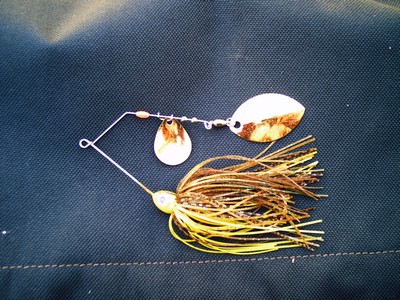
Yes, J, not all spinnerbaits are constructed with the "R" bend. Sometimes I switch spinnerbaits a lot during the day to match the prevailing pattern. The choices involve weight, frame size, skirt color, blade color/finish, blade style, and/or number of blades. Here is a 1/4 oz model that is very effective when the blue gills are spawning:
-
Another note, only use the slow cure epoxy and mix it slowly to prevent bubbles. The 5-minute type gets lots of bubbles in it when mixing
-
THE most secure clips are the coastlock type. I have lost a few lures, especially spinnerbaits, with the Norman Speed Clips, but I still use them for small cranks and Traps.
-
You won't know exactly were in the hull to get the best performance without doing that procedure. That is why it is recommended. All you need is enough water in the bilge to cover most of the transducer ( a couple of gallons may be enough). You need to put weight on the transducer so it will vibrate the hull at the same frequency as the tranducer transmit/receive. Lots of boats, especially fiberglass bass boats, have a thin smooth area in the hull near the drain plug that is prepared for that purpose. Shoot thru mounting does result in some sensitivity loss as compared to a transom mount, but a quality unit will perform very well with a properly installed transducer. The flat faced trolling motor type transducer is easier to install correctly rather than the torpedo shaped transom type although either will do well IF properly placed and installed. Mounting one on the transom is problematic for consistant high speed performance and it is subject to damage. Mounting a shoot-thru will have the transducer in the least disturbed flow of water you may ever get.
-
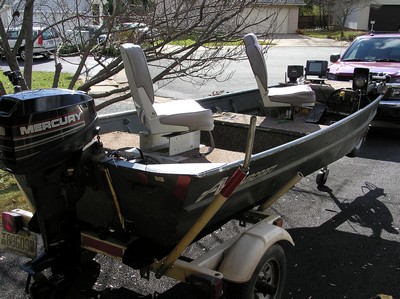
Another note, if your trailer does not have upright guides at the rear, add some to make loading easier. I made some for my last jon boat trailer out of 1 1/2" conduit with a PVC cover. It worked very well for many years. There are numerous versions pre-made available from boat dealers or places like Bass Pro Shops or Cabelas.
-
I do it a LOT. I have a length of rope that is about twice as long as the boat/trailer. When I get ready to launch, I lay the rope on the deck to make sure it is not tangled and hook one end to the trailer winch. The other end is always attached to the bow eye. After I unhook the winch from the boat, remove the tie-downs, and the motor toter, I just back in the water slowly until the boat floats and then pull forward enough for me to get out of the vehicle and unhook the rope from the trailer. I then pull the boat over to the dock, shore, tie up and go park the vehicle/trailer. Loading back up, I back the trailer in the water until the support bunks are just under the surface and then drive the boat onto the trailer, hook up the winch strap, get into the vehicle and pull away from the ramp a good ways to prepare to leave.
-
Yes, use #10 wire if it is a short run of 5' or less. Use a larger wire for a longer run. Make sure you get a solid connection in the wire splice. If it is a foot control motor, just replace all of it from the pedal terminals to the plug. Less chance of resistance due to a bad splice.